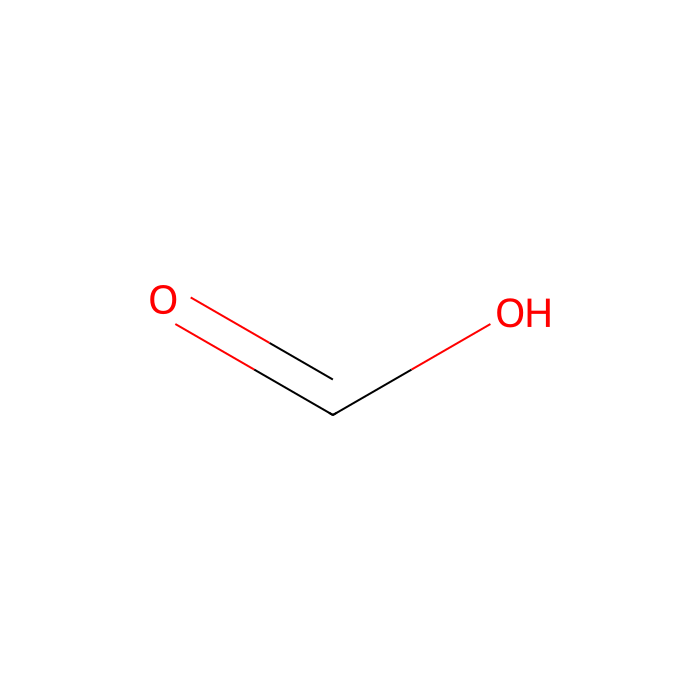
Formic acid(FA) - ≥85%, used for Formic acid can be used as a reagent for: carbonyl compounds and nitro compounds Co-Nx-catalyzed one-pot reductive amination for the synthesis of secondary amines. The photoreduction of polycyclic and heterocyclic nitroaro

CAS: 64-18-6 Cat. No.: F301789 Fórmula: CH2O2 Peso molecular: 46.03 Beilstein Registry Number: 1209246 Número CE: 200-579-1
Disponível para encomenda
GRAU & PUREZA ≥85%
Synonyms
FORMIC ACID [EP MONOGRAPH] | Acidum formicum | CCG-266004 | Formic acid, purum, >=85% | FORMICUM ACIDUM [HPUS] | Kyselina mravenci [Czech] | STL264243 | FORMIC ACID [INCI] | Formic acid, ACS reagent, >=96.0% | FORMIC ACID [HSDB] | Formic acid, AR, >=98% |
Storage
Room temperature,Argon charged,Desiccated
Shipped In
FedEx DG Service
★
Tamanho
Alemanha (EU)
USA*
Preço
Qtd
500g
F301789-500g
—
Em stock ≥10

13,80€

15,53€
Gravar 1,74 € (11.17%)
Enter a quantity for the sizes you want to add.
🧪
Por que este grau

≥85% para fluxos de trabalho cromatográficos e analíticos sensíveis que exigem interferência mínima da linha de base.

🌡

Armazenamento e envio

Room temperature,Argon charged,Desiccated Envio FedEx DG Service. Consulte o COA específico do lote para obter as especificações exatas.

📋

Documentos de qualidade

SDS, COA, ficha técnica e folha de especificações disponíveis para download. COA específico do lote acessível por meio de pesquisa por número de lote.

📚

Comprovação documental

Citado em 2832 publicações revisadas por pares nas áreas de cromatografia, síntese orgânica e reações de acoplamento cruzado.

Visão geral

It can be freely mixed with water, alcohols, ethers, and glycerol, and is corrosive to the skin. It serves as a reducing agent for determining arsenic, bismuth, aluminum, copper, gold, indium, iron, lead, manganese, mercury, molybdenum, silver, and zinc, as well as for testing cerium, rhenium, and tungsten. It is used to test aromatic primary and secondary amines, measure molecular weights and crystallization solvents, determine methoxy groups, act as a fixative in microanalysis, and in the production of formate salts.

Especificações

Sinónimos
FORMIC ACID [EP MONOGRAPH] | Acidum formicum | CCG-266004 | Formic acid, purum, >=85% | FORMICUM ACIDUM [HPUS] | Kyselina mravenci [Czech] | STL264243 | FORMIC ACID [INCI] | Formic acid, ACS reagent, >=96.0% | FORMIC ACID [HSDB] | Formic acid, AR, >=98% |
Especificações e pureza
≥85%
Aplicação
Formic acid can be used as a reagent for: carbonyl compounds and nitro compounds Co-Nx-catalyzed one-pot reductive amination for the synthesis of secondary amines. The photoreduction of polycyclic and heterocyclic nitroaromatics yields the corresponding a
Condições de armazenamento de armazenamento
Room temperature,Argon charged,Desiccated
Enviado em
FedEx DG Service
Pureza
≥85%
Nomes e identificadores
Pubchem Sid
Pubchem Sid Url
https://pubchem.ncbi.nlm.nih.gov/substance/508814990
Sorrisos canónicos
C(=O)O
IUPAC Name
formic acid
InChIKey
BDAGIHXWWSANSR-UHFFFAOYSA-N
INCHI
1S/CH2O2/c2-1-3/h1H,(H,2,3)
SMILES isoméricas
C(=O)O
WGK Alemanha
1
Número UN
1779
Grupo de embalagem
II
Peso molecular
46.03
Beilstein
1209246
Reaxy-Rn
1209246
Reaxys-RN_link_address
https://www.reaxys.com/reaxys/secured/hopinto.do?context=S&query=IDE.XRN=1209246&ln=

Documentação

📋 Ficha de dados de segurança (FDS)

Documento abrangente sobre perigos, manuseamento, armazenamento e conformidade regulamentar.

<<<<<<< HEAD Baixar SDS → ======= Baixar SDS → >>>>>>> release248-p3

✅ Certificado de análise (COA)

Dados de qualidade específicos do lote. Introduza o número de lote para obter o COA exato.

Consultar COA →

📊 Ficha técnica

Resumo de referência rápida das especificações e aplicações do produto.

Ver ficha técnica →

🔬 Folha de especificações

Atributos de qualidade completos e critérios de aceitação para este grau.

Ver folha de especificações →

Dados avançados

Taxonomic Classification

Taxonomy Tree

KingdomOrganic compounds
SuperclassOrganic acids and derivatives
ClasseCarboxylic acids and derivatives
SubclassCarboxylic acids
Intermediate Tree Nodes Not available
Direct ParentCarboxylic acids
Alternative Parents Monocarboxylic acids and derivatives  Organic oxides  Hydrocarbon derivatives  Carbonyl compounds  
Molecular FrameworkAliphatic acyclic compounds
Substituents Monocarboxylic acid or derivatives - Carboxylic acid - Organic oxygen compound - Organic oxide - Hydrocarbon derivative - Organooxygen compound - Carbonyl group - Aliphatic acyclic compound
DescriçãoThis compound belongs to the class of organic compounds known as carboxylic acids. These are compounds containing a carboxylic acid group with the formula -C(=O)OH.
External Descriptors Straight chain fatty acids - Saturated fatty acids
Estrutura 3D
Modelo de Estrutura Química Interativa


Alvos associados (não humanos)
Drosophila melanogaster (359 Activities)
Activity TypeRelationActivity valueUnitsAction TypeJournalPubMed IddoiAssay Aladdin ID
Mecanismos de ação
Certificados(CoA,COO,BSE/TSE e Mapa de Análise)
C of A & Other Certificates(BSE/TSE, COO):
Analytical Chart:

Find and download the COA for your product by matching the lot number on the packaging.

20 results found

Lot NumberCertificate TypeDataItem
G2622432G2622432Certificate of AnalysisJun 08, 2026 F301789
G2622433G2622433Certificate of AnalysisJun 08, 2026 F301789
D2630057D2630057Certificate of AnalysisApr 27, 2026 F301789
D2630058D2630058Certificate of AnalysisApr 27, 2026 F301789
D2630059D2630059Certificate of AnalysisApr 27, 2026 F301789
J2509374J2509374Certificate of AnalysisSep 20, 2025 F301789
J2509373J2509373Certificate of AnalysisSep 20, 2025 F301789
I2126250I2126250Certificate of AnalysisApr 03, 2025 F301789
I2126248I2126248Certificate of AnalysisApr 03, 2025 F301789
D2518259D2518259Certificate of AnalysisMar 18, 2025 F301789
D2518260D2518260Certificate of AnalysisMar 18, 2025 F301789
D2518261D2518261Certificate of AnalysisMar 18, 2025 F301789
B2513353B2513353Certificate of AnalysisFeb 26, 2025 F301789
B2513352B2513352Certificate of AnalysisFeb 22, 2025 F301789
F2419492F2419492Certificate of AnalysisJun 06, 2024 F301789
F2419491F2419491Certificate of AnalysisJun 06, 2024 F301789
F2419487F2419487Certificate of AnalysisJun 06, 2024 F301789
H2231374H2231374Certificate of AnalysisAug 08, 2022 F301789
H2231375H2231375Certificate of AnalysisAug 08, 2022 F301789
H2231382H2231382Certificate of AnalysisAug 08, 2022 F301789
Propriedades químicas e físicas
SensibilidadeMoisture sensitive. ;heat sensitive
Índice de refração1.3690 - 1.3730
Ponto de inflamação (°F)121.1 °F
Ponto de inflamação (°C)49.5 °C
Ponto de ebulição (°C)100-101°C
Ponto de fusão (°C)8.2-8.4°C
Peso molecular46.025 g/mol
XLogP3-0.200
Hydrogen Bond Donor Count1
Hydrogen Bond Acceptor Count2
Rotatable Bond Count0
Exact Mass46.0055 Da
Monoisotopic Mass46.0055 Da
Topological Polar Surface Area37.300 Ų
Heavy Atom Count3
Formal Charge0
Complexity10.300
Isotope Atom Count0
Defined Atom Stereocenter Count0
Undefined Atom Stereocenter Count0
Defined Bond Stereocenter Count0
Undefined Bond Stereocenter Count0
The total count of all stereochemical bonds0
Covalently-Bonded Unit Count1
FAQs e artigos
Small-Molecule Inhibitors: A Practical Guide for Research Selection — A Minimal Evidence Chain and Scenario-Based Validation Framework (Including a Selection Matrix, Case Cards, and Product Tables 1–4)
A Practical Guide to Small-Molecule Chemical Probes: Concept Clarification, Causal Validation, and Experimental Selection (with Product Navigation and Tables A–D)
Secondary Effects Behind Chromatographic Peak Tailing and Unstable Peak Shapes: How Residual Silanols (Si–OH) Affect Basic Compounds, and the Shortest Troubleshooting/Remediation Path (with Product Navigation and Tables 1–3)
2-Methylpyridine–Borane (2-Picoline·BH₃) Reductive Amination Guide: Process Drivers for Replacing NaBH₃CN, the Practical Operating Window, and Scale-Up/Quench Close-Out Essentials (Including Product Tables 1–3)
16 Frequently Asked Questions About Nourseothricin
How Organic Acids “Stabilize a System”: Selection Logic via the pH Window, Salt Forms, and Metal-Ion Management (with a navigation guide to Tables A–E)
Amino Acid Oxidases: Oxygen-Dependent Oxidative Deamination Systems and Their Analytical and Applied Uses
Angiotensin-Converting Enzyme (ACE): A Review of Molecular Features, Catalytic Functions, and Research and Translational Applications
Chymosin: A Review of Molecular Features, Coagulation Kinetics, and Activity Evaluation
Phytase: Enzymological Properties, Mechanism of Action, and Applications in Feed and Food
Chlorophyll: Structural Features, Physicochemical Properties, and Key Points for Research and Industrial Applications
Azithromycin: Physicochemical Features, Mechanism of Action, and Key Points for Research Applications
Ferulic Acid: Structural Features, Preparation Routes, and Key Points for Research Applications
Paeonol: Physicochemical Features, Uses, and Key Points for Research Applications
Famotidine: Physicochemical Features, Mechanism of Action, and Key Points for Research Applications
Flavones: Structural Features, Physicochemical Properties, and Key Points for Research and Applications
Review of Chymotrypsin: Enzymological Properties, Catalytic Mechanism, and Research Applications
Methodological Studies on Glycoprotein Structural Characterization and Quality Attribute Analysis
Understanding Cbz (Benzyloxycarbonyl): Selection Logic and Practical Value of a Classical Amino Protecting Group
From the Logic of Deprotection to Protecting Group Choice: Differences Among Bn, PMB, and Dmb in Experimental Design
Research Framework for Multi-Enzyme Digestion Strategies and Optimization of Proteomic Coverage
Extraction Methods and Process Selection for Flavonoid Compounds
Liquid Polyisoprene: Material Characteristics, Application Directions, and Selection Considerations
Preparation Methods and Precautions for Silane Coupling Agent Primer Solutions
How to Troubleshoot Abnormal Impurities in Peptide Synthesis? Locating Process Issues Through Amino-Related Side Reactions
Porous Graphitic Carbon (PGC) Chromatography Columns: Creating New Selectivity for Challenging Separations through Molecular Shape and the π-Electron Cloud on the Graphitic Surface
Oxalate Metabolism and Degradation Detection Methods: Enzymatic Assays, Chromatography, and Enzymatic Degradation System Analysis
How to Select Thickeners for Strongly Acidic Cleaning Systems: Comparison of Thickening Mechanisms and Application Considerations for Fatty Amine Ethoxylates
Formation and Control of Carboxyl- and Hydroxyl-Related Impurities in Peptide Synthesis — Using Asp/Glu and Ser/Thr Residue Side Reactions as Examples
β-Hydroxybutyrate Detection Methods and Metabolic Significance: Comparative Applications of Enzymatic Assays, Blood Ketone Meters, and LC-MS
The Logic of Biomimetic Peptide Action in Skin: Sequence and Conformation, Skin Delivery, Stability, and Target Matching
Mechanistic Basis of Acetyl Hexapeptide-8 in the Management of Expression Lines: SNARE Complex Interference, Constraints on Percutaneous Delivery, and Combination Strategies
Citations of This Product
Calculadoras de soluções
Revisões

Avaliações dos Clientes

Deseja que lhe enviemos uma mensagem quando tivermos descontos disponíveis?

Lembrar-me mais tarde

Obrigado! Por favor, verifique a sua caixa de entrada de e-mail para confirmar.

Ops! As notificações estão desativadas.