10mM in DMSO para fluxos de trabalho cromatográficos e analíticos sensíveis que exigem interferência mínima da linha de base.
🌡
Armazenamento e envio
Store at -80°C Envio Dry ice packs + Cold packs. Consulte o COA específico do lote para obter as especificações exatas.
📋
Documentos de qualidade
SDS, COA, ficha técnica e folha de especificações disponíveis para download. COA específico do lote acessível por meio de pesquisa por número de lote.
📚
Comprovação documental
Citado em 0 publicações revisadas por pares nas áreas de cromatografia, síntese orgânica e reações de acoplamento cruzado.
Visão geral
Fosciclopirox suppresses growth of urothelial cancer by targeting the γ-secretase complex. Fosciclopirox selectively delivers the active metabolite, Ciclopirox (CPX), to the entire urinary tract. Ciclopirox has anticancer activity in a number of solid and hematologic malignancies.
Especificações
Especificações e pureza
10mM in DMSO
Mecanismos bioquímicos e fisiológicos
Fosciclopirox suppresses growth of urothelial cancer by targeting the γ-secretase complex. Fosciclopirox selectively delivers the active metabolite, Ciclopirox (CPX), to the entire urinary tract. Ciclopirox has anticancer activity in a number of
Condições de armazenamento de armazenamento
Store at -80°C
Enviado em
Dry ice packs + Cold packs
Este produto requer transporte de cadeia fria. Serviços terrestres e outros serviços econômicos não estão disponíveis.
Tipo de ação
INHIBITOR
Nomes e identificadores
SMILES isoméricas
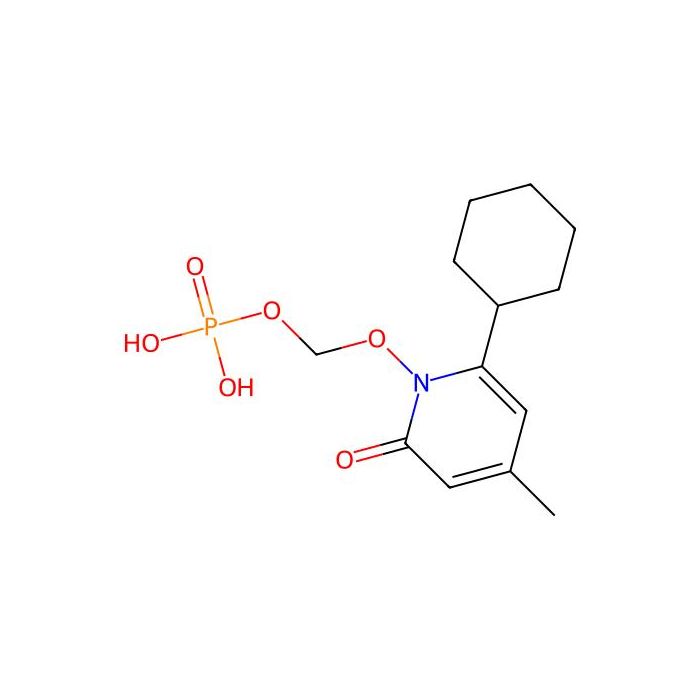
CC1=CC(=O)N(C(=C1)C2CCCCC2)OCOP(=O)(O)O
PubChem CID
67773619
Peso molecular
317.27
Documentação
📋 Ficha de dados de segurança (FDS)
Documento abrangente sobre perigos, manuseamento, armazenamento e conformidade regulamentar.
Determine the necessary mass, volume, or concentration for preparing a solution.
Dilution Calculator
Determine the dilution needed to prepare a stock solution.
Reconstitution Calculator
Revisões
Avaliações dos Clientes
Application Protocols
No formal, product-specific protocols are provided. The following general, non-binding procedures are commonly used for small-molecule phosphate prodrugs in discovery research. Adjust to your system and consult the CoA/SDS.
Preparation of stock solutions
Weigh quickly in a low-humidity environment. Prepare 10–20 mM stock in anhydrous DMSO. Vortex and, if needed, sonicate briefly. Filter (0.22 µm PTFE) if particulate persists.
Alternatively, prepare aqueous stocks if solubility allows; confirm concentration by UV or quantitative NMR.
Enzymatic conversion assay (example framework)
Incubate 1–50 µM fosciclopirox in pH 7.4 buffer with alkaline phosphatase (titrate activity) at 37°C.
Sample at defined times, quench on ice and acidify (0.1% formic acid), then analyze by LC–MS for both prodrug and ciclopirox.
Metal chelation readout (post-conversion)
Combine converted samples with Fe(III) salts under controlled pH and ionic strength; monitor spectral changes or use competition assays to infer binding, ensuring no excess chelators in buffer.
Storage of working solutions
Keep on ice during experiments. Discard remaining diluted solutions after use; avoid multiple freeze–thaw cycles of aliquots.
These are literature-style templates intended to help design experiments; they are not validated specifications for SKU F656293.
Biological Roles
Context (research-only)
Prodrug concept: Fosciclopirox is designed as a phosphate-masked form of ciclopirox. In biological systems, non-specific and tissue-localized phosphatases can cleave the phosphate promoiety, releasing ciclopirox.
Metal chelation: The released ciclopirox exhibits high affinity for Fe(III) via its 1-hydroxypyridin-2-one chelation motif. By modulating labile iron pools, it can influence iron-dependent biochemical processes in cells and lysates (e.g., ROS formation pathways, iron-requiring enzymes) in experimental settings.
Enzymology: Fosciclopirox itself is a substrate for phosphatases. Researchers use it to probe enzyme kinetics (Km/Vmax) and to profile enzyme expression/activity by monitoring conversion rates.
Transport and permeability: Compared to ciclopirox, the phosphate form typically shows altered permeability and transporter interactions (e.g., reduced passive diffusion; potential engagement with anion transporters). These features are studied in Caco-2, MDCK, and vesicle systems to understand ADME behavior.
Binding and distribution: The charged phosphate can reduce nonspecific membrane partitioning; protein binding profiles in plasma may differ substantially from those of the parent, which is useful for distribution modeling.
Notes
Specific biological effects depend on matrix, concentration, and exposure time. Outcomes observed in vitro do not imply clinical performance.
For robust interpretation, quantify both prodrug and parent in all biological samples and control for pH, temperature, and enzyme activity.
Buffer Applications
Relevance: Fosciclopirox is not a buffering reagent. However, buffer choice critically impacts its hydrolysis and assay performance.
Practical guidance (general)
pH control: Maintain near-neutral pH (≈7.0–7.4) to limit non-enzymatic phosphate ester hydrolysis during handling. Elevated pH (>8.5) can accelerate hydrolysis.
Common buffers: PBS, HEPES, or MOPS provide good pH stability without strongly coordinating iron. Avoid strong chelators (e.g., citrate, EDTA) when studying metal-binding phenomena of the released ciclopirox.
Ionic strength: 100–150 mM total salts are typical for bioassays and improve reproducibility of enzyme kinetics; confirm compatibility with your readout.
Stock solutions: Prepare concentrated DMSO stocks (e.g., 10–20 mM) and dilute into buffer immediately before use to the final DMSO ≤0.1–0.5% v/v to minimize precipitation and premature hydrolysis.
Additives: If adsorption losses are suspected, add 0.01% non-ionic surfactant (e.g., Tween 80) or use low-bind labware. When suppressing enzymatic hydrolysis during sample prep, include a phosphatase-inhibitor cocktail as compatible with your assay.
Quality controls
Measure pH before/after incubation; document temperature and exposure time. Include matrix blanks and spiked recovery controls for both prodrug and parent analyte.
Summary: While not functioning as a buffer, careful buffer selection and handling are central to obtaining reproducible results with phosphate prodrugs like fosciclopirox.
Green Alternatives
Green chemistry considerations focus on solvent and process choices when handling fosciclopirox (the molecule itself is fixed).
Opportunities
Prefer water and aqueous buffers whenever feasible, leveraging the enhanced hydrophilicity of the phosphate prodrug relative to ciclopirox.
Use bio-based or lower-toxicity polar aprotic solvents where compatible (e.g., Cyrene or propylene carbonate) for method development; confirm analyte stability and MS response.
Minimize DMSO volumes by preparing higher-concentration stocks and performing accurate microscale dilutions to reduce total organic solvent usage.
Comparison (general guidance)
DMSO vs. water: DMSO offers broad solvency but higher environmental footprint than water; attempt direct aqueous stocks if solubility allows.
MeCN vs. EtOH for LC: ethanol can partially replace acetonitrile in LC methods, though backpressure and selectivity may change; validate with both prodrug and parent analyte.
Solid-phase extraction (SPE): using aqueous-compatible wash/elution conditions can cut organic solvent consumption during sample cleanup.
Trade-offs
Aqueous-only systems may increase risk of enzymatic or base-catalyzed hydrolysis; balance green goals with analytical fidelity by controlling pH and temperature.
Greener polar aprotics (e.g., Cyrene) can be reactive toward some functionalities; perform stability checks.
Summary
The main levers for greener practice are solvent substitution and minimization, cold-chain efficiency (combine shipments when possible), and right-sized experiments to reduce waste.
Pharmaceutical Uses
This product is supplied strictly for research use and is not intended for human or animal use.
Formulation science context (non-clinical)
Prodrug rationale: Phosphate promoieties are widely used in discovery to enhance aqueous solubility and enable parenteral or oral formulation prototyping. They are enzymatically labile, releasing the active parent after administration in model systems.
Preformulation studies: Fosciclopirox can support solubility profiling, pH–solubility curves, and stability screens (forced degradation under acid/base/oxidation) to inform enabling formulations for in vivo research.
Dosage-form prototyping (research models): Aqueous solutions or lyophilized powders reconstituted in buffered systems are commonly evaluated. Counterion selection (e.g., sodium, tromethamine) and tonicity agents (e.g., mannitol) can be explored for stability/osmolarity, strictly within laboratory research.
Compatibility: Evaluate interactions with excipients that may chelate metals or alter phosphate ester stability (e.g., citrate, EDTA). Assess adsorption to filters and primary packaging.
Analytics: Develop stability-indicating LC methods that resolve prodrug, parent ciclopirox, and degradants; use orthogonal detection (UV/HRMS) and, where helpful, 31P NMR for degradation mapping.
No therapeutic claims are made here. Any references to formulation are limited to laboratory-scale research and method development contexts only.
Physical Properties
Item-specific specs
Appearance: Not specified for this item; refer to CoA/Spec Sheet.
Molecular weight: Not specified for this item; refer to CoA/Spec Sheet.
General/literature expectations for phosphate prodrugs of ciclopirox (informational only; verify on CoA/SDS for this item)
Physical state: typically a solid (often as a salt) with enhanced hydrophilicity relative to ciclopirox.
Solubility: substantially more soluble in aqueous buffers than ciclopirox; high solubility in polar aprotic solvents (DMSO, DMF). Solubility in nonpolar solvents is poor. Exact values vary by salt/counterion.
Acid/base behavior: phosphate esters show pH-dependent ionization; increased ionization above pKa2 of phosphate enhances water solubility; enzymatic hydrolysis can occur in biological media.
Partitioning: logP is expected to be lower (more hydrophilic) than ciclopirox due to the phosphate; reported distribution depends strongly on ionization state and counterion (literature trend).
Stability: phosphate esters are generally stable when dry and cold; hydrolysis is accelerated at high pH and in the presence of phosphatases (literature).
Hygroscopicity: many phosphate salts are hygroscopic; minimize atmospheric moisture exposure during weighing (practice guidance).
Do not treat the above as product specifications. For definitive BP/MP/density/refractive index/UV cutoff, etc.: Not specified for this item; refer to CoA/Spec Sheet.
Quality and Grades
Grade/purity: Not specified for this item; refer to CoA/Spec Sheet.
How to interpret grade (general guidance)
Research-grade small molecules are commonly qualified by identity (NMR/HRMS/IR), purity by HPLC/UPLC (area %), and residual solvents/metals. When designated “screening” or “library” quality, emphasis is on high chemical purity and accurate identity for SAR and phenotypic assays.
HPLC grade or LC-MS suitability (if stated on CoA) indicates low nonvolatile residue and minimal UV-absorbing impurities, enabling accurate quantitation.
Salt form/counterion content: Phosphate prodrugs may be supplied as specific salt forms (e.g., sodium). Verify the exact counterion and hydration/solvation state on the CoA, as these affect molecular weight calculations and solution preparation.
Stabilizers/additives
Stabilizers: Not specified for this item; refer to CoA/Spec Sheet. Many phosphate-containing research compounds are shipped without stabilizers; if present, they will be declared.
What is specific to this item
Storage condition is specified: Store at -80°C (from Product Data). Shipment is on dry ice + cold packs to maintain integrity. These controls help mitigate phosphate ester hydrolysis and maintain assay-relevant purity.
Recommendation
For quantitative work, request a current CoA and, if needed, a full analytical package (chromatogram, NMR integrals, water content, residual solvents). Adjust stock concentrations to the exact MW reported for the supplied salt/form.
Reaction and Applications
Scope in research applications (non-clinical)
Prodrug activation studies: Fosciclopirox serves as a model substrate for phosphatase-mediated unmasking, enabling time-course studies of conversion to ciclopirox in buffered media, cell lysates, or microsomes.
Metal chelation research: Upon conversion to ciclopirox, the hydroxypyridinone motif chelates Fe(III) and other transition metals; this underpins studies of iron-dependent pathways and enzyme systems.
ADME profiling: Used in permeability, stability (plasma, liver S9), and enzyme kinetics experiments to compare parent vs. prodrug properties (solubility, permeability, clearance).
Analytical method development: LC–MS/MS assays to simultaneously quantify prodrug and released parent across matrices, with attention to in-source fragmentation of phosphate esters.
Practical tips (general)
Minimize premature hydrolysis: prepare solutions fresh, keep on ice, and use buffered media at neutral pH for handling. Include phosphatase inhibitors where suppression of conversion is desired during sample prep.
Controls: run parallel incubations without enzyme (negative control) and with alkaline phosphatase (positive control) to bracket conversion rates.
Calibration: prepare separate standard curves for prodrug and parent; verify extraction recoveries independently due to differing polarity/ionization.
Orthogonal confirmation: verify identity and conversion by HRMS and retention time matching; 31P NMR can confirm phosphate integrity where applicable.
Note: No medical/clinical claims are made; this compound is supplied strictly for research use.
Reaction Conditions
There are no canonical “synthetic reaction conditions” for using fosciclopirox as a reagent, as it is typically the analyte in biochemical/analytical experiments. However, for research handling and hydrolysis/activation studies, the following general conditions are informative (literature-based):
Enzymatic hydrolysis: Alkaline phosphatase or non-specific phosphatases at pH 7.4–8.0, 25–37°C, can convert fosciclopirox to ciclopirox. Reaction times range from minutes to hours depending on enzyme load and matrix.
Non-enzymatic hydrolysis (control): Mild base (e.g., Tris buffer pH 8.5–9.0) at 25–37°C can induce measurable phosphate ester cleavage over hours; use as a positive control for stability studies.
Quenching: Immediate cooling on ice and acidification to pH ≈ 3–4 (formic or phosphoric acid, LC–MS grade) can arrest hydrolysis prior to analysis; validate to avoid back-conversion.
Solvents: Stocks in DMSO (10–20 mM) diluted into buffered aqueous media are common. Keep organic co-solvent ≤0.5% v/v in enzyme assays to avoid activity suppression.
Analytics: LC–MS/MS with negative ESI often enhances response for phosphate-containing species; monitor both prodrug and parent transitions. UV detection near the parent’s chromophore is useful, but phosphate substitution may alter λmax.
All conditions above are general research guidance and should be optimized for your specific system. No item-specific specifications are implied.
Safety and Handling
Product-specific hazard details
GHS classification: Not specified for this item; refer to SDS.
Signal word / H-statements / pictograms: Not specified for this item; refer to SDS.
General laboratory safety guidance (informational; defer to SDS)
PPE: lab coat, safety glasses, and appropriate chemically resistant gloves (e.g., nitrile). Handle powder in a fume hood or ventilated enclosure to avoid inhalation of dust/aerosol.
Avoid exposure routes: inhalation, ingestion, skin/eye contact. Wash thoroughly after handling.
First aid overview: if inhaled—move to fresh air; if on skin—wash with soap and water; if in eyes—rinse cautiously with water for several minutes; if ingested—rinse mouth and seek medical attention. Follow site SOPs.
Incompatibilities: strong bases and strong acids can catalyze phosphate ester hydrolysis; strong oxidizers should be avoided. Moisture can promote hydrolysis; keep tightly closed and desiccated when possible.
Thermal sensitivity: prodrugs bearing phosphate esters may decompose upon prolonged heating; avoid unnecessary thermal stress.
Environmental precautions: prevent release to the environment; collect spills with inert absorbent and dispose via approved chemical waste streams.
Special risk notes: no peroxide-formation risk expected (not an ether solvent). For any dust-forming solids, consider explosion-proof housekeeping per general lab practice.
Always consult the official SDS for authoritative hazard classification and response measures for SKU F656293.
Solvent Selection
Practical solvent considerations for fosciclopirox in research workflows (general guidance; check actual solubility on CoA or by small-scale testing)
Polarity class: highly polar/ionic when deprotonated (phosphate present), favoring aqueous and polar aprotic media.
Preferred solvents for stock solutions: DMSO is typically reliable up to 10–50 mM; DMF can be used similarly. If high aqueous solubility is confirmed, prepare stocks directly in sterile water or buffer.
Aqueous buffers: phosphate-buffered saline (PBS), HEPES, or Tris are commonly used; avoid very high pH to limit non-enzymatic hydrolysis of phosphate esters.
Cosolvent systems: for assay buffers requiring low organic content, prepare a concentrated DMSO stock (e.g., 10–20 mM) and dilute into buffer to ≤0.1–0.5% DMSO v/v, monitoring for precipitation.
Poor choices: nonpolar solvents (hexanes, toluene) and moderately nonpolar alcohols (isopropanol) typically offer limited solubility for phosphate-bearing compounds.
Comparison notes (literature-based trends)
Ciclopirox (parent) is relatively lipophilic and poorly water-soluble, often demanding DMSO-only stocks. Fosciclopirox generally displays greater compatibility with aqueous buffers, enabling broader bioassay formats.
If protein binding or adsorption to plastics is problematic, include small amounts of surfactant (e.g., 0.01% Tween 80) or use low-bind plastics; verify assay compatibility.
Tip: perform a quick solubility screen (visual + UV/LC analysis) at anticipated working concentrations in your exact buffer matrix.
Storage and Reconstitution
Item-specific storage
Store at -80°C (from Product Data).
Shipped on dry ice packs + cold packs to preserve integrity during transit (from Product Data).
General handling and reconstitution guidance (non-binding; verify solubility/stability for your batch)
Upon receipt: Keep container closed and cold. Allow the shipping container to equilibrate to room temperature before opening to prevent condensation. Immediately transfer vial to a -80°C freezer.
Aliquoting: If frequent use is anticipated, subdivide into single-use aliquots under dry inert atmosphere if possible (e.g., in a glovebox or with dry nitrogen) to minimize moisture uptake and freeze–thaw cycles.
Reconstitution: Prepare concentrated stocks in anhydrous DMSO (e.g., 10–20 mM). If aqueous stocks are desired, dissolve in buffer at neutral pH and use promptly to limit phosphate ester hydrolysis. Filter sterilize through 0.22 µm if sterility is required for cell-based assays.
Short-term storage of solutions: DMSO stocks can be stored at –20 to –80°C in tightly sealed, low-bind vials; protect from moisture and light. Avoid repeated freeze–thaw by using aliquots.
Stability notes: Phosphate prodrugs can hydrolyze in aqueous media, particularly at elevated pH/temperature or in the presence of phosphatases. Prepare fresh working solutions immediately before use.
Always refer to the product’s CoA and SDS for definitive storage, stability, and handling information for SKU F656293. Research use only.
Structure and Identity
Brief overview: Fosciclopirox is a phosphate prodrug of ciclopirox intended for research on prodrug activation and metal-chelation biology.
CAS: 1380539-06-9 (from Product Data)
PubChem CID: 67773619 (from Product Data)
Molecular formula: Not specified for this item; refer to CoA/Spec Sheet.
Molecular weight: Not specified for this item; refer to CoA/Spec Sheet.
SMILES: Not specified for this item; refer to CoA/Spec Sheet.
InChIKey: Not specified for this item; refer to CoA/Spec Sheet.
Structural features (general, literature-based):
Prodrug motif: an O-phosphoryloxymethyl (POM) or related phosphate promoiety covalently linked to the ciclopirox pharmacophore, designed to increase aqueous solubility and enable enzyme-triggered release.
Core pharmacophore: ciclopirox contains a hydroxypyridinone metal-chelating unit attached to a cyclohexyl moiety; the phenolic/chelatable oxygen is masked by the phosphate prodrug linkage in fosciclopirox.
Functional groups: aryl/heteroaryl hydroxamate-like chelator (masked), phosphate diester/monoester (depending on counterions), and aliphatic linker.
2D description in words: a substituted pyridinone ring bearing the chelating 1-hydroxyl functionality is tethered via a methylene/protecting linker to a phosphate group; counterions and hydration state may vary by batch/specification.
Notes
The exact stereochemistry is not usually a concern (typical structures are achiral or racemic); confirm specific isomeric form on the CoA.
Item-specific identifiers (SMILES/InChIKey/formula/MW) are intentionally not reproduced here unless present on the product CoA/spec sheet.
Synthetic Utility
Fosciclopirox is a final research compound (a phosphate prodrug) rather than a general-purpose synthetic building block. As such, it is not commonly employed as a reagent or intermediate in multistep synthesis.
General synthetic context (literature-based, for background)
Retrosynthesis: Prodrug assembly typically proceeds by selective phosphorylation (or phosphonooxymethylation) of the phenolic/chelatable hydroxyl of ciclopirox using protected phosphate reagents, followed by deprotection/salt formation.
Functional group compatibility: The hydroxypyridinone core and phosphate ester can be sensitive to strong bases and prolonged acidic conditions; protecting groups and mild coupling strategies are favored.
Purification: Due to amphiphilicity/ionic character, final materials are often purified by reverse-phase preparative HPLC or ion-exchange methods rather than normal-phase chromatography.
When this section is applicable
If your aim is to prepare analogs (SAR on linker or phosphate promoiety), the above guidance may inform choice of coupling reagents, protecting groups, and purification modalities.
For routine laboratory synthesis and transformations, consider using the parent ciclopirox or simpler phenolic precursors as building blocks; fosciclopirox itself is not typically used as a reagent.
Target Specificity
Not applicable. This product is a small-molecule research compound, not an antibody, protein, or targeted biological. No clone, isotype, antigen, or species reactivity information applies.
For biochemical studies, “specificity” relates to enzyme-mediated conversion (e.g., phosphatases) and the downstream metal-chelation properties of the released ciclopirox, which should be characterized experimentally in the relevant system.
Perguntas frequentes
How should this product be stored?
Store at ?80 °C. Ultra-low temperature storage is required to maintain the specified shelf life.
How is this product shipped?
This product ships frozen with dry ice and cold packs. Unpack on arrival and transfer it to the storage condition stated above; handle dry ice with insulated gloves in a ventilated area.
What are the CAS number, molecular formula and molecular weight?
The CAS Number is 1380539-06-9, the molecular formula is C13H20NO6P, and the molecular weight is 317.27 g/mol.
What documentation is provided?
Available product documentation, including Certificates of Analysis (COA), Safety Data Sheets (SDS), and specification sheets, is shown in the product document area. Document availability and access follow the current site policy.
Usamos cookies para garantir o funcionamento adequado do site e, quando permitido, para melhorar a sua experiência. Você pode gerenciar suas preferências a qualquer momento nas Configurações. Saiba mais em nossa Política de Cookies.
Deseja que lhe enviemos uma mensagem quando tivermos descontos disponíveis?
Lembrar-me mais tarde
Obrigado! Por favor, verifique a sua caixa de entrada de e-mail para confirmar.
Products are supplied to verified businesses, institutions, and qualified professionals for research and development use only. Not for use in humans, animals, diagnosis, or therapy.