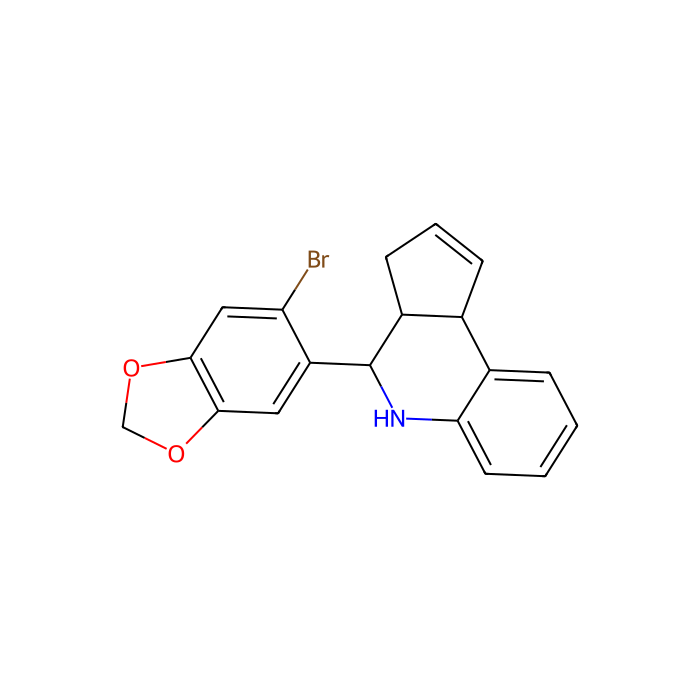
G-15 - Moligand™, ≥99%(HPLC) , Antagonist of GPER, CAS No.1161002-05-6, Antagonist of GPER

CAS: 1161002-05-6 Cat. No.: G286562 Fórmula: C19H16BrNO2 Peso molecular: 370.24
Disponível para encomenda
GRADE & PURITY Moligand™ ? Moligand™ — Aladdin's line of ligands and bioactive small molecules. Use for receptor, pathway, and binding studies needing defined small-molecule tools. ≥99%(HPLC)
Synonyms
(3aR,4S,9bS)-4-(6-bromobenzo[d][1,3]dioxol-5-yl)-3a,4,5,9b-tetrahydro-3H-cyclopenta[c]quinoline
Storage
Protegido da luz, conservar a -20°C
Shipped In
Arca de gelo + almofadas de gelo
★
Size
Alemanha (EU)
USA*
Price
Qty
5mg
G286562-5mg
—
3 Em stock

53,71€

80,61€
Gravar 26,90 € (33.37%)
10mg
G286562-10mg
Sob encomenda · 8–12 semanas

96,23€

144,83€
Gravar 48,59 € (33.55%)
50mg
G286562-50mg
—
2 Em stock

406,02€

609,07€
Gravar 203,05 € (33.34%)
100mg
G286562-100mg
—
2 Em stock

698,44€

1048,14€
Gravar 349,70 € (33.36%)
250mg
G286562-250mg
Sob encomenda · 8–12 semanas

1410,86€

2116,33€
Gravar 705,47 € (33.33%)
Enter a quantity for the sizes you want to add.
🧪

Why this grade

Moligand™, ≥99%(HPLC) Moligand™ for sensitive chromatographic and analytical workflows requiring minimal baseline interference.

🌡

Storage & shipping

Protegido da luz, conservar a -20°C Ships Arca de gelo + almofadas de gelo Check lot-specific COA for exact specifications.

📋

Quality documents

SDS, COA, datasheet, and spec sheet available for download. Lot-specific COA accessible via lot number lookup.

📚

Literature proof

Cited in 0 peer-reviewed publications across chromatography, organic synthesis, and cross-coupling reactions.

Specifications

Sinónimos
(3aR,4S,9bS)-4-(6-bromobenzo[d][1,3]dioxol-5-yl)-3a,4,5,9b-tetrahydro-3H-cyclopenta[c]quinoline
Especificações e pureza
Moligand™, ≥99%(HPLC)
Mecanismos bioquímicos e fisiológicos
Antagonista do recetor GPER de alta afinidade e seletivo (Ki= 20 nM) que não apresenta afinidade para ERαe ERβem concentrações até 10μM. Inibe a mobilização de cálcio induzida por agonistas in vitro (EC50 de ~185 nM) e antagoniza os efeitos antidepressivo
Condições de armazenamento de armazenamento
Protegido da luz, conservar a -20°C
Enviado em
Arca de gelo + almofadas de gelo
Grau
Moligand™
Tipo de ação
ANTAGONIST
Mecanismo de ação
Antagonist of GPER
Pureza
≥99%(HPLC)
Nomes e identificadores
Pubchem Sid504764763
Pubchem Sid Urlhttps://pubchem.ncbi.nlm.nih.gov/substance/504764763
Sorrisos canónicosC1C=CC2C1C(NC3=CC=CC=C23)C4=CC5=C(C=C4Br)OCO5
IUPAC Name(3aS,4R,9bR)-4-(6-bromo-1,3-benzodioxol-5-yl)-3a,4,5,9b-tetrahydro-3H-cyclopenta[c]quinoline
InChIKeyYOLTZIVRJAPVPH-MJLGCCKJSA-N
INCHI1S/C19H16BrNO2/c20-15-9-18-17(22-10-23-18)8-14(15)19-13-6-3-5-11(13)12-4-1-2-7-16(12)21-19/h1-5,7-9,11,13,19,21H,6,10H2/t11-,13-,19+/m0/s1
SMILES isoméricas C1C=C[C@@H]2[C@H]1[C@@H](NC3=CC=CC=C23)C4=CC5=C(C=C4Br)OCO5
Peso molecular 370.24
Reaxy-Rn 25760746
Reaxys-RN_link_address https://www.reaxys.com/reaxys/secured/hopinto.do?context=S&query=IDE.XRN=25760746&ln=

Documentation

📋 Safety Data Sheet (SDS)

Comprehensive hazard, handling, storage, and regulatory compliance document.

Download SDS →

✅ Certificate of Analysis (COA)

Lot-specific quality data. Enter your lot number to retrieve the exact COA.

Look up COA →

📊 Datasheet

Quick-reference summary of product specifications and applications.

View datasheet →

🔬 Specification Sheet

Full quality attributes and acceptance criteria for this grade.

View spec sheet →

Advanced Data

Taxonomic Classification

Taxonomy Tree

KingdomOrganic compounds
SuperclassOrganoheterocyclic compounds
ClasseQuinolines and derivatives
SubclassHydroquinolines
Intermediate Tree Nodes Not available
Direct ParentHydroquinolines
Alternative Parents Benzodioxoles  Secondary alkylarylamines  Aralkylamines  Benzenoids  Aryl bromides  Oxacyclic compounds  Azacyclic compounds  Acetals  Organopnictogen compounds  Organobromides  Hydrocarbon derivatives  
Molecular FrameworkAromatic heteropolycyclic compounds
Substituents Tetrahydroquinoline - Benzodioxole - Secondary aliphatic/aromatic amine - Aralkylamine - Aryl bromide - Aryl halide - Benzenoid - Acetal - Oxacycle - Secondary amine - Azacycle - Organonitrogen compound - Organobromide - Organohalogen compound - Hydrocarbon derivative - Organopnictogen compound - Organic oxygen compound - Organooxygen compound - Amine - Organic nitrogen compound - Aromatic heteropolycyclic compound
DescriçãoThis compound belongs to the class of organic compounds known as hydroquinolines. These are derivatives of quinoline in which in which at least one double bond in the quinoline moiety are reduced by adding two hydrogen atoms.
External Descriptors Not available
Estrutura 3D
Modelo de Estrutura Química Interativa


Alvos associados (humanos)
GPER1 Tchem G-protein coupled estrogen receptor 1 (3 Activities)
Activity TypeActivity Value -log(M)Mechanism of ActionActivity ReferencePublications (PubMed IDs)
ESR1 Tclin Estrogen receptor alpha (17718 Activities)
Activity TypeRelationActivity valueUnitsAction TypeJournalPubMed IddoiAssay Aladdin ID
ESR2 Tclin Estrogen receptor beta (9272 Activities)
Activity TypeRelationActivity valueUnitsAction TypeJournalPubMed IddoiAssay Aladdin ID
MCF7 (126967 Activities)
Activity TypeRelationActivity valueUnitsAction TypeJournalPubMed IddoiAssay Aladdin ID
MDA-MB-231 (73002 Activities)
Activity TypeRelationActivity valueUnitsAction TypeJournalPubMed IddoiAssay Aladdin ID
Alvos associados (não humanos)
Mus musculus (284745 Activities)
Activity TypeRelationActivity valueUnitsAction TypeJournalPubMed IddoiAssay Aladdin ID
Mecanismos de ação
Certificados(CoA,COO,BSE/TSE e Mapa de Análise)
C of A & Other Certificates(BSE/TSE, COO):
Analytical Chart:

Find and download the COA for your product by matching the lot number on the packaging.

5 results found

Lot NumberCertificate TypeDataItem
L2322030Certificate of AnalysisSep 21, 2026 G286562
J2115164Certificate of AnalysisJul 15, 2024 G286562
J2115202Certificate of AnalysisJul 15, 2024 G286562
J2115206Certificate of AnalysisJul 15, 2024 G286562
J2115245Certificate of AnalysisJul 15, 2024 G286562
Propriedades químicas e físicas
SolubilidadeSolvent:DMSO, Max Conc. mg/mL: 18.51, Max Conc. mM: 50
Sensibilidadelight sensitive
Peso molecular370.200 g/mol
XLogP34.900
Hydrogen Bond Donor Count1
Hydrogen Bond Acceptor Count3
Rotatable Bond Count1
Exact Mass369.036 Da
Monoisotopic Mass369.036 Da
Topological Polar Surface Area30.500 Ų
Heavy Atom Count23
Formal Charge0
Complexity484.000
Isotope Atom Count0
Defined Atom Stereocenter Count3
Undefined Atom Stereocenter Count0
Defined Bond Stereocenter Count0
Undefined Bond Stereocenter Count0
The total count of all stereochemical bonds0
Covalently-Bonded Unit Count1
Calculadoras de soluções
Revisões

Avaliações dos Clientes

Application Protocols

No tested application protocols are provided in the Product Data for this item. The following general templates can help design robust workflows once solubility and stability are verified for G‑15.

  • Stock solution preparation (general)

    • Dissolve compound in anhydrous DMSO to 10–50 mM. Vortex and sonicate briefly. Filter through 0.22 µm PTFE if required. Aliquot into amber vials; store at −20 °C, protected from light.
  • Biochemical assay dosing (general)

    • Prepare an 8–12 point serial dilution (e.g., 3-fold) in assay buffer with constant DMSO % across all wells (≤0.1–0.5% v/v typical). Include vehicle controls. Incubation time and temperature per enzyme/cellular SOP.
  • Stability check (general)

    • Analyze T0 and end-point samples by LC–MS or LC–UV to confirm concentration and integrity; monitor for precipitation or adsorption to plastics.
  • Analytical QC (general)

    • Run a quick HPLC purity check prior to critical experiments; compare with CoA acceptance criteria.

Note: For any target- or assay-specific parameters (e.g., cofactors, substrates, cell lines), follow your validated internal SOPs or primary literature. No item-specific dilutions, positive controls, WB/IHC/IF/FC conditions are provided for this product.

Biological Roles

Item-specific biological roles are not provided in the Product Data and must not be inferred. The following guidance outlines how Moligand™ small molecules are commonly positioned in research.

  • General (not specific to this item)

    • Small-molecule ligands are used to probe protein function, modulate signaling pathways, and serve as chemical tools for validating targets in vitro. They may act as agonists, antagonists, inhibitors, or allosteric modulators depending on structure and context.
    • In chemical biology, ligands enable time-resolved perturbations, complementing genetic approaches (e.g., RNAi/CRISPR) and allowing reversibility and dose control.
    • In systems biology, annotated ligands can map pathway responses through omics readouts (transcriptomics, phosphoproteomics, metabolomics).
  • Assay implications (general)

    • Potency/affinity, kinetic profile (k_on/k_off), and selectivity determine utility; confirm these experimentally for the exact chemical entity.
    • Solubility, stability, and nonspecific binding (to serum proteins or plastics) can confound biological readouts; pre-validate conditions.
  • Compliance note

    • This product is for laboratory research use only. No medical, diagnostic, or therapeutic use is intended or permitted.
Buffer Applications

This product is a small-molecule ligand and not a buffering reagent. As such, it is not typically used to establish or maintain pH in solution.

  • Practical note (general)

    • When preparing aqueous working solutions for assays, standard biological buffers (e.g., PBS, HEPES, Tris) may be used as the vehicle. Introduce the compound via dilution from an organic stock (commonly DMSO) while keeping final cosolvent at an assay-validated level.
    • Confirm compound stability across the buffer’s pH and ionic strength, as hydrolysis or ionization state changes can affect activity and solubility.
  • Buffer specifications (item-specific)

    • None provided for this item; refer to assay method SOPs rather than product specifications.
Green Alternatives

Context: For small-molecule screening ligands, the principal environmental impact often arises from solvent use and cold-chain logistics rather than the compound itself. Without item-specific synthesis or solvent requirements, greener practice focuses on solvent choice and workflow design.

  • Greener solvent strategies (general)

    • Prefer water-based assay media with minimal DMSO (≤0.1–0.5% v/v) when solubility permits.
    • Substitute high-toxicity solvents (DMF, dichloromethane) with lower-impact options where compatible (e.g., ethanol, 2-propanol, MeCN over halogenated solvents for analytics).
  • Comparison (general guidance)

    • DMSO vs 2-propanol/ethanol for stock prep: DMSO offers superior solubility but higher persistence; alcohols are greener but may limit achievable concentrations and evaporate more readily.
  • Operational improvements

    • Use miniaturized assay formats (384/1536-well) to reduce solvent volumes.
    • Implement sealed plates to curb VOC emissions and evaporation drift.
    • Consolidate cold shipments to lower environmental footprint; validate room-temperature stability where possible before changing from cold-chain.
  • Waste management

    • Segregate organic solvent waste; employ on-site distillation/recycling for high-volume solvents when permitted.

Note: No alternative chemical substitute for G‑15 can be recommended without the verified structure and use context; consider class-matched ligands with better safety/environmental profiles once the target and SAR are defined.

Pharmaceutical Uses

No pharmacopeial/excipient status or formulation role is provided for this Moligand™ research chemical.

  • Item-specific status

    • Pharmacopoeia listing (USP/EP/JP): Not specified for this item; refer to CoA/Spec Sheet.
    • GMP/clinical grade: Not applicable — this Moligand™ product is for research use only.
  • General guidance (non-clinical)

    • In preclinical research, small-molecule ligands may be formulated in simple vehicles (e.g., PEG/solvent blends) for exploratory studies; however, this product is not supplied for in vivo or clinical use and no such application is endorsed here.
    • Avoid making dosage or therapeutic claims. For any formulation stress-testing (e.g., photo/thermal stability), rely on your internal nonclinical SOPs and stability-indicating analytics.

Compliance statement: For research use only. Not for human or veterinary use, not for diagnostic procedures.

Physical Properties

Summary: Definitive physicochemical specifications are not provided in the Product Data and must be taken from the CoA for the supplied lot.

  • Item-specific specs (Product Data)

    • Appearance: Not specified for this item; refer to CoA/Spec Sheet.
    • Molecular Weight: Not specified for this item; refer to CoA/Spec Sheet.
    • Molecular Formula: Not specified for this item; refer to CoA/Spec Sheet.
  • Typical handling form (general for small-molecule ligands)

    • Often provided as a solid (powder or film) or in an ambered vial; solubilized for use in anhydrous DMSO or alcohols. Actual form for this SKU is not specified — confirm on CoA.
  • Solubility and partitioning (general/literature guidance)

    • DMSO: Common primary solvent for screening stocks (10–50 mM typical working stocks). Exact solubility limit: Not specified for this item; verify experimentally.
    • Aqueous buffers: Frequently require cosolvent or dilution from DMSO; watch for precipitation above 0.1–1% v/v DMSO depending on medium.
    • LogP, pKa, and refractive index: Not specified for this item; refer to CoA/Spec Sheet or compute from the verified structure.
  • Thermal properties (literature/general)

    • Melting point and boiling point: Not specified for this item. Many drug-like solids melt between 80–250 °C; do not assume — consult CoA.
  • Density/UV cutoff/trace metals/peroxide: Not specified for this item; refer to CoA/Spec Sheet.

Practical note: If you will quantify by UV/Vis or LC–UV, determine the compound’s absorbance maxima from a test spectrum after obtaining the verified structure; do not assume chromophores without confirmation.

Quality and Grades

Grade definition for this item: Moligand™ (Aladdin) — denotes small‑molecule ligands curated for research screening, target engagement studies, and chemical biology. This labeling emphasizes suitability for in vitro research; it is not a pharmacopoeial grade and is not intended for human or veterinary use.

  • Item-specific (from Product Data)

    • Grade/Purity: Moligand™ (exact purity metrics for this lot are Not specified for this item; refer to CoA/Spec Sheet for HPLC/GC purity, residual solvents, and identity tests).
  • What Moligand™ typically implies (general information)

    • Identity confirmation by one or more analytical techniques (e.g., NMR, MS, HPLC/UPLC). Specific methods used for this lot: Not specified; see CoA.
    • Purity suitable for biochemical assays and cell-free/cell-based research after appropriate dilution/filtration.
    • Packaging practices that limit light exposure and moisture ingress; cold-chain shipping to preserve integrity of light/temperature‑sensitive ligands.
  • Stabilizers/additives

    • Any stabilizers, salts, or counterions present: Not specified for this item; refer to CoA/Spec Sheet.
  • Practical guidance

    • Verify acceptance criteria (purity %, ID tests, water content, residual solvents, and assay) on the CoA before regulated or quantitative studies.
    • For sensitive assays (e.g., fluorescence, enzymology), pre-screen the lot for interfering fluorescence/absorbance and confirm impurity profile by LC–MS if required.
Reaction and Applications

Scope: This section focuses on research uses of a Moligand™ small-molecule entry in discovery workflows rather than synthetic transformations, since no reactive functional groups or synthetic role are specified for this item.

  • Research applications (general for small-molecule ligands)

    • Target engagement studies: Thermal shift assays (DSF), CETSA, SPR/BLI, ITC to quantify binding. Requires verified structure and high-purity stock.
    • Screening: Use in biochemical or cell-based assays as a reference, hit, or counter-screen ligand; ensure accurate stock concentration via weight-by-volume with moisture correction if applicable.
    • Mechanistic probes: Time-course inhibition/activation studies, competition assays with known ligands, and pathway mapping. Validate off-target profiles where necessary.
  • Assay setup considerations (general)

    • Prepare a fresh concentration-response curve (e.g., 8–12 points, 3-fold dilutions). Maintain constant cosolvent across wells. Include vehicle controls.
    • Confirm stability in assay media over the full incubation time (e.g., LC–MS at 0 and end timepoints) and monitor for adsorption to plastics; pre-block plates if needed.
  • Analytics

    • Identity/purity confirmation prior to critical experiments (HPLC/UPLC with PDA, LC–MS). If a chromophore is suspected, collect UV–Vis spectrum to select quantitation wavelength; otherwise, use mass-based dosing.

Note: Specific mechanistic/target claims for G‑15 are not provided in the Product Data and should not be assumed. Refer to the CoA or primary literature once the exact structure is verified.

Reaction Conditions

This Moligand™ listing is intended for use as a research ligand rather than as a reagent in chemical synthesis. No reaction condition data are provided for this item.

  • If derivatization is planned (general guidance only)

    • Solvent: Choose based on functional groups present (e.g., polar aprotic for nucleophilic substitutions; alcohols or toluene for esterifications/Fischer conditions).
    • Temperature: Maintain mild conditions initially (0–25 °C) and escalate as required after stability checks by TLC/LC–MS.
    • Catalysts/bases: Match to transformation (e.g., Pd for cross-coupling, organic bases for acylations); exclude moisture/oxygen when needed.
    • Workup: Quench carefully, extract into an appropriate organic phase, and purify by flash chromatography or preparative HPLC depending on polarity.
  • Yields/timelines: Not specified for this item; literature values depend entirely on structure and transformation and must not be assumed.

Note: For assay preparation (non-synthetic), typical conditions involve dissolving the solid in anhydrous DMSO at room temperature, followed by sterile filtration if required for cell-based work.

Safety and Handling

Safety overview: Specific GHS data are not provided in the Product Data. Treat G‑15 as a research chemical of unknown toxicity and handle under prudent laboratory practices. Always consult the item SDS for authoritative safety information.

  • Item-specific (from Product Data)

    • Storage: Store at −20 °C, protected from light.
    • Shipping: Ice chest + ice pads (cold chain maintained).
    • GHS Classification, Signal Word, H‑Statements, Pictograms: Not specified for this item; refer to SDS.
  • General laboratory precautions (general guidance)

    • PPE: Safety glasses, lab coat, and appropriate chemical-resistant gloves (e.g., nitrile). Use in a chemical fume hood to avoid inhalation of dust or aerosols.
    • Avoid: Ingestion, inhalation, skin/eye contact. Wash thoroughly after handling. Decontaminate surfaces after weighing and solution prep.
    • Incompatibilities: Unknown for this item; as a precaution, segregate from strong oxidizers and strong acids/bases until compatibility is established.
    • Photolability: Protect from light per Product Data; use amber vials and minimize light exposure during handling and storage.
  • First-aid overview (general guidance; defer to SDS)

    • Inhalation: Move to fresh air; seek medical attention if symptoms persist.
    • Skin/eyes: Rinse with water for at least 15 minutes; remove contaminated clothing; seek medical advice if irritation persists.
    • Ingestion: Rinse mouth; do not induce vomiting; seek medical attention.

Waste: Dispose of in accordance with institutional hazardous waste protocols; do not discharge to drains.

Solvent Selection

Intent: Provide practical guidance for preparing stocks and working solutions for a Moligand™ small-molecule ligand when specific solubility data are not supplied.

  • Primary solvent choices (general best practices)

    • DMSO (anhydrous): First-line solvent for 10–50 mM master stocks. Filter-sterilize if needed (0.22 µm PTFE). Protect from moisture; store aliquots at −20 °C, amber.
    • Ethanol or methanol: Alternative for some assays; confirm compatibility with biological systems. Typical final assay cosolvent ≤0.1–0.5% v/v to limit cytotoxicity.
    • Aqueous buffers: Prepare by serial dilution from an organic stock. Maintain DMSO ≤0.1–1% v/v depending on assay tolerance; add nonionic surfactant (e.g., 0.01–0.05% Tween-20) only if validated for your assay to mitigate precipitation.
  • Polarity/miscibility (general)

    • Most drug-like ligands exhibit limited water solubility and good solubility in polar aprotic solvents. Actual behavior for G‑15 is Not specified; perform a small-scale solubility screen.
  • Practical tips

    • Warm gently (room temperature) and vortex/sonicate briefly to assist dissolution; avoid heating above 40 °C unless stability is verified.
    • Use amber microtubes and minimize headspace oxygen/light.
    • Record exact solvent composition and final cosolvent % in assay logs to aid reproducibility.
  • Comparison snapshot (general)

    • DMSO: Highest solvating power; most universal for screening; may affect some targets at ≥0.5%.
    • EtOH: Broad compatibility; volatility can change concentrations; watch for evaporation during long incubations.
    • DMF/AcN: Useful for analytics; biological tolerance may be lower — validate carefully.
Storage and Reconstitution

Item-specific conditions (from Product Data)

  • Storage temperature: Store at −20 °C.
  • Light sensitivity: Protect from light (use amber vials/foil wrapping; work under low ambient light when feasible).
  • Shipping: Ice chest + ice pads (cold-chain). Inspect upon receipt and return to −20 °C storage promptly.

Reconstitution guidance (general for small-molecule ligands)

  • Solvent selection: Use anhydrous DMSO for primary stocks unless CoA/SDS indicate otherwise. Ethanol or methanol may be considered based on verified solubility and assay compatibility.
  • Stock concentration: Commonly 10–50 mM; determine based on solubility and intended working range. Document exact concentration and solvent lot.
  • Aliquoting: Prepare single-use aliquots (e.g., 10–50 µL) to avoid repeated freeze–thaw. Minimize headspace to reduce oxidative degradation; backfill with inert gas if stability is a concern.
  • Handling: Thaw on ice or at room temperature shielded from light. Mix gently before use. Avoid heating above ambient unless stability is verified.

Stability notes

  • Long-term stability, hygroscopicity, and photostability: Not specified for this item; refer to CoA/SDS and verify empirically by periodic analytical checks (e.g., HPLC purity after 1–3 months).
  • Aqueous working solutions: Prepare fresh on the day of use where possible; if storage is required, keep at 2–8 °C protected from light and re-check integrity before use.

Compliance: For research use only.

Structure and Identity

Overview: G-15 (SKU G286562) is supplied under Aladdin’s Moligand™ line as a small‑molecule research ligand. Item-specific identifiers are limited in the provided Product Data; consult the CoA/Spec Sheet for full structural details.

  • Item-specific (from Product Data)

    • CAS: 1161002-05-6
    • Product Name: G-15
    • SKU: G286562
    • Grade: Moligand™
    • InChIKey: 442704 (as provided; atypical format — verify on CoA)
    • SMILES: Not specified for this item; refer to CoA/Spec Sheet.
    • Molecular Formula: Not specified for this item; refer to CoA/Spec Sheet.
    • Molecular Weight: Not specified for this item; refer to CoA/Spec Sheet.
  • Structural features (general guidance)

    • Functional groups, ring systems, and stereochemistry: Not specified for this item. If structure is required for computational or analytical work (e.g., LC–MS method setup, docking), obtain the definitive structure (SMILES/InChI) from the CoA or authoritative databases corresponding to the exact lot.
  • 2D structure description (general)

    • Not available from the provided data. Many Moligand™ entries are heteroaromatic scaffolds designed for receptor/enzymatic engagements; however, do not assume substructures without the verified structural record for this catalog item.
  • Registry cross-references

    • PubChem CID: 7433743 (as provided; verify alignment with CAS on CoA before use)

Note: Where identifiers appear inconsistent (e.g., abbreviated InChIKey), the CoA/Spec Sheet and SDS are the authoritative sources for structure and identity.

Synthetic Utility

Given the absence of structural and functional group information in the Product Data, no specific synthetic transformations can be advised for this item. The following content is general to small molecules and may guide those considering derivatization after confirming the exact structure.

  • General considerations (not specific to this item)

    • If the molecule bears common handles (e.g., phenols, anilines, carboxylates, halides), typical transformations include acylation/alkylation, cross-coupling (Suzuki–Miyaura, Buchwald–Hartwig), and protection/deprotection sequences.
    • For SAR, parallel synthesis around solvent-exposed regions and conserved pharmacophores can be pursued once the binding model is known.
    • Late-stage functionalization strategies (C–H activation, photoredox) may enable rapid analog generation if the scaffold tolerates such conditions.
  • Analytical support

    • Employ LC–MS and NMR to confirm derivatizations; use stability-indicating methods to assess scaffold integrity under reaction conditions.
  • Caution

    • Do not undertake synthetic modifications without verified structural data for the exact lot. Any derivatization changes the identity relative to the supplied Moligand™ item and will require new characterization.
Target Specificity

Item-specific target, selectivity profile, and binding constants are not provided in the Product Data for G‑15.

  • Verified data required

    • Target class (e.g., enzyme, GPCR, ion channel), primary target ID, species cross-reactivity, and selectivity over related targets must be obtained from the CoA/Spec Sheet or primary literature once the exact structure is confirmed.
  • General guidance

    • Establish specificity via a panel including the presumed target family and key off-target liabilities relevant to your assay (e.g., counterscreens for common assay interferents).
    • Use orthogonal methods (enzymatic readout, binding biophysics, and cellular phenotyping) to corroborate specificity claims.

Note: No target claims are made here. This product is sold strictly for research use without implied biological performance guarantees.

Need help choosing the grade?

Our grade selection guide covers purity, stabilizer status, and application suitability for all variants in our catalog.

View Moligand™ grade guide →

Shall we send you a message when we have discounts available?

Remind me later

Thank you! Please check your email inbox to confirm.

Oops! Notifications are disabled.