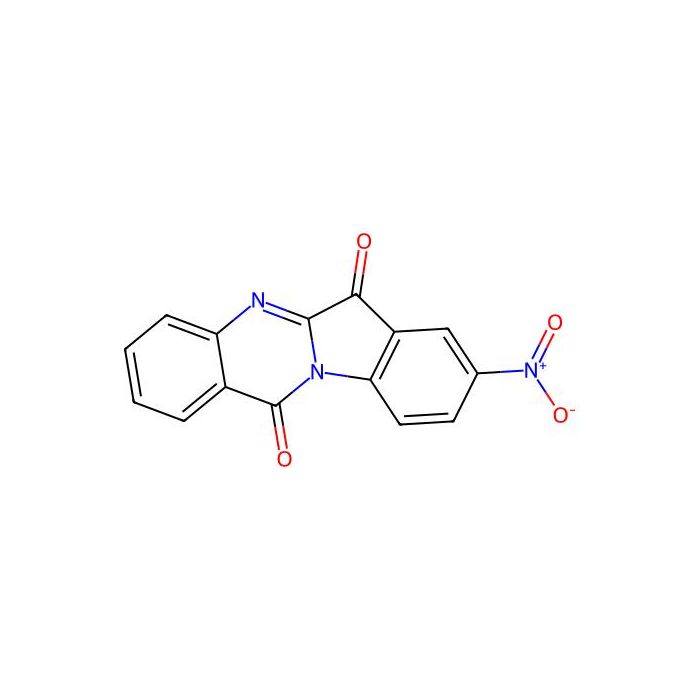
GNF-PF-3777 (8-Nitrotryptanthrin) is a potent human indoleamine 2,3-dioxygenase 2 (h IDO2 ) inhibitor which significantly reduces IDO2 activity with K i of 0.97 μM.
In Vitro
The typtanthrin derivative GNF-PF-3777 (8-Nitrotryptanthrin; Compound 5i) is found to be a potent hIDO2 inhibitor with superior efficiency far better than that of the most frequently-used inhibitor L-1-MT. The IC 50 values show that all nine tryptanthrin compounds display hIDO2 inhibitory activities, GNF-PF-3777 demonstrates much stronger inhibition (1.87 μM) than both L-1-MT (82.53 μM) and D-1-MT (262.75 μM). GNF-PF-3777 exhibits significant antitrypanosomal activity with EC 50 of 0.82 μM. GNF-PF-3777 (8-Nitrotryptanthrin) has a microplate Alamar Blue assay (MABA) minimum inhibitory concentration (MIC) value of 0.032 μg/mL. GNF-PF-3777 also has a LORA MIC value of 2.4 μg/mL, while the majority of analogues lack LORA activity. MCE has not independently confirmed the accuracy of these methods. They are for reference only.
GNF-PF-3777 (8-Nitrotryptanthrin) is a potent human indoleamine 2,3-dioxygenase 2 (h IDO2 ) inhibitor which significantly reduces IDO2 activity with K i of 0.97 μM.
Condições de armazenamento de armazenamento
Store at -20°C
Enviado em
Ice chest + Ice pads
Este produto requer transporte de cadeia fria. Serviços terrestres e outros serviços econômicos não estão disponíveis.
This compound belongs to the class of organic compounds known as indoloquinazolines. These are polycyclic aromatic compounds containing an indole fused to a quinazoline. Indole is a bicyclic compound consisting of a six-membered benzene ring fused to a five-membered nitrogen-containing pyrrole ring. Quinazoline is a heterocyclic compound consisting of two fused six-membered simple aromatic rings, a benzene ring and a pyrimidine ring.
External Descriptors
Not available
1. Djoumbou Feunang Y, Eisner R, Knox C, Chepelev L, Hastings J, Owen G, Fahy E, Steinbeck C, Subramanian S, Bolton E, Greiner R, and Wishart DS. ClassyFire: Automated Chemical Classification With A Comprehensive, Computable Taxonomy. Journal of Cheminformatics, 2016, 8:61.
Determine the necessary mass, volume, or concentration for preparing a solution.
Dilution Calculator
Determine the dilution needed to prepare a stock solution.
Reconstitution Calculator
Revisões
Avaliações dos Clientes
Application Protocols
Item-specific, tested applications and recommended conditions: Not specified for this item.
General protocols for small-molecule screening stocks (not item-specific):
Stock preparation: Weigh compound quickly in low humidity. Dissolve in anhydrous DMSO to a standard concentration (e.g., 10 mM). Vortex and, if needed, sonicate briefly.
Sterile handling (for cell-based assays): Pass stock through a 0.22 μm PTFE filter into sterile vials. Avoid cellulose ester filters when solvent is DMSO/DMF.
Aliquoting: Dispense into single-use aliquots (e.g., 10–50 μL) in low-bind tubes or 96/384-well plates to minimize freeze–thaw.
Storage: −20°C or below, desiccated, protected from light; record lot, date, and concentration on each aliquot. Thaw at room temperature; mix thoroughly before use.
Working solutions: Dilute into assay buffer/media to the desired final concentration, keeping vehicle (e.g., DMSO) ≤0.5–1% v/v unless your system tolerates more. Verify absence of precipitation by visual inspection and, ideally, by light scattering or HPLC.
Stability checks: Periodically confirm concentration and purity of stored stocks by LC–MS or UV–Vis (if chromophore present) to detect degradation.
Note: Replace with item-specific protocols if provided on the CoA/Spec Sheet.
Biological Roles
Item-specific biological targets or roles: Not specified for this item.
General context (not item-specific; for small-molecule library members):
Compounds in discovery libraries are evaluated empirically across biochemical and cell-based assays to identify modulators of enzymes, receptors, transporters, or protein–protein interactions.
Any observed activity is context- and assay-dependent and should be validated by orthogonal methods (e.g., biophysical binding assays, counter-screens for assay interference, and structure–activity profiling).
Aggregation, redox cycling, and covalent reactivity can produce artifactual signals; use appropriate controls (detergent supplementation, redox quenchers, time-dependence studies) to assess liabilities (literature best practices).
ADME-relevant properties (permeability, metabolic stability, protein binding) are typically measured experimentally and cannot be inferred without structure.
Important limitations:
No medical or clinical claims are made or implied. This product is for research use only.
Target specificity, mechanism of action, and pathway engagement are unknown based on the provided Product Data and must be established experimentally if relevant to your research.
Recommendation:
Upon receipt of structural confirmation (CoA/SDS), design assays tailored to plausible mechanisms (e.g., enzyme kinetics for putative enzyme modulators, thermal shift assays for binders) and include orthogonal validation steps.
Buffer Applications
This section typically applies to buffering agents or reagents used to prepare defined pH solutions. GNF-PF-3777 is listed as a small-molecule library member, not a buffering agent.
Item-specific buffer roles, pKa values, or buffering ranges: Not specified for this item; refer to CoA/Spec Sheet.
General guidance (not item-specific):
For biological testing, prepare stock solutions in DMSO and dilute into assay buffers (e.g., HEPES, PBS, Tris) ensuring the final DMSO content remains within tolerated limits for the biological system (commonly ≤0.5–1% v/v).
If the compound is ionizable (unknown here), buffer pH may influence solubility and apparent activity; include pH controls in assay design.
If a specific buffer application is intended, please consult the CoA/Spec Sheet once structure and acid–base properties are confirmed.
Green Alternatives
Because the chemical structure and solvent/processing requirements of GNF-PF-3777 are not specified, green alternatives can only be discussed at the level of general practice for small-molecule handling.
General greener chemistry considerations (not item-specific):
Solvent choices:
Prefer bio-based or lower-toxicity solvents (e.g., 2-MeTHF, CPME, EtOAc, MeOH, MeCN) over chlorinated solvents when compatible with the compound’s solubility and stability.
For crystallizations and extractions, prioritize ethyl acetate, isopropanol, and heptane over DCM/CHCl3 where feasible.
Work-up and purification:
Replace silica gel chromatography using DCM/hexanes with EtOAc/IPA/heptane systems when resolution allows.
Implement dry-loading and minimal solvent volumes; recycle solvents.
Energy and waste minimization:
Conduct reactions at ambient temperature and higher concentrations when possible; employ flow chemistry for hazardous steps (literature guidance).
Assay formats:
Use miniaturized high-throughput assays and aqueous-compatible conditions to reduce DMSO usage and waste.
Illustrative comparison (general, not item-specific):
Traditional: DCM for extractions and chromatography; high DMSO percentages in assays.
Greener approach: EtOAc or MTBE for extractions; EtOAc/heptane or MeOH/EtOAc gradients for chromatography; ≤0.5% DMSO in biological assays with solubility screens to optimize vehicle.
Always verify chemical compatibility and stability before adopting greener substitutions.
Pharmaceutical Uses
No pharmacopeial status, excipient role, or formulation use is specified for this item.
General, non-clinical context for small-molecule screening compounds (not item-specific):
These materials are typically used in early discovery research, including target validation and hit identification. Any progression toward formulation development requires comprehensive CMC characterization (impurity profile, solid form, stability, and synthetic route control) which is not provided here.
If pre-formulation studies are undertaken for research, evaluate: solubility across pH, pKa, logD, solid-state form (XRPD, DSC/TGA), and chemical stability (forced degradation) under ICH-like stress conditions. These activities are research-only and not for clinical use.
No claims are made regarding GMP manufacture, compendial compliance (USP/EP/JP), or suitability for use as API or excipient.
Use limitation:
For research use only. Not for human or veterinary use.
For any formulation-style experiments in a research setting, obtain structure-specific data from the CoA/Spec Sheet and perform compatibility studies with excipients and primary packaging as appropriate.
Physical Properties
Item-specific facts (from Product Data):
Appearance: Not specified for this item; refer to CoA/Spec Sheet.
Molecular weight: Not specified for this item; refer to CoA/Spec Sheet.
Not specified for this item; refer to CoA/Spec Sheet:
Melting point, boiling point, density, refractive index, pKa, logP/logD, vapor pressure, UV/Vis cutoff, water content, residual solvents.
Literature/general guidance for small-molecule screening compounds (not item-specific):
Many library compounds are solids at ambient temperature and are supplied for dissolution in DMSO or other polar aprotic solvents.
If hygroscopicity or polymorphism is a concern, verify by TGA/DSC or Karl Fischer (literature best practices).
Solubility screening can be performed in DMSO, DMF, acetonitrile, ethanol, or aqueous cosolvent mixtures; determine working concentration by turbidimetry or HPLC assay (general practice).
Identity: 1H/13C NMR, HRMS/ESI, and HPLC/UPLC purity profiling.
If chromophores are present, UV–Vis spectra can guide concentration determination via Beer–Lambert law using an experimentally determined ε (literature practice).
Note: Do not treat literature/general statements as specifications. For exact values governing your lot, consult the CoA/Spec Sheet and SDS.
Quality and Grades
Item-specific grade/purity: Not specified for this item; refer to CoA/Spec Sheet.
What grade typically implies (general guidance):
Research or screening grade indicates suitability for discovery biology and medicinal chemistry workflows, commonly with HPLC or UPLC purity reporting (e.g., area% at a specified wavelength) and confirmation by MS and/or NMR.
Analytical/AR grade focuses on low levels of inorganic/organic impurities, often appropriate for analytical method development.
CoA should include: lot number, purity method (HPLC/UPLC), detection wavelength(s), retention time, identity confirmation (MS, NMR), and residual solvent profile if available.
Spec Sheet should define acceptance criteria (e.g., purity threshold, identity tests) and any stabilizer or salt form used. Stabilizers, if present, will be listed explicitly; otherwise do not assume.
Fit-for-purpose selection:
For biochemical screening, request or verify: purity threshold (commonly ≥95% by HPLC, if applicable), salt/solvate state, and counterion content.
For synthetic use, assess residual water/solvents and confirm free base vs. salt to ensure stoichiometric accuracy.
Note: In the absence of item-specific grade/purity in the Product Data, treat this listing as research-use only and verify all quality attributes against the current CoA/Spec Sheet prior to critical applications.
Reaction and Applications
Manufacturer applications (from catalog): Not specified.
Given the lack of structural information for GNF-PF-3777, specific synthetic or mechanistic applications cannot be assigned. The compound is categorized under small molecules/compound libraries and is therefore most commonly used for:
High-throughput and fragment/lead discovery screening (general use case).
Target deconvolution and structure–activity relationship (SAR) development once activity is observed (general practice).
General best practices for screening compounds (not item-specific):
Confirm identity and purity prior to biological screening via HPLC/UPLC and MS; perform salt/solvate assessment to ensure accurate dosing.
Prepare DMSO stocks at known concentrations; verify by quantitative NMR (qNMR) or external-standard LC where appropriate.
Assess aggregation and fluorescence interference using counter-screens (e.g., detergent-supplemented assays, red-shifted readouts) to reduce false positives.
If used in synthesis (general remarks):
Without known functionality, no specific reaction families (e.g., cross-coupling, amide formation) can be recommended. If structural data are obtained, select conditions based on the functional group tolerance (e.g., base-sensitive moieties, redox sensitivity).
Documentation:
Record lot number, solution preparation details, and storage history to support reproducibility across screening campaigns.
For any application beyond initial screening, consult the CoA/Spec Sheet or contact Aladdin Scientific for structure-specific recommendations.
Reaction Conditions
Item-specific reaction condition preferences (solvent, temperature, catalysts): Not specified for this item; refer to CoA/Spec Sheet upon confirmation of structure and functionality.
General guidance for exploring reactivity of an unknown small molecule (not item-specific):
Stability scouting: Expose to acid (0.1–1 M HCl), base (0.1–1 M NaOH), oxidant (e.g., H2O2, mCPBA), and reductant (e.g., NaBH4) at controlled temperatures to map compatibility (bench-scale, with proper safety measures).
Solvent screening: DMSO, DMF, MeCN, toluene, THF, and alcohols are common starting points; choose based on solubility and anticipated functional group tolerance.
Temperature: Begin at ambient conditions; escalate as needed while monitoring by LC–MS/UPLC to avoid decomposition.
Catalysts/additives: Selection depends on functional groups (e.g., Pd for cross-coupling, EDC/HATU for amide coupling, acids/bases for acylations/alkylations). Do not proceed without structural confirmation.
Expected yields/timelines:
Not applicable—no literature precedent can be cited without a known structure. Establish empirical conditions once the structure is verified.
Note: Always validate identity and purity of starting material and products at each step (NMR, MS, HPLC).
Safety and Handling
Item-specific hazard data (from Product Data):
GHS Classification: Not specified for this item; refer to SDS.
Signal Word: Not specified for this item; refer to SDS.
Hazard (H) Statements: Not specified for this item; refer to SDS.
Pictograms: Not specified for this item; refer to SDS.
General laboratory safety (not item-specific; follow your institution’s EHS requirements):
PPE: Lab coat, safety glasses, and appropriate chemically resistant gloves (e.g., nitrile). Use in a certified chemical fume hood to avoid inhalation of dusts/vapors.
Avoid ingestion and skin/eye contact. Wash thoroughly after handling. Prevent environmental release.
Storage incompatibilities: Until structure is confirmed, segregate from strong oxidizers and acids/bases. Keep container tightly closed, desiccated, and protected from light if photosensitivity is suspected.
First aid (overview; defer to SDS): Eye contact—rinse with water for at least 15 minutes. Skin—wash with soap and water, remove contaminated clothing. Inhalation—move to fresh air; seek medical attention if symptoms persist. Ingestion—rinse mouth; do not induce vomiting; seek medical attention.
Spill response: Contain, avoid dust generation, collect with inert absorbent, and dispose of according to local regulations.
Special risks and precautions:
Unknown peroxide-forming or self-reactive potential due to unspecified functionality; therefore, avoid prolonged air/heat exposure until more data are available.
Always consult the item’s SDS for authoritative hazard classification and emergency measures.
Use limitation:
For research use only. Not for human or veterinary use.
Solvent Selection
Item-specific solubility/polarity data: Not specified for this item; refer to CoA/Spec Sheet.
General guidance for small-molecule library members (not item-specific):
Primary stock solvent: DMSO is commonly used (e.g., 10–50 mM) due to broad solubilizing power for heteroaromatics and lipophilic scaffolds. Filter sterilize if required for cell-based assays.
Alternative solvents: DMF, acetonitrile, methanol, ethanol, or co-solvent systems (e.g., DMSO/water or MeOH/water). For highly lipophilic compounds, consider 2-propanol, ethyl acetate, or MTBE for preparative operations (not for aqueous bioassays).
Aqueous work: If the compound is ionizable, adjust pH using appropriate buffers to favor soluble ionic forms. Use surfactants (e.g., 0.01–0.1% Tween 80) judiciously to mitigate aggregation in biological assays (literature practice).
Selection strategy:
Start with a solubility screen in DMSO, MeOH, ACN, and buffer (pH 2–10) to map precipitation limits.
Monitor actual concentration by UV–Vis (if chromophore present) or quantitative LC.
Avoid high DMSO percentages in biological systems (>0.5–1% v/v) to limit vehicle effects.
Comparison (general):
DMSO: maximal solubility, hygroscopic, potential assay interference at high %.
DMF: strong solvent, higher toxicity, difficult to remove.
Note: Confirm the exact solubility profile for your lot; do not assume behavior without empirical verification.
Storage and Reconstitution
Item-specific storage and shipping (from Product Data):
Storage Conditions: Store at −20°C.
Shipped In: Ice chest + ice pads.
Item-specific appearance, solvent, concentration, or stabilizer: Not specified for this item; refer to CoA/Spec Sheet.
General reconstitution guidance for small molecules (not item-specific):
Preferred stock solvent: Anhydrous DMSO is commonly used due to broad solubility; alternatively, DMF, MeOH, or ACN can be employed depending on compatibility.
Preparation: Equilibrate vial to room temperature before opening to minimize moisture condensation. Weigh promptly; dissolve to a convenient concentration (e.g., 10–50 mM). Mix until fully homogeneous; brief sonication may assist dissolution.
Aliquoting and storage: Prepare single-use aliquots in sealed, inert-compatible vials or plates. Store at −20°C (or lower) in a desiccated, dark environment. Avoid repeated freeze–thaw; thaw only what is required for immediate use.
Stability considerations: Without structural data, assume sensitivity to moisture, heat, and light may be possible. For long-term storage, consider an inert atmosphere (argon/nitrogen) and secondary containment with desiccant.
Documentation: Record lot number, exact concentration (verified if possible by UV–Vis with an extinction coefficient or by qNMR/LC), solvent, and date of preparation.
Always defer to the current CoA/Spec Sheet and SDS for any item-specific storage limitations, reconstitution solvents, and stability information.
Structure and Identity
Overview: GNF-PF-3777 is listed as a small-molecule library member. Specific structure-defining information for this item is limited in the provided Product Data.
Item-specific facts (from Product Data):
SKU: G649750
Product Name: GNF-PF-3777
CAS: 77603-42-0
PubChem CID: 478573
InChIKey: 358572 (note: atypical format; verify against CoA/SDS)
SMILES: Not specified for this item; refer to CoA/Spec Sheet.
Molecular formula: Not specified for this item; refer to CoA/Spec Sheet.
Molecular weight: Not specified for this item; refer to CoA/Spec Sheet.
Computed/literature values:
No computed/literature structural parameters can be asserted without a confirmed structure. Consult authoritative databases using the CAS or CID for definitive identifiers (literature).
General chemistry notes:
Without a confirmed SMILES/InChI, functional groups, ring systems, and stereochemistry cannot be described. For small-molecule screening compounds, typical 2D depictions include annotated heteroatoms, aromatic/heteroaromatic cores, and any chiral centers. Please consult the CoA/Spec Sheet or SDS for the definitive structure drawing and identifiers.
Practical guidance:
If using the CAS (77603-42-0) or CID (478573) to retrieve structure, cross-validate identifiers across two or more databases (e.g., PubChem, Reaxys, ChemSpider) to avoid misassignment. Ensure the InChIKey on the container label matches your database query before downstream use.
Synthetic Utility
Item-specific functional groups and reactivity: Not specified for this item; structure not provided in the Product Data.
General considerations (not item-specific):
If GNF-PF-3777 is to be used as a synthetic intermediate, the choice of transformations depends on its functional group content (e.g., aryl halides for cross-coupling, amines for amide/carbamate formation, alcohols for esterification/etherification). Without structural data, no specific retrosynthetic value can be asserted.
When repurposing screening compounds for synthesis, confirm:
Salt form vs. free base/acid (impacts stoichiometry and solubility).
Presence of protecting groups or latent handles (e.g., boronates, azides), verified by NMR/MS and, if needed, elemental analysis.
Purification strategy should be informed by polarity and stability: reverse-phase preparative LC for polar/ionizable species; normal-phase or crystallization for neutral/lipophilic ones.
Best practices:
Run small-scale scouting reactions to assess stability under acidic/basic and redox conditions before committing to scale.
Employ orthogonal analytics (TLC, UPLC, MS) to monitor reactions and detect byproducts or epimerization if stereocenters are present.
Conclusion:
Obtain and review the CoA/Spec Sheet (and SDS) to confirm structural features before planning synthetic transformations involving this material.
Target Specificity
Item-specific target, epitope, and related biological selectivity information: Not specified for this item.
Context:
This section is typically relevant for biologics (e.g., antibodies) or small molecules with defined targets. For GNF-PF-3777, no target is provided in the Product Data.
Recommendation:
If used in screening, report any emergent target specificity with complete assay conditions, counterscreens, and orthogonal validation (thermal shift, SPR/ITC, enzymology) to distinguish true target engagement from assay interference.
For authoritative information, consult the current CoA/Spec Sheet or contact Aladdin Scientific with structural and assay details.
Perguntas frequentes
What is the purity of this product?
This product is supplied at ≥98% purity (chemical assay). Lot-specific values are stated on the Certificate of Analysis.
How should this product be stored?
Store at ?20 °C. Freezer storage is required to maintain the specified shelf life.
How is this product shipped?
This product ships in an insulated container with ice pads. Unpack on arrival and transfer it to the storage condition stated above.
What are the CAS number, molecular formula and molecular weight?
The CAS Number is 77603-42-0, the molecular formula is C15H7N3O4, and the molecular weight is 293.23 g/mol. InChIKey UFMQJYHLIUACCG-UHFFFAOYSA-N.
What documentation is provided?
Available product documentation, including Certificates of Analysis (COA), Safety Data Sheets (SDS), and specification sheets, is shown in the product document area. Document availability and access follow the current site policy.
Usamos cookies para garantir o funcionamento adequado do site e, quando permitido, para melhorar a sua experiência. Você pode gerenciar suas preferências a qualquer momento nas Configurações. Saiba mais em nossa Política de Cookies.
Deseja que lhe enviemos uma mensagem quando tivermos descontos disponíveis?
Lembrar-me mais tarde
Obrigado! Por favor, verifique a sua caixa de entrada de e-mail para confirmar.
Products are supplied to verified businesses, institutions, and qualified professionals for research and development use only. Not for use in humans, animals, diagnosis, or therapy.