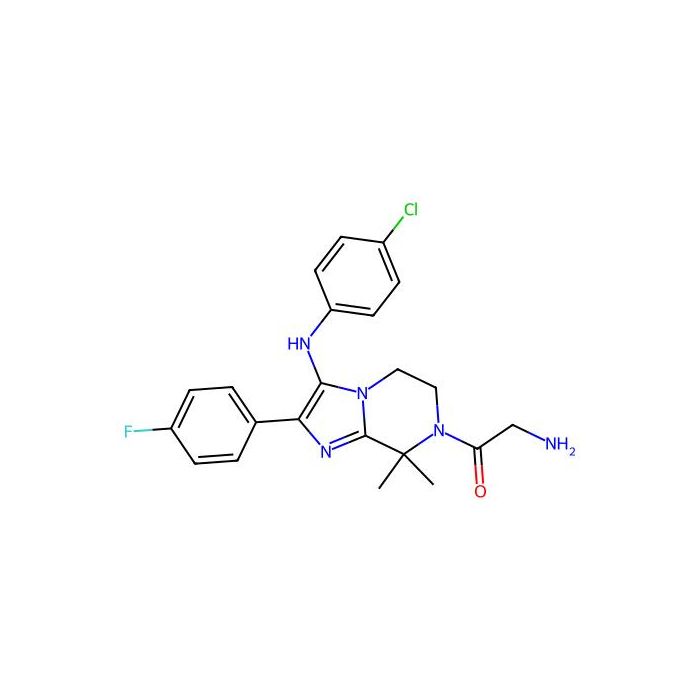
GNF179 is an optimized 8,8-dimethyl imidazolopiperazine analog that exhibits antimalarial potency ( IC 50 of 4.8 nM against the multidrug resistant strain W2). GNF179 is orally active
In Vitro
GNF179 does not rapidly inhibit parasite protein biosynthesis nor is it likely to target parasite cytochrome bc1, which has been validated as a hepatic stage target for Atovaquone . GNF179 may act against sporozoites instead of hepatic stages. GNF179 (5-100 nM; 48 h) shows high inhibition of gametocyte sexual life cycle progression in the mosquito as it abolished oocyst formation at 5 nM. MCE has not independently confirmed the accuracy of these methods. They are for reference only.
In Vivo
GNF179 (15 mg/kg; p.o.; single dose) shows antimalarial activity in rodent malaria model . MCE has not independently confirmed the accuracy of these methods. They are for reference only. Animal Model: Naïve Balb/C mice infected with P. berghei Dosage: 15 mg/kg Administration: Oral, single dose Result: Protected against an infectious P. berghei sporozoite. Animal Model: Naïve Balb/C mice Dosage: 3 or 20 mg/kg Administration: IV or PO (Pharmacokinetic Analysis) Result: Pharmacokinetics of GNF179 in naïve Balb/C mice . Dose AUC (0-∞) (hrs*µM) AUC/dose t 1/2 (hrs) MRT (hrs) CL (ml/min/kg) V ss (L/kg) C 0 or C max (µM) F (%) 3 mg/kg i.v. 8.88 3.0 8.9 9.0 22 11.8 6.1 nd 20 mg/kg p.o. 20.70 1.0 8.4 nd nd nd 1.2 58 AUC, Area Under the Curve; T 1/2 , half life; CL, clearance; V SS , steady-state volume of distribution; C 0 , initial concentration; C max maximum concentration; F, fraction of dose absorbed; hrs, hours; nd, not determined.
Form:Solid
IC50& Target:Plasmodium
Especificações
Especificações e pureza
≥99%
Mecanismos bioquímicos e fisiológicos
GNF179 is an optimized 8,8-dimethyl imidazolopiperazine analog that exhibits antimalarial potency ( IC 50 of 4.8 nM against the multidrug resistant strain W2). GNF179 is orally active.
Condições de armazenamento de armazenamento
Store at -20°C
Enviado em
Ice chest + Ice pads
Este produto requer transporte de cadeia fria. Serviços terrestres e outros serviços econômicos não estão disponíveis.
Tipo de ação
INHIBITOR
Pureza
≥99%
Nomes e identificadores
Peso molecular
427.90
Dados avançados
Certificados(CoA,COO,BSE/TSE e Mapa de Análise)
C of A & Other Certificates(BSE/TSE, COO):
Analytical Chart:
Propriedades químicas e físicas
Solubilidade
DMSO : 100 mg/mL (233.70 mM; Need ultrasonic)
Calculadoras de soluções
Molarity Calculator
Determine the necessary mass, volume, or concentration for preparing a solution.
Dilution Calculator
Determine the dilution needed to prepare a stock solution.
Reconstitution Calculator
Revisões
Avaliações dos Clientes
Application Protocols
No tested application protocols are provided for this item in the Product Data.
General workflow suggestions for small-molecule evaluation (research use only):
Stock preparation: Dissolve in dry, high-purity DMSO to 10–50 mM. Vortex and, if needed, gently warm (≤37°C) to aid dissolution. Filter through 0.22 µm PTFE for particulate removal when compatible.
Aliquoting: Dispense single-use aliquots to minimize freeze–thaw. Store in amber vials or low-bind tubes.
In vitro assays: Titrate across at least 8–12 points (half-log dilutions). Keep final vehicle constant in all wells/tubes. Include positive controls and orthogonal counterscreens.
Cell-based assays: Verify media compatibility and compound stability. Monitor for precipitation upon dilution. Pre-equilibrate to assay temperature and light-protect if needed.
Analytical confirmation: Periodically confirm concentration by UV or quantitative LC–MS to account for adsorption or degradation.
These are general best practices. For any specific protocol, consult the literature for the authenticated structure and adapt to your assay platform.
Biological Roles
Item-specific biological targets, pathways, or mechanisms of action are not provided in the Product Data. As supplied, GNF179 is a research-use small molecule and should be treated as a chemical probe candidate whose biological properties must be established empirically in your system.
General considerations for small molecules used in discovery (general guidance):
Mechanism exploration: Use target deconvolution techniques (chemoproteomics, CETSA/thermal shift, CRISPR knockouts/knockdowns, or genetic epistasis) alongside biochemical assays to infer MOA.
ADME profiling: Assess stability in buffer and microsomes, plasma protein binding, permeability (PAMPA/Caco-2), and efflux. These parameters often govern observed potency in cells.
Off-target risk: Evaluate against common counterscreens for assay interference (e.g., redox cycling, colloidal aggregation, fluorescence quenching). Record PAINS/REOS flags if structure is known.
Phenotypic readouts: For cellular studies, include cytotoxicity/viability controls and time-course experiments to separate primary effects from downstream consequences.
Chemical stability: Monitor for hydrolysis or oxidation in biological media; validate free fraction and actual exposure levels in the assay (LC–MS bioanalytics).
Note: No claims are made regarding therapeutic utility. This product is intended strictly for research use. For any claimed biological role or target, consult peer-reviewed literature corresponding to the verified structure (refer to CoA for identity) and confirm independently.
Buffer Applications
Not typically applicable. GNF179 is a discrete small organic molecule, not a buffering agent. It does not constitute a defined acid/base conjugate pair with a known pKa range for buffer preparation in the Product Data.
Practical notes for assay buffers (general guidance):
If preparing aqueous working solutions, use an appropriate biological buffer (e.g., PBS, HEPES, Tris) validated for your assay and confirm compound solubility at the working pH.
Maintain constant co-solvent percentage (e.g., 0.1–1% DMSO or ethanol) across controls and treated samples to avoid vehicle-related artifacts.
Item-specific pKa and buffering capacity: Not specified for this item; refer to CoA/Spec Sheet or experimental determination.
Green Alternatives
While this listing concerns a discrete small molecule (not a solvent or bulk reagent), users can improve the environmental footprint of their workflows by optimizing solvents and processes used with this compound.
Greener dissolution and processing choices (general guidance):
Stock solutions: If compatible, consider ethanol or water/ethanol mixtures instead of high-boiling polar aprotics (DMSO, DMF, NMP). Validate assay tolerance to ethanol (commonly ≤0.5–1% v/v final).
Reaction/purification (if derivatization is performed): Favor ethyl acetate, 2-MeTHF, isopropanol, or acetonitrile over chlorinated solvents where feasible. For normal-phase work, heptane/EtOAc can replace hexanes/DCM in many cases.
Workup: Employ aqueous biphasic systems and minimize halogenated waste; consider solid-supported scavengers to reduce solvent volumes.
Energy: Limit freeze–thaw cycles by aliquoting; use low-temperature storage efficiently (−20°C instead of −80°C unless required).
Small comparison (general):
DMSO vs ethanol for stocks: DMSO offers broader solubility but is higher boiling and more persistent in waste streams; ethanol is more benign but may not dissolve hydrophobic molecules at high concentrations.
Best practices:
Document and benchmark greener substitutions (solvent guides like CHEM21 or ACS GCI) and track any impact on assay performance. Ensure any co-solvents or surfactants do not interfere with your readout.
These are general process recommendations; item-specific green metrics are not available for this compound.
Pharmaceutical Uses
Not applicable for this catalog entry. This product is supplied strictly for research use only and is not formulated or certified for pharmaceutical manufacturing, clinical, or diagnostic applications.
Contextual information (general, non-clinical):
Some small molecules may be explored in early discovery settings (e.g., hit-to-lead, lead optimization). However, no pharmacopeial status, excipient role, or manufacturing specification is provided for this item.
No claims are made regarding safety, efficacy, dosage, or therapeutic indication. Do not use in humans or animals.
For any consideration beyond laboratory research, comprehensive CMC, toxicology, and regulatory pathways would be necessary; such information is outside the scope of this research-use listing.
Physical Properties
Item-specific physicochemical data are not provided in the Product Data and should be confirmed on the CoA/Spec Sheet for this exact lot.
Item-specific (from Product Data):
Appearance: Not specified for this item; refer to CoA/Spec Sheet.
Molecular weight: Not specified for this item; refer to CoA/Spec Sheet.
Melting point (MP): Not specified for this item; refer to CoA/Spec Sheet.
Boiling point (BP): Not specified for this item; refer to CoA/Spec Sheet.
Density: Not specified for this item; refer to CoA/Spec Sheet.
Refractive index: Not applicable/Not specified; refer to CoA/Spec Sheet.
Solubility in water/organic solvents: Not specified for this item; refer to CoA/Spec Sheet.
LogP/logD, pKa: Not specified for this item; refer to CoA/Spec Sheet.
General guidance for small-molecule screening compounds (literature/general):
Many discovery compounds are supplied as solids with limited aqueous solubility and are typically prepared as 10–50 mM DMSO stocks for screening.
If solubility data are absent, determine kinetic vs thermodynamic solubility experimentally (e.g., nephelometry or HPLC-based equilibrium solubility) across relevant pH values.
For optical assays, check for compound intrinsic absorbance/fluorescence that may interfere with readouts; record UV–Vis spectra and, if necessary, fluorescence excitation/emission profiles.
Hygroscopicity and polymorphism can affect handling and apparent purity; perform a quick Karl Fischer (if applicable) and powder XRD/DSC when exact solid-state properties matter.
Always prioritize item-specific values from the CoA for any quantitative specification.
Quality and Grades
Item-specific grade and purity are not listed in the provided Product Data.
Item-specific statements:
Grade/Purity: Not specified for this item; refer to CoA/Spec Sheet.
General expectations for small-molecule screening/library compounds (general guidance):
Typical QC package: Identity confirmation (1H NMR, MS/HRMS), purity by HPLC/UPLC (often ≥95% area by UV at multiple wavelengths), and sometimes 13C NMR and elemental analysis. Where relevant, chiral purity may be reported by chiral HPLC.
Residual solvents/water: If critical for biological assays or solid-state work, request residual solvent (GC) and water content (KF titration) data. Absent item-specific limits, do not assume specific ppm levels.
Counter-ions/salt form: Verify free base vs salt (e.g., HCl, mesylate) as it impacts molecular weight, solubility, and dosing. If not stated, confirm by NMR or titration.
UV background: For HPLC-grade claims (not provided here), low baseline absorbance and minimal non-volatile residues would be expected; since no such claim is provided, assume standard research grade unless the CoA indicates otherwise.
Batch-to-batch consistency: Use CoA lot number to align analytical data with experimental records. For SAR or screening, keep an analytical snapshot (HPLC trace, MS) in your ELN for each lot opened.
Always defer to the CoA/Spec Sheet for definitive item-specific grade, purity, and analytical methods/results.
Reaction and Applications
This product is offered as a discrete small-molecule research compound intended primarily for biological screening, target identification studies, and chemical biology—not as a general-purpose synthetic reagent.
Research applications (general guidance):
Tool compound usage: Employ in phenotypic or target-based assays to probe pathway responses, validate screening hits, or benchmark SAR series performance.
Dose–response: Prepare serial dilutions from a characterized DMSO stock; include vehicle controls and confirm linear dilution by analytical back-check (LC–UV or LC–MS) as needed.
Orthogonal assays: To mitigate assay interference, confirm activity across orthogonal readouts (e.g., enzymatic vs biophysical) and counterscreens for aggregation or redox cycling.
Chemical biology workflows: Use chemoproteomics or thermal shift/DSF to investigate binding, as appropriate to your system. For cell work, assess permeability, efflux sensitivity, and stability in media/serum.
Stability considerations: Without item-specific data, evaluate bench stability (RT, light) and freeze–thaw robustness experimentally. Track degradation by LC–MS over time.
Synthetic chemistry usage:
The compound is not positioned as a synthetic building block in this catalog entry. If derivatization is desired (e.g., for probe development), first establish functional group tolerance and develop bespoke routes based on the authentic structure from the CoA/literature.
Note: No medical or clinical uses are implied. For research use only.
Reaction Conditions
Not typically applicable. This product is not presented as a reagent for promoting or catalyzing reactions, and no derivatization protocols are provided in the Product Data.
General guidance (if users plan custom synthesis or tagging):
Choose solvents and temperatures according to the validated literature for the authenticated structure matching CAS 1261114-01-5.
Establish stability windows by TLC/LC–MS scouting under heat, oxidants, acids/bases, and light before scaling any transformation.
Aim for mild, chemoselective conditions to preserve the core scaffold when performing late-stage modifications. Employ inert atmosphere when necessary and verify product integrity by orthogonal analytics (HPLC, NMR, MS).
Without item-specific structure and functional groups, concrete conditions (solvents, catalysts, temperatures, yields) cannot be responsibly recommended. Consult primary literature and your internal method development standards.
Safety and Handling
Safety data specific to this item are not included in the provided Product Data. Always consult the product’s SDS for authoritative and up-to-date guidance.
Item-specific hazard information (from Product Data):
Signal word: Not specified for this item; refer to SDS.
H-statements: Not specified for this item; refer to SDS.
GHS classification: Not specified for this item; refer to SDS.
Pictograms: Not specified for this item; refer to SDS.
General laboratory safety for small-molecule research compounds (general guidance):
PPE: Safety glasses, lab coat, and suitable gloves (e.g., nitrile). Work in a chemical fume hood to avoid inhalation of dust or solvent vapors during solution preparation.
Handling: Avoid generating dust/aerosols. When preparing DMSO/organic solutions, prevent skin contact due to enhanced dermal transport by solvents.
Storage incompatibilities: Separate from strong oxidizers and acids/bases unless compatibility is known. Protect from light if the compound is suspected to be photosensitive (amber vials recommended for long-term storage of DMSO stocks).
First aid (overview; defer to SDS): Inhalation—move to fresh air; Skin—wash with soap and water; Eye—rinse cautiously with water for several minutes; Ingestion—rinse mouth and seek medical advice. Provide SDS to healthcare personnel.
Waste: Dispose according to institutional and local regulations for organic chemical waste. Decontaminate glassware using appropriate solvents.
Transport/temperature:
Shipped: Ice chest + ice pads (item-specific)
Storage: Store at −20°C (item-specific)
Note: Do not use in humans or animals. For research use only.
Solvent Selection
No item-specific solubility profile is provided. The following guidance reflects common practice for small-molecule screening compounds.
Primary stock solvent: DMSO is generally preferred for preparing concentrated stocks (e.g., 10–50 mM) due to broad solubilizing power and compatibility with many biochemical assays at ≤0.5–1% final DMSO.
Alternative solvents: DMF, NMP, ethanol, methanol, or isopropanol can be considered depending on assay tolerance. For purely chemical workflows, acetonitrile, ethyl acetate, or dichloromethane may be suitable for processing and purification.
Aqueous vehicles: If aqueous solubility is limited, consider co-solvent systems (e.g., 5–20% DMSO or ethanol in buffer) or inclusion of solubilizers (cyclodextrins, surfactants such as 0.01–0.1% Tween-80) as compatible with the assay.
pH control: If the molecule is ionizable, adjusting pH can enhance solubility. Perform small-scale pH–solubility scouting before committing to screening campaigns.
Photostability: If unknown, protect solutions from light (amber vials) and minimize prolonged exposure at room temperature.
Adsorption: To limit loss to plastics, use low-bind polypropylene tubes/plates; for sensitive assays, confirm recovery by LC–MS.
Comparison (general):
DMSO vs ethanol: DMSO typically affords higher solubility at lower volumes, but ethanol may be preferred for cell-based assays sensitive to DMSO. Validate assay tolerance to the chosen vehicle.
Always record the exact solvent and concentration used; verify clarity and absence of precipitate before use.
Storage and Reconstitution
Item-specific storage and shipping:
Storage conditions: Store at −20°C (from Product Data).
Reconstitution and handling (general guidance for small molecules):
Solvent choice: Prepare concentrated stocks in anhydrous DMSO unless specific solubility data suggest a better solvent. If using aqueous vehicles, confirm solubility and stability at the working pH and ionic strength.
Concentration: Typical screening stocks are 10–50 mM. Record exact concentration and solvent in your ELN.
Aliquots: Prepare single-use or limited-use aliquots (e.g., 10–50 µL) to avoid repeated freeze–thaw cycles.
Freeze–thaw: Minimize cycles; allow vials to equilibrate to room temperature before opening to reduce moisture ingress/condensation, then promptly return unused material to −20°C.
Light and air: If photosensitivity/oxidation is unknown, protect from light (amber containers) and purge headspace with inert gas for long-term storage of solutions.
Solid vs solution: If storing as a solution for >1–2 weeks, confirm stability by HPLC or LC–MS. Otherwise, store as solid at −20°C in a desiccated environment until needed.
Shelf-life and stability: Not specified for this item; refer to CoA/Spec Sheet. Always label vials with lot number, concentration, solvent, and date of preparation. For research use only.
Structure and Identity
GNF179 is listed as a small-molecule research compound. Item-specific identifiers are limited in the provided Product Data.
SKU: G647347
Product name: GNF179
CAS: 1261114-01-5 (item-specific)
Category: Small molecules and compound libraries (研究/筛选用途)
Item-specific identifiers (from Product Data):
Molecular formula: Not specified for this item; refer to CoA/Spec Sheet.
Molecular weight: Not specified for this item; refer to CoA/Spec Sheet.
InChIKey: Not specified for this item; refer to CoA/Spec Sheet.
SMILES: Not specified for this item; refer to CoA/Spec Sheet.
Structural features (general note):
The detailed 2D/3D structure, functional groups, and stereochemistry are not provided in the Product Data. For precise structural assignment (ring systems, heteroatoms, stereocenters), please consult the Certificate of Analysis (CoA), Spec Sheet, or primary literature reporting the structure corresponding to CAS 1261114-01-5.
Descriptive 2D overview (general guidance):
Without a supplied structure string (SMILES/InChI) or figure, we cannot provide a reliable textual structure description for this exact item. Users should reference authoritative databases or our CoA for definitive structural details before performing structure-based design, docking, or SAR documentation.
Synthetic Utility
This listing is for a discrete research compound rather than a general synthetic reagent or building block. No functional-group-specific reactivity or protecting-group behavior is provided in the Product Data.
General remarks (when derivatization is desired):
If the structure is available from the CoA/literature, map reactive handles (e.g., aryl halides, amines, alcohols) and assess chemoselectivity before attempting late-stage diversification for SAR.
Late-stage functionalization strategies may include C–H activation, Suzuki/Miyaura, Buchwald–Hartwig, amide coupling, or sulfonylation, contingent on actual functional groups present.
For probe development (e.g., biotin/fluorophore tags), consider linkers that minimize perturbation of physicochemical properties (logD, TPSA) to preserve biological activity.
Because the exact functional groups for GNF179 are not specified here, avoid assuming compatibility with particular reaction classes. Confirm identity and substitution pattern via the CoA and reproduce reported literature procedures if available.
Target Specificity
Not applicable. This is not an antibody, enzyme, or nucleic acid probe with defined target-binding specifications in the Product Data.
Item-specific target data: Not specified for this item; refer to CoA/Spec Sheet and peer-reviewed literature if available.
For users exploring biological targets (general guidance): Employ target deconvolution methods (e.g., affinity pull-downs, CETSA, CRISPR perturbation) and validate specificity with orthogonal assays and structure–activity relationships.
Perguntas frequentes
How should this product be stored?
Store at ?20 °C. Freezer storage is required to maintain the specified shelf life.
What is the purity of this product?
This product is supplied at ≥99% purity (chemical assay). Lot-specific values are stated on the Certificate of Analysis.
How is this product shipped?
This product ships in an insulated container with ice pads. Unpack on arrival and transfer it to the storage condition stated above.
What are the CAS number, molecular formula and molecular weight?
The CAS Number is 1261114-01-5, the molecular formula is C22H23ClFN5O, and the molecular weight is 427.90 g/mol.
What documentation is provided?
Available product documentation, including Certificates of Analysis (COA), Safety Data Sheets (SDS), and specification sheets, is shown in the product document area. Document availability and access follow the current site policy.
Usamos cookies para garantir o funcionamento adequado do site e, quando permitido, para melhorar a sua experiência. Você pode gerenciar suas preferências a qualquer momento nas Configurações. Saiba mais em nossa Política de Cookies.
Deseja que lhe enviemos uma mensagem quando tivermos descontos disponíveis?
Lembrar-me mais tarde
Obrigado! Por favor, verifique a sua caixa de entrada de e-mail para confirmar.
Products are supplied to verified businesses, institutions, and qualified professionals for research and development use only. Not for use in humans, animals, diagnosis, or therapy.