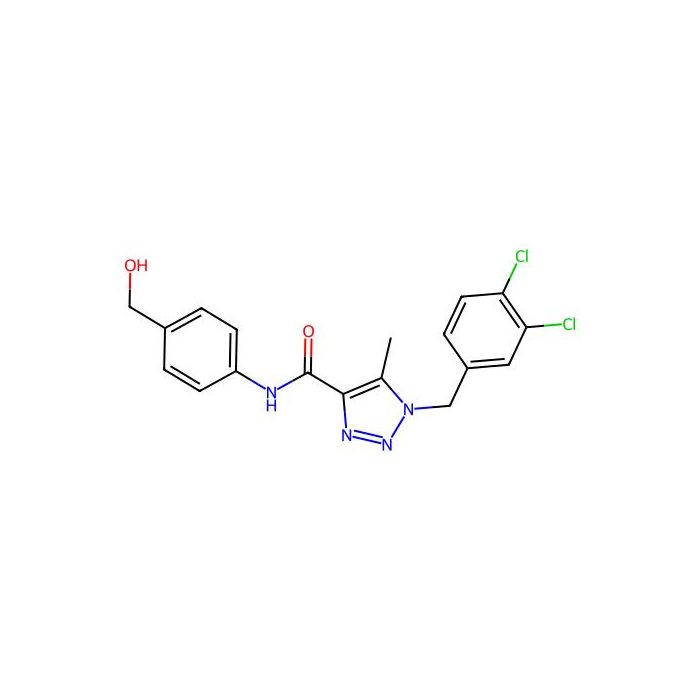
GSK1940029 (SCD inhibitor 1) is a stearoyl-coa desaturase ( SCD ) inhibitor extracted from patent WO/2009060053 A1, compound example 16.
In Vitro
GSK1940029 (SCD inhibitor 1) is a stearoyl-coa desaturase (SCD), which can be used to treat and/or preventing various diseases, including those mediated by SCD enzyme, such as diseases related to elevated lipid levels, cardiovascular disease, diabetes, obesity, metabolic syndrome, skin disorders such as acne, diseases or conditions related to cancer and the treatment of symptoms linked to the production of the amyloid plaque-forming Aβ42 peptide such as Alzheimer's disease. MCE has not independently confirmed the accuracy of these methods. They are for reference only.
IC50& Target:Stearoyl-CoA Desaturase (SCD)
Especificações
Especificações e pureza
10mM in DMSO
Mecanismos bioquímicos e fisiológicos
GSK1940029 (SCD inhibitor 1) is a stearoyl-coa desaturase ( SCD ) inhibitor extracted from patent WO/2009060053 A1, compound example 16.
Condições de armazenamento de armazenamento
Store at -80°C
Enviado em
Dry ice packs + Cold packs
Este produto requer transporte de cadeia fria. Serviços terrestres e outros serviços econômicos não estão disponíveis.
Determine the necessary mass, volume, or concentration for preparing a solution.
Dilution Calculator
Determine the dilution needed to prepare a stock solution.
Reconstitution Calculator
Revisões
Avaliações dos Clientes
Application Protocols
No tested application protocols are provided for this item in the Product Data. The following outlines general, non-binding practices for small-molecule screening samples.
DMSO stock preparation (general):
Warm the vial to room temperature in a desiccator. Add anhydrous DMSO to prepare a 10–50 mM stock. Vortex and briefly sonicate if needed. Filter through 0.22 µm PTFE only if particulate persists and material quantity permits.
Aliquot into single-use, low-bind tubes or 96/384-well plates; seal tightly. Label with lot, concentration, solvent, and date.
Assay dilution:
Add stock to assay buffer to reach desired test concentrations, keeping final DMSO at 0.1–1% v/v unless assay-specific limits differ. Include DMSO-only controls at the matched percentage.
Analytical confirmation:
Verify concentration via UV-visible calibration if chromophore exists, or by quantitative NMR/LC-UV. Assess purity by UPLC before critical experiments.
Light/oxidation precautions:
If the compound is suspected photosensitive, prepare and store solutions under low light and consider amber vials.
These are general guidelines only; adapt to your assay and consult the CoA/SDS for any item-specific instructions.
Biological Roles
Item-specific biological function/target: Not specified for this item; refer to CoA/Spec Sheet or primary literature if available.
General context for small-molecule library members:
Such compounds are used to probe biochemical processes in vitro and, after appropriate validation, can support mechanistic hypotheses in cell-free or cellular assays. Any biological roles are contingent on experimentally determined target engagement, selectivity, and potency, none of which are provided here.
Prior to mechanistic interpretation, evaluate liabilities including aggregation, redox cycling, covalent reactivity, pan-assay interference (PAINS) motifs, and photoreactivity. Use orthogonal assay formats (enzymatic, biophysical such as SPR/ITC, and cellular target engagement assays) to confirm specific interactions.
ADME-relevant measurements (e.g., solubility, microsomal stability, permeability, plasma protein binding) may be performed to contextualize observed assay effects; however, these are not provided in this listing and must not be inferred.
Important: No clinical or therapeutic claims are made or implied. This material is supplied strictly for research use only, consistent with the Product Data.
Buffer Applications
This product is a discrete small molecule, not a buffering agent.
Applicability:
It does not serve as a pH buffer system. Instead, it is typically dissolved in an organic cosolvent (commonly DMSO) and then diluted into an appropriate experimental buffer for assays.
Practical notes for use in buffers (general):
Choose assay buffers compatible with the target biology (e.g., HEPES pH 7.4, Tris pH 7.5–8.0, PBS pH 7.2–7.4). Maintain constant ionic strength to reduce variability.
Keep final DMSO (or other cosolvent) at the lowest feasible level (often 0.1–1% v/v). Include solvent-only controls at the same final percentage.
Monitor precipitation upon dilution with nephelometry or by visual inspection, especially at higher test concentrations.
Recipes and pH ranges:
Not applicable to this compound as a buffer component. Standard buffer recipes (HEPES, Tris, PBS) can be used as needed for the intended assay.
Green Alternatives
Although this item is a discrete small molecule rather than a solvent or reagent class, greener practices apply to its handling and use in assays and analytics.
Greener solvent choices for stock prep/dilution (general):
Prefer water and aqueous buffers as final media whenever feasible; minimize organic cosolvent to ≤0.1–1% v/v.
If possible, favor ethanol over DMF/NMP due to lower toxicity and improved EHS profile. Acetonitrile can be preferable to DMF/NMP for analytical sample prep given lower reproductive toxicity, though flammability must be managed.
Operational waste reduction:
Prepare small, right-sized aliquots to lower discard rates from stability-limited solutions.
Use 96/384-well miniaturization to reduce per-experiment solvent and sample consumption.
Adopt plate-sealing films that minimize evaporation, reducing the need for re-preparation.
Comparative considerations (general):
| Use case | Conventional choice | Greener alternative | Trade-offs |
|---|---|---|---|
| Stock solution | DMF or NMP | Ethanol or aqueous with cyclodextrin/co-solvent systems | Solubility may be lower; evaluate assay tolerance |
| Analytical diluent | DMSO-rich | MeCN/water (0.1% FA) | May affect ionization/retention; method re-optimization needed |
| Reaction/synthesis of analogs | Chlorinated solvents | 2-MeTHF, CPME, EtOAc | Boiling point and selectivity differences |
Note: Item-specific solvent compatibility and stability are not specified for this item; verify experimentally.
Pharmaceutical Uses
No pharmacopeial status or excipient role is indicated for this item.
Item-specific information:
Pharmaceutical/excipient use: Not specified for this item; refer to CoA/Spec Sheet.
General guidance (non-clinical, research-only):
In early discovery settings, small molecules from screening libraries may be evaluated in biochemical or biophysical assays to explore target engagement. Any progression towards formulation studies would require extensive additional data (physicochemical properties, stability, compatibility, impurity profile), which are not provided here.
Do not use in human or veterinary applications. This product is supplied strictly for research use only, consistent with the Product Data.
Physical Properties
Item-specific properties (from Product Data):
Appearance: Not specified for this item; refer to CoA/Spec Sheet.
Boiling point, melting point, density, logP, pKa, refractive index, and aqueous/organic solubility: Not established in this record. Consult the CoA/Spec Sheet or primary literature associated with CAS 1150701-66-8 / CID 42603008.
General guidance for small-molecule library members (literature-based best practices):
Solubility screening: Start with DMSO (anhydrous) stock at 10–50 mM; if insoluble, apply gentle warming (≤40 °C) and brief sonication. Assess precipitation upon dilution into aqueous buffers (final DMSO 0.1–1% v/v typical).
Hygroscopicity/polymorphism: Unknown for this item; minimize atmospheric exposure until properties are verified.
Solid-state characterization: If needed, determine polymorph or amorphous nature by PXRD/DSC/TGA; confirm purity by HPLC/UPLC and identity by HRMS/1H NMR.
Important: Do not treat these general notes as specifications. For any numeric property not listed above, the correct statement is: Not specified for this item; refer to CoA/Spec Sheet.
Quality and Grades
Item-specific grade/purity: Not specified for this item; refer to CoA/Spec Sheet.
What the grade typically signifies (general guidance):
Screening/compound library materials are commonly supplied at high chemical purity suitable for biological assay development (often ≥95% by HPLC/UPLC), with identity confirmed by NMR and/or HRMS. However, exact acceptance criteria vary by supplier and lot.
If designated “HPLC grade” or similar for solvents, that would refer to low UV background and minimal nonvolatile residues; this does not apply here unless expressly stated.
Recommended quality controls on receipt (best practices):
Verify identity by HRMS and 1H NMR (and 13C NMR if available). Confirm purity by reversed-phase HPLC/UPLC with diode-array detection; orthogonal LC-MS is advised.
Check for residual solvents and water content (GC headspace; Karl Fischer) if solubility or stability is critical to your application.
Document lot-specific data from the CoA. If specifications are critical (e.g., purity threshold for SAR), request a detailed spec sheet prior to purchase.
Stabilizers/additives:
None indicated in the item record. If any stabilizers or salts are present (e.g., TFA, HCl), they will be specified on the CoA.
Summary: Without a declared grade, treat this as a research-use library compound; consult the CoA/SDS for definitive specifications and analytical data.
Reaction and Applications
Context: This product is categorized under “small molecules and compound libraries” and is intended for research use only. No specific bioactivity or target information is provided in this listing.
Typical research applications for library compounds (general):
High-throughput screening (HTS) and fragment/lead identification in biochemical or biophysical assays.
Hit validation, counter-screening, and orthogonal assay confirmation.
Structure–activity relationship (SAR) exploration via analog synthesis and profiling.
Mechanism-of-action studies using chemical biology approaches once a putative target is identified (requires additional data not provided here).
Practical handling tips:
Prepare concentrated DMSO stocks (e.g., 10–50 mM), aliquot to single-use vials/plates, and store at −80 °C to minimize freeze–thaw cycles.
Employ plate mapping that balances edge effects and DMSO gradients for HTS. Include DMSO-only controls at the same final concentration used for test wells.
Evaluate compound aggregation with detergent controls (e.g., 0.01% Triton X-100 or 0.01% Tween-20) and by monitoring Hill slopes and concentration-response curve shapes.
Assess redox activity (e.g., with resazurin interference tests) and fluorescence/absorbance overlaps relative to assay readouts.
Not a synthetic reagent:
No item-specific reactivity or named-reaction usage is provided. This product is not positioned as a general synthetic building block in this listing.
Reaction Conditions
Not typically applicable. This product is offered as a discrete screening compound rather than as a reagent for chemical transformations.
Item-specific reaction conditions: Not specified for this item; refer to CoA/Spec Sheet if any synthetic history is disclosed.
General notes (only if synthesizing analogs after obtaining the structure):
Choice of solvent, temperature, catalysts, and workup will depend entirely on the functional groups present in the verified scaffold.
Typical med-chem conditions: cross-couplings (Pd-catalyzed) in 2-MeTHF/EtOH or toluene/water with suitable bases; amide couplings using modern coupling reagents under mild conditions; heterocycle formations under microwave heating if appropriate.
For this catalog item, treat it as a finished research compound; no reaction-condition guidance is implied for routine use.
Safety and Handling
Authoritative safety data must be taken from the product SDS. The following summarizes what is known from this item record and adds general laboratory precautions.
Item-specific hazard data (from Product Data):
Signal Word: Not specified for this item; refer to SDS.
H-Statements: Not specified for this item; refer to SDS.
GHS Classification: Not specified for this item; refer to SDS.
Pictograms: Not specified for this item; refer to SDS.
General laboratory precautions for small organic molecules:
Use in a chemical fume hood; avoid inhalation of dust/aerosols.
Wear appropriate PPE: lab coat, safety glasses, and chemically resistant gloves (nitrile recommended). Change gloves regularly if handling solutions in DMSO/DMF which can enhance dermal absorption.
Avoid contact with skin and eyes; wash thoroughly after handling.
Prevent environmental release; collect waste in halogenated or non-halogenated organic waste streams as appropriate.
Incompatibilities and stability (general):
Unknown specific incompatibilities for this item. Until verified, avoid strong oxidizers/reductants and extremes of pH. Protect from moisture if hygroscopicity is suspected and from light if chromophoric groups are present (wrap in foil as a precaution).
First-aid overview (general):
Skin/eye contact: Rinse with water for ≥15 minutes. Remove contaminated clothing. Seek medical attention if irritation persists.
Ingestion/inhalation: Move to fresh air; rinse mouth. Seek medical advice. Provide SDS to responders.
Always defer to the product’s SDS for definitive hazard classification and response measures.
Solvent Selection
Because the structure and polarity of GSK1940029 are not provided in this record, select solvents using a conservative, stepwise solubility workflow suitable for diverse small molecules.
Practical stock-solution strategy:
Start with anhydrous DMSO to prepare 10–50 mM stocks. If insoluble, try DMF or NMP. Apply brief sonication and mild warming (≤40 °C). Avoid prolonged heating.
For assay use, dilute DMSO stocks into aqueous buffers to a final DMSO content of 0.1–1% v/v (optimize per assay tolerance). Monitor for precipitation (visual/turbidity or Nephelometry).
Secondary solvent options (if DMSO is unsuitable):
Polar protic: ethanol, methanol, isopropanol (often compatible up to 0.5–2% v/v in biochemical assays).
Nonpolar/less polar: acetonitrile, ethyl acetate, THF (primarily for analytical/sample prep, not typical for cell-free assays without re-dilution).
DMF/NMP (ε ≈ 37/32) can solubilize many aromatics and heterocycles; ensure assay compatibility and remove by dilution if necessary.
When to choose alternatives:
If compound is base- or acid-labile, avoid strongly basic/acidic aqueous buffers during dilution.
If compound is photosensitive, prepare and handle solutions under low light or foil wrap.
Note: Item-specific solubility is not specified for this item; refer to CoA/Spec Sheet.
Storage and Reconstitution
Item-specific conditions (from Product Data):
Storage Conditions: Store at −80 °C.
Shipped In: Dry ice packs + Cold packs.
Appearance: Not specified for this item; refer to CoA/Spec Sheet.
General best practices for small-molecule research compounds:
As received: Keep the container tightly closed. Allow vials shipped on dry ice to equilibrate to room temperature in a desiccator before opening to prevent condensation.
Aliquoting: Immediately prepare small, single-use aliquots (solid or DMSO stock) to avoid repeated freeze–thaw and moisture uptake. Use pre-chilled, dry equipment.
Aqueous dilution: Add to buffer with vigorous mixing to the desired concentration, maintaining low final cosolvent (typically 0.1–1% v/v). Inspect for precipitation.
Stability of solutions:
At −80 °C, DMSO stocks often remain stable for months; however, item-specific stability is Not specified for this item; refer to CoA/Spec Sheet. Minimize freeze–thaw cycles by aliquoting.
At 4 °C or room temperature, use promptly; many small molecules may degrade via hydrolysis or oxidation.
Light and moisture: Store protected from light if chromophores are suspected; maintain under dry conditions with desiccant or inert gas backfill if feasible.
Research Use Note: For research use only, consistent with the Product Data.
Structure and Identity
Brief overview: GSK1940029 is listed as a small-molecule research compound from a screening/compound library. Item-specific structural identifiers are limited in this record.
Item-specific (from Product Data):
SKU: G654585
Product Name: GSK1940029
CAS: 1150701-66-8
PubChem CID: 42603008
InChIKey: Not specified for this item; refer to CoA/Spec Sheet.
SMILES: Not specified for this item; refer to CoA/Spec Sheet.
Molecular Formula: Not specified for this item; refer to CoA/Spec Sheet.
Molecular Weight: Not specified for this item; refer to CoA/Spec Sheet.
Structural features (general note):
Specific ring systems, functional groups, and stereochemistry are not provided in this listing. Please consult the CoA/SDS or primary references (e.g., PubChem CID 42603008) for definitive structure.
2D structure description:
Not provided in the item record. A 2D depiction and atom connectivity should be verified from the CoA/Spec Sheet or trusted databases before designing assays, analytical methods, or synthetic modifications.
Synthetic Utility
This listing does not position GSK1940029 as a synthetic reagent or building block, and no functional-group information is provided.
Item-specific reactivity/functional handles: Not specified for this item; refer to CoA/Spec Sheet.
General considerations if analog synthesis is contemplated:
Once the scaffold and functional groups are verified (via structural data from CoA or databases), classical medicinal chemistry modifications (bioisosteres, ring substitutions, heteroatom variations) can be planned to explore SAR.
Protecting-group strategies, cross-coupling routes (e.g., Suzuki–Miyaura, Buchwald–Hartwig), and heterocycle formations may be applicable depending on the confirmed structure.
Analytical control: Employ LC-MS and NMR for identity and purity; use chiral HPLC if stereocenters are present.
Note: Without the disclosed structure, no specific named reactions or transformation guidance can be responsibly provided for this item.
Target Specificity
Item-specific target/biomolecular specificity: Not specified for this item; refer to CoA/Spec Sheet or peer-reviewed literature associated with CAS 1150701-66-8 / CID 42603008.
Notes:
Without validated target data (Kd/IC50/EC50, selectivity panels, off-target profiling), no claims about specificity can be made.
If you identify a putative target experimentally, confirm with orthogonal assays (e.g., binding by SPR/ITC, activity assays, thermal shift/DSF) and counter-screens to exclude assay interference.
Perguntas frequentes
How should this product be stored?
Store at ?80 °C. Ultra-low temperature storage is required to maintain the specified shelf life.
How is this product shipped?
This product ships frozen with dry ice and cold packs. Unpack on arrival and transfer it to the storage condition stated above; handle dry ice with insulated gloves in a ventilated area.
What are the CAS number, molecular formula and molecular weight?
The CAS Number is 1150701-66-8, the molecular formula is C18H16Cl2N4O2, and the molecular weight is 391.25 g/mol.
What documentation is provided?
Available product documentation, including Certificates of Analysis (COA), Safety Data Sheets (SDS), and specification sheets, is shown in the product document area. Document availability and access follow the current site policy.
Usamos cookies para garantir o funcionamento adequado do site e, quando permitido, para melhorar a sua experiência. Você pode gerenciar suas preferências a qualquer momento nas Configurações. Saiba mais em nossa Política de Cookies.
Deseja que lhe enviemos uma mensagem quando tivermos descontos disponíveis?
Lembrar-me mais tarde
Obrigado! Por favor, verifique a sua caixa de entrada de e-mail para confirmar.
Products are supplied to verified businesses, institutions, and qualified professionals for research and development use only. Not for use in humans, animals, diagnosis, or therapy.