GRAU & PUREZAMoligand™?Moligand™ — Aladdin's line of ligands and bioactive small molecules. Use for receptor, pathway, and binding studies needing defined small-molecule tools.≥98%
Store under desiccating conditions. The product can be stored for up to 12 months.
Application
HC-067047 has been used as a transient receptor potential cation channel subfamily V member 4 (TRPV4) inhibitor:
to study its effects on organoid formation and proliferation in human endometrial tissues
to determine its effects on neuronal survival after intracerebral hemorrhage (ICH)
to study its effects on TRPV4 regulation of angiotensin II receptor type 1 (AT1R) task, phosphorylation and β-arrestin recruitment in choroid plexus
Especificações
Sinónimos
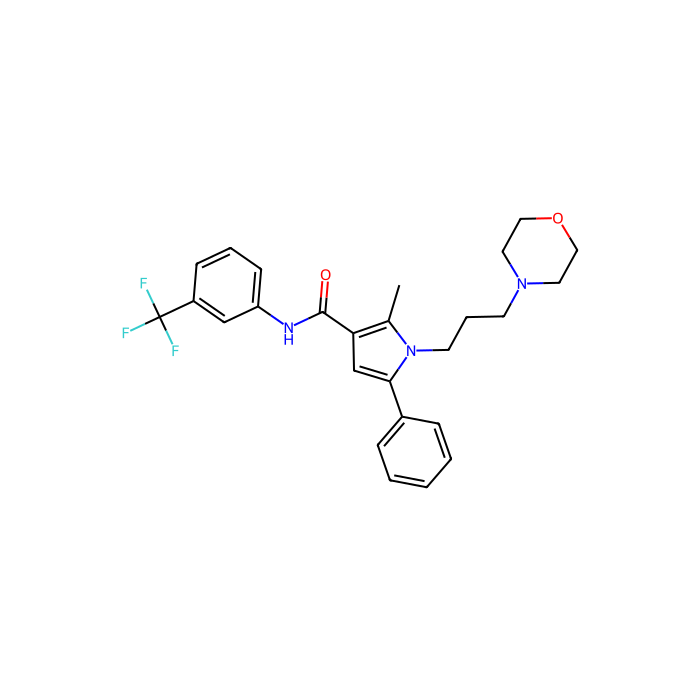
[2-methyl-1-[3-(4-morpholinyl) propyl]-5-phenyl-N-[3-(trifluoromethyl)phenyl]-1h-pyrrole-3-carboxamide | 2-methyl-1-(3-morpholin-4-ylpropyl)-5-phenyl-N-[3-(trifluoromethyl)phenyl]pyrrole-3-carboxamide | 2-methyl-1-[3-(morpholin-4-yl)propyl]-5-phenyl-N-[3-(trifluoromethyl)phenyl]-1H-pyrrole-3-carboxamide | 2-Methyl-1-[3-(4-morpholinyl)prop Show more
Especificações e pureza
Moligand™, ≥98%
Mecanismos bioquímicos e fisiológicos
Potent and selective reversible TRPV4 antagonist (IC 50 values are 17, 48 and 133 nM for mouse, human and rat orthologs, respectively.) Potently inhibits the endogenous TRPV4-mediated response to 4α-PDH (IC 50 = 22 nM). Shows antivasoconstrictive effects
HC-067047 is a potent, selective inhibitor of hTRPV4. The compound inhibits human, rat and mouse TRPV4 with IC50 values of 48, 133 and 17 nM, respectively. HC-067047 does not inhibit other TRPV isoforms at concentrations up to 5 μM. HC-067047 inhibits hERG channel and the menthol receptor TRPM8 with IC50 values of 370 and 780 nM, respectively.
Condições de armazenamento de armazenamento
Store at -20°C,Desiccated
Enviado em
Ice chest + Ice pads
Este produto requer transporte de cadeia fria. Serviços terrestres e outros serviços econômicos não estão disponíveis.
Grau
Moligand™
Tipo de ação
CHANNEL BLOCKER
Mecanismo de ação
Channel blocker of TRPV4
Nota
Wherever possible, you should prepare and use solutions on the same day. However, if you need to make up stock solutions in advance, we recommend that you store the solution as aliquots in tightly sealed vials at -20°C. Generally, these will be useable for up to one month. Before use, and prior to opening the vial we recommend that you allow your product to equilibrate to room temperature for at least 1 hour. Need more advice on solubility, usage and handling? Please visit our frequently asked questions (FAQ) page for more details.
This compound belongs to the class of organic compounds known as aromatic anilides. These are aromatic compounds containing an anilide group in which the carboxamide group is substituted with an aromatic group. They have the general structure RNC(=O)R', where R= benzene, and R = aryl group.
External Descriptors
Not available
1. Djoumbou Feunang Y, Eisner R, Knox C, Chepelev L, Hastings J, Owen G, Fahy E, Steinbeck C, Subramanian S, Bolton E, Greiner R, and Wishart DS. ClassyFire: Automated Chemical Classification With A Comprehensive, Computable Taxonomy. Journal of Cheminformatics, 2016, 8:61.
Determine the necessary mass, volume, or concentration for preparing a solution.
Dilution Calculator
Determine the dilution needed to prepare a stock solution.
Reconstitution Calculator
Revisões
Avaliações dos Clientes
Application Protocols
Only application details provided in the Product Data can be listed here. No tested applications, recommended dilutions, or control conditions are specified for this item.
Guidance:
Refer to your internal SOPs or the methods reported in the primary literature for HC 067047 when designing experiments.
Establish vehicle controls matched to the highest solvent concentration used.
For validated, product-specific protocols (e.g., WB, IF, cell-based assays), please consult the CoA/Spec Sheet or contact Aladdin Technical Support with your SKU and lot number.
Biological Roles
Item-specific biological target data are not listed in the Product Data, and Aladdin provides this material strictly for research use only.
General/literature context for compounds in this class:
HC 067047 is cited in the literature as a bioactive small molecule used to modulate protein function in cellular and biochemical assays. Such ligands are commonly employed for target validation, pathway dissection, and phenotypic screening.
Typical study designs include concentration–response experiments to derive apparent potency metrics (e.g., IC50/EC50), time-course analyses for on/off-target assessment, and use as reference controls in assay qualification.
Key experimental considerations include compound solubility, stability in assay media, adsorption to plastics, and vehicle effects on cells or enzymes.
Caveats and responsibilities:
Do not infer therapeutic suitability or in vivo safety from research use. No clinical, diagnostic, or veterinary applications are supported.
When employing this compound in live-cell or organismal models, confirm the absence of confounding solvent effects (e.g., DMSO) and assess cytotoxicity under your exact conditions.
For precise target annotations, kinetics, or pathway mapping, consult peer-reviewed publications and characterize performance in your system; Target Specificity for this item is not provided here.
Buffer Applications
This product is a small-molecule research ligand and is not a buffering agent. It does not serve to control pH directly.
Practical handling in buffered systems (general guidance):
Prepare a concentrated DMSO stock and perform serial dilutions into the desired buffer (e.g., PBS, HBSS, assay-specific buffers) with vigorous mixing to minimize precipitation.
Maintain consistent vehicle concentration across all samples and controls (commonly ≤0.1% v/v DMSO final, subject to assay tolerance).
If precipitation occurs upon dilution, consider adding a minimal amount of co-solvent, a non-ionic surfactant (e.g., 0.01–0.05% Tween 80), or using complexation vehicles (e.g., 10–20% HP-β-CD) after verifying compatibility with the biological system.
Exact buffer recipes or pH ranges are not applicable to this compound per se; tailor buffer composition to your specific assay requirements.
Green Alternatives
Because this product functions as a research ligand rather than a bulk solvent or process reagent, “green chemistry” considerations center on formulation and assay preparation rather than replacement of the molecule itself.
Greener handling strategies (general guidance):
Solvent minimization: use highly concentrated DMSO stocks (e.g., 10–50 mM) to keep assay DMSO ≤0.1% v/v.
Alternative vehicles: where compatible, consider aqueous formulations using cyclodextrin inclusion (e.g., 10–20% w/v HP-β-CD) or PEG-400/water blends to reduce neat organic solvent.
Waste reduction: scale assays to microplate formats; adopt automation to minimize overage; segregate halogenated vs. non-halogenated waste streams per local regulations.
Energy and cold-chain efficiency: consolidate shipments and store at the lowest temperature required by the Product Data (−20°C, desiccated) to balance stability with energy use.
Comparison of common vehicles (general, not item-specific):
DMSO: excellent solvency; moderate EHS profile; miscible with water—preferred for screening.
Aqueous with excipients (HP-β-CD, polysorbates): improved biocompatibility; requires characterization of complexation effects on potency.
Any change in vehicle may alter apparent potency/solubility; re-validate assay conditions after modifications.
Pharmaceutical Uses
For research use only. This product is not intended for human or veterinary use, not for diagnostic procedures, and not for use in foods, cosmetics, or household items.
Context (general, non-therapeutic):
Small-molecule ligands like this one are sometimes used in preclinical research to explore target biology, characterize structure–activity relationships (SAR), and support assay development. Such work is distinct from GMP manufacturing or clinical formulation.
No pharmacopeial monographs, excipient roles, or GMP specifications are provided in the Product Data for this item.
Implications for formulation scientists (research setting only):
If in vitro dosing or in vivo exploratory studies are contemplated, develop fit-for-purpose formulations (vehicle selection, stability indicating methods) and perform full risk assessments. Lot-specific specifications and impurity profiles must be obtained from the CoA/Spec Sheet.
No therapeutic claims or clinical use cases are made or supported by Aladdin for this SKU.
Physical Properties
Item-specific properties (from Product Data):
Appearance: Not specified for this item; refer to CoA/Spec Sheet.
Not specified for this item; refer to CoA/Spec Sheet:
Melting point (MP)
Boiling point (BP)
Density
Refractive index
UV/Vis characteristics and cutoff
Water content, residual solvents, metals
Partition coefficient (logP/logD), pKa
Solubility profile
General/literature context for small-molecule ligands (non-specification):
Bioactive research ligands of this class are commonly isolated as crystalline or amorphous solids and are typically formulated as concentrated DMSO stock solutions for biological testing due to limited aqueous solubility. If aqueous use is required, co-solvent systems (e.g., DMSO→buffer serial dilution), surfactants (0.01–0.05% Tween 80), or complexation (e.g., hydroxypropyl-β-cyclodextrin) are often employed. These are general practices and not item specifications.
Always confirm exact physicochemical parameters for your lot from the CoA/Spec Sheet if method validation or quantitative formulation is required.
Quality and Grades
Grade/purity for this item:
Grade: Moligand™ (as provided in Product Data)
What Moligand™ typically implies (general description):
Moligand™ designates small-molecule ligands curated for molecular recognition studies (e.g., target engagement, screening, pathway interrogation). Emphasis is placed on identity confirmation and suitability for biochemical/cellular assays rather than chromatographic solvent specifications.
Typical controls for such grades include orthogonal identity tests (NMR/HRMS/HPLC), impurity profiling appropriate for research screening, and batch traceability. Exact acceptance criteria for this SKU are not listed here—refer to the CoA/Spec Sheet.
What is NOT specified for this item (do not assume):
Exact purity percentage, residual solvent limits, elemental impurities, water content, and UV cutoff: Not specified for this item; refer to CoA/Spec Sheet.
Practical implications:
For quantitative biology or medicinal chemistry SAR, verify lot-specific purity and identity data on the CoA.
If LC/MS assay interference is a concern, request UV and MS chromatograms for baseline separation of main peak vs. related substances.
Stabilizers, if any, would be declared on the CoA; none are listed in the Product Data.
Reaction and Applications
This product is supplied as a research small-molecule ligand and is not primarily intended as a synthetic reagent. Consequently, classical synthetic reaction families (e.g., cross-coupling, condensations) are not the typical use-case for this SKU.
Research applications (general, literature-based context for such ligands):
Chemical biology: probe-based modulation of molecular targets to interrogate signaling pathways and phenotype.
Assay development: use as a positive/negative control in binding or functional assays (e.g., ion flux, reporter gene, enzyme activity), following internal optimization of dose and exposure.
Mechanistic studies: time-dependent or concentration-dependent studies to map on-target vs. off-target responses; determination of kinetic parameters (apparent IC50/EC50) and reversibility.
Practical tips (non-specification):
Prepare fresh DMSO stocks and limit freeze–thaw cycles to preserve integrity.
Verify identity/purity by analytical HPLC/LC–MS upon receipt for critical experiments.
Establish vehicle controls matched to the highest delivered solvent content.
If you intend to use this item as a synthetic starting material or intermediate, verify compatibility and stability independently; no synthetic performance claims are made for this SKU.
Reaction Conditions
Not typically applicable. This product is offered as a research-grade small-molecule ligand and is not intended for use as a synthetic reagent where standardized reaction conditions would be relevant.
If adapting for conjugation or probe synthesis (general guidance only):
Solvent: choose dry, aprotic media (e.g., DMF, DMSO, or acetonitrile) suitable for the intended coupling chemistry; confirm solubility experimentally.
Temperature: maintain moderate temperatures (rt to 60°C) unless literature indicates stability to heat; avoid prolonged exposure to strong acids/bases without prior stability data.
Atmosphere: inert gas (N2/Ar) recommended for moisture/oxygen-sensitive steps.
Workup: use gentle purification (prep HPLC or flash) to avoid thermal or hydrolytic decomposition.
These points are general and not item specifications; consult primary literature for any reported derivatizations of HC 067047 if you pursue chemical modification.
Safety and Handling
GHS/SDS status for this specific item:
Signal Word: Not specified for this item; refer to SDS.
Hazard Statements (H-phrases): Not specified for this item; refer to SDS.
GHS Classification and Pictograms: Not specified for this item; refer to SDS.
General laboratory safety guidance (non-SDS, good practice):
Handle in a chemical fume hood. Avoid inhalation of dust/aerosols and contact with skin or eyes.
Recommended PPE: lab coat, safety glasses or goggles, and appropriate chemical-resistant gloves (change regularly). For weighing fine powders, consider using a dust mask/respirator per institutional policy.
Storage incompatibilities: keep separate from strong oxidizers and strong acids/bases unless compatibility is documented. Prevent moisture ingress when a product is labeled “Desiccated.”
Hygiene measures: wash hands thoroughly after handling. Do not eat, drink, or smoke in work areas.
First aid overview: if inhaled—move to fresh air; if on skin—wash with soap and water; if in eyes—rinse cautiously with water for several minutes; if ingested—rinse mouth and seek medical attention. Always follow site SOPs.
Spill/cleanup: avoid dust generation; collect by gentle sweeping or HEPA vacuum; dispose of in accordance with local regulations.
Authoritative information for this item is the product SDS; consult it before large-scale or in vivo work. For research use only.
Solvent Selection
Item-specific solubility data are not provided. The following are general, literature-based practices for small, hydrophobic bioactive ligands (non-specification):
Primary stock solvent: DMSO is commonly used due to broad solvating ability and compatibility with biological assays at ≤0.1–0.5% v/v final concentration. Prepare concentrated stocks (e.g., 10–50 mM) to minimize delivered DMSO.
Alternative organic vehicles: DMF or ethanol can be used for certain assays; verify assay tolerance and compound stability.
Aqueous phase handling: Most hydrophobic ligands are poorly water-soluble; use serial dilution from DMSO into buffered media with vigorous mixing. Consider co-solvents (up to 5% v/v), non-ionic surfactants (e.g., 0.01–0.05% Tween 80 or Pluronic F-68), or cyclodextrin inclusion as needed.
Adsorption minimization: Use low-bind plastics or glass for low-nanomolar work; include carrier protein (e.g., 0.1% BSA) if nonspecific binding is suspected in biological matrices.
Comparison (general guidance, not item-specific):
DMSO: highest solubilizing power; potential assay effects at >0.5%.
Ethanol: volatile, moderate solubilizer; more restrictive for certain cell lines.
Aqueous buffers: best for biological compatibility; require cosolvent/complexation for hydrophobic ligands.
Always confirm solubility and stability experimentally for your assay conditions and consult the item’s CoA/Spec Sheet for any lot-specific recommendations.
Storage and Reconstitution
Item-specific instructions (from Product Data):
Storage Conditions: Store at −20°C, desiccated.
Shipping Conditions: Ice chest + ice pads.
General storage guidance for small-molecule ligands (complementary, non-specification):
Keep container tightly closed under dry, inert conditions if possible. Allow vials to warm to room temperature in a desiccator before opening to avoid condensation.
After opening, promptly reseal. For multi-use vials, consider preparing single-use aliquots to minimize freeze–thaw and headspace moisture.
Reconstitution (general practice, not item-specific):
Prepare a concentrated stock in anhydrous DMSO (e.g., 10–50 mM) unless your assay requires a different vehicle. Mix thoroughly (vortex/sonication) to ensure complete dissolution.
Filter sterilize through a 0.22 μm PTFE syringe filter if sterility is required and the compound is soluble; avoid cellulose-based filters if solvent-incompatible.
Store aliquots at −20°C to −80°C, protected from light if the compound is photosensitive (not specified for this item). Record the number of freeze–thaw cycles.
Always defer to the lot-specific CoA/Spec Sheet and SDS for definitive storage, stability, and handling instructions.
Structure and Identity
Item-specific identifiers (from Product Data):
SKU: H276201
Product Name: HC 067047
CAS: 883031-03-6
PubChem CID: 2742550
InChIKey: 235292
Grade: Moligand™
Item-specific structural descriptors:
Molecular Formula: Not specified for this item; refer to CoA/Spec Sheet.
Molecular Weight: Not specified for this item; refer to CoA/Spec Sheet.
SMILES: Not specified for this item; refer to CoA/Spec Sheet.
General notes (literature/context):
HC 067047 is widely referenced in the literature as a small-molecule bioactive used as a ligand in target validation and mechanistic studies. Without an item-provided structure string, detailed functional-group annotation cannot be given here.
2D structure description (scope note):
Not described here due to lack of item-provided SMILES/InChI. Consult the CoA/Spec Sheet or primary literature for an annotated 2D structure and functional-group features.
Synthetic Utility
This SKU is supplied as a finished research ligand rather than a synthetic building block. As such, it is not typically used as a reagent or intermediate in standard organic synthesis workflows.
Notes for synthetic chemists (general guidance):
If you plan to derivatize or immobilize the molecule for affinity matrices or probe development, consult structural literature for functional handles and assess chemoselectivity. Because no structural string is provided here, Aladdin cannot advise on site-specific transformations for this item.
For analytical support, develop LC–MS and HPLC methods capable of resolving the parent from potential degradants and synthetic byproducts under your transformation conditions.
No named-reaction compatibility, protecting-group strategies, or reactivity patterns are claimed for this product. Verify feasibility empirically if using the compound outside of its intended role as a bioactive ligand.
Target Specificity
Only information from Product Data may be listed here.
Target/Pathway: Not specified for this item; refer to CoA/Spec Sheet or primary literature.
Species reactivity/Selectivity metrics: Not specified for this item.
Clone/Isotype/Epitope (if applicable): Not applicable.
For detailed target-binding data (Kd, IC50, selectivity vs. related targets), please consult peer-reviewed publications and verify performance in your own assay system.
Precisa de ajuda para escolher o grau?
O nosso guia de seleção de graus abrange pureza, estado do estabilizador e adequação à aplicação para todas as variantes do nosso catálogo.
Usamos cookies para garantir o funcionamento adequado do site e, quando permitido, para melhorar a sua experiência. Você pode gerenciar suas preferências a qualquer momento nas Configurações. Saiba mais em nossa Política de Cookies.
Deseja que lhe enviemos uma mensagem quando tivermos descontos disponíveis?
Lembrar-me mais tarde
Obrigado! Por favor, verifique a sua caixa de entrada de e-mail para confirmar.
Products are supplied to verified businesses, institutions, and qualified professionals for research and development use only. Not for use in humans, animals, diagnosis, or therapy.

 L2216936