GRAU & PUREZAExactAb™?ExactAb™ — Aladdin's antibody line emphasizing precision and validated quality. Use for reliable, specificity-validated antibody applications.Validated?Validated grade — performance confirmed in defined applications before release. Use when you want documented assurance the reagent works as stated.0.5 mg/mL
Human IgG3, Recombinant (IB3), Isotype Control, could be used for Flow Cytometry.
Especificações
Product Name
Human IgG3 (AF647) - Isotype Control Antibody
Sinónimos
Human IgG3|Human IgG3 Isotype Control|Human IgG3 antibody|Human IgG3 Isotype Control antibody
Especificações e pureza
ExactAb™, Validated, 0.5 mg/mL
Espécie hospedeira
Human
Conjugação
AF647
Excitação (nm)
Red Laser(633nm)
Emissão (nm)
668nm
Ex/Em(nm)
Ex:650nm;Em:668nm
Grau
ExactAb™, Validated
Tipo de corrente de luz
kappa
Método de purificação
Protein A purified
Concentração
0.5 mg/mL
Product Line
Produtos biológicos
Armazenamento e envio
Condições de armazenamento de armazenamento
Store at 2-8°C,Protected from light,Do not freeze
Enviado em
Wet ice,Do not freeze
Estabilidade e armazenamento
The antibody solution should be stored undiluted between 2°C and 8°C, and protected from prolonged exposure to light. Do not freeze.
Imagens
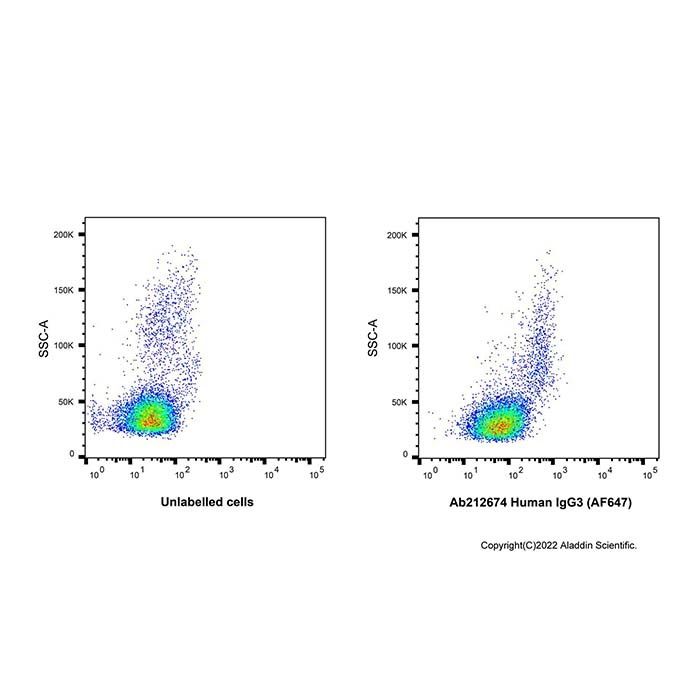
Human IgG3 (AF647) (Ab212674) - Flow Cytometry Human peripheral blood cells were stained with Human IgG3 (AF647) (Ab212674) (right panel) at 0.1μg/test for 1 hour at 4°C. Left panel - Unlabelled control, cells without incubation with primary antibody.
Human IgG3 (AF647) (Ab212674) - Flow Cytometry Human peripheral blood lymphocytes were stained with Human IgG3 (AF647) (Ab212674) (blue) at 0.1μg/test for 1 hour at 4°C. Black - Unlabelled control, cells without incubation with primary antibody.
Aplicação
Aplicação
Dilution info
Flow Cytometry
Use at an assay dependent concentration. Each lot of this antibody is quality control tested by flow cytometric analysis as negative control. Use at concentrations comparable to those of the speci
Dados avançados
Certificados(CoA,COO,BSE/TSE e Mapa de Análise)
C of A & Other Certificates(BSE/TSE, COO):
Analytical Chart:
Find and download the COA for your product by matching the lot number on the packaging.
Determine the necessary mass, volume, or concentration for preparing a solution.
Dilution Calculator
Determine the dilution needed to prepare a stock solution.
Reconstitution Calculator
Revisões
Avaliações dos Clientes
Application Protocols
Tested applications, recommended dilutions, and positive control tissues/cell lines for Ab212674 are Not specified for this item; refer to CoA/Spec Sheet.
General considerations (non-specific):
Always include appropriate controls (unstained, single-stained, isotype, and FMO as relevant).
Validate working dilution by titration in your assay matrix to achieve optimal signal-to-background.
Protect from light during all steps to preserve AF647 fluorescence.
For precise, product-backed protocols, consult the lot-specific datasheet or perform in-house optimization.
Biological Roles
Human IgG3 is a major subclass of immunoglobulin G involved in humoral immunity (literature). Key biological characteristics:
Effector potency: Among human IgG subclasses, IgG3 exhibits strong complement activation via C1q and high affinity for several Fcγ receptors, supporting potent ADCC and phagocytosis (literature).
Hinge architecture: IgG3’s extended, proline-rich hinge provides increased Fab flexibility, which can enhance antigen binding in some contexts but also affects serum half-life and susceptibility to proteolysis (literature).
Glycosylation: Conserved N-linked glycan at Asn297 in CH2 modulates Fc conformation and effector interactions; subclass- and donor-dependent heterogeneity influences function (literature).
Subclass prevalence: IgG1 and IgG3 often dominate responses to protein antigens and viral infections, with IgG3 elicited early in some immune responses (literature).
Relevance to this product: The AF647 label confers far-red fluorescence for detection; the dye does not impart biological activity per se but enables optical readout in cell-based and biochemical assays. No antigen specificity is provided in this listing, so the conjugate may function as an IgG3-class reagent where subclass matching is required (e.g., controls, assay calibration) depending on experimental design.
Note: All biological role details above are general literature context and not item-specific performance claims.
Buffer Applications
This is a fluorescent antibody reagent rather than a buffering agent. It is not used to establish or control pH. For best performance, select an assay-appropriate buffer system to maintain antibody stability and fluorescence.
General guidance (literature/practice):
Working buffers: 1× PBS or TBS, pH ~7.2–7.6, commonly used for staining and washing. Include protein-based blockers (e.g., BSA) and mild nonionic surfactants as needed to reduce background.
Fixation/permeabilization: If used in IF, ensure compatibility of fixatives (e.g., paraformaldehyde) and detergents (e.g., saponin, Triton X-100) with AF647 signal and epitope accessibility.
Item-specific buffer composition for this SKU is Not specified for this item; refer to CoA/Spec Sheet.
Green Alternatives
Environmental considerations for fluorescent antibodies focus on buffer composition, preservatives, and waste minimization rather than solvent replacement.
General sustainability guidance (literature/practice):
Minimize hazardous preservatives: Where biosafety allows, select formulations with lower azide concentrations or alternative biocides to reduce aquatic toxicity. This item’s preservative system is Not specified for this item; refer to CoA/Spec Sheet.
Reduce plastic and dye waste: Plan experiments to titrate precisely, prepare minimal working volumes, and pool wash steps to cut consumables and effluent.
Durable fluorophores: AF647 is a photostable far-red dye; higher stability can reduce repeat staining and reagent consumption compared with less stable dyes, lowering overall waste.
Aqueous-only workflows: Maintain fully aqueous buffers and avoid organic cosolvents/clearing agents where assay design permits.
Comparison (general):
AF647 vs. short-wavelength dyes: Far-red dyes often require lower laser power and provide improved signal-to-background, potentially reducing acquisition repeats.
Alternative near-IR dyes: Dyes excited >680 nm can further separate from autofluorescence but may require specialized detectors; tradeoffs include availability and panel compatibility.
Always dispose of dye-containing buffers as hazardous laboratory waste according to local regulations.
Pharmaceutical Uses
For research use only; not for diagnostic or therapeutic applications.
Process and analytical development: Fluorescent human IgG3 conjugates can serve as controls or tracers in flow cytometry–based cell line development, binding assays, or instrument qualification.
Reference materials: Useful as fluorescence and isotype standards for method development in regulated labs (e.g., establishing linearity, LOD/LOQ in bioanalytical assays). Any regulated use requires independent qualification.
Device and imaging validation: AF647’s far-red emission is suitable for testing red-laser channels on flow cytometers and microscopes, enabling spectral unmixing and compensation training.
No pharmacopeial status, excipient role, or cGMP suitability is provided for this SKU. Any application beyond basic research requires user-led risk assessment and method validation. Where specific compliance attributes are needed (endotoxin level, bioburden, residual free dye, buffer composition), they are Not specified for this item; refer to CoA/Spec Sheet.
Physical Properties
As a protein–dye conjugate, bulk physicochemical parameters depend on formulation and labeling ratio.
Item-specific properties:
Appearance: Not specified for this item; refer to CoA/Spec Sheet.
Concentration, buffer composition, excipients: Not specified for this item; refer to CoA/Spec Sheet.
Density, refractive index, pI, pH: Not specified for this item; refer to CoA/Spec Sheet.
General/literature values for context (not specifications):
IgG molecular mass: ~150–165 kDa depending on subclass and glycosylation; IgG3 tends toward the higher end due to the long hinge (literature).
Isoelectric point (human IgG): typically pI ~6–9 depending on sequence and glycoform (literature).
AF647 photophysics: excitation maximum ~650 nm; emission maximum ~665–668 nm; high quantum yield in aqueous buffer; photostable in the far-red region (literature).
Typical degree of labeling for functional antibodies: often ~2–5 dyes per IgG to balance brightness and binding (literature). Actual DOL for this item is not specified.
Solubility: IgGs are highly soluble in isotonic aqueous buffers (e.g., PBS) and precipitate under extreme pH, high ionic strength, or with strong dehydrating cosolvents (literature).
Notes on handling (general): AF647 is light-sensitive; minimize exposure to intense ambient light to preserve fluorescence. Protein conformation and fluorescence can be impacted by temperature, pH, chaotropes, and organic solvents.
Quality and Grades
Item grade: ExactAb™, Validated (as provided). Specific acceptance criteria for this SKU are not listed here; consult the CoA/Spec Sheet for lot-specific data.
What this generally implies (general information, not item-specific specifications):
ExactAb™: Denotes a defined antibody identity and format, typically with standardized manufacturing controls for concentration, conjugation chemistry, and consistent performance across lots.
Validated: Typically indicates verification of identity and functional performance using orthogonal methods (e.g., SDS-PAGE for integrity, UV/Vis for concentration and dye content, and application-specific checks such as signal-to-noise in immunofluorescence or flow cytometry). Exact validation methods for this item are not specified here.
Fluorophore considerations (literature/practice):
AF647 is a far-red dye with low nonspecific binding and strong photostability, suitable for multiplexing. Validation commonly includes determination of dye:protein ratio and absence of free dye.
What to check on the CoA for this SKU:
Identity (isotype, subclass: human IgG3), purity/integrity (monomer content), concentration (mg/mL), dye:protein ratio, buffer composition and preservatives, residual free dye, and performance notes.
Note: No item-specific acceptance values (e.g., DOL range, residual free dye limits, UV cutoff) are provided in this listing. Where a particular value is required, it is Not specified for this item; refer to CoA/Spec Sheet.
Reaction and Applications
AF647-labeled human IgG3 is used as a far-red fluorescent reagent in antibody-based detection workflows. While no application claims are specified for this SKU, the following are common research applications for AF647-conjugated IgGs (literature/general):
Immunofluorescence microscopy: Far-red emission minimizes cellular autofluorescence and enables multiplexing with blue/green/orange channels. Compatible with fixed or live-cell staining when buffer and temperature are optimized.
Flow cytometry: AF647 provides bright signal on conventional and spectral cytometers using red lasers (~633–640 nm), facilitating multicolor panels with limited spectral spillover into FITC/PE channels.
High-content imaging and immunoassays: Use in plate-based assays (e.g., cell-based ELISA variants) where far-red detection boosts signal-to-background.
Isotype control or standard: A human IgG3 conjugate can serve as a subclass-matched control for gating and background assessment when the antigen specificity is not required (if applicable to the experimental design).
Practical tips (general):
Optimize dilution empirically to balance brightness and background; start with literature-typical ranges for AF647 antibodies and titrate.
Minimize light exposure during incubation and washing.
Validate compensation/unnmixing using single-stained controls due to AF647’s spectral profile.
Note: This listing contains no item-specific tested applications or recommended dilutions; consult the product datasheet or perform assay-specific optimization.
Reaction Conditions
This product is applied in bioassays rather than chemical synthesis. General, literature-based guidance for using AF647-conjugated antibodies is provided below (not item-specific specifications):
Immunofluorescence (IF): Perform staining in PBS/TBS with appropriate blocking (e.g., 1–5% BSA/serum). Incubate antibody at the empirically determined dilution for 30–60 min at room temperature or overnight at 4°C. Protect from light throughout. Wash thoroughly to minimize background.
Flow cytometry: Stain cells on ice or at 4°C (to limit internalization) or at RT as protocol dictates, in protein-containing buffer (e.g., PBS + 0.5–1% BSA + 0.1% sodium azide if compatible). Include Fc blocking where relevant. Excite with a red laser (~633–640 nm); collect emission ~660–700 nm. Use single-color controls for compensation/spectral unmixing.
Fixed samples: Confirm that fixation/permeabilization conditions preserve epitope and AF647 signal (paraformaldehyde generally compatible; methanol may reduce signal for some targets).
Mounting media: Choose antifade media compatible with far-red dyes; avoid components that increase background in the red channel.
None of the above constitutes validated conditions for this SKU. Recommended dilutions, buffers, and incubation conditions for Ab212674 are Not specified for this item; refer to CoA/Spec Sheet or optimize empirically.
Safety and Handling
Research use only. Follow institutional biosafety and chemical hygiene practices.
GHS/SDS information for this specific item:
Signal word: Not specified for this item; refer to SDS.
Hazard statements, pictograms, classification: Not specified for this item; refer to SDS.
General guidance (literature/practice):
Personal protective equipment: lab coat, nitrile gloves, safety glasses. Use in a clean area suitable for biological reagents.
Light sensitivity: Protect the AF647 conjugate from light at all times (use amber tubes/foil wrap) to prevent photobleaching.
Temperature excursions: Avoid freezing unless explicitly permitted on the CoA; freeze–thaw can cause aggregation and loss of activity/fluorescence. Product data state: store at 2–8°C, do not freeze.
Incompatibilities: Avoid strong oxidants or reducing agents, extreme pH (<5 or >9), and high percentages of organic solvents that may denature protein or quench fluorescence (literature).
Microbial contamination: Work aseptically when opening/aliquoting to preserve product integrity.
First aid (general): On contact with skin or eyes, rinse with water. If inhaled as aerosol, move to fresh air. If ingested, rinse mouth and seek medical attention as per SDS.
Waste: Dispose of antibody and dye-containing solutions as laboratory chemical/biological waste per local regulations. Always consult the product-specific SDS for authoritative hazard and response information.
Solvent Selection
This conjugate is intended for use in aqueous buffers. Organic solvents are generally unsuitable as primary diluents for functional antibodies.
General recommendations (literature/practice):
Preferred buffers: PBS or TBS at physiological ionic strength (e.g., 1× PBS, pH ~7.2–7.6). Add protein stabilizers only if compatible with your assay.
Avoid: High concentrations of alcohols, acetone, acetonitrile, or DMSO; strong acids/bases; or detergents that may denature IgG or affect AF647 fluorescence.
Blocking/diluent additives: For many immunoassays, 0.1–1% BSA or serum and 0.05% nonionic surfactants (e.g., Tween 20) can reduce nonspecific binding (optimize per assay). Verify compatibility with your detection system.
Light protection: Use amber vials or foil-wrapped tubes during preparation and storage to protect AF647.
Comparison (general):
PBS vs. carbonate buffer: PBS better preserves structure for routine staining; carbonate (pH ~9–9.5) is commonly used for conjugation, not routine use.
HEPES-based buffers: Useful where phosphate interferes (e.g., calcium-sensitive systems); ensure pH ~7.2–7.5 for stability.
For this specific SKU, the supplied buffer/excipient system is Not specified for this item; refer to CoA/Spec Sheet for exact formulation and compatible diluents.
Storage and Reconstitution
Storage temperature (provided): Store at 2–8°C.
Light protection (provided): Protect from light.
Freezing (provided): Do not freeze.
Shipping (provided): Shipped on wet ice; do not freeze during transit.
Additional guidance (general/literature):
Aliquoting: If frequent use is anticipated, prepare working aliquots under aseptic conditions to minimize contamination and repeated temperature cycling. Maintain light protection (amber vials/foil).
Handling: Equilibrate to working temperature on ice or at 4°C before opening to reduce condensation. Mix gently; avoid vortexing to prevent aggregation/foaming.
Reconstitution: The physical state (liquid vs. lyophilized) and any reconstitution instructions are Not specified for this item; refer to CoA/Spec Sheet. If lyophilized, reconstitute with the recommended buffer to the stated concentration; avoid low-ionic-strength or extreme pH solutions.
Stability: Observe the indicated shelf life and any post-opening stability guidance on the datasheet. Discard if turbidity, precipitation, or unexpected color changes occur.
Note: For long-term storage strategies, follow the exact buffer/excipient and preservative details provided on the CoA. Where such details are required, they are Not specified for this item; refer to CoA/Spec Sheet.
Structure and Identity
Human IgG3 (AF647) is a fluorescently labeled human immunoglobulin G subclass 3 antibody. As a biomacromolecule, it consists of two γ3 heavy chains and two κ or λ light chains linked by disulfide bonds, forming the canonical Y-shaped IgG architecture with an extended hinge characteristic of IgG3 (literature). The AF647 fluorophore is typically attached via amide linkages to accessible lysine ε-amines on the antibody surface (literature), producing a conjugate suitable for fluorescence-based detection.
Item-specific identifiers:
Molecular formula: Not specified for this item; refer to CoA/Spec Sheet.
Molecular weight: Not specified for this item; refer to CoA/Spec Sheet.
SMILES: Not specified for this item; refer to CoA/Spec Sheet.
InChIKey: Not specified for this item; refer to CoA/Spec Sheet.
General structural features (literature):
IgG3 features a long, proline-rich hinge with multiple inter-heavy-chain disulfides, enhancing Fc flexibility and effector engagement.
Two Fab arms provide antigen-binding via variable domains; the Fc region engages complement (C1q) and Fcγ receptors.
AF647 (a far-red sulfonated dye) is covalently linked; the degree of labeling (DOL) is typically controlled during manufacturing but is not specified here.
2D description in words (literature): A central Fc stem formed by paired γ3 heavy-chain constant domains (CH2–CH3) bearing the N-glycan at Asn297, branching into two Fab arms (VH–VL–CH1–CL) connected through an extended hinge; multiple lysine residues across constant/variable domains serve as common dye attachment sites.
Synthetic Utility
As a finished antibody–dye conjugate, this product is not a synthetic building block. However, understanding its bioconjugation chemistry can be valuable for method development (general/literature):
Conjugation framework: AF647 is commonly introduced via NHS ester chemistry, forming stable amide bonds to solvent-accessible lysine ε-amines on IgG3. Alternative strategies include click chemistry (azide–alkyne, tetrazine–TCO) when site-specificity is desired.
Degree of labeling (DOL): Optimized DOL (often ~2–5 dyes/IgG, literature) balances brightness with antigen-binding retention. Excessive labeling can impair affinity or increase nonspecific binding via hydrophobic patches.
Site-specific approaches: Enzymatic tagging (e.g., sortase, transglutaminase), engineered cysteines, or glycan remodeling (GalT-based) can yield more uniform conjugates with improved performance.
Purification: Post-conjugation cleanup typically employs desalting or size-exclusion chromatography to remove free dye, verified by UV/Vis spectral deconvolution.
Stability considerations: Buffer pH ~7–7.5, isotonic salts, and light protection preserve AF647 fluorescence and IgG structure; avoid reducing agents that could affect disulfides or certain linkers.
Note: The specific chemistry and DOL used for this SKU are Not specified for this item; refer to CoA/Spec Sheet.
Target Specificity
Antigen/target details for Ab212674 are Not specified for this item; refer to CoA/Spec Sheet.
General notes (not item-specific claims):
The name "Human IgG3 (AF647)" identifies the subclass and fluorophore. Without an antigen description, the reagent may represent a human IgG3-format antibody or isotype control. Do not assume specificity to any antigen without explicit documentation.
For critical applications, confirm antigen, clonality, and epitope mapping with the manufacturer’s datasheet or by in-house validation.
Perguntas frequentes
What does ExactAb? mean?
ExactAb? indicates the product has been validated for use in rigorous antibody validation workflows. Validation may include positive/negative control samples, signal-to-noise testing, and protocol-specific QC. Lot-specific test data is published on the Certificate of Analysis where available.
What does Validated mean?
Validated indicates the product has been validated for use in rigorous antibody validation workflows. Validation may include positive/negative control samples, signal-to-noise testing, and protocol-specific QC. Lot-specific test data is published on the Certificate of Analysis where available.
How should this product be stored?
Store at 2–8 °C, protected from light. Do not freeze. Freezing may cause irreversible damage to this material.
How is this product shipped?
This product ships chilled on wet ice. Unpack on arrival and transfer it to the storage condition stated above.
What documentation is provided?
Available product documentation, including Certificates of Analysis (COA), Safety Data Sheets (SDS), and specification sheets, is shown in the product document area. Document availability and access follow the current site policy.
Which species reactivity has this antibody been validated against?
Validated reactivity is listed on the PDP and on each lot's datasheet. We validate against the most commonly tested species for the target (Human IgG3 (AF647)); cross-reactivity in untested species may exist but is not guaranteed. Contact technical support for specific species inquiries.
Precisa de ajuda para escolher o grau?
O nosso guia de seleção de graus abrange pureza, estado do estabilizador e adequação à aplicação para todas as variantes do nosso catálogo.
Usamos cookies para garantir o funcionamento adequado do site e, quando permitido, para melhorar a sua experiência. Você pode gerenciar suas preferências a qualquer momento nas Configurações. Saiba mais em nossa Política de Cookies.
Deseja que lhe enviemos uma mensagem quando tivermos descontos disponíveis?
Lembrar-me mais tarde
Obrigado! Por favor, verifique a sua caixa de entrada de e-mail para confirmar.
Products are supplied to verified businesses, institutions, and qualified professionals for research and development use only. Not for use in humans, animals, diagnosis, or therapy.

 ZJ25F0217991