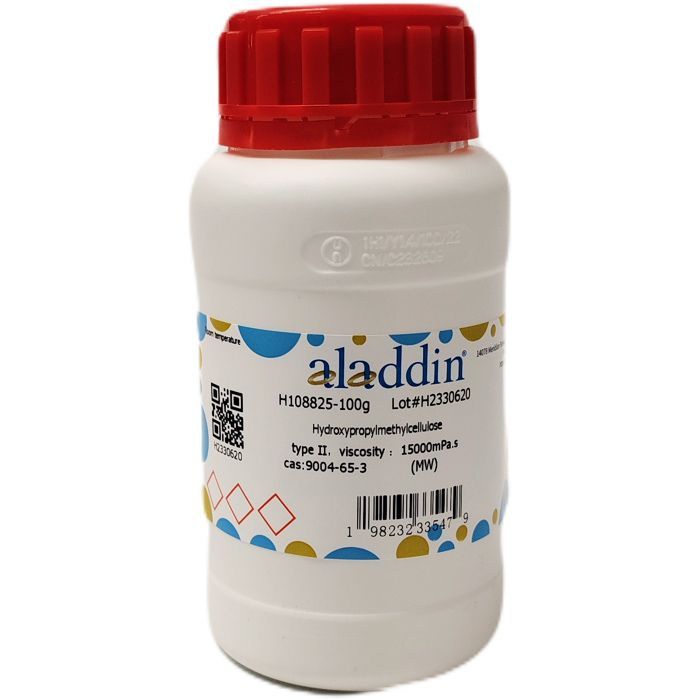
Hydroxypropylmethylcellulose - Substitution type 2208, viscosity: 15000mPa. s, methoxy group: 19-24%; Hydroxypropyl group: 4.0-12% , CAS No.9004-65-3

CAS: 9004-65-3 Cat. No.: H108825 Número CE: 618-389-6 PubChem CID: 206257985
Disponível para encomenda
GRAU & PUREZA Substitution type 2208, viscosity: 15000mPa. s, methoxy group: 19-24%; Hydroxypropyl group: 4.0-12%
Synonyms
HPMC MHPC Hydroxypropyl Methyl Cellulose
Storage
Room temperature
Shipped In
Normal
★
Tamanho
Alemanha (EU)
USA*
Preço
Qtd
25g
H108825-25g
—
1 Em stock
8,59€
100g
H108825-100g
—
2 Em stock
17,27€
500g
H108825-500g
5 Em stock
Em stock ≥10
55,45€
Enter a quantity for the sizes you want to add.
🧪
Por que este grau

Substitution type 2208, viscosity: 15000mPa. s, methoxy group: 19-24%; Hydroxypropyl group: 4.0-12% para fluxos de trabalho cromatográficos e analíticos sensíveis que exigem interferência mínima da linha de base.

🌡

Armazenamento e envio

Room temperature Envio Normal. Consulte o COA específico do lote para obter as especificações exatas.

📋

Documentos de qualidade

SDS, COA, ficha técnica e folha de especificações disponíveis para download. COA específico do lote acessível por meio de pesquisa por número de lote.

📚

Comprovação documental

Citado em 256 publicações revisadas por pares nas áreas de cromatografia, síntese orgânica e reações de acoplamento cruzado.

Especificações

Sinónimos
HPMC MHPC Hydroxypropyl Methyl Cellulose
Especificações e pureza
Substitution type 2208, viscosity: 15000mPa. s, methoxy group: 19-24%; Hydroxypropyl group: 4.0-12%
Condições de armazenamento de armazenamento
Room temperature
Enviado em
Normal
Nomes e identificadores
Pubchem Sid
WGK Alemanha
1
PubChem CID
206257985

Documentação

📋 Ficha de dados de segurança (FDS)

Documento abrangente sobre perigos, manuseamento, armazenamento e conformidade regulamentar.

<<<<<<< HEAD Baixar SDS → ======= Baixar SDS → >>>>>>> release248-p3

✅ Certificado de análise (COA)

Dados de qualidade específicos do lote. Introduza o número de lote para obter o COA exato.

Consultar COA →

📊 Ficha técnica

Resumo de referência rápida das especificações e aplicações do produto.

Ver ficha técnica →

🔬 Folha de especificações

Atributos de qualidade completos e critérios de aceitação para este grau.

Ver folha de especificações →

Dados avançados

Certificados(CoA,COO,BSE/TSE e Mapa de Análise)
C of A & Other Certificates(BSE/TSE, COO):
Analytical Chart:

Find and download the COA for your product by matching the lot number on the packaging.

26 results found

Lot NumberCertificate TypeDataItem
I2617793I2617793Certificate of AnalysisSep 11, 2026 H108825
I2617792I2617792Certificate of AnalysisSep 11, 2026 H108825
I2617791I2617791Certificate of AnalysisSep 11, 2026 H108825
I2617790I2617790Certificate of AnalysisSep 11, 2026 H108825
C2620351C2620351Certificate of AnalysisMar 13, 2026 H108825
C2620353C2620353Certificate of AnalysisMar 13, 2026 H108825
C2620354C2620354Certificate of AnalysisMar 13, 2026 H108825
C2620355C2620355Certificate of AnalysisMar 13, 2026 H108825
E2619030E2619030Certificate of AnalysisMar 13, 2026 H108825
K2519014K2519014Certificate of AnalysisNov 07, 2025 H108825
K2514612K2514612Certificate of AnalysisNov 07, 2025 H108825
K2514610K2514610Certificate of AnalysisNov 07, 2025 H108825
K2514609K2514609Certificate of AnalysisNov 07, 2025 H108825
D2417308D2417308Certificate of AnalysisMar 12, 2024 H108825
H2330590H2330590Certificate of AnalysisAug 07, 2023 H108825
K2406173K2406173Certificate of AnalysisAug 07, 2023 H108825
I2523032I2523032Certificate of AnalysisAug 07, 2023 H108825
H2330620H2330620Certificate of AnalysisAug 07, 2023 H108825
H2330591H2330591Certificate of AnalysisAug 07, 2023 H108825
G2510047G2510047Certificate of AnalysisAug 07, 2023 H108825
D2517699D2517699Certificate of AnalysisAug 07, 2023 H108825
B2507199B2507199Certificate of AnalysisAug 07, 2023 H108825
A2218483A2218483Certificate of AnalysisJan 03, 2022 H108825
B2306823B2306823Certificate of AnalysisJan 03, 2022 H108825
A2218550A2218550Certificate of AnalysisJan 03, 2022 H108825
A2218528A2218528Certificate of AnalysisJan 03, 2022 H108825
FAQs e artigos
A Practical Guide to Fragrance Compositions: Turning a Black-Box Formula into an Engineerable System—Compatibility, Stability, Controlled Release, Traceability, and Selection
Microcrystalline Cellulose (MCC): A Comprehensive Primer and Selection Guide—Structural Features, Key Performance Metrics, and Application Scenarios
Understanding Hydrophilic Polymers in Aqueous Systems: Hydration Mechanisms, Structural Knobs, and Task-Oriented Selection Guide (Including Tables 1–3)
Biomedical Polymer Insights: Role-Based Task Map, Six Key Material Levers, and a Risk-Driven Evidence Chain (including the Product Navigation Guide and Product Tables 1–3)
Functional Framework of Starch Metabolism-Related Enzymes in Food Science Research and Mechanistic Analysis of Quality Regulation
Injectable Thermosensitive Gels: Gelation Behavior, Rheological Properties, and Drug Release Characteristics
Waterborne Resin Technology Explained: Waterborne Forms, Performance Balance, and a Technology Map
Waterborne Resin Application Guide: Formulation Synergy, Troubleshooting, and Technology Development Trends
Why LABSA (Sulfonic Acid) Is Commonly Used in Household Cleaning Formulations: Neutralization Mechanism, Detergency Action, and Formulation Application Points
From Structure to Performance: Conditioning, Film-Forming, Thickening, and Chelating Applications of Functional Ingredients in Personal Care and Home Care
From Structure to Rheology: How Carbomer Forms Gel Structures and Enables Thickening, Suspension, and Auxiliary Emulsion Stabilization
Thickening, Suspension, Auxiliary Stabilization, and Agglomeration Mechanisms of Xanthan Gum in Personal Care Formulations: From Molecular Structure to Processing Applications
From Structure to Rheology: Thickening, Stabilization, and Selection Logic of Cellulose Ethers for Personal Care Applications
Structure, Properties, and Mechanisms of Powdered Fragrances and Fragrance Delivery Materials: Stability, Release Mechanisms, and Selection Logic
Analysis of the Production Process of Hydroxypropyl Methylcellulose (HPMC) for Putty: Understanding Differences in Substitution Structure and Gelation Temperature from High-Ratio and Low-Ratio Formulations
Why Are Daily Chemical Products Prone to Viscosity Thinning in Summer? Core Mechanisms, Troubleshooting Methods, and Solutions
Types, Mechanisms of Action, Key Quality Indicators, and Selection and Application of Common Cellulose Ethers in Wall Putty
Influencing Factors and Control Strategies for Blistering in Neutral Wall Putty: An Experimental Analysis Based on HPMC Dosage, Viscosity, and Ground Calcium Carbonate Fineness
How to Select Binding/Gel Materials for Neutral Wall Putty? A Comparison of Pregelatinized Starch, PVA, and Redispersible Polymer Powder Based on Four Application Trials
Causes and Mechanism Analysis of Delamination During Sanding of Water-Resistant Putty
What Are the Differences Between Polyvinyl Alcohol 1788, 2488, and 2699? Understanding Workability, Bonding Strength, and Relative Water Resistance from the Perspective of Degree of Polymerization and Degree of Hydrolysis
Why Do Rust Spots Appear on Neutral Wall Putty? Iron Sources, Moisture Migration, Oxidative Color Development, and Prevention Measures
Common Problems and Formulation Adjustment Strategies for Neutral Putty Under High Summer Temperatures
Differences and Application Selection of Cassava- and Corn-Based Pregelatinized Starch in Neutral Putty Formulations
The Role, Selection, Cracking Risk Analysis, and Dosage Control of Bentonite in Neutral Putty
What Is Direct Compression? Process Characteristics, Suitability Criteria, and Excipient Selection
Niacinamide Brightening Mechanisms and Formulation Design: Melanosome Transfer, pH Regulation, and Combination Strategies
Citations of This Product
Calculadoras de soluções
Revisões

Avaliações dos Clientes

Produtos Relacionados

Hydroxypropylmethylcellulose(HPMC) - Substitution type 2208, viscosity: 4000mPa. s, methoxy group: 19-24%; Hydroxypropyl group: 4.0-12% , CAS No.9004-65-3
Hydroxypropylmethylcellulose - type I,viscosity :100mPa.s , CAS No.9004-65-3
Hydroxypropylmethylcellulose - Type I, viscosity: 400mPa. s , CAS No.9004-65-3
Hydroxypropylmethylcellulose - 30mPa.s, Methoxy group: 28-30%; Hydroxypropyl group: 7.5-12% , CAS No.9004-65-3
Hydroxypropylmethylcellulose - type II,viscosity :100mPa.s , CAS No.9004-65-3
Hydroxypropylmethylcellulose - Substitution type 2208, viscosity: 100000mPa. s, methoxy group: 19-24%; Hydroxypropyl group: 4.0-12% , CAS No.9004-65-3
Hydroxypropylmethylcellulose - USP2910,2%viscosity :15mPa.s,methoxyl:28-30%;hydroxyl:7.0-12% , CAS No.9004-65-3
(Hydroxypropyl)methyl cellulose (HPMC) - USP2910,2%viscosity :50mPa.s,methoxyl:28-30%;hydroxyl:7.0-12% , CAS No.9004-65-3
Hydroxypropylmethylcellulose - USP2910,2%viscosity :3mPa.s,methoxyl:28-30%;hydroxyl:7.0-12% , CAS No.9004-65-3
Hydroxypropylmethylcellulose - Type II, viscosity: 400mPa. s , CAS No.9004-65-3
Hydroxypropylmethylcellulose - Substituted Type 2910, Viscosity: 4000 mPa·s, Methoxy: 28-30%; Hydroxypropyl: 7.0-12% , CAS No.9004-65-3
Hydroxypropyl methyl cellulose(HPMC) - 2%viscosity :6mPa.s,methoxyl:28-30%;hydroxyl:7.0-12% , CAS No.9004-65-3
(Hydroxypropyl)methyl cellulose(HPMC) - average Mn ~10,000 , CAS No.9004-65-3
Hydroxypropylmethylcellulose(HPMC) - average Mn ~90,000 , CAS No.9004-65-3
Hydroxypropylmethylcellulose(HPMC) - average Mn ~120,000 , CAS No.9004-65-3
(Hydroxypropyl)methyl cellulose(HPMC) - average Mn ~86,000 , CAS No.9004-65-3

Deseja que lhe enviemos uma mensagem quando tivermos descontos disponíveis?

Lembrar-me mais tarde

Obrigado! Por favor, verifique a sua caixa de entrada de e-mail para confirmar.

Ops! As notificações estão desativadas.