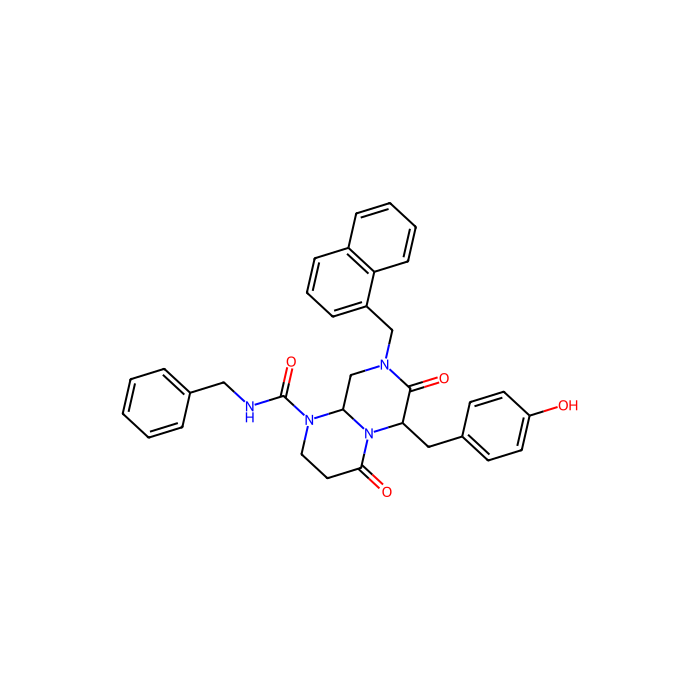
10mM in DMSO for sensitive chromatographic and analytical workflows requiring minimal baseline interference.
🌡
Storage & shipping
Store at -80°C Ships Dry ice packs + Cold packs Check lot-specific COA for exact specifications.
📋
Quality documents
SDS, COA, datasheet, and spec sheet available for download. Lot-specific COA accessible via lot number lookup.
📚
Literature proof
Cited in 1 peer-reviewed publications across chromatography, organic synthesis, and cross-coupling reactions.
Visão geral
Information
ICG-001 ICG-001 antagonizes Wnt/β-catenin /TCF-mediated transcription and specifically binds to CREB-binding protein (CBP) with IC50 of 3 μM, but is not the related transcriptional coactivator p300. ICG-001 induces apoptosis . In vitro
ICG-001 has no effect on the related reporter construct, FOPFLASH, which contains mutated TCF sites. After treatment with 25μM of ICG-001 for 8 hours, SW480 cell reduces the steady-state levels of Survivin and Cyclin D1 RNA and protein, both of which can be up-regulated by β-catenin. ICG-001 selectively induces apoptosis in transformed cells but not in normal colon cells, reduces in vitro growth of colon carcinoma cells. ICG-001, can phenotypically rescue normal nerve growth factor (NGF) -induced neuronal differentiation and neurite outgrowth in the presenilin-1 mutant cells, emphasizing the importance of the TCF/β-catenin signaling pathway on neurite outgrowth and neuronal differentiation. A recent study demonstrates that 5μM ICG-001 inhibits leptin-induced EMT, invasion and tumorsphere formation in MCF7 cells.
In vivo
Administration of a water-soluble analog of ICG-001 for 9 weeks reduces the formation of colon and small intestinal polyps by 42% as effectively as the nonsteroidal antiinflammatory agent Sulindac, which has consistently demonstrated efficacy in this model. No overt toxicity is detected throughout the course of treatment. In the SW620 nude mouse xenograft model of tumor regression, 150 mg/kg, i.v. of analog demonstrates a dramatic reduction in tumor volume over the 19-day course of treatment, with no mortality or weight loss. ICG-001 (5 mg/kg per day) significantly inhibits beta-catenin signaling and attenuates bleomycin-induced lung fibrosis in mice, while concurrently preserving the epithelium. Cell Data
cell lines:wt-p53 cancer cell lines (SJSA1, RKO, HCT116)
ICG-001 antagonizes Wnt/β-catenin/TCF-mediated transcription and specifically binds to CREB-binding protein (CBP) with IC50 of 3 μM, but is not the related transcriptional coactivator p300. ICG-001 induces apoptosis.
Condições de armazenamento de armazenamento
Store at -80°C
Enviado em
Dry ice packs + Cold packs
Este produto requer transporte de cadeia fria. Serviços terrestres e outros serviços econômicos não estão disponíveis.
Determine the necessary mass, volume, or concentration for preparing a solution.
Dilution Calculator
Determine the dilution needed to prepare a stock solution.
Reconstitution Calculator
Revisões
Avaliações dos Clientes
Application Protocols
No vendor-validated application protocols are provided for this item. The following general workflows apply to bioactive small-molecule probes in cell-based or biochemical assays.
General cell-based assay workflow:
Prepare a sterile-filtered DMSO stock at a validated concentration.
Plate cells and allow to adhere/equilibrate per cell line requirements.
Treat with serial dilutions maintaining constant final DMSO across wells (e.g., ≤0.1–0.5% v/v; verify tolerance).
Incubate for defined time points (e.g., 2–72 h depending on readout).
Measure primary endpoints (reporter activity, target protein levels, phenotype) and include vehicle controls and cytotoxicity counterscreens.
Biochemical assay workflow:
Prepare working solutions in assay buffer with minimal DMSO.
Preincubate compound with target or add concurrently depending on mechanism.
Record dose–response and calculate IC50/EC50 with appropriate curve-fitting models.
Documentation:
Record lot number, stock concentration, solvent, dilution scheme, and exact incubation conditions for reproducibility.
Biological Roles
ICG‑001 is widely referenced in the literature as a bioactive small molecule used to interrogate cell signaling pathways in research settings. Specific biological targets or mechanisms are not provided in this product entry and should be confirmed from primary literature and the CoA/SDS for your records.
General guidance for use as a research probe (no medical/clinical claims):
Enables perturbation of intracellular signaling, facilitating studies of transcriptional programs, differentiation status, and pathway crosstalk in cultured cells or biochemical systems.
Common experimental contexts include reporter assays, gene expression profiling (qPCR/RNA‑seq) after short-term exposure, and phenotypic screens to map pathway dependencies.
Off-target assessment: Employ counterscreens and inactive analog controls where available. Consider CRISPR/siRNA genetic validation to corroborate chemical probe findings.
Experimental considerations:
Determine non-cytotoxic concentration ranges using viability assays (e.g., resazurin, CellTiter‑Glo) in parallel with primary readouts.
Time dependence: Capture both early transcriptional events (2–6 h) and downstream phenotypes (24–72 h) to resolve primary vs. secondary effects.
Note: This product is for research use only and is not intended for human or veterinary applications.
Buffer Applications
This item is a bioactive small-molecule probe and is not itself a buffering agent. It does not participate in defined buffer systems.
Practical notes for preparing assay buffers with small-molecule stocks:
Prepare a concentrated DMSO stock, then dilute into pre-warmed assay buffer (e.g., HBSS, DPBS, culture medium) with vigorous mixing to avoid precipitation.
Maintain consistent final vehicle percentage across treatments and controls. Typical assay tolerances are ≤0.1–0.5% DMSO (literature guidance), but verify for your system.
If precipitation occurs, consider gentle warming, slower addition, or minimal non-ionic surfactant (0.01–0.05%), ensuring compatibility with the assay.
Green Alternatives
Green chemistry considerations are generally more applicable to bulk solvents and reagents than to specialized screening probes used at micromolar quantities. For handling ICG‑001-like probes, consider the following to reduce environmental impact:
Solvent minimization: Use the smallest feasible DMSO stock volume at the highest validated concentration to reduce solvent waste.
Aqueous compatibility: Where assay performance permits, keep final DMSO ≤0.1% v/v and maximize aqueous buffer content to reduce organic solvent usage.
Alternative vehicles: Cyclodextrin formulations or minimal amounts of biocompatible co-solvents (e.g., PEG400) can sometimes aid aqueous delivery; validate for assay interference.
Trade-offs (general):
DMSO alternatives may reduce environmental burden but can introduce assay artifacts or reduce compound stability/solubility. Always verify with vehicle controls and stability checks.
Waste handling:
Collect DMSO/organic waste in appropriate halogen-free waste streams. Decontaminate glassware with minimal solvent and follow institutional green lab guidelines.
Pharmaceutical Uses
This product is supplied strictly for research use and is not formulated or approved for pharmaceutical, diagnostic, or clinical applications.
Regulatory status: Research Use Only (RUO). Not intended for human or veterinary use.
Excipient/formulation role: Not applicable; this is not an approved excipient and is not supplied under GMP.
Process development: If used in preclinical discovery biology, maintain thorough documentation of lot identity, purity, and stability; replicate findings with independent lots or orthogonal probes where possible.
For any translational or manufacturing contexts, obtain appropriate regulatory-grade materials and follow applicable pharmacopeial and GMP guidance. No pharmacopeial monograph is available for this item (as per product data provided).
Physical Properties
Item-specific physicochemical specifications have not been provided for this listing. When planning experiments, consult the CoA/Spec Sheet for definitive values.
Appearance: Not specified for this item; refer to CoA/Spec Sheet.
Molecular weight: Not specified for this item; refer to CoA/Spec Sheet.
Melting point: Not specified for this item; refer to CoA/Spec Sheet.
Boiling point: Not typically applicable for a high-melting organic solid used as a screening probe.
Density: Not specified for this item; refer to CoA/Spec Sheet.
Refractive index: Not applicable to solids.
Aqueous solubility: Not specified for this item; refer to CoA/Spec Sheet.
Organic solubility: Not specified for this item; refer to CoA/Spec Sheet.
logP/logD: Not specified for this item; refer to CoA/Spec Sheet.
pKa: Not specified for this item; refer to CoA/Spec Sheet.
General laboratory guidance (literature/experience for small-molecule probes):
Many hydrophobic bioactive probes show good solubility in DMSO and limited solubility in water or alcohols; prepare concentrated DMSO stocks and dilute into assay buffers last.
To minimize precipitation upon dilution into aqueous media, warm gently (room temp), add DMSO stock slowly with mixing, and keep final DMSO ≤0.1–0.5% v/v as compatible with your assay.
Quality and Grades
Grade/Purity: Not specified for this item; refer to CoA/Spec Sheet. In the absence of a declared analytical grade, end-users should verify identity and purity (e.g., HPLC, LC–MS, NMR) as appropriate for sensitive biological assays.
What grade typically implies (general guidance):
Bioactive screening compounds are commonly supplied at high chemical purity with low residual solvents and verified identity (NMR/MS). UV absorbance and counter‑ion content may influence bioassay background; consult CoA.
If HPLC or LC–MS purity is reported on the CoA, this reflects the main-peak area percent under specific conditions and is not directly interchangeable between methods.
Stabilizers/antioxidants:
Stabilizers used/not used: Not specified for this item; refer to CoA/Spec Sheet. If no stabilizer is present, minimize repeated thaw/warm cycles and exposure to air/light to reduce degradation.
Batch-specific documentation:
Request CoA/Spec Sheet for the exact batch to obtain assay method, chromatographic conditions, residual solvent profile, water content, and identity confirmation.
Reaction and Applications
This product is supplied as a bioactive small-molecule screening compound rather than a synthetic reagent. It is not typically employed as a solvent, catalyst, or building block in preparative organic synthesis.
Research usage (general for probe molecules):
Employed as a chemical probe in cell-based and biochemical assays to study signaling pathway modulation, transcriptional responses, and phenotypic outcomes. Users should define concentration ranges empirically and include appropriate DMSO vehicle controls.
Often integrated into high-content imaging, reporter gene assays, and target engagement studies (e.g., thermal shift or CETSA-like approaches) to validate on-target effects.
Assay design tips (general):
Establish concentration–response curves across ≥8–10 half-log dilutions; include cytotoxicity counterscreens where applicable.
Verify probe integrity by LC–MS at study end if assays span multiple days.
Consider orthogonal readouts (reporter vs. qPCR/protein levels) to strengthen mechanistic conclusions.
Note: No manufacturer application notes were provided for this item; adapt standard probe evaluation workflows accordingly.
Reaction Conditions
Not typically applicable. This product is intended as a bioactive small-molecule probe rather than a reagent for chemical transformations.
General laboratory handling for solution preparation (research use):
Solvent: DMSO is commonly used to prepare concentrated stock solutions; verify solubility empirically.
Concentration: Establish a stock concentration that is fully soluble and stable for your workflow (e.g., 10–50 mM as a general range in literature for similar probes), then perform serial dilutions into assay media.
Temperature/light: Prepare and handle at room temperature in low light if the compound is light sensitive (not specified for this item; consult SDS/CoA).
Stability checks: Assess stability by LC–MS following storage or extended assay timelines; discard solutions showing degradation or precipitation.
These are general practices for small-molecule assay preparation, not reaction conditions for synthetic chemistry.
Safety and Handling
GHS classification and hazard statements are not provided for this item. Always review the SDS for authoritative safety data before use.
GHS/Signal word/H-statements/Pictograms: Not specified for this item; refer to SDS.
General hazards (good laboratory practice): Treat as a laboratory chemical of unknown toxicity. Avoid inhalation of dust, ingestion, and skin/eye contact.
PPE: Lab coat, safety glasses, and appropriate chemically resistant gloves (e.g., nitrile). Use a certified chemical fume hood for weighing and solution prep.
Storage: Store at −80°C (per product data). Protect from moisture and light. Keep container tightly closed.
Incompatibilities (general): Strong oxidizers and strong acids/bases may degrade organic small molecules; avoid prolonged exposure to reactive atmospheres. Use anhydrous solvents for stock solutions if hydrolysis is a concern.
First aid overview (general): If on skin/eyes, rinse with water for ≥15 min; if inhaled, move to fresh air; if ingested, seek medical attention. Provide SDS to responders.
Spill response: Avoid dust generation; collect with inert absorbent under fume hood and dispose per institutional and local regulations.
Note: Information above is general guidance for small-molecule research chemicals and does not replace the SDS.
Solvent Selection
Item-specific solubility is not provided. The following are general best practices for hydrophobic bioactive small molecules like ICG‑001 in assay workflows.
Primary stock solvent: Dimethyl sulfoxide (DMSO) is typically preferred for high-concentration stocks (e.g., 10–50 mM), due to broad solvency and compatibility with many cell-based and biochemical assays. Confirm solubility experimentally.
Secondary solvents/co-solvents: DMF and ethanol can sometimes be used, but may affect assay readouts more than DMSO. Verify vehicle controls.
Aqueous buffers: Direct dissolution into water/DPBS is often poor; instead, prepare a DMSO stock and perform serial dilutions into pre-warmed buffer with vigorous mixing. Maintain final DMSO below the assay’s tolerated level (commonly ≤0.1–0.5% v/v; literature guidance).
Light and oxygen: If the compound is light- or air-sensitive (not specified), use amber vials, degassed solvents, and minimize headspace.
Quick comparison (general):
DMSO: Highest solvency; widely tolerated in assays.
Ethanol: Moderate solvency; more cytotoxic at comparable v/v than DMSO.
Aqueous buffer with surfactant (e.g., 0.01–0.05% Tween-20): Can mitigate precipitation upon dilution but may impact certain readouts; validate compatibility.
Storage and Reconstitution
Storage conditions (as supplied): Store at −80°C (per product data). Keep tightly closed in original container. Protect from moisture and light.
Shipping: Shipped on dry ice packs + cold packs to maintain low temperature during transit.
Reconstitution solvent: Not specified for this item; common practice for small-molecule probes is to use anhydrous DMSO for stock solutions. Verify solubility empirically and consult the CoA for any specific recommendations.
Stock solution preparation (general): Allow vial to equilibrate to room temperature in a desiccated environment before opening to prevent condensation. Weigh quickly and dissolve in dry DMSO to a convenient high concentration. Mix thoroughly until fully dissolved; sterile-filter if using in cell culture.
Aliquoting: Divide stock into single-use aliquots in solvent-compatible, low-bind tubes to minimize freeze–thaw cycles and adsorption losses.
Storage of solutions: Store DMSO stocks at −20 to −80°C in amber vials to limit photodegradation; avoid repeated freeze–thaw. Discard if precipitation, discoloration, or degradation (by LC–MS) is observed.
Stability: Not specified for this item; refer to CoA/Spec Sheet and verify experimentally under your conditions.
Research Use Only: For research use only; not for human or veterinary use.
Structure and Identity
This product is supplied as the bioactive small-molecule screening compound ICG-001 (SKU: I409283), intended for research use in chemical biology and assay development.
CAS: 780757-88-2
PubChem CID: 11238147 (literature identifier)
Molecular formula: Not specified for this item; refer to CoA/Spec Sheet.
Molecular weight: Not specified for this item; refer to CoA/Spec Sheet.
InChIKey: Not specified for this item; refer to CoA/Spec Sheet.
SMILES: Not specified for this item; refer to CoA/Spec Sheet.
Structural features (general, literature context for ICG‑001):
Literature describes ICG‑001 as a heteroaromatic, polycyclic small molecule with multiple hydrogen-bond acceptors and donors, commonly used as a pathway-modulating probe in cell-based assays. Exact stereochemistry and substituent pattern should be confirmed from the CoA/SDS or primary literature for this lot.
2D structure description (general):
Aromatic/heteroaromatic ring system(s) with amide/urea-like or related polar functionality are often present in this class of modulators, enabling target-binding via H-bonding and π–π interactions. Please consult the CoA/Spec Sheet for definitive structure for this product lot.
Synthetic Utility
ICG‑001 is supplied as a finished bioactive probe compound and is not typically employed as a synthetic intermediate.
General considerations (for those studying structure–activity relationships):
If performing analog synthesis, the heteroaromatic and amide-like motifs commonly associated with probes of this class suggest opportunities for late-stage diversification (e.g., acylation, urea/amide coupling, heteroaryl substitution) and solubilizing group installation to tune ADME properties for in vitro assays.
Purification for bioassays should prioritize methods yielding high purity and low salt/solvent residues (prep-HPLC, recrystallization when feasible). Confirm identity by NMR and HRMS.
Note: No item-specific functional group reactivity or synthetic transformations are provided for this product listing.
Target Specificity
Target, binding site/epitope, selectivity profile, and species reactivity are not provided in the product data for this listing.
Target name/mechanism: Not specified for this item; refer to CoA/Spec Sheet and primary literature.
Assay-verified selectivity: Not specified for this item; refer to CoA/Spec Sheet and independent validation.
Off-targets/counterscreens: Users should include appropriate negative/orthogonal controls and evaluate off-target effects experimentally for their system.
We use cookies to ensure the website functions properly and, where permitted, to improve your experience. You can manage your preferences at any time in Settings. Learn more in our Cookie Policy.
Shall we send you a message when we have discounts available?
Remind me later
Thank you! Please check your email inbox to confirm.
Products are supplied to verified businesses, institutions, and qualified professionals for research and development use only. Not for use in humans, animals, diagnosis, or therapy.