Determine the necessary mass, volume, or concentration for preparing a solution.
Taxonomy Tree
| Kingdom | Organic compounds |
|---|---|
| Superclass | Organic acids and derivatives |
| Classe | Carboxylic acids and derivatives |
| Subclass | Amino acids, peptides, and analogues |
| Intermediate Tree Nodes | Amino acids and derivatives |
| Direct Parent | Beta amino acids and derivatives |
| Alternative Parents | Medium-chain fatty acids Branched fatty acids Amino fatty acids Amino acids Monocarboxylic acids and derivatives Carboxylic acids Organopnictogen compounds Organic oxides Monoalkylamines Hydrocarbon derivatives Carbonyl compounds |
| Molecular Framework | Aliphatic acyclic compounds |
| Substituents | Beta amino acid or derivatives - Medium-chain fatty acid - Amino fatty acid - Branched fatty acid - Fatty acyl - Fatty acid - Amino acid - Carboxylic acid - Monocarboxylic acid or derivatives - Amine - Primary amine - Organooxygen compound - Organonitrogen compound - Hydrocarbon derivative - Primary aliphatic amine - Organic oxide - Carbonyl group - Organopnictogen compound - Organic oxygen compound - Organic nitrogen compound - Aliphatic acyclic compound |
| Descrição | This compound belongs to the class of organic compounds known as beta amino acids and derivatives. These are amino acids having a (-NH2) group attached to the beta carbon atom. |
| External Descriptors | Not available |
| Peso molecular | 173.25 |
|---|---|
| XLogP3 | -0.700 |
| Hydrogen Bond Donor Count | 2 |
| Hydrogen Bond Acceptor Count | 3 |
| Rotatable Bond Count | 6 |
| Exact Mass | 173.142 Da |
| Monoisotopic Mass | 173.142 Da |
| Topological Polar Surface Area | 63.300 Ų |
| Heavy Atom Count | 12 |
| Formal Charge | 0 |
| Complexity | 136.000 |
| Isotope Atom Count | 0 |
| Defined Atom Stereocenter Count | 2 |
| Undefined Atom Stereocenter Count | 0 |
| Defined Bond Stereocenter Count | 0 |
| Undefined Bond Stereocenter Count | 0 |
| The total count of all stereochemical bonds | 0 |
| Covalently-Bonded Unit Count | 1 |
There are no vendor-validated application protocols provided for this item.
General guidance for small-molecule tool compounds (adapt to your lab SOPs):
Because no item-specific protocols are provided, users should pilot small-scale tests to establish solubility limits, stability over the assay window, and non-specific binding to plastics (test low-adhesion plates or add minimal inert carrier protein if compatible). Always consult your institutional safety procedures and the product SDS.
Biological/biochemical context (literature/background; no clinical claims):
Caveats:
This product is a small-molecule research compound and is not typically used as a buffering agent or pH calibrant.
Refer to the CoA/SDS for any constraints on pH or ionic strength, and verify solubility/compatibility at the intended working concentrations.
This product is a research reference compound rather than a process solvent or auxiliary reagent, so substitution with a “green alternative” is generally not applicable.
Guidance for greener practice when handling small-molecule tool compounds:
If Imagabalin is employed in synthetic method exploration (uncommon), consider:
Overall, the principal green-impact lever for this item is minimizing the scale and solvent usage in analytical and bioassay workflows, as there is no direct functional equivalent “alternative compound” serving the same reference role.
No formulation or pharmacopeial grade information is provided for this catalog item, and it is supplied strictly for research use only (Product Data). Accordingly, it is not intended for human or veterinary use, clinical administration, or compounding.
General formulation context for small polar amino-acid–like compounds (background only):
For any laboratory formulation or dosing in nonclinical research models, independently establish stability, solubility, and sterility as appropriate to your protocol and institutional approvals. Always consult and rely on the item’s CoA/SDS for constraints and avoid any implication of therapeutic application.
Item-specific physicochemical parameters were not supplied in the Product Data.
General context (literature/background, not item specifications):
Note: For method development (e.g., LC, LC–MS), determine actual solubility and ionization behavior from the CoA and conduct small-scale solubility and pH scouting. Always prioritize item-specific data on the CoA/SDS for numerical values.
Interpreting typical quality information (general guidance):
Stabilizers/antioxidants: Not specified for this item; refer to CoA. If no stabilizers are listed, material is typically supplied neat.
Lot-specific traceables: Retain the lot number and request the CoA to confirm identity (assay, IR/NMR/MS) and exact specifications applicable to your received material. For regulated workflows or method validation, qualify a single lot and retain retain-samples under recommended storage (room temperature per Product Data).
Manufacturer Applications: Not specified beyond listing in a small-molecule compound library. For research use only (Product Data).
Applicational context (literature/background, not item-specific claims):
Practical tips:
Note: Imagabalin is not commonly used as a synthetic reagent or catalyst; its value is primarily as a research reference/tool compound. No specific reaction chemistry (e.g., as a coupling partner) is typically associated with this molecule.
This item is not primarily intended for use as a reagent in chemical reactions; therefore, no canonical “reaction conditions” are associated with it.
General handling conditions for small polar amine/acid–containing compounds (background guidance):
If employing the compound in biological assays:
No yield, catalyst, or temperature data are applicable because Imagabalin is not used as a substrate or catalyst in standard synthetic transformations.
Safety details specific to this item were not provided in the Product Data. Handle as a research chemical with standard laboratory precautions.
General laboratory guidance (good practice; defer to SDS for authoritative instructions):
Storage per Product Data: store at room temperature. Maintain tightly closed, in a dry, well-ventilated place. Protect from moisture and cross-contamination. Always consult the product SDS for hazard classification and response measures before use.
Item-specific solubility data are not provided. The following guidance is general for small, polar, amine/carboxylate–bearing molecules (gabapentinoid class) and should be verified empirically for this item.
Practical tips:
Comparison (general):
Reconstitution (general guidance to be verified experimentally):
Aliquoting and stability:
Disposal: Follow institutional and local regulations for disposal of organic chemical waste and aqueous solutions containing research compounds.
Note: In the absence of item-specific stability data, prepare fresh solutions on the day of use whenever feasible and verify stability by analytical methods (e.g., HPLC).
Imagabalin is a research-use small molecule listed in our compound library. Item-specific structural identifiers are limited in the provided data; consult the CoA/SDS for definitive identifiers.
General structural context (literature/background, not item-specific specifications):
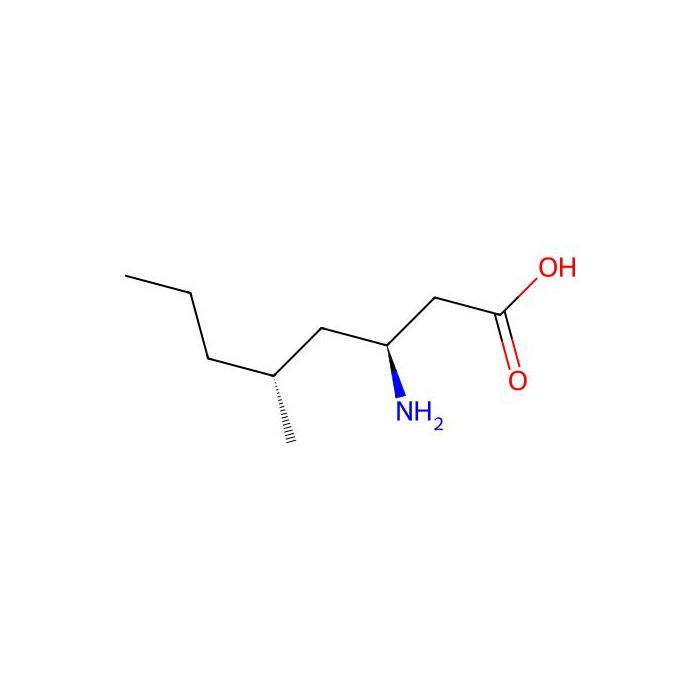
2D structure description (general, literature): small, saturated, non-aromatic carbon chain with a pendant aminomethyl-like moiety and a terminal carboxylate, typically arranged to mimic the spatial separation present in GABA analogs.
Important: The above structural notes are contextual and should not be treated as item-specific specifications without confirmation from the CoA.
Imagabalin is offered as a research small molecule and is not typically used as a synthetic reagent or catalyst.
General retrosynthetic/medchem context (literature/background for gabapentinoid-class analogs):
While the above informs synthetic planning, no specific transformations using Imagabalin as a reagent are standard. If the compound is to be derivatized (e.g., for probe development), consider:
All item-specific functional group details must be confirmed from the CoA before attempting derivatization.
No antibody/biologic “target specificity” data are applicable to this small-molecule listing, and none are provided in the Product Data.
Background (literature; not item-specific claims):
For your research, determine target engagement empirically (e.g., radioligand displacement, SPR, MST, patch-clamp readouts) and document the exact salt form, concentration, and assay conditions used. No target epitope, clone, isotype, or species cross-reactivity data apply to this small molecule.