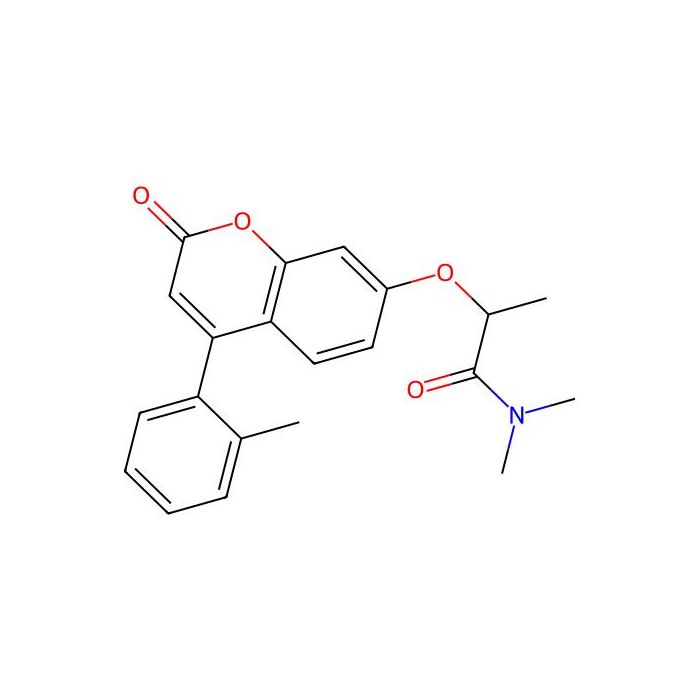
IMT1 - ≥98% , CAS No.2304621-31-4

CAS: 2304621-31-4 Cat. No.: I647743 Fórmula: C21H21NO4 Peso molecular: 351.40 PubChem CID: 138490559
Disponível para encomenda
GRAU & PUREZA ≥98%
Storage
Store at -20°C
Shipped In
Ice chest + Ice pads
★
Tamanho
Alemanha (EU)
USA*
Preço
Qtd
5mg
I647743-5mg
Sob encomenda · 8–12 semanas
313,17€
10mg
I647743-10mg
Sob encomenda · 8–12 semanas
504,07€
25mg
I647743-25mg
Sob encomenda · 8–12 semanas
1007,36€
50mg
I647743-50mg
Sob encomenda · 8–12 semanas
1597,42€
100mg
I647743-100mg
Sob encomenda · 8–12 semanas
2170,13€
Enter a quantity for the sizes you want to add.

Visão geral

IMT1 is a first-in-class specific and noncompetitive human mitochondrial RNA polymerase (POLRMT) inhibitor. IMT1 causes a conformational change of POLRMT, which blocks substrate binding and transcription in a dose-dependent way in vitro. IMT1 reduces deoxynucleoside triphosphate levels and citric acid cycle intermediates, resulting in a marked depletion of cellular amino acid levels. IMT1 has the potential for mitochondrial transcription disorders related diseases.

In Vitro

IMT1 (0.00001-10 μM; 0-168 h) has a dose-dependent decrease in cell viability in A2780, A549 and HeLa cells. IMT1 shows a strong decrease in cell viability in about one third of the cancer cell lines, 89 cancer cell lines and primary cells (IMR90 lung fibroblasts and human peripheral blood mononuclear cells (PBMCs)), whereas primary cells remained unresponsive. IMT1 (0.01-10 μM; for 24-200 h) causes a dose-dependent decrease in the levels of mitochondrial transcripts and gradual depletion of mtDNA in HeLa cells. There is a dose-dependent decrease in the levels of subunits (NDUFB8, UQCRC2 and COXI) of respiratory chain complexes I, III and IV. IMT1 reveals a time-dependent and marked increase in the levels of mono- and diphosphate nucleotides that results in a considerable increase in the AMP/ATP ratio and levels of phosphorylated AMPK in A2780 cells. IMT1 severely impairs mtDNA gene expression in A2780 cells that express wild-type POLRMT, whereas cells that express mutant POLRMT (L796Q or L816Q) are resistant. POLRMT is essential for mtDNA transcription and biogenesis of the oxidative phosphorylation (OXPHOS) system. MCE has not independently confirmed the accuracy of these methods. They are for reference only. Cell Viability AssayCell Line: A2780, A549 and HeLa cells Concentration: 0.00001-10 μM Incubation Time: 0-168 hours Result: Had a dose-dependent decrease in cell viability in A2780, A549 and HeLa cells, but had not cytotoxic to human PBMCs or pooled primary human hepatocytes.

Form:Solid

Especificações

Especificações e pureza
≥98%
Mecanismos bioquímicos e fisiológicos
IMT1 is a first-in-class specific and noncompetitive human mitochondrial RNA polymerase (POLRMT) inhibitor. IMT1 causes a conformational change of POLRMT, which blocks substrate binding and transcription in a dose-dependent way in vitro. IMT1 reduces deox
Condições de armazenamento de armazenamento
Store at -20°C
Enviado em
Ice chest + Ice pads
Este produto requer transporte de cadeia fria. Serviços terrestres e outros serviços econômicos não estão disponíveis.
Tipo de ação
INHIBITOR
Pureza
≥98%
Nomes e identificadores
SMILES
CC1=CC=CC=C1C2=CC(=O)OC3=C2C=CC(=C3)OC(C)C(=O)N(C)C
IUPAC Name
N,N-dimethyl-2-[4-(2-methylphenyl)-2-oxochromen-7-yl]oxypropanamide
InChIKey
DBIPGWVTQBAHGP-UHFFFAOYSA-N
InChI
1S/C21H21NO4/c1-13-7-5-6-8-16(13)18-12-20(23)26-19-11-15(9-10-17(18)19)25-14(2)21(24)22(3)4/h5-12,14H,1-4H3
PubChem CID
138490559
Peso molecular
351.40

Dados avançados

Taxonomic Classification

Taxonomy Tree

KingdomOrganic compounds
SuperclassPhenylpropanoids and polyketides
ClasseNeoflavonoids
SubclassNeoflavones
Intermediate Tree Nodes Not available
Direct ParentNeoflavones
Alternative Parents Coumarins and derivatives  1-benzopyrans  Pyranones and derivatives  Alkyl aryl ethers  Benzene and substituted derivatives  Tertiary carboxylic acid amides  Heteroaromatic compounds  Lactones  Oxacyclic compounds  Organopnictogen compounds  Organonitrogen compounds  Organic oxides  Hydrocarbon derivatives  
Molecular FrameworkAromatic heteropolycyclic compounds
Substituents 4-phenylcoumarin - Coumarin - 1-benzopyran - Benzopyran - Pyranone - Alkyl aryl ether - Benzenoid - Pyran - Monocyclic benzene moiety - Heteroaromatic compound - Tertiary carboxylic acid amide - Lactone - Carboxamide group - Oxacycle - Organoheterocyclic compound - Ether - Carboxylic acid derivative - Organic nitrogen compound - Organic oxygen compound - Organopnictogen compound - Organic oxide - Hydrocarbon derivative - Organooxygen compound - Organonitrogen compound - Aromatic heteropolycyclic compound
DescriçãoThis compound belongs to the class of organic compounds known as neoflavones. These are neoflavonoids with a structure based on the 4-phenylcoumarin skeleton.
External Descriptors Not available
Estrutura 3D
Modelo de Estrutura Química Interativa


Certificados(CoA,COO,BSE/TSE e Mapa de Análise)
C of A & Other Certificates(BSE/TSE, COO):
Analytical Chart:
Propriedades químicas e físicas
SolubilidadeDMSO : 50 mg/mL (142.29 mM; Need ultrasonic)
Calculadoras de soluções
Revisões

Avaliações dos Clientes

Application Protocols

No vendor-validated application protocols are provided for this item.

  • General protocol suggestions for small-molecule screening (research use only)

    • Stock preparation: Dissolve in anhydrous DMSO to 10–50 mM. Store aliquots at −20°C to minimize freeze–thaw.
    • Assay setup: Maintain constant final DMSO concentration across wells (commonly 0.1–1% v/v). Include vehicle controls and, where possible, positive/negative control ligands.
    • Counter-screens: Include orthogonal readouts and interference controls (e.g., detergent to assess aggregation, redox/fluorescence interference panels).
    • Analytical QC: Verify concentration by UV or quantitative NMR where feasible; confirm purity by LC–MS before critical experiments.
  • Note

    • Adjust details to your assay system and institutional SOPs; consult the SDS and CoA for any item-specific cautions.
Biological Roles
  • Item-specific biological roles: Not specified for this item; no target or pathway annotations are provided in the Product Data.

  • General context for small-molecule research tools (general knowledge)

    • Small molecules in screening libraries are commonly employed as chemical probes to modulate biological targets (enzymes, receptors, ion channels) and interrogate cellular pathways. Specificity, potency, and off-target liability must be empirically determined.
    • Prior to mechanistic claims, perform orthogonal confirmation (biochemical vs cellular assays), concentration–response curves, and counter-screens for assay interference (fluorescence, redox cycling, aggregation).
    • ADMET profiling (permeability, metabolic stability, microsomal clearance) can contextualize observed biological effects but requires structure disclosure for meaningful interpretation.
  • Guidance

    • Document exact batch identifiers and preparation methods in notebooks/ELNs to ensure traceability.
    • If target annotations exist in external databases (e.g., PubChem for CID 138490559), confirm they correspond to the same substance and batch.
Buffer Applications

This product is a small-molecule library member and not a buffering agent.

  • Applicability

    • No defined buffering capacity or pKa information is provided. It is not typically used to prepare laboratory buffers.
  • Practical note

    • If used in biological assays, dissolve the compound in DMSO or another suitable co-solvent and then dilute into an appropriate assay buffer (e.g., phosphate, HEPES) validated for your system. Maintain consistent final co-solvent percentages across controls and test wells.
Green Alternatives

Green chemistry considerations apply primarily to solvent choice and handling, as the specific compound structure is not disclosed.

  • Greener solvent considerations (general)

    • Prefer aqueous buffers with minimal co-solvent where assay-compatible.
    • When organic solvent is necessary, consider ethanol or 2-propanol first; for higher solvency needs, acetonitrile often has a favorable environmental and safety profile compared with DMF or NMP.
    • Avoid chlorinated solvents unless required for analytics.
  • Example comparison (general guidance)

    • DMSO vs ethanol: DMSO offers superior solvency and chemical stability but is less renewable; ethanol is renewable and safer but may not dissolve hydrophobic chemotypes.
    • ACN vs DMF: ACN is more volatile and easier to remove but flammable; DMF offers high polarity but has greater health/environmental concerns.
  • Operational green practices

    • Use microscale assays to minimize solvent and compound consumption.
    • Consolidate waste streams and implement solvent recycling where feasible.
    • Store at −20°C (per Product Data) to extend shelf life and reduce repeat synthesis/resupply.
  • Item-specific note

    • Without structural details, substitution of the compound itself is not addressed. Focus on greener diluents, minimized volumes, and energy-efficient storage/handling.
Pharmaceutical Uses

No pharmacopeial status, excipient role, or manufacturing use is specified for this item.

  • General guidance (non-clinical)

    • As a research-use-only small molecule, this product is intended for laboratory studies such as screening and method development. It is not approved for human or veterinary use, diagnostic procedures, or as an excipient.
    • If progression beyond discovery research is contemplated, ensure sourcing of GMP-grade material and a full regulatory documentation package; this listing does not provide those attributes.
  • Research Use Note

    • For research use only (per Product Data).
Physical Properties

No definitive physical constants are provided for this specific item.

  • Item-specific physical data

    • Appearance: Not specified for this item; refer to CoA/Spec Sheet.
    • Molecular weight: Not specified for this item; refer to CoA/Spec Sheet.
    • Melting point / Boiling point / Density / Refractive index / pKa / logP: Not specified for this item; refer to CoA/Spec Sheet.
    • Solubility: Not specified for this item; refer to CoA/Spec Sheet.
  • General guidance for small-molecule screening compounds (general knowledge)

    • Stock solutions are commonly prepared at 10–50 mM in anhydrous DMSO; evaluate solubility by serial dilution and visual inspection for precipitation.
    • If aqueous work is required, consider co-solvents (DMSO ≤1–2% v/v in assay buffer) and pH adjustments within biologically compatible ranges.
    • For solids with unknown hygroscopicity, handle quickly under low humidity and cap promptly.
  • Notes on data sources

    • Where literature values are desired, consult PubChem (CID 138490559) or vendor-supplied specification sheets. Do not transpose literature constants into internal specifications without confirming batch-specific CoA.
Quality and Grades
  • Item-specific grade/purity: Not specified for this item; refer to CoA/Spec Sheet.

  • Interpreting quality for screening compounds (general knowledge)

    • Purity for screening: For primary HTS, ≥90–95% is common; for hit confirmation and SAR, ≥95–98% with orthogonal purity verification (HPLC/UPLC-UV, MS) is preferred.
    • Identity confirmation: HRMS and 1H NMR are typical; 13C NMR and 2D NMR are recommended for complex scaffolds or stereodefined molecules.
    • Residual solvents and counter-ions: Specify on CoA if present. Pay attention to salt form and hydration state, which can shift molecular weight and assay concentrations.
    • UV background/fluorescence: For bioassays with optical readouts, obtain a UV–Vis scan to flag strong chromophores that may interfere.
  • What is specific to this item

    • Storage requirement is provided: Store at −20°C. Grade, purity, and stabilizers are not listed and should be requested if critical to your application.
  • Recommendations

    • Request batch CoA including: structure, MW, purity method and result, residual solvent levels, water content (KF), and chromatogram traces before use in regulated workflows.
Reaction and Applications
  • Manufacturer Applications: Not specified for this item; refer to catalog updates. The product is categorized under small molecules/compound libraries and is typically intended for discovery research workflows.

  • Likely research contexts (general guidance for library members)

    • Use as a test article in biochemical or cell-based assays to probe target classes of interest (enzyme inhibition/activation, receptor binding, pathway modulation). No target specificity is provided for this item.
    • Analytical reference: May serve as a reference standard in LC–MS method development if structural information is available.
    • Physicochemical profiling: Solubility, stability, and permeability assessments (e.g., PAMPA, Caco-2) can be conducted to evaluate developability, contingent on structure access.
  • Not a typical synthetic reagent

    • Without defined functional groups, it should not be assumed to be a building block or catalyst. Do not plan synthetic transformations with this item until the structure is confirmed.
  • Practical tips

    • Prepare fresh DMSO stocks; minimize light/air exposure until photolability/oxidation sensitivity are known.
    • Run orthogonal assay readouts to mitigate false positives (fluorescence quenching, redox cycling, aggregation). Employ detergent controls and counter-screens as appropriate.
Reaction Conditions

No reaction conditions can be recommended for this specific compound in the absence of structural information.

  • General laboratory handling of small molecules (non-reactive context)

    • Solution preparation: Typical 10–50 mM stocks in anhydrous DMSO; equilibrate to room temperature and vortex/sonicate to aid dissolution.
    • Light/air sensitivity: Until known, protect from light and minimize exposure to air and moisture.
    • Filtration: Use 0.2 µm PTFE syringe filters for LC–MS sample prep.
  • If synthetic transformations are intended

    • Obtain full structural and functional group information and consult primary literature for reaction conditions tailored to that scaffold.
    • Run small-scale pilot reactions with in situ monitoring (TLC, LC–MS) to establish feasibility before scale-up.
Safety and Handling

Definitive GHS data are not provided in the Product Data for this item. Always consult the SDS for authoritative guidance.

  • Item-specific safety fields

    • GHS classification: Not specified for this item; refer to SDS.
    • Signal word / H-statements / Pictograms: Not specified for this item; refer to SDS.
  • General laboratory precautions for small organic molecules (general guidance)

    • PPE: Wear lab coat, safety glasses, and appropriate chemically resistant gloves (e.g., nitrile). Use a fume hood when handling powders/solutions to control inhalation exposure.
    • Incompatibilities: Until functional groups are known, avoid strong oxidizers, strong acids/bases, and reducing agents. Do not mix with peroxides or reactive metals.
    • First-aid overview: Inhalation—move to fresh air. Skin/eye contact—rinse with water for ≥15 min. Ingestion—rinse mouth; seek medical advice. Refer to SDS for item-specific measures.
    • Spill response: Avoid dust generation, contain with inert absorbent, and collect for disposal following institutional guidelines.
    • Waste: Dispose as organic chemical waste per local regulations; segregate halogenated vs non-halogenated if applicable.
  • Transport & stability

    • Shipped in: Ice chest + ice pads (per Product Data) to protect integrity.
    • Avoid repeated freeze–thaw and prolonged exposure to ambient temperatures without stability data.
Solvent Selection

Because the structure and polarity are not specified, initial solubility scouting is advised.

  • Practical solvent strategy (general guidance)

    • Primary stock solvent: Anhydrous DMSO is typically the first choice for small-molecule libraries.
    • Secondary options: DMF, acetonitrile, ethanol, methanol, or isopropanol may be evaluated if DMSO solubility is limited.
    • Aqueous work: Use co-solvent approaches (e.g., 0.5–2% DMSO or 5–20% ACN/EtOH in buffer) with gentle warming and vortex/sonication. Filter through 0.2 µm PTFE/NYLON as needed.
    • pH leverage: If acidic/basic functionality is suspected, adjust buffer pH within 6.5–8.0 to enhance solubility while maintaining assay compatibility.
  • Miscibility and materials compatibility

    • DMSO, DMF, and ACN are water-miscible; verify compatibility with plastics (some compounds adsorb to polystyrene—use polypropylene or glass when adsorption is observed).
  • Small comparison (general)

    • DMSO: maximal solvency; higher viscosity; good freeze–thaw stability.
    • ACN: low viscosity; volatile; good for LC-injection solutions.
    • EtOH/MeOH: biocompatible at low percentages; may alter enzyme activities—validate in assays.
  • Item-specific note

    • Solvent recommendations are general; confirm actual solubility for this specific item using a tiered solvent screen and document in lab notebook/ELN.
Storage and Reconstitution
  • Item-specific storage

    • Storage Conditions: Store at −20°C (per Product Data).
    • Shipped In: Ice chest + ice pads to preserve material integrity during transit.
  • Reconstitution (general guidance)

    • Solvent: Use anhydrous DMSO for primary stocks unless otherwise indicated on the CoA. Start at 10–50 mM; adjust to solubility limits.
    • Technique: Allow vial to equilibrate to room temperature before opening to prevent condensation. Vortex and, if needed, sonicate gently to assist dissolution. Avoid heating above ambient unless stability is known.
    • Filtration: If particulate persists, pass solution through a 0.2 µm PTFE filter for analytical work.
  • Aliquoting and stability

    • Prepare single-use aliquots in inert vials/plates (glass or polypropylene). Minimize headspace and protect from light.
    • Freeze–thaw: Avoid repeated cycles; thaw on ice or at room temperature as appropriate. Track cumulative time above −20°C.
  • Shelf-life

    • Absent item-specific stability data, reassess purity by LC–MS/HPLC after 6–12 months of storage or before critical studies.
  • Specifications not provided

    • Appearance, purity, water content, and stabilizers: Not specified for this item; refer to CoA/Spec Sheet.
Structure and Identity

Item-specific data available in this listing are insufficient to detail the molecular structure.

  • Item-specific identifiers (from Product Data)

    • SKU: I647743
    • Product Name: IMT1
    • CAS: 2304621-31-4
    • PubChem CID: 138490559
    • InChIKey: 59030 (note: this does not conform to standard InChIKey length; verify on the CoA/SDS)
    • Molecular formula: Not specified for this item; refer to CoA/Spec Sheet.
    • Molecular weight: Not specified for this item; refer to CoA/Spec Sheet.
    • SMILES: Not specified for this item; refer to CoA/Spec Sheet.
  • Structural features (general guidance)

    • Without an explicit structure, functional groups, ring systems, and stereochemistry cannot be described for this item. Consult the Certificate of Analysis or Structure Sheet for definitive identity information.
  • Best practices

    • Cross-verify CAS and CID in your internal databases before use in structure-based design, docking, or ADME prediction workflows.
    • If working under regulated environments, request a structure-confirmation package (NMR, HRMS, HPLC) before first use.
Synthetic Utility

This item is listed as a small-molecule library member with no disclosed structure; it is therefore not positioned as a general-purpose synthetic reagent or building block.

  • Applicability

    • Without known functional groups, guidance on reactivity (e.g., nucleophilicity, electrophilicity, cross-coupling competence) cannot be provided. Do not plan synthetic sequences around this material without obtaining and reviewing the structural dossier.
  • Alternative approach (general guidance)

    • If analog synthesis is desired, request the structure and key intermediates from the supplier, or perform de novo design around any disclosed scaffold using standard retrosynthetic disconnections.
    • For analytical method development, the compound could serve as a system suitability or retention-time marker once its chromatographic behavior is established.
Target Specificity

Not applicable. This product is not supplied as a biological macromolecule (e.g., antibody, enzyme) and no target annotations are provided for the small molecule.

  • Item-specific note
    • No antigen, epitope, species reactivity, clone, or isotype information is relevant or provided for this product.
    • If a biological target is associated with this compound in external databases, verify identity and batch before citing.

Deseja que lhe enviemos uma mensagem quando tivermos descontos disponíveis?

Lembrar-me mais tarde

Obrigado! Por favor, verifique a sua caixa de entrada de e-mail para confirmar.

Ops! As notificações estão desativadas.