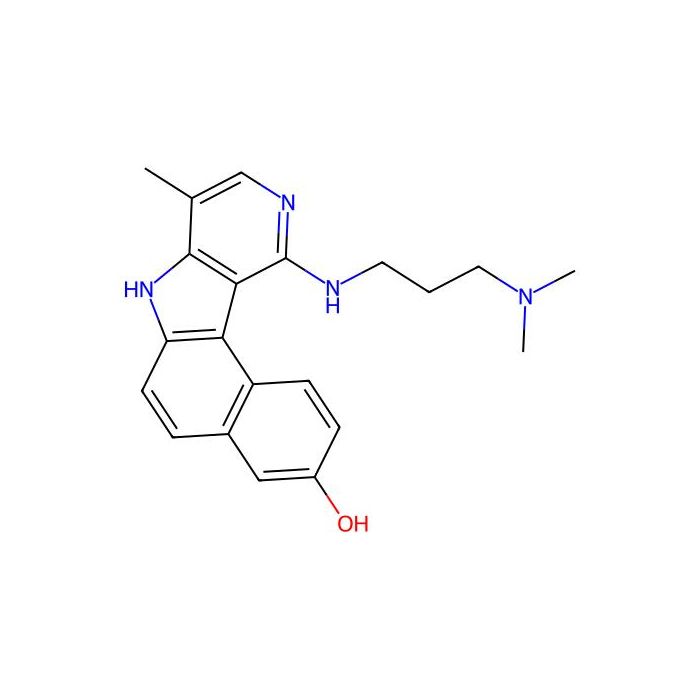
Intoplicine (RP 60475), an antitumor derivative in the 7H-benzo[e]pyrido[4,3-b]indole series, is a DNA topoisomerase I and II inhibitor. Intoplicine strongly binds DNA (K A = 2 x 10 5 /M) and thereby increases the length of linear DNA
In Vitro
With 1-hour exposure to Intoplicine at final concentrations of 2.5 micrograms/mL and 10.0 micrograms/mL, 26% and 54% of the assessable specimens shows positive in vitro responses, respectively. With continuous exposure to Intoplicine at concentrations of 0.25 micrograms/mL and 2.5 micrograms/mL, 16% and 71% of the assessable specimens showed positive responses, respectively. Activity is seen against breast (71%), non-small-cell lung (69%), and ovarian (45%) cancer colony-forming units at a Intoplicine concentration of 10.0 micrograms/mL after 1-hour exposure. MCE has not independently confirmed the accuracy of these methods. They are for reference only.
In Vivo
At the highest non-toxic dose (HNTD) (6 mg/kg/injection, total dose, 36 mg/kg), Intoplicine shows highly active with a T/C of 0% and a corresponding total log cell kill of 3. MCE has not independently confirmed the accuracy of these methods. They are for reference only.
Cell Assay
The K562 human erythroleukemia cell line is established from a patient with chronic myelogenous leukemia. Cells are in the exponential growth phase at 5-8×10 5 in RPMI 1640 (GIBCO) supplemented with 10% fetal calf serum (Seromed) and 2 mM L-glutamine. Cell growth and viability are determined by phase contrast microscopy and by using the trypan blue test. Cells (2×10 6 ) are incubated with 1 μM Intoplicine for 1 h at 37°C, washed twice with PBS by centrifugation (200× g at 4°C) and resuspended in 200 μL PBS. MCE has not independently confirmed the accuracy of these methods. They are for reference only.
Form:Solid
IC50& Target:Topoisomerase I Topoisomerase II
Especificações
Sinónimos
INTOPLICINE [WHO-DD] | RP-60475 | 16-[3-(dimethylamino)propylamino]-13-methyl-11,15-diazatetracyclo[8.7.0.02,7.012,17]heptadeca-1(10),2(7),3,5,8,12(17),13,15-octaen-5-ol | Intoplicine [INN] | Intoplicine | 11-[[3-(Dimethylamino)propyl]amino]-8-methyl-7H-benzo[e]pyrido[4,3-b]indol-3-ol | RP 60475 | 11-((3-(Dimethylamino)propyl)amino)-8-met Show more
Especificações e pureza
≥98%
Mecanismos bioquímicos e fisiológicos
Intoplicine (RP 60475), an antitumor derivative in the 7H-benzo[e]pyrido[4,3-b]indole series, is a DNA topoisomerase I and II inhibitor. Intoplicine strongly binds DNA (K A = 2 x 10 5 /M) and thereby increases the length of linear DNA.
Condições de armazenamento de armazenamento
Store at 2-8°C,Protected from light,Desiccated
Enviado em
Wet ice
Este produto requer transporte de cadeia fria. Serviços terrestres e outros serviços econômicos não estão disponíveis.
This compound belongs to the class of organic compounds known as gamma carbolines. These are polycyclic aromatic compounds containing a gamma-carbazole(5H-pyrido[4,3-b]indole) moiety, with a structure characterized by the presence of pyridine fused to the pyrrole ring of an indole.
External Descriptors
Not available
1. Djoumbou Feunang Y, Eisner R, Knox C, Chepelev L, Hastings J, Owen G, Fahy E, Steinbeck C, Subramanian S, Bolton E, Greiner R, and Wishart DS. ClassyFire: Automated Chemical Classification With A Comprehensive, Computable Taxonomy. Journal of Cheminformatics, 2016, 8:61.
Determine the necessary mass, volume, or concentration for preparing a solution.
Dilution Calculator
Determine the dilution needed to prepare a stock solution.
Reconstitution Calculator
Revisões
Avaliações dos Clientes
Application Protocols
No vendor-validated application protocols are provided in the product data for this item.
General guidance for small-molecule assay setup (for research use only):
Stock solution: Prepare in anhydrous DMSO at an empirically determined concentration. Record lot number, exact concentration (by weight/volume and, if possible, spectrophotometrically), and preparation date.
Plate handling: Use low-binding tips/plates; include DMSO-only controls matched to the highest solvent percentage used.
Serial dilutions: Perform in DMSO or assay buffer depending on solubility; verify absence of precipitation at each dilution step.
Readouts: For spectroscopic assays, account for the compound’s intrinsic absorbance/fluorescence and correct for inner-filter effects where applicable.
Stability checks: Reassess concentration and purity by LC–MS/HPLC after storage or prolonged assay runs.
For any specialized applications (e.g., biophysical DNA-binding assays, topoisomerase enzymology), adopt assay-specific literature protocols and validate with internal positive/negative controls.
Item-specific recommendations, tested applications, and dilutions: Not specified for this item; refer to CoA/Spec Sheet.
Biological Roles
Literature/general background (no medical claims):
Intoplicine is widely described in the literature as an indolocarbazole-class DNA intercalator that engages the DNA double helix via π–π stacking interactions. Such intercalation can perturb DNA topology and interfere with DNA-processing enzymes.
Numerous reports attribute activity in biochemical systems related to topoisomerases (e.g., interaction with topoisomerase I/II complexes) for compounds of this class. These effects have made indolocarbazoles valuable research tools in studies of DNA damage responses, cell-cycle checkpoints, and genome integrity pathways.
Because of its extended planar aromatic core and heteroatom content, binding is often sequence- and topology-sensitive; ionic strength, Mg2+ concentration, and chromatin state can modulate observed potency in vitro.
In cell-free systems, intercalators commonly show robust fluorescence/UV absorption, enabling spectroscopic tracking of binding events and facilitating biophysical assays (e.g., thermal denaturation of DNA, fluorescence displacement assays).
Practical research use notes:
Prepare well-characterized DMSO stocks; quantify by UV–Vis using an extinction coefficient determined empirically for your solvent to avoid dose errors.
Include solvent controls and adsorption controls (compound-to-plastic binding) in microplate assays.
Be mindful of redox or photolytic degradation under intense illumination; use amberware and minimize light exposure.
Important: Target specificity, potency values, and assay-validated activities are not specified for this item in the product data and should be established empirically under your experimental conditions.
Buffer Applications
This compound is not a buffering agent and does not define a pH range. However, practical buffer-related considerations apply for preparing and using assay solutions.
Stock preparation: Dissolve in anhydrous DMSO to a convenient concentration (e.g., 10–20 mM). Confirm complete dissolution visually; sonication and brief gentle warming can help.
Dilution into buffers: Add the DMSO stock to the target buffer (e.g., PBS, HEPES, or assay-specific media) under vigorous mixing to achieve the desired final concentration with minimal DMSO (commonly 0.1–1% v/v depending on assay tolerance).
Precipitation control: If cloudiness appears on dilution, incrementally increase DMSO percentage, add nonionic surfactant (e.g., 0.01–0.05% Tween 20), or adjust ionic strength. Filter through 0.22 μm PTFE if needed.
Adsorption mitigation: Use low-binding polypropylene tubes/plates; pre-rinse with dilute DMSO solution to reduce wall loss.
Stability in buffer: Protect from light. Assess stability by time-course LC–MS or HPLC after dilution; many polycyclic intercalators can slowly adsorb or degrade under ambient light.
Documentation: Record solvent percentages and buffer composition in your ELN; small changes can materially affect apparent activity and solubility.
Note: No item-specific buffer recipes or pKa values are provided for this product; consult the CoA/Spec Sheet for any additional handling instructions.
Green Alternatives
Green chemistry considerations mainly concern solvent choice, as the compound itself is a fixed molecular entity used in very small quantities for screening.
Opportunities (general):
Stock solvent optimization: Prefer DMSO over DMF/NMP when biologically compatible, as DMSO generally offers a better EHS profile and lower regulatory concern than NMP.
Aqueous-compatible workflows: Minimize final organic cosolvent in assays (≤0.1–0.5% v/v where feasible) to reduce solvent burden and improve operator safety.
Waste minimization: Use microplate-based assays and miniaturized volumes to reduce organic waste. Pool compatible waste streams for efficient disposal.
Illustrative comparison (general guidance):
DMSO: relatively low volatility, good biodegradability profile; widely accepted for bioassays.
DMF: reproductive toxicity concerns; avoid when DMSO suffices.
NMP: recognized reproductive hazard; restrict use and ensure engineering controls if required.
Operational tips:
Adopt amber polypropylene plates/vials to extend solution life and reduce repeat preparations.
Implement just-in-time solution preparation and aliquoting to cut down on discarded, expired stocks.
Note: No greener “substitute compound” is applicable here; sustainability gains come from solvent selection, scale minimization, and careful inventory management.
Pharmaceutical Uses
No pharmacopeial grade or excipient role is specified for this item. The product is supplied strictly for research use only.
General research/manufacturing context (no therapeutic claims):
Reference standard: Intoplicine may be used as a reference material in analytical method development and validation (e.g., LC–MS/MS, HPLC) for laboratories studying indolocarbazole-class compounds.
Stability-indicating methods: Develop gradient RP-HPLC methods with photodiode array (UV) and MS detection to separate potential degradants (e.g., oxidative or photolytic products typical of polycyclic aromatics).
Impurity profiling: Use orthogonal techniques (NMR, HRMS) to confirm identity/purity prior to inclusion in internal compound libraries.
Formulation research: In preformulation-style studies, DMSO-based concentrates with subsequent dilution into biocompatible vehicles are typical for in vitro work; adsorption to plastics and limited solubility are key practical constraints.
Regulatory note:
No compendial monograph or GMP status is indicated for this item. Do not use for human or veterinary applications. For any regulated work (GLP/GMP), obtain appropriate grade, documentation, and qualification.
Item-specific information:
Grade/Purity: Not specified for this item; refer to CoA/Spec Sheet.
Molecular Formula/Weight: Not specified for this item; refer to CoA/Spec Sheet.
Physical Properties
Item-specific specifications:
Appearance: Not specified for this item; refer to CoA/Spec Sheet.
Grade/Purity: Not specified for this item; refer to CoA/Spec Sheet.
Key physicochemical properties (literature/general for indolocarbazole intercalators; for guidance only):
Phase: typically isolated as a solid polycyclic heteroaromatic compound with very low volatility.
Aqueous solubility: generally low at neutral pH; solubility may increase in acidic media depending on basic sites. Practical handling often relies on DMSO stock solutions.
Organic solubility: commonly soluble in high–donor-number polar aprotic solvents (e.g., DMSO, DMF, NMP); limited solubility in less polar solvents.
LogP/logD: many DNA-intercalating indolocarbazoles exhibit moderate-to-high lipophilicity (qualitative), contributing to poor water solubility and strong π–π interactions.
UV–Vis: strongly absorbing in the UV (aromatic π–π* transitions), often with tails into the visible for extended conjugation; useful for spectrophotometric quantification of stocks (exact λmax requires literature/experiment).
Melting point, boiling point, density, refractive index: Not specified for this item; refer to CoA/Spec Sheet.
Practical notes:
Prepare concentrated stocks (e.g., 10–20 mM) in anhydrous DMSO, then dilute into assay buffers with careful control of final DMSO percentage to avoid precipitation.
If solubility limits are encountered, gentle warming (≤40 °C) and sonication can assist dissolution; avoid prolonged heating or light exposure to minimize degradation.
Always confirm item-specific properties on the supplied CoA prior to quantitative work.
Quality and Grades
Item-specific grade/purity and stabilizers:
Grade/Purity: Not specified for this item; refer to CoA/Spec Sheet.
Stabilizers/antioxidants: Not specified for this item; refer to CoA/Spec Sheet.
Guidance on typical grading for discovery compounds (general):
Research-grade screening compounds are commonly supplied at ≥95% purity by HPLC unless otherwise specified; however, actual acceptance criteria vary by supplier and lot. Always consult the CoA for this item.
If low-UV-absorbing solvents are used for HPLC quantitation, ensure the analyte’s strong UV absorbance does not saturate the detector; consider MS or ELSD confirmation.
Residual solvents/metals/water content: Not specified for this item; refer to CoA/Spec Sheet. For sensitive biophysical assays, you may wish to verify by KF and residual solvent analysis.
Implications for use:
For SAR and screening: consistent purity and defined counter-ions/salt forms reduce assay variability. Confirm free base vs. salt form on the CoA.
For quantitative bioassays: verify identity by LC–MS and purity by orthogonal methods (HPLC/UPLC, NMR) when setting up critical experiments.
Documentation:
Request the lot-specific CoA, Spec Sheet, and SDS prior to use in regulated experiments. Archive chromatograms and spectra with your ELN entry to ensure traceability.
Reaction and Applications
This product is a bioactive small molecule research compound and is not typically used as a reagent or substrate in synthetic transformations.
Not a general-purpose reagent: Intoplicine (indolocarbazole class) is commonly employed as a reference chemical in biochemical or cell-based assays rather than in bench synthetic chemistry.
If analytical derivatization or conjugation is desired (e.g., for probe development), such procedures are highly structure-specific and require bespoke route design based on the exact substitution pattern and functional groups present in the supplied material (confirm via CoA/SDS and analytical characterization).
For work focused on reactivity studies:
Any functionalization of an indolocarbazole core generally involves electrophilic substitution on activated positions, N-alkylation/acylation, or selective oxidation/reduction on peripheral functionalities; however, these are literature-general strategies and may not be applicable to this exact compound without structural confirmation.
Recommendation:
For chemical synthesis projects, obtain detailed structural data (NMR, HRMS, XRD if available) for this specific item and consult the primary literature on indolocarbazole functionalization before attempting transformations.
Reaction Conditions
Not typically applicable. Intoplicine is supplied as a bioactive small molecule for research and is not commonly utilized as a reactant under standard synthetic reaction condition families.
Guidance if derivatization is pursued (literature/general):
Solvents: anhydrous polar aprotics (DMSO, DMF, NMP) for N-alkylation/acylation; chlorinated solvents or aromatic hydrocarbons for electrophilic aromatic substitution, contingent on solubility and stability.
Temperatures: generally ambient to moderate heating (20–80 °C) to avoid decomposition of the polycyclic core; monitor by TLC/LC–MS.
Atmosphere: inert gas (N2/Ar) advisable to mitigate oxidative degradation during functionalization steps.
Catalysis: for advanced C–H functionalizations, Pd/Cu/Ir catalysts and photoredox conditions appear in the broader indolocarbazole literature; feasibility must be established experimentally for the specific substitution pattern of this compound.
Important: No item-specific reactivity, yields, or conditions are provided in the product data. Treat the above as general literature guidance for related scaffolds only.
Safety and Handling
Authoritative safety information should be taken from the SDS. The following are general laboratory precautions for polycyclic, bioactive small molecules.
Item-specific hazard data:
Signal Word: Not specified for this item; refer to SDS.
H-Statements: Not specified for this item; refer to SDS.
GHS Classification: Not specified for this item; refer to SDS.
Pictograms: Not specified for this item; refer to SDS.
General precautions (literature/general):
Intoplicine is reported as a potent DNA-interacting research compound. Handle as a hazardous substance with appropriate containment.
PPE: lab coat, safety glasses, and disposable nitrile gloves; consider double-gloving for weighing/solution prep. Work in a certified chemical fume hood or ventilated enclosure.
Avoid inhalation of dust and contact with skin/eyes. Use closed transfers for DMSO stock solutions to minimize dermal exposure.
Storage incompatibilities: avoid strong oxidizers and strong acids/bases unless required for controlled dissolution; protect from light to mitigate photodegradation. Keep desiccated to prevent moisture uptake.
Light sensitivity: store and handle under subdued light or amber containers; wrap vials in aluminum foil if necessary.
First-aid overview (general):
Skin/eye contact: rinse with water for ≥15 minutes; remove contaminated clothing.
Inhalation: move to fresh air; seek medical attention if symptoms occur.
Ingestion: rinse mouth; do not induce vomiting; seek medical advice.
Waste: collect solid and solution waste as organic hazardous chemical waste. Decontaminate surfaces with suitable organic solvent followed by detergent/water, observing institutional policies.
Solvent Selection
Intoplicine is a planar, polycyclic heteroaromatic compound with low aqueous solubility typical of indolocarbazoles. Solvent choice strongly impacts handling and assay performance.
Polarity and miscibility (literature/general):
Preferred stock solvents: anhydrous DMSO (primary), DMF, or NMP, owing to their high donor numbers and ability to solvate π-stacked aromatics.
Aqueous buffers: limited solubility; dilution from DMSO stocks into buffered media typically requires final DMSO at 0.1–1% v/v (optimize per assay). Incorporating nonionic surfactants (e.g., 0.01–0.05% Tween 20) can reduce precipitation on dilution.
Poor solvents: alkanes, simple ethers, and low-polarity esters often provide insufficient solvation and lead to crystallization/precipitation.
Practical recommendations:
Prepare a concentrated DMSO stock (e.g., 10–20 mM). Filter through a low-protein-binding 0.22 μm PTFE syringe filter if particulate is observed.
When making assay plates, pre-wet tips with DMSO stock to improve pipetting accuracy and avoid adsorption to plastics.
Sequence of mixing matters: add the DMSO stock to vigorously stirred buffer; avoid adding buffer to the DMSO concentrate to minimize local supersaturation.
Comparison (general):
DMSO vs DMF/NMP: DMSO offers best biocompatibility at low percentages; DMF/NMP can enhance solubility further but may be less tolerated biologically.
Co-solvent strategies: small amounts of ethanol or PEG-400 can sometimes assist, but verify compatibility with your biological readout.
Always verify solubility and stability experimentally under your exact assay conditions.
Storage and Reconstitution
Item-specific storage and shipping conditions:
Storage Conditions: Store at 2–8 °C, protected from light, desiccated (as provided).
Shipped In: Wet ice (as provided).
Reconstitution (general guidance for research use):
Solvent: Reconstitute in anhydrous DMSO to prepare a concentrated stock solution. Ensure the vial is at room temperature in a dry environment before opening to prevent moisture condensation.
Technique: Add solvent incrementally with gentle swirling or brief sonication to achieve complete dissolution. If particulates persist, filter through a 0.22 μm PTFE syringe filter.
Aliquoting: Dispense into amber, low-binding microtubes to minimize headspace and adsorption. Label with concentration, solvent, lot, and date.
Light/moisture protection: Use amber containers or foil wrap; keep desiccated during storage and handling to maintain integrity.
In-use stability (general):
Avoid repeated freeze–thaw or warm–cold cycling of solutions by working from single-use aliquots.
Inspect solutions for precipitation, color change, or LC–MS/HPLC-detectable degradation prior to critical experiments.
Note: No item-specific solution stability or long-term storage data are provided. For extended storage of solutions or alternative solvent systems, determine stability empirically under your laboratory conditions and defer to the SDS/CoA for any additional handling instructions.
Structure and Identity
Intoplicine is a polycyclic heteroaromatic small molecule widely cited as an indolocarbazole-class DNA intercalator used in research discovery screening.
Product identifiers (item-specific):
SKU: I649345
Product Name: Intoplicine
CAS: 125974-72-3
PubChem CID: 65954
InChIKey: 304673 (as provided in product data)
SMILES: Not specified for this item; refer to CoA/Spec Sheet.
Composition (item-specific):
Molecular Formula: Not specified for this item; refer to CoA/Spec Sheet.
Molecular Weight: Not specified for this item; refer to CoA/Spec Sheet.
Structural features (literature/general):
Intoplicine belongs to the indolocarbazole scaffold family, comprising fused indole-derived ring systems that create a flat, highly conjugated aromatic surface conducive to DNA intercalation.
Typical features reported for this class include: multiple condensed rings, at least two ring nitrogens (indole-like), and peripheral carbonyl/amide-like functionality depending on specific derivative. Stereochemistry is generally not central to function for planar intercalators of this class.
2D description (general for indolocarbazoles): a near-rectangular polycyclic aromatic core with heteroatoms embedded in the rings; minimal rotatable bonds; extended π-system.
Notes:
Any definitive structural identifiers beyond those listed as item-specific should be confirmed against the product’s CoA/SDS. Values labeled “literature/general” reflect common descriptions of the class and may not represent the exact substitution pattern of this specific batch.
Synthetic Utility
This product is a target small molecule and is not typically employed as a reagent, catalyst, or building block in routine synthesis.
General notes (literature/general for indolocarbazoles):
The indolocarbazole framework is synthetically challenging and often assembled via oxidative coupling of indole derivatives, intramolecular cyclizations, or transition-metal-catalyzed annulations. As such, the molecule is more commonly an endpoint than a synthon.
Post-synthetic diversification strategies sometimes explored on related scaffolds include N-alkylation/acylation of indole nitrogens, electrophilic aromatic substitution at activated positions, and late-stage functionalization via C–H activation—each highly dependent on the exact substitution and protecting-group pattern.
If modification is intended:
Obtain and confirm the precise structure and functional groups by comprehensive characterization (1D/2D NMR, HRMS). Map reactive handles, assess regioselectivity, and evaluate stability under planned conditions (acids, bases, oxidants).
Consider using milder, photoredox, or electrochemical methods for selective functionalization to preserve the sensitive polycyclic core.
Conclusion:
As supplied, Intoplicine should be regarded as a research target/reference compound rather than a synthetic input. Any derivatization program should be treated as a custom medicinal chemistry effort with appropriate feasibility studies.
Target Specificity
Item-specific, validated biological targets and selectivity data are not provided for this product.
Target(s): Not specified for this item; refer to CoA/Spec Sheet or primary literature.
Species reactivity/assay context: Not specified for this item.
Potency/selectivity metrics (e.g., IC50, Ki): Not specified for this item.
Note: If target engagement data are required for your application, please consult peer-reviewed literature and generate assay-specific confirmation (e.g., enzymatic inhibition curves, CETSA/thermal shift, or cellular phenotypic readouts) under your laboratory’s conditions.
Perguntas frequentes
What is the purity of this product?
This product is supplied at ≥98% purity (chemical assay). Lot-specific values are stated on the Certificate of Analysis.
How should this product be stored?
Store at 2–8 °C, protected from light, desiccated. Keep the container tightly closed with desiccant — the material is moisture-sensitive.
How is this product shipped?
This product ships chilled on wet ice. Unpack on arrival and transfer it to the storage condition stated above.
What are the CAS number, molecular formula and molecular weight?
The CAS Number is 125974-72-3, the molecular formula is C21H24N4O, and the molecular weight is 348.44 g/mol. InChIKey QROONAIPJKQFMC-UHFFFAOYSA-N.
What documentation is provided?
Available product documentation, including Certificates of Analysis (COA), Safety Data Sheets (SDS), and specification sheets, is shown in the product document area. Document availability and access follow the current site policy.
Usamos cookies para garantir o funcionamento adequado do site e, quando permitido, para melhorar a sua experiência. Você pode gerenciar suas preferências a qualquer momento nas Configurações. Saiba mais em nossa Política de Cookies.
Deseja que lhe enviemos uma mensagem quando tivermos descontos disponíveis?
Lembrar-me mais tarde
Obrigado! Por favor, verifique a sua caixa de entrada de e-mail para confirmar.
Products are supplied to verified businesses, institutions, and qualified professionals for research and development use only. Not for use in humans, animals, diagnosis, or therapy.