GRADE & PURITYMoligand™?Moligand™ — Aladdin's line of ligands and bioactive small molecules. Use for receptor, pathway, and binding studies needing defined small-molecule tools.10 mM in DMSO
1.Naying Qi, Jia Dong, Xiaoyang Cai, Hongtao Fan, Ying Zhang, Chang Liu, Hongguo Wang, Siqi Zhang. (2024) Graphene-based nanomaterials for adsorption of iodinated X-ray contrast media from contaminated water: A comparative study. CHEMOSPHERE, [PMID:39038712][10.1016/j.chemosphere.2024.142915]
2.Boxiang Gao, Yan Yan, Shuai Zhang, Zenghui Wu, You Meng, Yuxuan Zhang, Weijun Wang, Yi Shen, Siliang Hu, Bowen Li, He Shao, Pengshan Xie, SenPo Yip, Johnny C. Ho. (2025) Precise p-Type Substitutional Doping Enables WS2 p-n Anti-Ambipolar Homojunction Phototransistor Arrays. ADVANCED FUNCTIONAL MATERIALS, [PMID:][10.1002/adfm.202425884]
Calculadoras de soluções
Molarity Calculator
Determine the necessary mass, volume, or concentration for preparing a solution.
Dilution Calculator
Determine the dilution needed to prepare a stock solution.
Reconstitution Calculator
Revisões
Avaliações dos Clientes
Application Protocols
Example protocol: Iodixanol step-gradient purification of extracellular vesicles (EVs) (literature, general guidance)
Prepare buffers: 1× PBS (Mg2+/Ca2+-free), pH 7.4; chill to 4°C.
Prepare iodixanol solutions: 60% (w/v) stock; dilute to 40%, 30%, and 20% w/v in PBS.
Assemble gradient (Ultraclear tube compatible with your rotor): Underlay 3 mL 40%, then 3 mL 30%, then 3 mL 20%; carefully layer precleared EV sample on top.
Fractionate from the top in 1 mL steps; measure refractive index to estimate density. Pool EV-enriched fractions (literature often ~1.10–1.19 g/mL, verify for your system).
Remove iodixanol by ultrafiltration (100 kDa MWCO) or SEC into desired buffer.
Characterize: NTA, TEM, and immunoblotting for EV markers.
Example protocol: AAV purification by iodixanol step gradient (literature)
Prepare 15%, 25%, 40%, 60% iodixanol layers in PBS + 1 mM MgCl2.
Harvest the interface between 40% and 60% for enriched full capsids; confirm by qPCR, ELISA, or ddPCR.
Notes and tips
Use matched buffer composition across layers and sample to prevent interfacial convection.
Prechill rotors/tubes; avoid vibrations and abrupt movements during layering.
Always confirm fraction identities with orthogonal analytics.
These protocols are illustrative and should be optimized for your equipment and sample.
Biological Roles
Nature and interaction (literature)
Iodixanol is a synthetic, nonionic, polyhydroxylated, iodinated small molecule. It does not have a known endogenous biological role. Its neutrality and high hydrophilicity confer low nonspecific interactions with biomacromolecules, making it suitable as an inert density-modifying agent.
Function in experimental biology
Acts as an iso-osmotic density medium enabling separation of biological assemblies by buoyant density without imposing hyperosmotic stress typical of alternatives like high-sucrose solutions.
Supports the preservation of membrane integrity and activity for organelles (e.g., mitochondria, endosomes) and enveloped particles (e.g., many viruses, extracellular vesicles), facilitating functional assays post-purification.
Compatibility considerations
Generally compatible with proteins, nucleic acids, lipids, and membrane-bound complexes across neutral pH ranges.
Can interfere with certain colorimetric/fluorometric assays if present at high concentration; removal or appropriate blanking is recommended before downstream quantification.
Removal and downstream processing
Readily removed by dialysis or ultrafiltration due to its high molecular weight relative to typical buffer components but lower than many macromolecular assemblies; select MWCO appropriately to retain analyte while clearing iodixanol.
All uses are for research purposes only; no biological or clinical claims are made for this product.
Buffer Applications
Iodixanol is typically formulated in aqueous buffers to create density gradients for ultracentrifugation-based separations.
Common buffer systems (literature)
HEPES-buffered saline (e.g., 10–20 mM HEPES, 150 mM NaCl, pH 7.2–7.4) for EVs and virus purifications.
Tris-buffered saline (e.g., 10 mM Tris-HCl, 100–150 mM NaCl, pH 7.4) for organelle isolation.
Sucrose-free, Mg2+/Ca2+-free PBS for membrane microdomain work.
Typical gradient compositions
Continuous gradients: 10–60% (w/v) iodixanol generated using a gradient mixer or by diffusion (literature typical).
Step gradients: Example 40% / 30% / 20% (w/v) layers for EVs; or 15% / 25% / 40% / 60% for broad-range separations. Adjust to target buoyant densities.
Practical preparation tips
Prepare a 60% (w/v) iodixanol stock in your chosen buffer; sterile-filter (0.22 µm). Maintain all solutions on ice to minimize convection during gradient assembly.
Carefully underlay higher-density layers using long, narrow cannulas or overlay lower-density layers along the tube wall to prevent mixing.
Verify gradient density by refractive index or mass/volume checks on aliquoted fractions post-spin.
Compatibility and stability
Neutral pH (6.8–7.4) is recommended. Avoid divalent cation chelators only if they impact your biological target; iodixanol itself is nonchelating.
Store working solutions refrigerated and use promptly or preserve sterility to avoid bioburden.
These are general, literature-based practices; tailor buffer composition to your biological system.
Green Alternatives
While iodixanol itself is often selected for its biocompatibility in density-based separations, users may evaluate alternatives based on environmental impact, cost, and downstream compatibility.
Comparison of common high-density media (literature, qualitative)
Iodixanol: Nonionic, iso-osmotic at high density; supports labile assemblies (viruses/EVs/organelles). Readily removed by dialysis/ultrafiltration. Synthetic origin; higher cost per run.
Sucrose: Renewable, low-toxicity carbohydrate; widely available and inexpensive. High viscosity and hyperosmolar at target densities can impair recovery/viability of delicate particles.
Nycodenz: Chemically related to iodixanol with comparable performance; choice may hinge on density range and availability. Disposal similar to iodixanol.
Percoll (colloidal silica coated with PVP): Reusable in some settings, but silica particulates may complicate waste handling and downstream analytics.
Greener practice tips
Optimize gradient volumes and tube selection to reduce reagent use.
Regenerate and reuse ultracentrifuge tubes when compatible with your application to cut consumable waste.
Implement dialysis/UF recovery of iodixanol from spent gradients when feasible for waste minimization; evaluate purity if considering reuse in noncritical steps.
Favor aqueous buffers and avoid organic co-solvents; iodixanol functions entirely in water, aligning with greener solvent principles.
Trade-offs
Although sucrose is bio-based and inexpensive, iodixanol’s iso-osmotic behavior at high density can significantly improve sample integrity, reducing rework and overall resource consumption.
Pharmaceutical Uses
Scope of this section
No therapeutic or clinical claims are made. The following notes describe formulation roles from public literature and do not constitute specifications for this product.
Literature/formulation context
Iodixanol is known in the literature as a nonionic, iodinated, radiopaque small molecule used in imaging formulations; compendial monographs may exist in certain pharmacopeias. In a research/manufacturing context, it serves as a high-density excipient in laboratory-scale preparation of density gradient media for purification of biological products (e.g., viral vectors) during process development.
Role in development workflows
Facilitates isopycnic banding of biologics to separate full vs. empty capsids (e.g., in AAV development), remove process-related impurities, and enrich active fractions prior to analytics.
Its near-iso-osmotic behavior at high density can aid in maintaining structural integrity of delicate assemblies during purification, which is advantageous for subsequent formulation studies.
Considerations for downstream processing
Residual iodixanol is typically removed post-purification by diafiltration or chromatography. Clearance should be verified by appropriate analytics (e.g., RI detection, UV with blanking, or specific assays reported in literature).
Interaction with excipients is minimal, but confirm compatibility with stabilizers, surfactants (polysorbates), and buffers used later in drug product formulation.
Regulatory and quality note
This catalog item is designated Moligand™ and For research use only. It is not supplied as a GMP/commercial excipient. For regulated applications, source suitable grade material and establish specifications via quality agreements.
Physical Properties
Item-specific specifications
Appearance: Not specified for this item; refer to CoA/Spec Sheet.
Molecular Formula: Not specified for this item; refer to CoA/Spec Sheet.
Molecular Weight: Not specified for this item; refer to CoA/Spec Sheet.
Literature/typical values (for reference; not product specifications)
Physical state: High-melting solid; commonly supplied as concentrated aqueous solutions (e.g., 60% w/v) for density-gradient work (literature).
Solubility: Highly water-soluble; miscible with common biological buffers (HEPES, Tris, PBS) and saline. Poorly soluble in nonpolar organic solvents (literature).
LogP/logD: Effectively very hydrophilic due to extensive hydroxylation; behaves as a nonionic polyol-like solute (literature, qualitative).
pKa: No relevant acid–base ionization centers within biological pH; behaves as a neutral solute across pH 2–10 (literature, qualitative).
Density of concentrated solutions: Up to ~1.32 g/mL for ~60% w/v solutions, enabling isopycnic separation of organelles, viruses, and extracellular vesicles (literature, typical).
Refractive index: Elevated for concentrated solutions relative to water (literature, qualitative), useful for gradient characterization.
Thermal behavior: Concentrated aqueous solutions are stable to moderate heating for sterilization by filtration; avoid prolonged high-temperature exposure that can promote slow degradation (literature guidance).
Note: Where precise numerical values are required for your method validation, consult the specific lot CoA/SDS and method development references.
Quality and Grades
Item grade (from Product Data)
Moligand™: Supplied as part of a small-molecule/compound library suitable for screening and chemical biology applications. Lots are intended for research use only.
What the Moligand™ designation implies (general)
Application focus: Facilitates high-throughput screening (HTS), phenotypic assays, target deconvolution, and chemogenomic studies where compound identity and consistency are critical.
Characterization: Typically includes identity confirmation (e.g., MS/NMR) and purity appropriate for screening. Exact analytical specifications (e.g., water content, residual solvents, inorganic impurities) are Not specified for this item; refer to CoA/Spec Sheet.
Form/format: Often provided neat or in DMSO/water-ready formats in microplates or vials; consult the package label for your lot’s presentation.
Stabilizers and additives
No stabilizers are stated in the Product Data. If your assay is sensitive to trace excipients, verify with the CoA.
Fit for purpose
For structure–activity studies or bioassays, Moligand™ lots enable reproducible dosing and storage under library conditions. For regulated uses or analytical reference standards requiring metrological traceability, obtain a certificate specifying the needed parameters or consider a compendial/primary standard grade where applicable.
Documentation
For assay development and QC, request CoA/SDS for your specific lot to confirm identity, purity, water content, and solvent composition (if any).
Reaction and Applications
This compound is not typically used as a synthetic reagent; its principal laboratory application is as a high-density, iso-osmotic medium for separations.
Core research applications (literature)
Density gradient ultracentrifugation: Preparation of continuous or discontinuous gradients (e.g., 10–60% w/v iodixanol) for fractionating extracellular vesicles, viruses (AAV, lentivirus, adenovirus), mitochondria, nuclei, endosomes, and membrane microdomains (rafts).
Isopycnic banding: Samples migrate to their buoyant density with minimal osmotic stress, improving recovery and preserving activity of labile assemblies.
Gentle fractionation: Nonionic nature and lower viscosity vs. sucrose at comparable density help maintain biological functionality.
Practical tips
Degassing: Degas gradient solutions under mild vacuum to minimize bubble formation in ultracentrifuge tubes.
Layering: For step gradients (e.g., 15/25/40/60%), chill solutions and use narrow-bore pipettes or gradient makers to avoid mixing.
Marker calibration: Use density marker beads or refractive index measurements to verify gradient integrity.
Buffer compatibility: Prepare stocks in the same buffer matrix as the sample to minimize interfacial disturbances.
Downstream processing
Desalting/exchange: Post-separation, remove iodixanol by dialysis, SEC, ultrafiltration (10–100 kDa MWCO depending on cargo), or buffer exchange spin columns.
Analytics: Iodixanol absorbs weakly in the UV-visible range; for accurate protein/NA quantitation, perform blanks or remove prior to A280/OD260 readings.
Note: No manufacturer application notes were provided; the above expands on broadly used research workflows.
Reaction Conditions
Classical synthetic reaction conditions are not applicable; however, operational conditions for its principal use—density gradient separations—are provided as literature-based guidance.
Gradient preparation (literature)
Stock: Prepare ~60% (w/v) iodixanol in your chosen buffer; sterile-filter (0.22 µm). Keep on ice.
Step gradients: Assemble 20–60% layers (e.g., 20/30/40/60%) by careful underlay/overlay. Total volume per ultracentrifuge tube depends on rotor/tube specification (e.g., 12–14 mL for SW41 Ti).
Ultracentrifugation conditions (examples from literature; adjust to your system)
Viruses (AAV): 100,000–200,000 × g for 2–4 h at 4°C in swinging-bucket rotors. Fractions near 1.37 g/mL often enrich full capsids; verify by analytics.
Extracellular vesicles: 100,000–120,000 × g for 16–18 h at 4°C using continuous 10–40% gradients. Collect 1 mL fractions from top; identify EV-enriched fractions by protein markers and particle analysis.
Organelles (mitochondria): 50,000–100,000 × g for 1–2 h at 4°C with 20–30–40% steps. Confirm purity by enzyme assays and immunoblotting.
Post-run processing
Fractionation: Top-loading aspiration or bottom puncture; measure refractive index or density to map fractions.
Removal of iodixanol: Dialysis or ultrafiltration (typical MWCO 50–100 kDa for EVs/viruses) to exchange into storage/assay buffer.
These conditions are representative literature practices and should be optimized to sample type, rotor geometry, and tube specifications. They are not product specifications.
Safety and Handling
Item-specific hazard information
Signal Word: Not specified for this item; refer to SDS.
H-Statements: Not specified for this item; refer to SDS.
GHS Classification/Pictograms: Not specified for this item; refer to SDS.
General laboratory safety (literature/good practice)
Classification: Typically regarded as of low acute toxicity and nonionic; however, always treat as a laboratory chemical. Avoid ingestion, inhalation of dust/aerosols, and contact with eyes/skin.
PPE: Laboratory coat, safety glasses, and suitable gloves (e.g., nitrile). Use in a clean area; handle powders/lyophilized forms in a fume hood or biological safety cabinet to minimize aerosolization.
Incompatibilities: Strong oxidizers and strong reducing agents can, in principle, affect iodinated aromatics. Avoid mixing with reactive halogen exchange reagents. Maintain neutral pH in working solutions to minimize degradation.
Hygroscopicity/bioburden: Concentrated aqueous solutions can support microbial growth unless sterile-filtered; prepare with sterile technique and use preservatives only if compatible with downstream assays.
Spill/first aid overview: For solutions, absorb with inert material; for powders, avoid dust generation and collect by HEPA vacuum or damp wiping. Rinse skin with water; flush eyes with water for several minutes; seek medical advice if irritation persists. If inhaled, move to fresh air.
Waste: Dispose according to institutional chemical waste procedures. Iodine content may trigger specific local disposal requirements—consult EHS.
Always defer to the product SDS and institutional EHS guidance for authoritative safety information.
Solvent Selection
Iodixanol is extremely hydrophilic and designed to be used in aqueous media rather than organic solvents.
Miscibility: Freely soluble in water, saline, and common biological buffers (PBS, HEPES, Tris). Poorly soluble in nonpolar solvents (e.g., hexanes, toluene) and only sparingly in many aprotic organics (ACN, MeCN) due to extensive hydrogen bonding with water.
Practical solvent choices
Preferred: Ultrapure water (18 MΩ·cm), sterile PBS or HEPES-buffered saline for biological fractionation. Solutions up to ~60% w/v are commonly prepared for density gradients (literature).
pH control: Neutral pH (6.8–7.4) preserves chemical stability and compatibility with biomolecules.
Filtration: 0.22 µm sterile filtration is recommended for gradient stock solutions.
When to choose Iodixanol vs alternatives
Choose iodixanol when low osmotic stress, iso-osmotic high-density solutions, and compatibility with enveloped viruses, extracellular vesicles (EVs), and organelles are needed.
Alternatives: Sucrose (cost-effective but hyperosmotic at high density), Nycodenz (chemically related; similar performance at slightly different density range), Percoll/colloidal silica (robust for cells but can interfere with downstream analyses).
Small comparison (literature, qualitative)
Iodixanol: Nonionic, iso-osmotic at high density, low viscosity relative to sucrose at equivalent densities.
Sucrose: Inexpensive; higher viscosity and osmolarity at target densities.
Shipped on dry ice packs + cold packs to maintain low temperature.
General handling
Upon receipt, keep frozen at -80°C until use. If provided as solution, aliquot into working volumes to avoid repeated freeze–thaw. If provided as solid/film, allow to equilibrate in a desiccator to avoid condensation before opening.
Reconstitution (literature guidance; not a specification)
Solvent: Ultrapure water or desired buffer (e.g., PBS, HEPES). Prepare concentrated stocks (e.g., ~60% w/v) for gradient work.
Technique: Add solvent gradually with gentle stirring at room temperature until fully dissolved; avoid foaming. Sterile-filter through 0.22 µm for biological applications.
pH: Aim for neutral pH (6.8–7.4) unless your application dictates otherwise.
Stability of working solutions (literature)
Short-term: Refrigerated (2–8°C) solutions are generally stable for days to weeks if sterile and protected from microbial contamination.
Long-term: For extended storage, keep concentrated, sterile stocks at ≤ -20°C in suitable containers; avoid multiple freeze–thaw cycles.
Light and materials compatibility
Protect from prolonged intense light/UV to minimize potential slow degradation of iodinated aromatics. Use compatible plastics (polypropylene) or glass; verify tube compatibility with ultracentrifugation forces.
Documentation
For lot-specific stability data, concentration, and any excipients, consult the CoA/Spec Sheet and SDS. Product is for research use only.
Structure and Identity
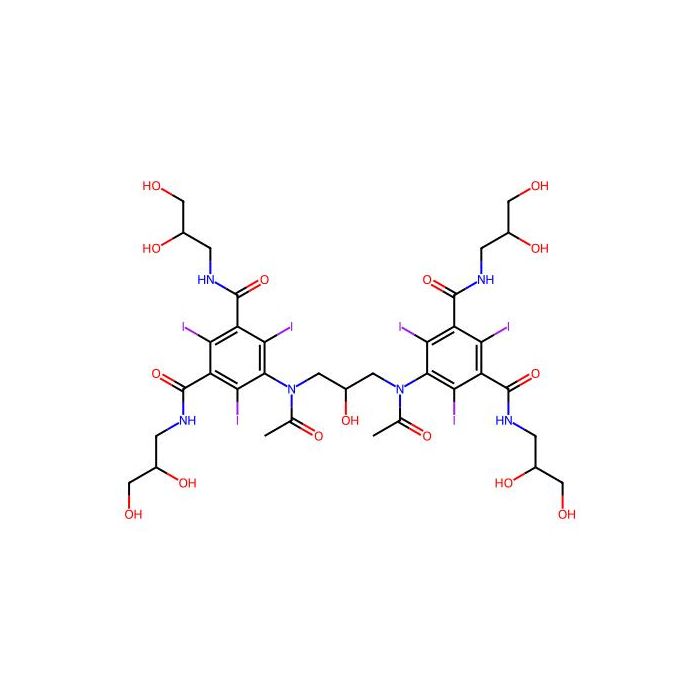
Iodixanol is a highly iodinated, nonionic, dimeric benzamide derivative widely used as an inert high-density medium in research workflows.
InChIKey: Not specified for this item; refer to CoA/Spec Sheet.
SMILES: Not specified for this item; refer to CoA/Spec Sheet.
Literature identity (for reference only; not item specifications)
Common name: Iodixanol
Molecular formula (literature): C35H44I6N6O15
Molecular weight (literature): ~1550.17 g/mol
Structural class: Nonionic, tri-iodinated benzamide dimer (two tri-iodinated aromatic rings linked via a polyhydroxylated, amide-containing scaffold)
Structural features (descriptive)
Aromatic system: Two substituted 2,4,6-triiodophenyl rings (three iodine atoms on each ring; total six iodines).
Functional groups: Multiple secondary and primary alcohols (polyhydroxylated), two amide linkages, tertiary amide carbons, and ether-like linkages within the polyol framework.
Charge/ionization: Overall neutral (nonionic) across physiological pH; extensive hydrogen-bonding capacity due to numerous –OH and amide groups.
2D description in words: Two heavily iodinated benzene cores, each bearing an amide substituent that connects to a central, short, branched polyol chain; the overall molecule is symmetric, compact, and densely functionalized with hydroxyls that confer high aqueous solubility despite the heavy iodine content.
Synthetic Utility
Iodixanol is not typically employed as a reagent or building block in organic synthesis due to its high molecular weight, dense functionalization, and specialized role as a density medium.
Reactivity profile (general)
The molecule contains multiple aryl iodides embedded within a deactivated, amide-substituted, polyhydroxylated framework. Although aryl iodides can, in principle, undergo cross-coupling, the steric bulk, low solubility in organic media, and synthetic value of the intact molecule make such transformations impractical and uncommon.
Numerous hydroxyl groups and two amide linkages confer strong hydrogen-bonding and high aqueous affinity, further limiting its use in typical organic reaction manifolds.
Practical takeaway
Consider iodixanol as a functional additive (density modifier) rather than a synthetic intermediate. If an iodinated aromatic building block is required, choose simpler aryl iodides or iodinated benzoic acid derivatives tailored for cross-coupling or substitution reactions.
Retrosynthetic perspective
The structural complexity of iodixanol reflects convergent assembly of iodinated aromatic units with protected polyol linkers; reverse engineering this architecture is not an efficient route to simpler iodinated motifs.
Accordingly, this section is largely non-applicable for bench synthesis; see Reaction & Applications and Buffer Applications for relevant laboratory use.
Target Specificity
Not applicable. This product is a small molecule/density medium, not a biological targeting reagent (e.g., antibody, ligand with defined target binding specificity). No antigen/epitope, species reactivity, clone, or isotype information applies.
We use cookies to ensure the website functions properly and, where permitted, to improve your experience. You can manage your preferences at any time in Settings. Learn more in our Cookie Policy.
Shall we send you a message when we have discounts available?
Remind me later
Thank you! Please check your email inbox to confirm.
Products are supplied to verified businesses, institutions, and qualified professionals for research and development use only. Not for use in humans, animals, diagnosis, or therapy.