
Determine the necessary mass, volume, or concentration for preparing a solution.
| Activity Type | Relation | Activity value | Units | Action Type | Journal | PubMed Id | doi | Assay Aladdin ID |
|---|
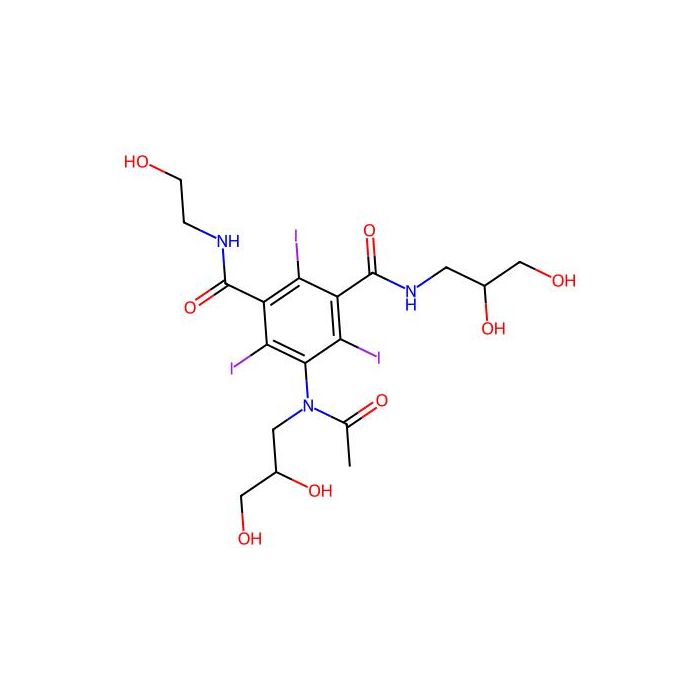
Ioxilan is a low-osmolar, nonionic and tri-iodinated diagnostic contrast agent. Ioxilan is also an X-ray contrast agent for excretory urography and contrast enhanced computed tomographic (CECT) imaging of the head and body. Intravascular injection results in opacification of vessels in the path of flow of the contrast medium, permitting radiographic visualization of the internal structures of the human body until significant hemodilution occurs .
In Vitro
As a low-osmolar nonionic monomer, Ioxilan increases the safety and tolerance of X-ray contrast agents. The development of Ioxilan is based on the introduction of a double methylene as a hydrophobic region and masking it with a hydrophilic hydroxyl group could lower the osmolality without adversely affecting the biological tolerance. MCE has not independently confirmed the accuracy of these methods. They are for reference only.
In Vivo
Rapid intravenous injection of water-soluble X-ray contrast agents (Ioxilan) can be performed with dynamic computed tomography to improve the detectability of liver lesions. When injected intravenously, water-soluble, intravenous X-ray contrast agents are largely distributed in the extracellular fluid space and excreted unchanged by the kidneys. Contrast enhancement of a region of interest depends on the route of administration, delivery of the agent to the area by blood flow, and the final iodine concentration in the region . MCE has not independently confirmed the accuracy of these methods. They are for reference only.
Form:Solid
Taxonomy Tree
| Kingdom | Organic compounds |
|---|---|
| Superclass | Benzenoids |
| Classe | Benzene and substituted derivatives |
| Subclass | Benzoic acids and derivatives |
| Intermediate Tree Nodes | Not available |
| Direct Parent | Acylaminobenzoic acid and derivatives |
| Alternative Parents | O-haloacetanilides P-haloacetanilides 2-halobenzoic acids and derivatives 4-halobenzoic acids and derivatives Benzamides Benzoyl derivatives N-acylethanolamines Iodobenzenes Aryl iodides Tertiary carboxylic acid amides Vinylogous halides Acetamides Secondary alcohols Secondary carboxylic acid amides Organoiodides Organic oxides Hydrocarbon derivatives Carbonyl compounds Organopnictogen compounds Primary alcohols |
| Molecular Framework | Aromatic homomonocyclic compounds |
| Substituents | Acylaminobenzoic acid or derivatives - O-haloacetanilide - P-haloacetanilide - Haloacetanilide - Acetanilide - 2-halobenzoic acid or derivatives - 4-halobenzoic acid or derivatives - Halobenzoic acid or derivatives - Benzamide - Anilide - N-acylethanolamine - Benzoyl - Halobenzene - Iodobenzene - Aryl iodide - Aryl halide - Acetamide - Vinylogous halide - Tertiary carboxylic acid amide - Carboxamide group - Secondary carboxylic acid amide - Secondary alcohol - Alkanolamine - Carboxylic acid derivative - Organohalogen compound - Primary alcohol - Organic nitrogen compound - Alcohol - Carbonyl group - Hydrocarbon derivative - Organic oxide - Organopnictogen compound - Organic oxygen compound - Organoiodide - Organonitrogen compound - Organooxygen compound - Aromatic homomonocyclic compound |
| Descrição | This compound belongs to the class of organic compounds known as acylaminobenzoic acid and derivatives. These are derivatives of amino benzoic acid derivatives where the amine group is N-acylated. |
| External Descriptors | Not available |
| Activity Type | Relation | Activity value | Units | Action Type | Journal | PubMed Id | doi | Assay Aladdin ID |
|---|
| Activity Type | Relation | Activity value | Units | Action Type | Journal | PubMed Id | doi | Assay Aladdin ID |
|---|
| Solubilidade | DMSO : ≥ 250 mg/mL (316.01 mM) |
|---|---|
| Peso molecular | 791.1 |
| XLogP3 | -2.400 |
| Hydrogen Bond Donor Count | 7 |
| Hydrogen Bond Acceptor Count | 8 |
| Rotatable Bond Count | 11 |
| Exact Mass | 790.87 Da |
| Monoisotopic Mass | 790.87 Da |
| Topological Polar Surface Area | 180.000 Ų |
| Heavy Atom Count | 32 |
| Formal Charge | 0 |
| Complexity | 647.000 |
| Isotope Atom Count | 0 |
| Defined Atom Stereocenter Count | 0 |
| Undefined Atom Stereocenter Count | 2 |
| Defined Bond Stereocenter Count | 0 |
| Undefined Bond Stereocenter Count | 0 |
| The total count of all stereochemical bonds | 0 |
| Covalently-Bonded Unit Count | 1 |
No manufacturer-tested bioassay protocols are provided for this item. The following general, research-use procedures illustrate common laboratory applications for iodinated radiopaque standards:
A. CT calibration phantom solution (general)
B. HPLC reference standard preparation (general)
C. Hydrogel phantom embedding (general)
These are illustrative only; optimize parameters for your instruments and objectives.
Ioxilan does not serve a native biochemical role; it is a synthetic, nonionic, tri‑iodinated aromatic designed to be highly X‑ray attenuating and water‑soluble. For research contexts, key physicochemical interactions in biological systems can be summarized as follows (general chemistry/biochemistry knowledge):
Note: Any in vivo behavior, ADME, or safety profile is outside the scope of this listing. This product is for research use only and not for human or animal diagnostic applications.
This compound is not a buffering agent and does not establish a defined pH range. However, in research workflows it can be incorporated into aqueous buffers to impart controlled X‑ray attenuation for imaging phantoms or instrument calibration.
Practical guidance (general):
For rigorous pH control, pair with a true buffer system appropriate for your target pH; this material contributes attenuation, not buffering capacity.
Context: Iodinated, tri‑iodo aromatics are specialty materials; “green” selection focuses on achieving the imaging/analytical objective with minimal environmental burden while ensuring lab safety.
Alternative strategies (general, application-driven):
Comparison snapshot (literature/general):
Waste minimization:
No pharmacopeial grade, monograph compliance, or clinical use status is stated for this catalog item. It is supplied strictly for research use only.
Formulation and manufacturing considerations (general knowledge for nonionic iodinated media):
If a pharmacopeial or clinical-grade supply is required, do not use this item; contact us to discuss availability of appropriate grades and documentation.
Item-specific physico-chemical specifications were not provided with this listing. Values below are general/literature-style guidance for nonionic tri‑iodinated benzamide contrast media and should not be treated as specifications for this SKU.
For certified values and acceptance limits (e.g., water content, impurities, UV absorbance), see the batch CoA/Spec Sheet. Do not substitute literature values for quality control of this item.
How to interpret grades for this product category (general guidance):
Item-specific QC parameters to confirm on CoA:
If your application requires a defined grade (e.g., USP/EP, injection-grade), contact us to discuss availability; this catalog item is for research use only as noted in the product data.
Research and laboratory applications (non-clinical):
Practical tips:
Note: This product is for research use only and not for human or animal diagnostic use.
This product is generally used as a formulated, highly water‑soluble analyte/standard rather than as a substrate in preparative reactions. Consequently, there are no typical “reaction conditions” specific to this compound in synthetic chemistry.
Method-development contexts (general guidance):
These are literature/general practices; for this SKU, consult the CoA/Spec Sheet for any item-specific recommendations.
General safe-handling guidance (laboratory, research use only):
Incompatibilities and stability (general chemistry knowledge):
First-aid overview (refer to SDS for authoritative instructions):
Spills and disposal:
Solubility and solvent behavior (general chemistry knowledge for nonionic iodinated benzamides):
When to choose water vs alternatives:
Comparative notes:
Always filter aqueous stock solutions (0.22–0.45 µm) to remove particulates for optical or imaging applications.
Storage guidance (general):
Reconstitution (general procedure):
Stability of solutions (general):
Research Use Note (product data): For research use only.
Ioxilan is a nonionic, tri‑iodinated, benzamide-based contrast agent molecule designed for high X‑ray attenuation while maintaining aqueous solubility.
Structural features (general chemistry knowledge):
Note: For exact constitutional depiction (SMILES/InChI) and batch identity, please consult the item’s CoA/Spec Sheet.
Ioxilan is a highly functionalized, tri‑iodinated aromatic designed as a final radiopaque agent; it is not commonly used as a synthetic intermediate. Nevertheless, in method development and analytical chemistry it can serve roles that support synthesis and QC:
Reactivity considerations (general):
For synthetic building-block needs, consider less elaborated iodinated benzoic acid derivatives that offer more accessible reactivity.
Not applicable. This product is a small-molecule, nonionic iodinated compound and is not an antibody, protein, or targeted ligand. No antigen/epitope or species reactivity applies. Refer to the Reaction & Applications tab for relevant research uses.