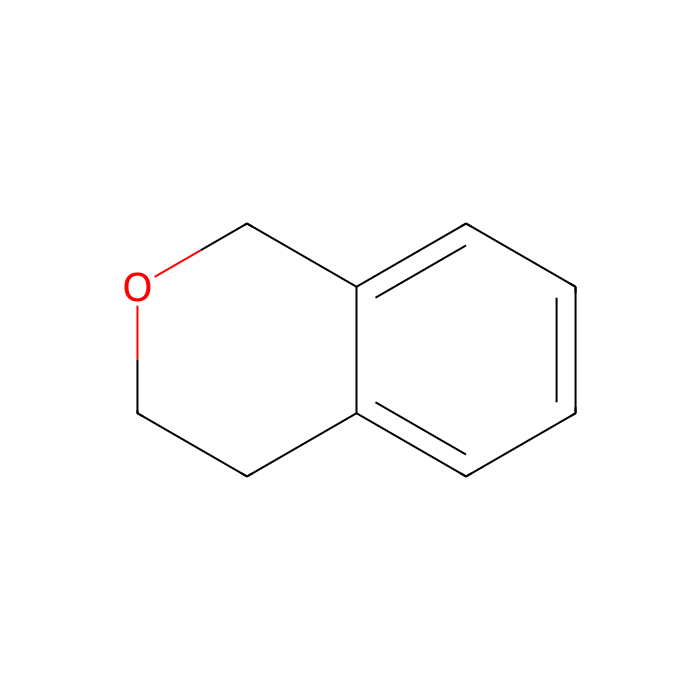
This compound belongs to the class of organic compounds known as 2-benzopyrans. These are organic aromatic compounds that 1-benzopyran, a bicyclic compound made up of a benzene ring fused to a pyran, so that the oxygen atom is at the 2-position.
External Descriptors
isochromanes
1. Djoumbou Feunang Y, Eisner R, Knox C, Chepelev L, Hastings J, Owen G, Fahy E, Steinbeck C, Subramanian S, Bolton E, Greiner R, and Wishart DS. ClassyFire: Automated Chemical Classification With A Comprehensive, Computable Taxonomy. Journal of Cheminformatics, 2016, 8:61.
Determine the necessary mass, volume, or concentration for preparing a solution.
Dilution Calculator
Determine the dilution needed to prepare a stock solution.
Reconstitution Calculator
Revisões
Avaliações dos Clientes
Application Protocols
No assay or immunoapplication protocols apply to this small-molecule reagent.
Usage guidance (general)
For synthetic applications, see the Reaction & Applications and Reaction Conditions sections for literature-based setups.
For analytical characterization, GC/MS and 1H/13C NMR in CDCl3 are commonly employed; verify identity and purity against reference spectra.
Item-specific tested applications: Not specified for this item; refer to CoA/Spec Sheet.
Biological Roles
Item-specific biological information: Not specified for this item; refer to CoA/Spec Sheet.
Literature/general context (no medical claims)
Isochroman itself is a simple aromatic ether scaffold without a known intrinsic biological role in primary metabolism. However, the isochroman motif appears in natural products and bioactive small molecules as a hydrophobic, conformationally restricted ether ring system.
The benzylic position can be functionalized to install polar groups (alcohols, amines, carbonyls), allowing derivatization into ligands or fragments for chemical biology studies.
Physicochemical profile: moderate lipophilicity and aromatic surface area can enhance membrane permeability of derivatives; the ether oxygen offers a single H-bond acceptor site. These are general design considerations rather than properties of the neat material.
Research use
Employed as a scaffold in fragment-based screening libraries or as a starting point for synthesis of probes; any biological evaluation should follow institutional safety and regulatory guidance and is outside the scope of this product description.
Buffer Applications
Isochroman is a neutral, hydrophobic organic compound and is not used as a buffering agent or pH control component. It has negligible water solubility and no relevant acid/base equilibria in the physiological pH range.
For aqueous buffer preparation, refer instead to standard systems (phosphate, HEPES, Tris, acetate). Isochroman may partition into organic phases during extractions but has no typical role in buffer formulation.
Green Alternatives
Because isochroman is most often employed as a building block rather than a bulk reaction solvent, direct “green replacement” is generally not applicable. However, greener choices can be made in transformations that involve isochroman.
Greener solvent choices around isochroman (literature/general)
Replace chlorinated solvents (e.g., CCl4 in radical brominations) with greener alternatives such as acetonitrile, ethyl acetate, or 2-MeTHF when compatible.
Use CPME or 2-MeTHF instead of THF for organolithium chemistry when stability allows (both have higher boiling points and improved safety profiles), noting potential differences in coordination and reactivity.
Oxidation choices
Swap stoichiometric DDQ or MnO2 with catalytic oxidations (e.g., TEMPO/bleach, or aerobic Pd catalysis) where chemoselectivity permits, to reduce waste.
Energy and safety
Conduct benzylic functionalizations at ambient temperature using photoredox catalysis as an alternative to thermal radical initiators.
Example comparison (general)
Traditional: NBS/AIBN in CCl4 (effective but hazardous solvent).
Greener: NBS under LED irradiation in MeCN or EtOAc; or electrochemical benzylic oxidation in MeOH/H2O with benign electrolytes.
Trade-offs
Greener media can alter selectivity/kinetics; verify by small-scale screening and ensure peroxide monitoring when using etheric co-solvents.
Pharmaceutical Uses
Item-specific pharmacopeial status/uses: Not specified for this item; refer to CoA/Spec Sheet.
Literature/general context (no therapeutic claims)
Isochroman is used as a synthetic intermediate in the manufacture of small-molecule candidates where the isochroman ring imparts lipophilicity and conformational bias. Typical roles include: precursor to isochromanones, benzylic halides (for cross-coupling), and functionalized side chains in medicinal chemistry programs.
It is not a common excipient, and there is no general pharmacopeial monograph for isochroman as an inactive ingredient.
Process considerations
For GMP settings, specification would typically include identity (GC/MS), purity (GC/HPLC), residual solvents, and peroxides due to ether functionality. Any such requirements are process- and program-specific and are not implied for this research-use product.
Physical Properties
Item-specific specs
Appearance: Not specified for this item; refer to CoA/Spec Sheet.
Literature/general properties (for reference; not item-specific specs)
State: typically a colorless to pale liquid with aromatic odor.
Boiling point: ~206–209 °C at 101 kPa (literature).
Melting point: typically below room temperature (liquid at RT; literature reports no sharp mp).
Density: ~1.05–1.07 g/mL at 20–25 °C (literature).
Refractive index (n20/D): ~1.556–1.560 (literature).
Solubility: low in water; miscible with common organic solvents (ethers, esters, aromatics, chlorinateds) (literature).
Vapor pressure: low at ambient temperature (literature qualitative).
UV characteristics: aromatic chromophore absorbs in near-UV; no defined low-UV cutoff established for HPLC use (literature qualitative).
Notes
The above are typical literature values meant to guide handling and selection; they are not specifications for this catalog item. For exact certificate values and test methods, consult the CoA/Spec Sheet for SKU I122961.
Quality and Grades
Item-specific quality information
Grade/Purity: Not specified for this item; refer to CoA/Spec Sheet.
Stabilizers/Inhibitors: Not specified for this item; refer to CoA/Spec Sheet.
Guidance on interpreting grades (general)
Research grade: typically suitable for most synthetic and analytical applications; impurity profiles (e.g., peroxides in ethers, trace aromatics, metals) vary by lot and are detailed on the CoA.
Low-UV/HPLC grade (if applicable): controlled UV absorbance and low nonvolatile residue for chromatographic use; absence of such a designation implies standard research-grade suitability rather than chromatographic solvent use.
Peroxide specification: For etheric materials, suppliers may include a peroxide test limit or ship under inert gas; this product is noted as argon charged, consistent with best practices for peroxide-prone ethers.
What to check on the CoA for Isochroman
Identity confirmation (GC/MS retention/mass), purity by GC or HPLC, water content (if tested), and any stabilizer or inhibitor used.
Peroxide content and test method, especially if solvent-like use is intended.
Residual solvent profile (if distilled) and assay basis (area% vs weight%).
Reaction and Applications
Isochroman is a versatile benzylic ether scaffold. The C1 (benzylic) position adjacent to oxygen is activated toward radical, cationic, and anionic transformations, enabling rapid diversification.
Benzylic radical halogenation: NBS or NCS (radical initiator, hv or AIBN) to give 1-haloisochromans, which are useful electrophiles.
Oxidation: DDQ or MnO2 to isochromanones (1-oxoisochromans); Baeyer–Villiger-like rearrangements from corresponding ketones expand the oxygen framework.
Lithiation/metalation: Directed deprotonation at C1 with strong bases (e.g., s-BuLi/TMEDA in THF, −78 °C) to form carbanions that react with electrophiles (carbonyls, CO2, halides).
Cationic activation: Brønsted or Lewis acids (e.g., TfOH, BF3·OEt2) form oxocarbenium ions enabling nucleophilic additions (allylation, cyanation, Friedel–Crafts-type arylation).
Cross-coupling via benzylic halides: Generated 1-bromomethyl isochromans participate in Suzuki, Negishi, or Kumada couplings under Pd or Ni catalysis.
Ring-opening: Hydrogenolysis or acid-catalyzed opening affords 2-aryl- or 2-alkyl-substituted benzyl alcohol derivatives.
Photochemical o-quinodimethane generation: Under photolysis, substituted isochromans may generate o-xylylene intermediates for intramolecular Diels–Alder (useful in polycyclic constructions).
Application domains
Diversity-oriented synthesis and medicinal chemistry: isochroman serves as a privileged, lipophilic heteroarene surrogate.
Protecting-group chemistry: related isochroman acetals act as protecting groups for benzylic alcohols; the parent isochroman framework informs those strategies.
Practical tips
Maintain anhydrous/inert conditions for organometallic steps. Monitor for over-oxidation when using strong oxidants. Benzylic selectivity can be tuned via solvent polarity and acid strength.
Reaction Conditions
The following are literature/general guidelines for common isochroman transformations; they are not specifications for this item.
Benzylic bromination
Reagents: NBS (1.1–1.2 eq), AIBN (5–10 mol%) or hv.
Solvent: acetonitrile, ethyl acetate, or toluene (avoid CCl4 for greener practice).
Temperature/time: reflux or LED irradiation at RT; 2–6 h. Typical isolated yields: 60–85% depending on substitution.
Oxidation to isochromanone
Reagents: DDQ (1.2–1.5 eq) in toluene or CH2Cl2; or MnO2 (excess) in CH2Cl2.
Temperature/time: 0 °C to RT; 1–12 h. Yields: 55–90% (substrate-dependent). Aerobic Pd or TEMPO systems may be used catalytically.
Benzylic lithiation/electrophile trapping
Base: s-BuLi (1.1–1.5 eq) with TMEDA in THF.
Temperature: −78 °C to −40 °C for deprotonation; then add electrophile (e.g., CO2, aldehyde).
Workup: careful quench at low temperature; inert atmosphere throughout.
Oxocarbenium-mediated additions
Activation: BF3·OEt2 (10–50 mol%) or TfOH (cat.) to generate oxocarbenium.
Nucleophiles: allyltrimethylsilane, arenes (Friedel–Crafts), TMSCN.
Solvent: CH2Cl2 or toluene, 0 °C to RT. Yields: typically 50–85%.
Cross-coupling from 1-bromomethyl isochroman
Catalyst: Pd(PPh3)4 (3–5 mol%) or Ni catalysts; base: K2CO3/Cs2CO3.
Solvent: toluene/DMF/1,4-dioxane. 60–100 °C; 4–16 h. Broad coupling partner scope.
Always run small-scale trials to optimize for your substrate and equipment.
Safety and Handling
GHS/Classification (item-specific)
Signal word: Not specified for this item; refer to SDS.
Hazard statements (H-): Not specified for this item; refer to SDS.
GHS classification/pictograms: Not specified for this item; refer to SDS.
General safety profile (literature/good practice; defer to SDS for authoritative guidance)
Aromatic ethers of this class are combustible liquids with low acute toxicity but can irritate eyes, skin, or respiratory tract upon high exposure.
Peroxide formation: like many ethers, isochroman can form peroxides upon prolonged exposure to air and light. The product is supplied argon charged (per Product Data), which mitigates this risk.
Handling recommendations
Work under inert atmosphere for long-term operations or storage; keep containers tightly closed. Minimize headspace oxygen.
Use in a chemical fume hood. Wear appropriate PPE: safety glasses or goggles, lab coat, and nitrile gloves. Consider cut-resistant gloves for large volumes and splash protection (face shield) when transferring heated liquid.
Avoid strong oxidizers and strong acids that may promote oxidative cleavage or ring opening. Avoid alkali metals/strong bases unless intended for deprotonation steps (benzylic lithiation generates reactive species).
First aid (overview; see SDS)
Inhalation: move to fresh air; seek medical attention if symptoms persist.
Skin/eye contact: rinse with water for several minutes; remove contaminated clothing; seek medical advice for persistent irritation.
Ingestion: rinse mouth; do not induce vomiting; seek medical attention.
Fire fighting
Use dry chemical, CO2, or alcohol-resistant foam. Cool containers with water spray. Combustion may produce CO/CO2 and irritant fumes.
Solvent Selection
Isochroman is primarily a hydrophobic aromatic ether building block rather than a mainstream process solvent. However, it can function as a specialty medium in niche transformations.
Polarity and miscibility (literature/general)
Polarity: low-to-moderate; aromatic ether character with modest dipole from the C–O bond.
Miscibility: miscible with common organic solvents (toluene, ethers, chlorinated solvents, esters); negligible solubility in water.
When it may be chosen
As an internal substrate/medium combination for reactions benefiting from substrate-rich conditions (e.g., benzylic functionalizations where neat or high-substrate concentration is useful).
For NMR or kinetic studies where using the substrate as diluent reduces extraneous signals (with appropriate deuterated lock solvent added).
Alternatives (typically preferred as bulk solvents)
Toluene, CPME, 2-MeTHF, MTBE for nonpolar to moderately polar conditions.
THF or dioxane when higher polarity/coordination is required.
Practical notes
Check peroxide content before using as medium. If the application is as a reagent/substrate, select standard anhydrous solvents as needed and treat isochroman itself as the limiting reagent rather than the solvent.
Storage and Reconstitution
Item-specific instructions (from Product Data)
Storage: Room temperature, Argon charged.
Shipped in: Normal.
Practical guidance (general/best practice)
Keep tightly sealed under inert gas to limit peroxide formation and oxidative discoloration. If possible, blanket headspace with argon or nitrogen after each use.
Store away from heat, light, and sources of ignition. Segregate from strong oxidizers and strong acids.
If long-term storage is anticipated, periodic peroxide testing (e.g., iodometric or commercial peroxide test strips) is recommended for ethers. Remove peroxides by approved methods only if necessary and if compatible with your application.
Drying: If anhydrous conditions are required, pass through activated alumina or treat with appropriate drying agents; verify water content by Karl Fischer if critical (not specified for this item; refer to CoA/Spec Sheet).
Reconstitution
Not applicable; supplied neat. If preparing solutions, use dry, oxygen-free solvents when moisture/oxygen sensitivity of your planned transformation warrants it.
Research use note
For research use only (as provided). Always consult the SDS for detailed handling and emergency information prior to use.
Structure and Identity
Isochroman is a bicyclic aromatic ether consisting of a benzene ring fused to a saturated tetrahydrofuran-like ring (a 1,3-benzodioxin without the second oxygen; formally a benzannulated oxacyclohexane). The oxygen is part of a six-membered saturated ring fused ortho to the benzene, giving a benzylic (C1) position adjacent to oxygen that is synthetically versatile.
Item-specific (from Product Data)
CAS: 493-05-0
PubChem CID: 96266
InChIKey: 119094 (as provided)
SMILES: Not specified for this item; refer to CoA/Spec Sheet.
Molecular formula: Not specified for this item; refer to CoA/Spec Sheet.
Molecular weight: Not specified for this item; refer to CoA/Spec Sheet.
Literature/general identity (for reference; not item-specific specs)
Common name: Isochroman (1,3-dihydroisobenzofuran)
Structural features: one ether oxygen; benzylic methylene at C1; aromatic ring permits EAS; no stereocenters in the parent unsubstituted ring system.
2D structure description (general)
A six-membered oxacycle (–O–CH2–CH2–CH2–CH–) fused to a benzene ring; the ring junction is ortho to the oxygen on the aromatic ring. The oxygen lies para to the benzylic C1 within the saturated ring. The benzylic C–H bonds are activated by both the adjacent oxygen and the aromatic ring.
Synthetic Utility
Isochroman serves as a compact, benzylic-activated ether that enables rapid installation of functionality at C1 and on the aromatic ring.
Benzylic C–H: selectively addressable for halogenation, oxidation, or C–C bond formation.
Aromatic ring: undergoes electrophilic substitution (nitration, halogenation, Friedel–Crafts acylation) with regioselectivity influenced by the fused ether ring.
Named/related strategies
Oxocarbenium-mediated additions (Sakurai allylation, cyanation, Friedel–Crafts) from 1-halo or protonated isochromans.
Benzylic metalation (s-BuLi/TMEDA) followed by quench with electrophiles (CO2 → carboxylates; aldehydes/ketones → secondary/tertiary alcohols).
Oxidations to isochromanone followed by further transformations (e.g., ring-expansion, amidation, or reductive opening to benzyl alcohol derivatives).
Cross-coupling from benzylic halides: Pd/Ni-catalyzed C(sp3)–C(sp2/sp3) bond formation.
Retrosynthetic value
Accessible from o-hydroxymethyl benzyl derivatives via intramolecular etherification; conversely, strategic ring opening of isochroman can unmask ortho-disubstituted benzyl frameworks.
Practical notes
Control overreaction at benzylic center by temperature and reagent stoichiometry; monitor with GC. Maintain anhydrous conditions for organometallic steps; quench carefully to avoid ring opening when undesired.
Target Specificity
This product is a small organic molecule, not a biochemical probe or antibody. No target specificity information applies.
Item-specific notes: Not specified for this item; refer to CoA/Spec Sheet if any target-binding data are provided for related research applications.
Usamos cookies para garantir o funcionamento adequado do site e, quando permitido, para melhorar a sua experiência. Você pode gerenciar suas preferências a qualquer momento nas Configurações. Saiba mais em nossa Política de Cookies.
Deseja que lhe enviemos uma mensagem quando tivermos descontos disponíveis?
Lembrar-me mais tarde
Obrigado! Por favor, verifique a sua caixa de entrada de e-mail para confirmar.
Products are supplied to verified businesses, institutions, and qualified professionals for research and development use only. Not for use in humans, animals, diagnosis, or therapy.

 E23171037