GRADE & PURITYMoligand™?Moligand™ — Aladdin's line of ligands and bioactive small molecules. Use for receptor, pathway, and binding studies needing defined small-molecule tools.10 mM in DMSO
Determine the necessary mass, volume, or concentration for preparing a solution.
Dilution Calculator
Determine the dilution needed to prepare a stock solution.
Reconstitution Calculator
Revisões
Avaliações dos Clientes
Application Protocols
Tested applications, recommended dilutions, positive controls, and assay-specific conditions are not provided for this item.
Application scope: Not specified for this item; refer to CoA/Spec Sheet.
If protocols are needed, consult peer-reviewed literature for compounds with the same CAS (1628870-27-8) and adapt carefully, validating all conditions locally. Maintain appropriate vehicle controls and confirm solubility/stability before use.
Biological Roles
Item-specific biological target(s), mechanism(s) of action, and pathway assignments are not provided in the product data for Itacnosertib.
General considerations for small-molecule research ligands (literature/general)
Potential roles may include modulation of enzyme activity, receptor binding, signal transduction alteration, or pathway perturbation in cellular systems; however, no specific claims can be made for this item without target data.
When exploring biological roles, recommend:
Establishing concentration–response relationships and evaluating selectivity against related targets.
Performing orthogonal assays (biochemical vs cellular) to confirm on-target effects.
Assessing time dependence, reversibility, and washout behavior to understand binding kinetics.
Evaluating cytotoxicity and general cell health to separate target-specific effects from nonspecific stress responses.
Important note
This product is designated For research use only. It is not intended for diagnostic, therapeutic, or clinical applications. All biological role assignments should be supported by user-generated or peer-reviewed data specific to this compound/lot.
Buffer Applications
This product is a small-molecule research compound and is not a buffering agent. Therefore, classical buffer system recipes and pH ranges are not directly applicable.
Practical assay buffer notes (general)
When dosing small molecules, prepare concentrated DMSO stocks and dilute into the assay buffer with vigorous mixing to avoid precipitation.
Maintain consistent vehicle (DMSO) percentage across all conditions (e.g., 0.1% v/v) to control for solvent effects.
Consider surfactants at low levels (e.g., 0.01–0.05% Tween-20) where compatible to reduce aggregation artifacts, and include protein (e.g., 0.1% BSA) if non-specific adsorption is observed.
Verify compound stability in the chosen buffer over the assay period by LC–MS or HPLC.
Item-specific buffer compatibility: Not specified for this item; refer to CoA/Spec Sheet and user validation.
Green Alternatives
Although this is a small-molecule research ligand rather than a solvent or bulk reagent, greener handling choices can reduce environmental impact.
Greener choices (general)
Prefer DMSO over DMF where feasible for stock preparation; DMSO has a more favorable safety and environmental profile than many dipolar aprotics (literature/general).
Minimize organic solvent volumes in assays by preparing higher-concentration stocks and delivering at low final v/v (e.g., ≤0.1%).
Use aqueous buffers with small cosolvent fractions instead of neat organic media when compatible with the assay.
Implement microscale screening and plate-based workflows to reduce chemical consumption and waste.
Adopt closed-well handling and vapor barriers to limit solvent evaporation and emissions.
Comparison snapshot (general)
DMSO vs DMF: DMSO generally lower volatility/odor and broader biological compatibility; DMF offers higher solvency for some chemotypes but with more stringent handling/disposal.
Ethanol vs isopropanol: similar greenness; choose based on solubility and assay tolerance.
Waste management
Segregate halogenated/non-halogenated organic waste and minimize purge volumes by using low-dead-volume tips and lines.
Pharmaceutical Uses
No pharmacopeial status, excipient role, or formulation guidance is provided for this item. This product is supplied strictly for research use only.
General notes (for preclinical research contexts only)
Small-molecule ligands are sometimes formulated for in vivo exploratory studies using vehicles such as PEG/solutol/saline, captisol solutions, or DMSO/cremophor/saline mixtures (literature/general). Any such use requires rigorous internal safety and ethical review and is outside the scope of this catalog listing.
Do not use in humans or for diagnostic purposes. No claims of efficacy, safety, or therapeutic utility are made or implied for this product.
Physical Properties
Item-specific physical constants have not been provided for this catalog entry.
Appearance: Not specified for this item; refer to CoA/Spec Sheet.
Melting point: Not specified for this item; refer to CoA/Spec Sheet.
Boiling point: Not specified for this item; refer to CoA/Spec Sheet.
Density: Not specified for this item; refer to CoA/Spec Sheet.
Refractive index: Not specified for this item; refer to CoA/Spec Sheet.
Solubility: Not specified for this item; refer to CoA/Spec Sheet.
logP/logD: Not specified for this item; refer to CoA/Spec Sheet.
pKa(s): Not specified for this item; refer to CoA/Spec Sheet.
General guidance (literature/general)
Many small-molecule screening ligands are supplied as solids intended for dissolution in DMSO to prepare concentrated stocks (e.g., 10–50 mM), then diluted into aqueous assay media to ≤0.1–0.5% DMSO v/v. Actual solubility and stability should be verified experimentally for this item.
If the compound contains ionizable groups (unknown here), solubility may be enhanced by adjusting pH or using cosolvents (DMSO, DMF, ethanol) with appropriate controls. Always verify by visual inspection and analytical methods (e.g., LC–MS, UV–Vis, HPLC).
Quality and Grades
Grade/Purity designation: Moligand™
What Moligand™ implies (general description)
Moligand™ products are positioned for discovery chemistry and screening workflows, typically as research-use-only small molecules. Analytical characterization, acceptance criteria, and any stabilizers/inhibitors (if applicable) should be confirmed in the CoA/Spec Sheet for the specific lot.
Item-specific notes
Declared purity, residual solvents, metal content, water/peroxide levels, and UV cutoffs are Not specified for this item; refer to CoA/Spec Sheet.
No stabilizers or salt form are stated in the provided data. If salt form, counter-ions, or polymorph are relevant to your use, verify against the CoA.
Best practices for screening-grade materials (general)
Verify identity and purity upon receipt if your application is sensitive (e.g., use LC–MS, 1H NMR, HPLC/UPLC). Record lot numbers in data packages for reproducibility.
For plate-based screening, filter stock solutions (e.g., PTFE 0.2 µm compatible with organic solvents) to reduce particulates. Monitor for precipitates after dilution into aqueous media.
If conducting quantitative studies (e.g., IC50, KD), confirm exact concentration by weight-by-volume with appropriate buoyancy correction and consider qNMR or UV–Vis with an extinction coefficient if available.
Reaction and Applications
This product is supplied as a research small molecule for discovery and screening. It is not typically used as a synthetic reagent or catalyst in bench transformations.
Research applications (general, literature)
Biochemical assays: Evaluate activity in enzyme or protein-binding assays after preparing DMSO stocks and serial dilutions; ensure vehicle controls and confirm linearity of signal with concentration.
Cell-based assays: Test phenotypic effects in cell lines with controlled DMSO content; assess cytotoxicity, target engagement (e.g., CETSA/BRET if applicable), and off-target profiles as needed.
ADME profiling: Determine stability, permeability, protein binding, and metabolic liability to contextualize activity data.
Chemoproteomics/affinity (if derivatization is feasible): Design photoaffinity or clickable analogs to explore target space. No specific derivatization is provided for this item; verify feasibility from the structure (not provided here).
Practical tips
Verify concentration by gravimetry and consider qNMR if extinction coefficients are unknown.
Assess compound stability in assay buffers over time (0–24 h) to avoid time-dependent artifacts. Track precipitation visually and analytically.
Use replicate lots or retain aliquots for hit reconfirmation to ensure data robustness.
Reaction Conditions
Not typically applicable. This product is not supplied for use as a reagent or catalyst in synthetic transformations, and no reaction condition data are provided for Itacnosertib.
General methodological note (literature/general)
If users undertake custom derivatization (e.g., to prepare analogs or probes), standard conditions should be selected based on the disclosed structure (not provided here) and functional-group tolerance. Validate on milligram scale and verify identity/purity by LC–MS and NMR.
Item-specific conditions: Not specified for this item; refer to CoA/Spec Sheet.
Safety and Handling
GHS and hazard information
Signal word: Not specified for this item; refer to SDS.
H-statements: Not specified for this item; refer to SDS.
GHS classification and pictograms: Not specified for this item; refer to SDS.
General laboratory precautions (professional guidance; defer to SDS/PI)
Handle in a chemical fume hood wearing appropriate PPE: lab coat, safety glasses, and chemical-resistant gloves (e.g., nitrile). Avoid inhalation of dust/vapors and contact with skin/eyes.
Unknown toxicological profile: treat as harmful if swallowed, inhaled, or in contact with skin. Prevent environmental release.
Incompatibilities are structure-dependent and not provided; as a precaution, avoid strong oxidizers, strong acids/bases, and reactive metals until specific data are available.
First aid (overview; see SDS for details): in case of skin/eye contact, rinse with water for ≥15 min; remove contaminated clothing. If inhaled, move to fresh air. If ingested, rinse mouth; seek medical attention. Provide SDS to responders.
Special risks and stability
Light, heat, and moisture can degrade many bioactive small molecules. Minimize exposure and keep tightly sealed under inert headspace when feasible.
Avoid repeated freeze–thaw cycles; aliquot upon first thaw (see Storage & Reconstitution).
Waste disposal
Dispose of unused material, solutions, and contaminated PPE as hazardous chemical waste in accordance with institutional and local regulations.
Solvent Selection
Because structure and solubility are not provided, begin with conservative, screening-compatible solvents and escalate only as needed.
General solvent strategy (literature/general)
Primary stock solvent: DMSO is the default for many discovery compounds due to broad solvency and biological compatibility at ≤0.1–0.5% v/v in assays.
Secondary options: DMF (higher solvency; use sparingly for bioassays), ethanol or isopropanol for less polar chemotypes; water with pH adjustment if ionizable groups are present (unknown here).
Cosolvent systems: DMSO/H2O, DMSO/PBS, or DMSO/ethanol can mitigate precipitation upon dilution. Add compound-in-DMSO into vigorously mixed buffer to avoid local supersaturation.
Polarity and miscibility (general)
DMSO is miscible with water and common organic solvents, simplifying serial dilutions for biochemical and cell-based assays. Verify that final DMSO content does not confound assay readouts.
Decision guide (practical)
If insoluble at 10 mM in DMSO at RT, gently warm (≤40 °C) and sonicate briefly. If still insoluble, consider DMF or adding a small amount of ethanol as a cosolvent, with proper controls.
Confirm solubility and absence of aggregation using orthogonal readouts (light scattering, UV–Vis baseline, HPLC recovery).
Storage and Reconstitution
Storage conditions (item-specific)
Store at -80 °C.
Shipped on dry ice packs + cold packs. Upon receipt, place immediately at -80 °C.
General handling and aliquoting (professional guidance)
Allow containers to equilibrate to ambient temperature in a desiccator before opening to avoid condensation. Reseal promptly under dry air or inert gas if possible.
To prevent degradation and precipitation artifacts, prepare single-use aliquots upon first thaw and return unused stock to -80 °C promptly. Avoid repeated freeze–thaw cycles.
Reconstitution guidance (general; not item-specific)
Typical approach: dissolve in anhydrous DMSO to prepare a concentrated stock (e.g., 10–50 mM), verifying complete dissolution by visual inspection and analytics (LC–MS/HPLC). If solubility is limited, gentle warming (≤40 °C) and brief sonication can help.
For aqueous assays, add the DMSO stock slowly into vigorously mixed buffer to the desired final concentration, keeping DMSO ≤0.1–0.5% v/v unless otherwise validated.
Record lot number, concentration, solvent, and date on each aliquot. Store working stocks at -20 °C (short term) or -80 °C (long term) as stability permits; actual stability for this item is Not specified for this item; refer to CoA/Spec Sheet.
Stability and compatibility
Light/moisture sensitivity: Unknown; protect from light and moisture as a precaution.
Long-term stability, degradation pathways, and recommended retest intervals: Not specified for this item; refer to CoA/Spec Sheet.
Research use note
For research use only. Not for human or diagnostic use.
Structure and Identity
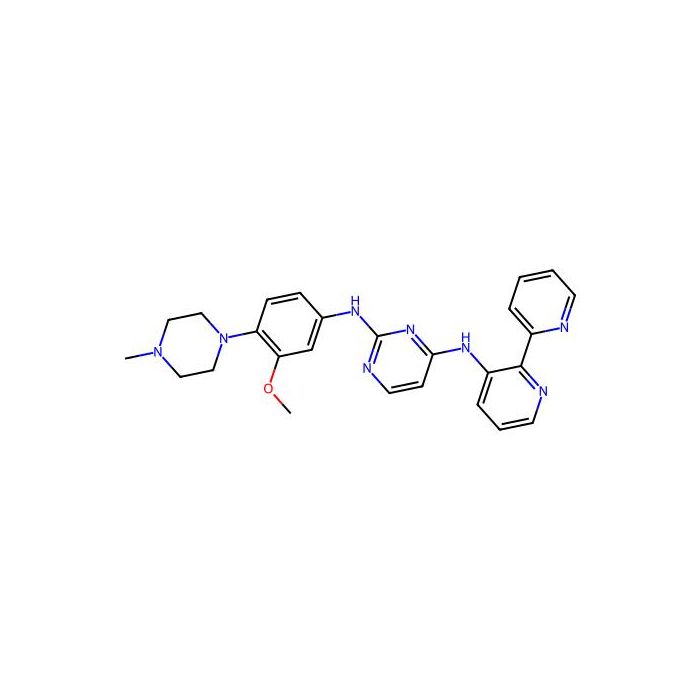
Product name: Itacnosertib (SKU: I1494289)
CAS: 1628870-27-8
PubChem CID: 86290265
Molecular formula: Not specified for this item; refer to CoA/Spec Sheet.
Molecular weight: Not specified for this item; refer to CoA/Spec Sheet.
SMILES: Not specified for this item; refer to CoA/Spec Sheet.
InChIKey: Not specified for this item; refer to CoA/Spec Sheet.
Structural features
Item-specific functional groups, ring systems, and stereochemistry: Not specified for this item; refer to CoA/Spec Sheet.
General notes
Based on the naming convention “-sertib,” Itacnosertib may belong to a class of small-molecule research ligands often investigated in kinase-related pathways (literature/general), but no target or scaffold information is provided in this product’s data. All structural and mechanistic inferences should be confirmed against the CoA/SDS for this specific lot.
Without an available 2D structure, treat it as an unknown small-molecule research compound when planning solubility and handling (see Solvent Selection and Storage & Reconstitution).
Synthetic Utility
Itacnosertib is offered as a research ligand, not as a general synthetic building block. Without a disclosed structure, specific functional-group reactivity, protecting-group strategies, and named-reaction participation cannot be detailed for this item.
General strategies for analogous compounds (literature/general)
If analog generation or SAR is planned, identify potential diversification points (heteroaryl substituents, linkers, stereocenters) from the structure (not provided here) and apply modular cross-couplings (e.g., Suzuki, Buchwald–Hartwig), amide couplings, or heterocycle annulations where compatible.
Late-stage functionalization (C–H activation, photocatalysis) can accelerate library expansion once tolerated positions are known.
Salt formation, prodrug derivatization, or isotopic labeling can be considered for PK or mechanistic studies, subject to chemical feasibility.
For this specific item
Reaction participation, reactivity, and building-block value: Not specified for this item; refer to CoA/Spec Sheet and any available structural disclosure.
Target Specificity
Target, pathway, or enzyme specificity: Not specified for this item; refer to CoA/Spec Sheet.
Binding constants, selectivity panels, or mode of action: Not specified for this item; refer to CoA/Spec Sheet.
Note: Any target attributions must be supported by data specific to this compound/lot. No target claims are made in this listing.
Need help choosing the grade?
Our grade selection guide covers purity, stabilizer status, and application suitability for all variants in our catalog.
We use cookies to ensure the website functions properly and, where permitted, to improve your experience. You can manage your preferences at any time in Settings. Learn more in our Cookie Policy.
Shall we send you a message when we have discounts available?
Remind me later
Thank you! Please check your email inbox to confirm.
Products are supplied to verified businesses, institutions, and qualified professionals for research and development use only. Not for use in humans, animals, diagnosis, or therapy.