≥98% for sensitive chromatographic and analytical workflows requiring minimal baseline interference.
🌡
Storage & shipping
Store at -20°C Ships Ice chest + Ice pads Check lot-specific COA for exact specifications.
📋
Quality documents
SDS, COA, datasheet, and spec sheet available for download. Lot-specific COA accessible via lot number lookup.
📚
Literature proof
Cited in 0 peer-reviewed publications across chromatography, organic synthesis, and cross-coupling reactions.
Visão geral
Information
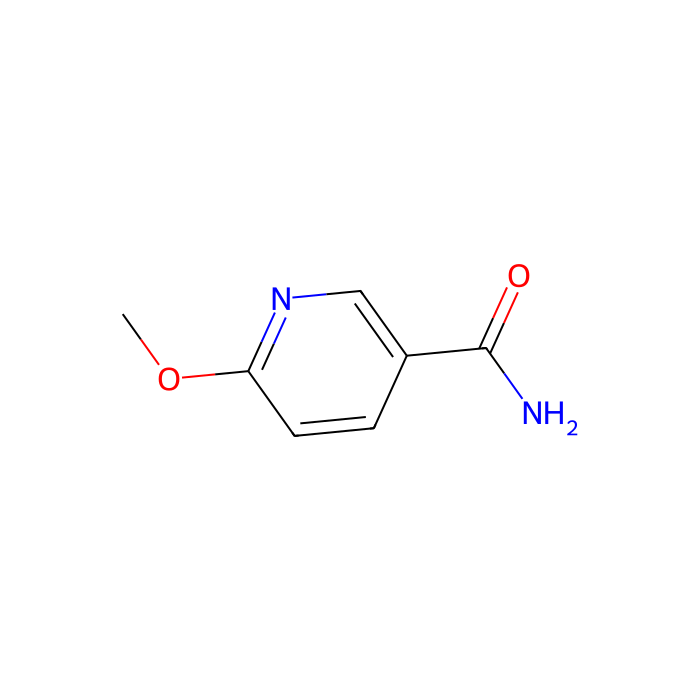
JBSNF-000088 (6-Methoxynicotinamide), an analog of nicotinamide (NA), is a potent inhibitor ofNicotinamide N-methyltransferase (NNMT)with IC50 of 1.8 µM, 2.8 µM, and 5.0 µM for human NNMT(hNNMT), monkey NNMT (mkNNMT) and mouse NNMT (mNNMT), respectively.
This compound belongs to the class of organic compounds known as nicotinamides. These are heterocyclic aromatic compounds containing a pyridine ring substituted at position 3 by a carboxamide group.
External Descriptors
Not available
1. Djoumbou Feunang Y, Eisner R, Knox C, Chepelev L, Hastings J, Owen G, Fahy E, Steinbeck C, Subramanian S, Bolton E, Greiner R, and Wishart DS. ClassyFire: Automated Chemical Classification With A Comprehensive, Computable Taxonomy. Journal of Cheminformatics, 2016, 8:61.
Determine the necessary mass, volume, or concentration for preparing a solution.
Dilution Calculator
Determine the dilution needed to prepare a stock solution.
Reconstitution Calculator
Revisões
Avaliações dos Clientes
Application Protocols
No application protocols are specified for this SKU in the product data.
General protocol framework for using small-molecule library members in assays:
Stock solution: Dissolve the compound at 10–50 mM in anhydrous DMSO. Record exact concentration by gravimetric preparation or UV/qNMR where possible.
Plate handling: Aliquot into low-binding, solvent-compatible plates or tubes. Minimize freeze–thaw by preparing single-use aliquots (e.g., 10–20 µL).
Dilution: Prepare serial dilutions in DMSO, then back-dilute into assay buffer to achieve the final DMSO content tolerated by the assay (commonly 0.1–1%). Include vehicle controls at each dilution.
Readout controls: Include positive and negative controls, detergent (for aggregation checks), and redox or fluorescence interference controls as warranted.
Data quality: Monitor Z′-factor, signal window, and hit rate; confirm hits with independent assay modalities.
Stability check: Verify integrity by LC–MS of working stocks after the assay window.
For chromatographic or spectroscopic applications, or any vendor-validated protocols, please request the lot-specific documentation (CoA/Spec Sheet/SDS).
Biological Roles
The biological roles, targets, or pathways for this specific compound are not provided in the product data, and no structure is disclosed here. Consequently, item-specific biological function cannot be stated.
General considerations when evaluating biological roles of screening compounds:
Target engagement: Use orthogonal biophysical methods (e.g., DSF, ITC, SPR, CETSA) to confirm binding independent of assay signal.
Selectivity profiling: Employ counterscreens against common off-targets and broad profiling panels (e.g., kinases, GPCRs, CYPs) as appropriate to the modality suggested by preliminary SAR.
ADME liabilities: Early checks for permeability (PAMPA/MDCK), metabolic stability (HLM/microsomes/S9), and basic solubility/ionization profiles (kinetic solubility, pKa) guide dosing in cellular assays.
Aggregation and redox artifacts: Use detergents, BSA, or redox buffers to mitigate colloidal aggregation and redox cycling that can mimic activity.
Fluorescence/absorbance interference: Capture UV–Vis and emission spectra of the compound to flag overlaps with assay readouts.
Research Use Only note:
This product is intended for laboratory research use only. No clinical, diagnostic, or therapeutic claims are made or implied. For any biological role assertions, rely on your internally generated data in conjunction with the full CoA/SDS for this lot.
Buffer Applications
This product is not supplied or positioned as a buffering agent, and no acid/base pKa or buffer-capable functional groups are provided in the product data. Therefore, buffer formulation guidance is not applicable.
If you intend to use the compound in buffered assay systems:
Prepare a concentrated stock in a suitable organic solvent (commonly DMSO or ethanol) and dilute into the target buffer, keeping the final organic content within the assay’s tolerance (often ≤0.5–1% v/v).
Validate kinetic solubility at the intended pH and ionic strength. Adjust pH or use salt forms to enhance solubility only after confirming chemical stability.
For actual buffer preparation (HEPES, PBS, TRIS, acetate, citrate), consult standard biochemical buffer references. Item-specific pKa values and buffering ranges: Not specified for this item; refer to CoA/Spec Sheet if relevant.
Green Alternatives
Because the chemical identity and solvent preferences of this specific library member are undisclosed in the provided data, concrete greener substitutions for this compound itself cannot be proposed.
General guidance for greener practice with small-molecule libraries:
Solvents: Prefer greener solvents for stock dissolution and work-up when compatible with the compound and assay (e.g., ethanol over methanol, 2-MeTHF or CPME over THF/diethyl ether, water-based buffers with minimal DMSO when possible).
Minimizing DMSO: While DMSO offers unmatched solvency, limit final assay DMSO to the lowest effective concentration (typically ≤0.5–1%) and consider ethanol or PEG-400/water co-solvent systems if compatible.
Micro-scale operations: Use miniaturized assay formats (384/1536-well) to reduce solvent and compound consumption.
Energy: Store consolidated at −20 °C to reduce freezer load; plan batch thawing/aliquoting to minimize freeze–thaw cycles and waste.
Waste: Segregate halogenated vs. non-halogenated solvent waste; use solvent recyclers where feasible.
Illustrative solvent comparison (general):
Ethanol vs. Methanol: Ethanol is less toxic and preferred where solubility permits; both are volatile and assay-friendly.
2-MeTHF/CPME vs. THF: Similar solvency with improved stability and greener profiles; confirm compound stability in ethers before use.
Water/co-solvent systems: Ideal when compound ionization/salt formation allows; verify stability and assay compatibility.
For item-specific green alternatives or processing recommendations, consult the CoA and conduct a small solvent/stability screen.
Pharmaceutical Uses
No pharmacopeial status, excipient role, or formulation use is provided for this SKU. This product is supplied strictly for research use as part of a small-molecule/compound library.
General considerations if using in pre-formulation research (non-clinical, lab-only):
Solubility/permeability: Determine equilibrium and kinetic solubility across biorelevant media; measure logD/pKa if formulation screening is contemplated.
Solid form: Characterize polymorph/salt state by PXRD/DSC/TGA and moisture sorption (DVS) to anticipate stability and handling behaviors.
Stability: Conduct forced-degradation studies (acid/base, oxidative, thermal, photolytic) to map vulnerabilities prior to excipient compatibility screens.
Vehicle systems for in vivo research (if permitted by your institution and within all regulations): Use only after toxicology review; typical lab vehicles include PEG-400, Captisol, cremophor/ethanol/saline, or 0.5% methylcellulose with minimal DMSO — but applicability depends entirely on the compound’s properties, which are not provided here.
Important: Aladdin Scientific supplies this material for research use only. It is not an API, excipient, or GMP-grade material, and no clinical, diagnostic, or therapeutic use is intended or permitted.
Physical Properties
Item-specific physicochemical constants are not provided in the current product data. Where a quantitative value is required for your application, please consult the CoA/Spec Sheet or measure experimentally.
Appearance: Not specified for this item; refer to CoA/Spec Sheet.
Melting point (MP): Not specified for this item; refer to CoA/Spec Sheet.
Boiling point (BP): Not specified for this item; refer to CoA/Spec Sheet.
Density: Not specified for this item; refer to CoA/Spec Sheet.
Solubility: Not specified for this item; refer to CoA/Spec Sheet.
LogP/logD, pKa, refractive index: Not specified for this item; refer to CoA/Spec Sheet.
General laboratory guidance (literature/practice-based):
Solubility screening is recommended for library compounds: test DMSO (typically 10–50 mg/mL target for primary stocks), MeOH, EtOH, DMF, and aqueous buffers with co-solvent (2–10% DMSO) as needed.
If the compound is highly lipophilic (observed by persistent turbidity or oiling out), raise temperature gently (≤40 °C) and consider sonication; avoid prolonged heating if stability is unknown.
If ionizable, adjust pH to favor salt formation (e.g., convert amines to HCl salts; acids to Na/K salts) to enhance aqueous solubility; verify by NMR/LC–MS.
Thermal behavior can be rapidly assessed with DSC/TGA if processing or storage stability is a concern.
For hygroscopic or deliquescent solids, handle in a dry box or quickly cap to minimize water uptake (check with Karl Fischer if critical).
All specific property values for this SKU: Not specified for this item; refer to CoA/Spec Sheet.
Quality and Grades
Grade/Purity: Not specified for this item; refer to CoA/Spec Sheet.
Context and expectations for library compounds from Aladdin Scientific:
Library members are typically supplied as research-grade solids or DMSO solutions with identity confirmed by LC–MS and/or NMR. For this specific SKU, confirm the provided analytical package on the CoA.
Purity reporting: For screening, a minimum of ≥90–95% by HPLC/LC–MS is commonly targeted in the industry; verify the actual value on the CoA for this item. When orthogonal purity (qNMR, 2D NMR) is required, request associated documentation.
Residual solvents, water content, and stabilizers: Not specified for this item; refer to CoA/Spec Sheet. If trace stabilizers or salt forms are present, they will be listed on the CoA and may affect assay readouts.
Lot-to-lot consistency: For HTS/HCS, we recommend confirming identity and purity on receipt (rapid LC–MS and 1H NMR) and after any repackaging.
UV profile: If using in photometric assays or HPLC UV detection, obtain the UV spectrum to assess cutoff and potential interference. Not specified for this item; refer to CoA/Spec Sheet.
Documentation:
This product is provided for research use only. Request the latest CoA/Spec Sheet from Aladdin Scientific with lot-specific purity, chromatographic conditions, retention time, and analytical traces for your records.
Reaction and Applications
This SKU is supplied as a screening library member rather than a general-purpose reagent or building block. Without a disclosed structure, specific synthetic or mechanistic applications cannot be recommended.
Research use contexts (general guidance):
Primary/secondary screening: Use in biochemical, biophysical, or cell-based assays to identify and validate structure–activity relationships (SAR). Maintain meticulous plate mapping and vehicle controls (e.g., 0.1–1.0% DMSO).
Orthogonal confirmation: Confirm activity with alternate readouts (e.g., enzyme kinetics vs. thermal shift) to rule out assay interference (fluorescence quenching, aggregation, redox cycling). Include counter-screens for pan-assay interference (PAINS) where applicable.
Stability checks: Prior to screening, assess compound integrity by LC–MS after thaw and after assay incubation conditions (pH, buffer components, light). Some small molecules can hydrolyze or oxidize under assay conditions.
Aggregation controls: Incorporate low non-ionic detergents (e.g., 0.01% Tween-20) and dynamic light scattering where aggregation artifacts are suspected.
Solubility ceiling: Establish top test concentration below kinetic solubility to avoid precipitation and false negatives/positives.
Not applicable for this item:
Named synthetic reactions and reagent-type applications cannot be specified without structural information. If you intend to use this material as a synthetic intermediate, request the full structural data and stability profile from the CoA/Spec Sheet first.
Reaction Conditions
Reaction conditions are not applicable for this SKU in the absence of structural and functional group information. As supplied, the material is intended for biological or biochemical screening rather than for use as a reagent in named transformations.
If you plan exploratory chemistry on this compound (after obtaining the full structure and CoA):
Run micro-scale reactions (≤10 mg) to evaluate stability under acid/base, redox, and thermal stress.
Start with mild, chemoselective conditions; monitor by LC–MS/UPLC to capture transient degradation or rearrangements.
Conduct parallel solvent screening (e.g., MeCN, DCM, toluene, 2-MeTHF, EtOAc, MeOH) with controlled water content to gauge solvolysis or hydrolysis.
Establish a quench/extraction protocol compatible with the compound’s polarity (salting out vs. liquid–liquid extraction vs. SPE).
Photostability: If chromophores are suspected (colored solutions, UV absorbance), protect from light during reactions and handling.
Expected yields, catalysts, and temperature ranges: Not applicable to this item without structure; refer to literature only after identity is confirmed. Always verify the compound’s integrity by NMR/LC–MS before and after any reaction attempt.
Safety and Handling
Safety data specific to this SKU have not been provided. Always consult the SDS supplied with the lot for authoritative hazard classification and response procedures.
GHS classification: Not specified for this item; refer to SDS.
Signal word and H-statements: Not specified for this item; refer to SDS.
Pictograms: Not specified for this item; refer to SDS.
General laboratory precautions for small-molecule libraries:
Work in a chemical fume hood; avoid inhalation and skin/eye contact.
Wear appropriate PPE: lab coat, safety glasses, and disposable nitrile gloves (double-glove when handling neat materials or DMSO solutions).
Avoid generating aerosols or dust; if powdered, gently tap to settle before opening.
Incompatibilities: Unknown for this item; segregate from strong oxidizers, strong acids/bases, and reducing agents until stability is verified by SDS/CoA.
If dissolved in DMSO, note that DMSO enhances dermal absorption; prevent skin contact.
First aid (overview; defer to SDS): move to fresh air if inhaled; rinse skin with water for ≥15 minutes upon contact; irrigate eyes for ≥15 minutes; seek medical advice after ingestion or significant exposure.
Spill response: Absorb with inert material, collect in sealed container for disposal; decontaminate area per institutional EHS procedures. Avoid release to the environment.
Waste disposal: Follow local regulations; many screening compounds are best treated as hazardous organic waste.
Research Use Only: Not for human or veterinary use; not for diagnostic or therapeutic applications.
Solvent Selection
Item-specific solubility parameters are not provided; select solvents empirically, beginning with robust screening solvents appropriate for diverse small molecules.
Recommended workflow (general guidance):
Primary stock preparation: DMSO (anhydrous) is the default for screening libraries; aim for 10–50 mM (or mg/mL equivalents) based on molecular weight from the CoA. Warm gently (≤40 °C) and sonicate if needed.
Organic alternatives: Methanol, ethanol, acetonitrile, DMF, or 2-methyltetrahydrofuran (2-MeTHF) may be used depending on polarity and stability. Verify chemical stability by LC–MS after 24–48 h at room temperature.
Aqueous use: Prepare intermediate stocks in organic solvent, then dilute into assay buffer to a final organic content typically ≤0.5–1% v/v (check assay tolerance). For poorly soluble analytes, consider 2–5% v/v with appropriate vehicle controls.
Salt formation: For basic amines, convert to HCl salts to enhance water solubility; for acids, use Na/K salts. Confirm by NMR.
Avoid: Reactive protic solvents if the compound has labile moieties (acyl halides, anhydrides, isocyanates). If structure is unknown, run a quick stability panel.
Small comparison (general):
DMSO: Broad solubility; may affect cells/enzymes at >0.5–1%.
MeOH/EtOH: Good for many heterocycles; volatile and assay-friendly at low %.
ACN: UV-transparent; can precipitate hydrophobes upon aqueous dilution.
DMF: Strong solvent; higher toxicity; use sparingly and with controls.
Storage and Reconstitution
Storage conditions (from Product Data): Store at −20 °C.
Shipping: Shipped in an ice chest with ice pads (from Product Data) to maintain low temperature.
Container: Keep tightly closed in the original, light-protective container if supplied; purge with inert gas after opening if recommended on the CoA.
General reconstitution guidance for library compounds:
Upon receipt, allow the sealed container to equilibrate to room temperature before opening to prevent condensation.
If supplied as a solid: Prepare a concentrated stock in anhydrous DMSO (typical 10–50 mM). Mix by gentle vortex and short sonication; avoid prolonged heating unless stability is known.
If supplied in solution (e.g., DMSO): Inspect for precipitation or discoloration after transit. Warm to room temperature and vortex to fully redissolve. If persistent solids remain, briefly sonicate and verify concentration by UV/qNMR if critical.
Aliquoting: Prepare single-use aliquots to avoid repeated freeze–thaw. Store aliquots at −20 °C in sealed, inert-atmosphere vials when possible.
Freeze–thaw guidance: Minimize cycles; thaw on ice or at room temperature, mix thoroughly, and promptly return unused material to −20 °C. Discard aliquots showing degradation by LC–MS/NMR.
Light/moisture sensitivity: Not specified for this item; refer to CoA/Spec Sheet. As a precaution, protect from light and humidity during handling.
Research Use Only: For laboratory research use; not for human or veterinary applications.
Structure and Identity
This product is a member of a small-molecule screening library (internal code JBSNF-000088), supplied for research use.
SKU: J413630
Product code/name: JBSNF-000088
CAS: 7150-23-4 (as provided in product data)
PubChem CID: 250810 (as provided in product data)
InChIKey: Not specified for this item; refer to CoA/Spec Sheet. (Note: the provided string “192024” is not a valid InChIKey format.)
SMILES: Not specified for this item; refer to CoA/Spec Sheet.
Molecular formula: Not specified for this item; refer to CoA/Spec Sheet.
Molecular weight: Not specified for this item; refer to CoA/Spec Sheet.
Structural description:
Item-specific functional groups, ring systems, and stereochemistry are not available in the supplied data. For definitive identity, please consult the Certificate of Analysis (CoA), Spec Sheet, and SDS.
Acquire high-resolution mass spectrometry (HRMS) to confirm exact mass and isotopic pattern.
Record 1H/13C NMR (and 2D NMR as needed) in an appropriate deuterated solvent (DMSO-d6, CDCl3, or CD3OD based on solubility screening).
Obtain IR spectrum for key functional group verification.
For chiral compounds, use chiral HPLC or optical rotation where applicable.
If available, cross-verify with external databases (CAS/CID) using the CoA structural string (SMILES/InChI) supplied by the manufacturer.
Notes:
Any missing identifiers should be requested from Aladdin Scientific customer support. Ensure all identifiers on the CoA match your internal records before use in screening campaigns.
Synthetic Utility
Specific synthetic roles for this SKU cannot be described without a disclosed structure or functional group information. The product is sold as a small-molecule screening library member rather than as a designated reagent or building block.
General guidance if considering the compound as a synthetic intermediate (ensure structural information is obtained from the CoA first):
Functional group compatibility: Review NMR/IR/LC–MS data to identify reactive handles (e.g., halides, boronates, esters, nitriles) before planning transformations.
Protection strategy: If polyfunctional, map protecting group needs based on orthogonality and stability (acid/base/redox) using small-scale scouting reactions.
Purification: Establish a baseline chromatographic method (normal/reverse phase) from the CoA HPLC system; verify UV wavelengths and potential fluorescence that may aid detection.
Scalability: Library compounds are often supplied in limited quantities; plan micro-scale reactions and analytical monitoring (UPLC, LC–MS) to conserve material.
IP/novelty: If the structure is unique to a library, assess freedom-to-operate and publication constraints before derivative synthesis.
If you require a defined building block for synthesis, please contact Aladdin Scientific with your target functionality; we can assist in identifying a catalog reagent with specified structure and grade.
Target Specificity
Target specificity data (e.g., named protein, enzyme class, receptor family) are not provided for this SKU.
Tested targets/epitopes: Not specified for this item; refer to CoA/Spec Sheet or internal screening results.
Assay-validated selectivity: Not specified for this item; refer to CoA/Spec Sheet or your lab’s profiling data.
Guidance for establishing specificity with screening compounds:
Use orthogonal binding and functional assays (biochemical vs. cellular readouts) to ensure congruent activity.
Profile off-targets based on chemotype once structural data are available (e.g., kinome scans for kinase-like motifs, broad GPCR panels for cationic amphiphiles).
Incorporate negative controls and inactive analogs; apply counterscreens for redox cycling, metal chelation, or detergent-sensitive aggregation.
All target-related claims for this item should be based on your experimental evidence and the final structure confirmed by the product CoA.
Perguntas frequentes
What is the purity of this product?
This product is supplied at ≥98% purity (chemical assay). Lot-specific values are stated on the Certificate of Analysis.
How should this product be stored?
Store at ?20 °C. Freezer storage is required to maintain the specified shelf life.
How is this product shipped?
This product ships in an insulated container with ice pads. Unpack on arrival and transfer it to the storage condition stated above.
What are the CAS number, molecular formula and molecular weight?
The CAS Number is 7150-23-4, the molecular formula is C7H8N2O2, and the molecular weight is 152.2 g/mol. InChIKey KXDSMFBEVSJYRF-UHFFFAOYSA-N.
What documentation is provided?
Available product documentation, including Certificates of Analysis (COA), Safety Data Sheets (SDS), and specification sheets, is shown in the product document area. Document availability and access follow the current site policy.
Usamos cookies para garantir o funcionamento adequado do site e, quando permitido, para melhorar a sua experiência. Você pode gerenciar suas preferências a qualquer momento nas Configurações. Saiba mais em nossa Política de Cookies.
Deseja que lhe enviemos uma mensagem quando tivermos descontos disponíveis?
Lembrar-me mais tarde
Obrigado! Por favor, verifique a sua caixa de entrada de e-mail para confirmar.
Products are supplied to verified businesses, institutions, and qualified professionals for research and development use only. Not for use in humans, animals, diagnosis, or therapy.

 L2413205