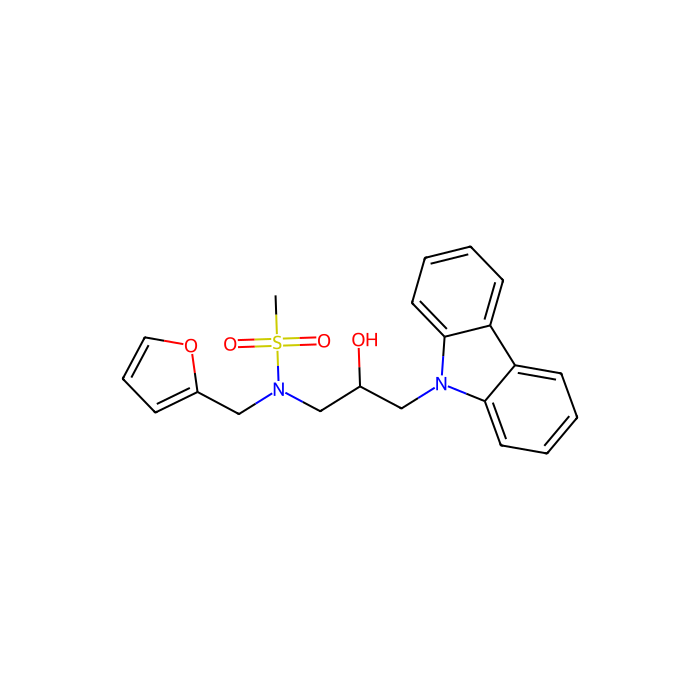
Cryptochrome protein (CRY) stabilizer; blocks proteasome-mediated degradation of CRY1 and CRY2. Lengthens circadian period in mouse NIH-3T3 fibroblasts without altering casein kinase activity. Represses Glukagon-induced hepatic gluconeogenesis through the
Condições de armazenamento de armazenamento
Store at 2-8°C,Argon charged
Enviado em
Wet ice
Este produto requer transporte de cadeia fria. Serviços terrestres e outros serviços econômicos não estão disponíveis.
This compound belongs to the class of organic compounds known as carbazoles. These are compounds containing a three ring system containing a pyrrole ring fused on either side to a benzene ring.
External Descriptors
Not available
1. Djoumbou Feunang Y, Eisner R, Knox C, Chepelev L, Hastings J, Owen G, Fahy E, Steinbeck C, Subramanian S, Bolton E, Greiner R, and Wishart DS. ClassyFire: Automated Chemical Classification With A Comprehensive, Computable Taxonomy. Journal of Cheminformatics, 2016, 8:61.
Solvent:DMSO, Max Conc. mg/mL: 39.85, Max Conc. mM: 100; Solvent:ethanol, Max Conc. mg/mL: 7.97, Max Conc. mM: 20
Peso molecular
398.500 g/mol
XLogP3
2.500
Hydrogen Bond Donor Count
1
Hydrogen Bond Acceptor Count
5
Rotatable Bond Count
7
Exact Mass
398.13 Da
Monoisotopic Mass
398.13 Da
Topological Polar Surface Area
84.100 Ų
Heavy Atom Count
28
Formal Charge
0
Complexity
600.000
Isotope Atom Count
0
Defined Atom Stereocenter Count
0
Undefined Atom Stereocenter Count
1
Defined Bond Stereocenter Count
0
Undefined Bond Stereocenter Count
0
The total count of all stereochemical bonds
0
Covalently-Bonded Unit Count
1
Calculadoras de soluções
Molarity Calculator
Determine the necessary mass, volume, or concentration for preparing a solution.
Dilution Calculator
Determine the dilution needed to prepare a stock solution.
Reconstitution Calculator
Revisões
Avaliações dos Clientes
Application Protocols
No item-specific, validated application protocols are provided in this listing. The following is general literature-style guidance for research use only.
Example workflow: Cell-based circadian reporter assay (general)
Prepare a 10 mM DMSO stock of KL 001; store in small, inert-gas–blanketed aliquots.
Seed cells harboring a circadian reporter (e.g., Bmal1-luc) in appropriate plates and allow to adhere overnight.
Treat with serial dilutions (e.g., 0.3, 1, 3, 10 µM) maintaining constant DMSO across wells (≤0.1–0.5% v/v as tolerated).
Record luminescence periodically for 2–4 days; analyze period/phase/amplitude changes.
Example workflow: CRY stabilization by immunoblot (general)
Treat cells with KL 001 vs vehicle for defined times (e.g., 4–24 h).
Harvest lysates, normalize protein, and immunoblot for CRY1/CRY2 with appropriate antibodies.
Quantify relative CRY abundance vs control.
Controls and cautions:
Include vehicle controls and, if possible, CRY knockout/siRNA lines to assess on-target effects.
Verify lack of compound precipitation after dilution; consider 0.22 µm filtration of working solutions.
These are non-validated, literature-style examples. Optimize conditions for your system.
Biological Roles
Biological context (literature; not item-specific claims):
KL001 is widely cited as a small-molecule modulator of circadian clock proteins, particularly by stabilizing cryptochromes CRY1/CRY2, thereby influencing the transcriptional–translational feedback loop of circadian rhythms in mammalian cells.
Mechanistic studies (literature) suggest binding to cryptochrome surfaces involved in recognition by the F-box protein FBXL3, attenuating ubiquitination and proteasomal degradation of CRYs, which lengthens circadian period in cellular models.
As a tool compound, it is employed to interrogate connections between the clock and cellular pathways such as metabolism, DNA damage response, and cell cycle control (basic research only).
Best practices for biological use:
Verify target engagement in your system (e.g., CRY stabilization by immunoblot, reporter period lengthening) since responses can be cell-type and context dependent.
Control for vehicle effects and off-targets by including DMSO controls and, where possible, inactive analogs or CRY knockout/knockdown lines.
Titrate concentrations to identify a window that modulates CRY without confounding cytotoxicity or assay interference.
Note: For research use only. Not for diagnostic or therapeutic applications.
Buffer Applications
KL 001 is not a buffering agent. However, practical buffer considerations apply when preparing solutions for biochemical or cell-based assays.
General guidance (not item-specific):
Stock preparation: Prepare concentrated stocks in DMSO (e.g., 10–50 mM), store as small aliquots.
Assay dilution: Dilute stocks into physiological buffers (e.g., PBS, HEPES, or cell culture media) under vigorous mixing to minimize precipitation. Keep final DMSO typically ≤0.1–0.5% v/v for sensitive cell lines; verify tolerance for your assay.
pH considerations: Compound activity is not used to control pH; maintain buffer pH appropriate for your biological system (e.g., HEPES pH 7.4 for in vitro assays).
Adsorption mitigation: Use low-binding plastics or include minimal serum/protein to reduce nonspecific adsorption, as hydrophobic small molecules can adhere to labware.
Always confirm solubility/clarity after dilution and filter if necessary (0.22 µm) to remove particulates.
Green Alternatives
Green chemistry alternatives generally pertain to solvent/reagent choices. As KL 001 is a research tool compound (not a process solvent or reagent), “green alternatives” are not directly applicable to the compound itself.
Nevertheless, greener handling strategies can apply to its use:
Prefer aqueous assay buffers with minimal DMSO content while maintaining solubility and activity.
When organic co-solvents are required, consider ethanol or propylene carbonate as alternatives where assay-compatible.
Use microscale assay formats to reduce chemical footprint and waste.
Implement closed microtiter workflows to minimize volatilization and operator exposure.
Illustrative comparison (general; not item-specific):
DMSO vs ethanol for stock dilution: DMSO offers superior solubility for hydrophobic ligands but has stronger effects on membrane permeability and some enzyme activities; ethanol is greener but may afford lower solubility. Choose based on assay tolerance and required working concentrations.
Pharmaceutical Uses
This product is supplied strictly for research use only.
Context (general, non-clinical):
KL 001 is used as a reference tool compound in discovery research related to circadian biology, target validation, and assay benchmarking. It may serve as a quality control spike or positive control in high-content or reporter-based screening platforms.
No pharmacopeial monograph or excipient role is indicated. It is not approved for use in humans or for clinical diagnostics.
Manufacturing/formulation notes (research scale):
For in vitro assays, typical practice is to formulate in DMSO and then dilute into assay media. For in vivo animal research (if applicable under institutional approvals), formulation vehicles are experiment-specific and must consider solubility, osmolality, and vehicle tolerability; such uses are outside the scope of this listing and must follow institutional guidelines.
Regulatory: For laboratory research use only. Not for drug, household, or cosmetic use.
Physical Properties
Item-specific physicochemical specifications are not provided in the current listing.
Appearance: Not specified for this item; refer to CoA/Spec Sheet.
Molecular Weight: Not specified for this item; refer to CoA/Spec Sheet.
Molecular Formula: Not specified for this item; refer to CoA/Spec Sheet.
Melting point (mp): Not specified for this item; refer to CoA/Spec Sheet.
Boiling point (bp): Not applicable/rarely reported for this type of solid tool compound; Not specified for this item; refer to CoA/Spec Sheet.
Density: Not specified for this item; refer to CoA/Spec Sheet.
Solubility: Not specified for this item; refer to CoA/Spec Sheet.
LogP/LogD: Not specified for this item; refer to CoA/Spec Sheet.
pKa: Not specified for this item; refer to CoA/Spec Sheet.
Refractive index: Not applicable to solids; Not specified for this item; refer to CoA/Spec Sheet.
General/literature context (not item-specific):
KL001 and close analogs are typically hydrophobic, with good solubility in DMSO and DMF, limited aqueous solubility, and formulations commonly prepared as DMSO stock solutions for bioassays (literature). Always verify actual solubility and purity on the CoA for the specific lot you receive.
Quality and Grades
Grade/Purity: Not specified for this item; refer to CoA/Spec Sheet.
Interpretation and guidance:
For small-molecule research tool compounds such as KL 001, suppliers typically provide a purity specification (e.g., HPLC area %), residual solvent limits, and identity confirmation by NMR/MS/HRMS. Because these are not listed here, consult the CoA for lot-specific values.
If “analytical” or “screening” grade is indicated on your CoA, that usually implies suitability for biochemical and cell-based assays with low levels of common impurities; however, UV cutoff, metal limits, water content, and stabilizers are not specified for this item.
If your application is particularly sensitivity-limited (e.g., quantitative cellular chronobiology readouts or biophysical binding assays), consider requesting additional documentation (full HPLC trace, NMR, and water/solvent content) before use.
Stabilizers and additives:
No stabilizer is indicated for this listing. If the CoA notes any stabilizer or form (free base vs. salt, solvate), adjust dissolution and molarity calculations accordingly.
Reaction and Applications
This product is primarily a research tool compound (ligand/modulator) rather than a synthetic reagent. As such, it is not typically used as a solvent, reagent, or catalyst in preparative organic transformations.
Applicable use scenarios (general, literature):
Target engagement studies: Probe the modulation of cryptochrome (CRY) stability and downstream circadian transcriptional feedback loops in cellular systems.
Assay development: Positive control or reference compound in circadian reporter assays (e.g., Bmal1-luc, Per2-luc) and protein degradation assays monitoring CRY1/CRY2 levels.
Chemoproteomics/biophysics: Ligand binding and stabilization studies (e.g., thermal shift, CETSA, SPR, MST) using recombinant CRY proteins.
Not typically applicable:
Named organic reactions (e.g., cross-couplings, nucleophilic substitutions) are not a standard use case for KL 001. For synthetic chemistry applications, please refer to reagents in relevant categories on our catalog.
Reaction Conditions
Not typically applicable. KL 001 is a research tool compound rather than a reagent or catalyst, so standard “reaction condition” parameters (temperature windows, catalytic loadings, equivalents) are not relevant.
If your use involves biochemical reactions or cell-based assays (general, literature guidance):
Stock solutions: Prepare 10–50 mM in DMSO; store aliquots and avoid repeated freeze–thaw cycles.
Working concentrations: Many cell studies explore ~0.5–10 µM, with effects and toxicity being cell-line dependent; optimize empirically for your assay. This is general literature guidance, not a specification for this item.
Incubation: Equilibrate for several hours to observe transcriptional feedback effects; circadian reporter assays often monitor multiple days.
Always validate conditions locally and consult primary literature for protocols specific to your biological system.
Safety and Handling
Safety profile for this specific item is not provided in the listing; always consult the product SDS for authoritative guidance.
GHS Classification: Not specified for this item; refer to SDS.
Signal Word / H‑Statements / Pictograms: Not specified for this item; refer to SDS.
General laboratory handling (good practice):
PPE: Laboratory coat, safety glasses, and appropriate chemically resistant gloves. Handle in a fume hood to avoid inhalation of dust or aerosols.
Incompatibilities: Avoid strong oxidizers and strong bases/acids unless verified compatible; store away from moisture. Given the argon charge instruction, minimize air and moisture exposure.
Hygiene: Avoid ingestion, inhalation, and skin/eye contact. Wash thoroughly after handling.
First aid (overview): If inhaled, move to fresh air; if on skin, wash with soap and water; if in eyes, rinse cautiously with water for several minutes; if ingested, seek medical advice. Refer to SDS for specific measures.
Waste: Dispose of according to institutional and local regulations for organic laboratory chemicals.
Special notes for small-molecule tool compounds (general):
Prepare and handle concentrated DMSO stocks carefully to avoid spills; wipe surfaces as DMSO can enhance dermal absorption of solutes.
Argon blanket suggests potential sensitivity to oxygen/moisture or long-term stability benefits; keep containers tightly closed, purge headspace with inert gas after use when possible.
Solvent Selection
Item-specific solubility is not provided. The following guidance is general/literature-based for KL001-like aromatic amides used as tool compounds:
Primary stock solvent (common): DMSO, due to high solvating power for polyaromatic, halogenated amide scaffolds.
Alternative organic solvents: DMF, NMP, ethanol, or isopropanol may dissolve moderate concentrations; miscibility with aqueous buffers can be improved by co-solvent strategies.
Aqueous media: Typically exhibits poor intrinsic water solubility; formulate by diluting a DMSO stock into buffer with vigorous mixing, keeping final DMSO ≤0.1–0.5% v/v for cell assays (literature guidance; verify assay tolerance).
Polarity and comparisons (general):
Polarity class: Moderately lipophilic small molecule (literature context); choose polar aprotic solvents for maximal solubility.
Comparison: Versus highly polar tool compounds, KL001-like molecules require higher DMSO fractions; versus very hydrophobic ligands, KL001 analogs are often manageable at 1–10 mM in DMSO.
Practical tips:
Warm gently (≤37 °C) and sonicate to aid dissolution; avoid prolonged heating.
Filter through 0.22 µm PTFE for particulate removal if needed.
For biophysical assays, pre-screen solvent effects on CRY proteins and assay readouts.
Note: Always confirm exact solubility and compatibility with your specific lot (CoA) and assay system.
Storage and Reconstitution
Item-specific instructions (from Product Data):
Storage Conditions: Store at 2–8 °C, argon charged.
Shipped In: Wet ice.
Research Use Note: For research use only.
Best practices (general):
Keep the container tightly closed. Minimize headspace exchange; if possible, re‑purge with argon after each use to maintain an inert atmosphere.
Protect from moisture and prolonged light exposure.
Upon first opening, consider subdividing into single-use aliquots under inert gas to limit repeated air exposure.
Reconstitution guidance (general; not item-specific):
For biochemical/cellular assays, dissolve in anhydrous DMSO to prepare a concentrated stock (e.g., 10–50 mM). Mix thoroughly (gentle warming/sonication if needed). Record exact concentration by mass and volume.
Store aliquots at 2–8 °C as per item instruction. If longer-term storage is required, verify stability before freezing; avoid multiple freeze–thaw cycles.
Inspect solutions for precipitation or discoloration before use; discard if integrity is questionable.
Always consult the Certificate of Analysis and SDS for lot-specific stability and handling guidance.
Structure and Identity
Brief overview: KL 001 is a research small molecule commonly referenced as a circadian clock modulator (literature). The identifiers below reflect catalog and registry information; detailed structural specifications for this catalog item are not provided.
Product Name: KL 001 (also written KL001 in literature)
CAS: 309928-48-1
PubChem CID: 2888648 (literature identifier)
InChIKey (catalog listing): 264358 (note: not a standard InChIKey format; consult CoA/SDS for definitive identifier)
SMILES: Not specified for this item; refer to CoA/Spec Sheet.
Molecular Formula: Not specified for this item; refer to CoA/Spec Sheet.
Molecular Weight: Not specified for this item; refer to CoA/Spec Sheet.
Structural features (general, literature):
Reported as an aromatic small molecule bearing amide functionality and halogenated phenyl substituents; used as a ligand that stabilizes cryptochromes (CRY1/CRY2) by modulating protein–protein interactions (literature).
Typical 2D description (literature): polyaromatic scaffold with hydrogen‑bond donor/acceptor sites (amide/phenolic motifs) and lipophilic domains that support cell permeability.
Notes:
Where exact structural descriptors (SMILES/InChI) are required for computational use, please retrieve the canonical record for CAS 309928-48-1 / CID 2888648 from curated databases and verify against the CoA for this lot.
Synthetic Utility
KL 001 is not generally employed as a building block or reagent in synthetic organic chemistry.
Notes for chemists:
If derivatization is desired (e.g., to create probes or affinity tags), synthetic campaigns typically start from known KL001 precursors in the literature rather than modifying the final compound directly, to preserve binding pharmacophore features.
Direct late-stage functionalization may disrupt activity due to the importance of halogenation patterns and amide topology (literature observations for related scaffolds). Any planned modification should be guided by structure–activity relationship (SAR) data and validated biochemically.
For routine organic synthesis workflows, consult our catalog for dedicated reagents (coupling agents, catalysts, solvents) rather than using KL 001 itself.
Target Specificity
Antibody-specific fields (antigen, clone, isotype) do not apply to this small-molecule product.
Literature context (for researchers planning studies):
Reported primary targets: Cryptochrome proteins CRY1 and CRY2 (circadian clock components). KL001 has been described to stabilize CRY proteins by interfering with FBXL3-mediated ubiquitination (literature).
Specificity considerations: Off-target profiles can be assay- and context-dependent; include appropriate controls (e.g., CRY-deficient lines) to attribute observed effects to CRY modulation.
Note: No target-binding data are specified for this catalog item. Refer to peer-reviewed literature for detailed target validation and kinetics.
Usamos cookies para garantir o funcionamento adequado do site e, quando permitido, para melhorar a sua experiência. Você pode gerenciar suas preferências a qualquer momento nas Configurações. Saiba mais em nossa Política de Cookies.
Deseja que lhe enviemos uma mensagem quando tivermos descontos disponíveis?
Lembrar-me mais tarde
Obrigado! Por favor, verifique a sua caixa de entrada de e-mail para confirmar.
Products are supplied to verified businesses, institutions, and qualified professionals for research and development use only. Not for use in humans, animals, diagnosis, or therapy.

 C23081012