This compound belongs to the class of organic compounds known as l-alpha-amino acids. These are alpha amino acids which have the L-configuration of the alpha-carbon atom.
1. Djoumbou Feunang Y, Eisner R, Knox C, Chepelev L, Hastings J, Owen G, Fahy E, Steinbeck C, Subramanian S, Bolton E, Greiner R, and Wishart DS. ClassyFire: Automated Chemical Classification With A Comprehensive, Computable Taxonomy. Journal of Cheminformatics, 2016, 8:61.
Determine the necessary mass, volume, or concentration for preparing a solution.
Dilution Calculator
Determine the dilution needed to prepare a stock solution.
Reconstitution Calculator
Revisões
Avaliações dos Clientes
Application Protocols
Not applicable. No validated immunoassay applications (WB, IHC, IF, FC) are associated with this small‑molecule reagent. For general use:
Solution preparation (research context): dissolve in water or dilute aqueous acid, filter (0.22 μm) if sterility is required, and use freshly prepared solutions when possible to minimize oxidative degradation of the indole moiety.
Analytical setup: for LC‑MS, typical eluents are water/MeCN with 0.1% formic acid; monitor at ~280 nm for UV detection. Optimize gradient and column chemistry for zwitterionic analytes.
Biological Roles
Context (research/biochemistry; no clinical claims)
L‑Abrine is the L‑enantiomer of N‑methyltryptophan, reported as a natural indole alkaloid constituent in certain plant species (notably Abrus precatorius). It is structurally analogous to L‑tryptophan with an N‑methylated α‑amino group, which alters protonation, hydrogen bonding, and recognition by enzymes/transporters.
Potential roles studied (literature context)
Probe for amino acid transporter specificity and for substrate scope of tryptophan‑metabolizing enzymes (e.g., aminotransferases, decarboxylases, oxidases) where N‑methylation affects binding and turnover.
Model for understanding N‑methylated residues in natural product biosynthesis and peptide secondary structure stabilization.
Indole chromophore enables spectroscopic tracking (UV fluorescence) akin to tryptophan, facilitating binding and folding studies when incorporated into model peptides.
Physicochemical/biochemical implications of N‑methylation
Reduced basicity/nucleophilicity at nitrogen compared to primary amines; impacts enzyme catalysis pathways and peptide bond formation kinetics.
Maintains hydrophobic/aromatic interactions via the indole ring while modulating overall polarity and isoelectric behavior.
Notes
Actual biological activity/affinity is system‑dependent. Experimental verification is essential for each target or pathway under investigation.
This product is intended strictly for laboratory research; it is not formulated or approved for any therapeutic or diagnostic use.
Buffer Applications
L‑Abrine is not a buffering reagent and is not commonly used to prepare defined pH buffer systems.
Practical guidance
For aqueous work, dissolve L‑Abrine in an appropriate existing buffer (e.g., acetate, phosphate, citrate) chosen for the target pH and compatibility with downstream assays.
If ionic strength or pH sensitivity of L‑abrine is under study, prepare matched buffer controls and verify pH after solute addition due to zwitterionic contributions at certain pH ranges.
For buffer recipes and pH ranges, refer to standard buffering agents (HEPES, Tris, phosphate, acetate). L‑Abrine serves as a solute/analyte within those systems rather than as the buffer itself.
Green Alternatives
For L‑Abrine itself (a solid building block), “green” considerations focus on solvent/coupling choices, protection strategies, and waste minimization rather than replacing the molecule.
Replace DMF/NMP with emerging dipolar aprotics (e.g., N‑butylpyrrolidone, PolarClean, Cyrene) where compatible with coupling reagents.
Use Oxyma‑based systems (e.g., COMU, PyOxim) with greener solvent blends (EtOAc/MeCN, 2‑MeTHF, water‑EtOH) when solubility allows.
Explore aqueous or water/EtOH couplings for salts/esterification under carbodiimide (EDC·HCl) with catalytic NHS.
Protection/minimization strategies
Select protecting groups that enable orthogonal, low‑hazard deprotection (e.g., Fmoc base‑lability avoiding TFA where possible; use milder scavengers if TFA is required for side‑chain protection).
Telescoping steps and on‑resin strategies reduce solvent usage and workup waste.
Greener tilt: Cyrene/NBP or EtOAc/2‑MeTHF + COMU/EDC; potentially lower environmental impact, may require optimization of bases, temperature, and concentrations.
Waste and energy
Favor concentrated reactions, room‑temperature couplings, and solvent recycling/distillation where facility supports it.
Implement in‑process controls (HPLC) to avoid over‑processing and rework that increase E‑factor.
Pharmaceutical Uses
No pharmacopeial or excipient status is specified for this item; consult the CoA/specification if required by your quality system.
Research/formulation context (general)
L‑Abrine may be employed as a reference standard, synthetic intermediate, or analytical spike in R&D settings investigating indole amino acid derivatives.
In preformulation studies, its solubility profile (water‑soluble as a zwitterion; enhanced solubility in slightly acidic media) can be characterized to inform potential delivery research for peptidomimetic series.
Compliance note
This product is supplied for research use only and is not intended for use in humans, clinical diagnostics, or as a finished drug substance/excipient.
If moving toward regulated applications, independent qualification (identity, purity, residual solvents, elemental impurities) and vendor assessments are necessary; Aladdin’s research listing does not imply GMP compliance.
Physical Properties
Item-specific physico-chemical specifications
Appearance: Not specified for this item; refer to CoA/Spec Sheet.
Grade/Purity: Not specified for this item; refer to CoA/Spec Sheet.
Literature/general reference values (for context; not item specifications)
Physical state: crystalline solid (typical for amino acids and their N‑methyl analogs)
Solubility: readily soluble in water and aqueous acids/buffers (zwitterionic amino acid), sparingly soluble to practically insoluble in most nonpolar organic solvents; moderate solubility in polar protic solvents (MeOH, EtOH) may be achieved with acidification (literature/experience-based).
Optical activity: L‑enantiomer; specific rotation depends on solvent and concentration (consult CoA for item-specific data).
Acid–base behavior: one carboxylic acid (acidic), one secondary amine (basic), and an indole NH (very weakly acidic). Exhibits zwitterionic character around its isoelectric region (qualitative literature note).
Practical notes
Hygroscopic uptake of moisture can affect weighing accuracy for amino acid salts/zwitters; dry under vacuum if needed before analytical work.
For solution prep, slight warming and sonication in water or dilute aqueous acid (e.g., 0.1 M HCl or acetate buffer) typically accelerates dissolution.
Exact bp/mp, density, refractive index, logP, pKa, and UV cutoff are not established here; consult primary literature or the item’s CoA/SDS for authoritative values.
Quality and Grades
Item-specific information
Grade/Purity: Not specified for this item; refer to CoA/Spec Sheet.
Stabilizers/antioxidants: Not specified for this item; refer to CoA/Spec Sheet.
How to interpret grades for this compound class (general guidance)
Research grade amino acid derivatives are typically evaluated by HPLC/UPLC purity, enantiomeric excess (ee or er), water content (Karl Fischer), and residual solvent/ash. For chiral building blocks, optical rotation and/or chiral chromatography data are critical.
If peptide synthesis is intended, low inorganic content and tightly controlled residual metal levels are preferred to avoid catalyst poisoning in subsequent steps.
Practical quality considerations for L‑Abrine (N‑methyl‑L‑tryptophan)
Enantiopurity: Verify L‑configuration (e.g., chiral HPLC, polarimetry). Even minor D‑content can influence biological studies and asymmetric synthesis.
Indole integrity: Monitor for oxidative byproducts (e.g., dimerization/quinonoid species) by U(H)PLC with UV and MS detection.
Water/solvent content can impact accurate massing and coupling stoichiometry; if critical, dry under vacuum and confirm by KF.
Documentation
For this specific item, consult the Aladdin CoA/Spec Sheet for certified purity, analytical methods used (e.g., HPLC conditions), and any stabilizers or handling notes. Absent explicit listing, do not assume pharmacopeial or HPLC grades.
Reaction and Applications
L‑Abrine (N‑methyl‑L‑tryptophan) is both a biochemical probe and a chiral building block. The N‑methyl substituent imparts steric/electronic effects that are valuable in peptides and small molecules.
Typical research uses
Reference/standard for plant alkaloid studies (originating from Abrus precatorius) and metabolism of N‑methylated tryptophan analogs.
Ligand/substrate analog in transporter and enzyme specificity studies where N‑methylation modulates binding/turnover (research context).
Synthetic/peptidomimetic applications
Incorporation into peptides to modulate backbone hydrogen bonding, conformation, and proteolytic stability. N‑methyl residues often enhance membrane permeability in peptidomimetics.
Precursor to protected derivatives (e.g., Fmoc‑N‑Me‑L‑Trp‑OH) for SPPS; coupling requires more activated reagents (HATU/HOAt, PyBOP, COMU, or DEPBT) due to decreased nucleophilicity of secondary amine.
Formation of esters, amides, or salts for derivatization and SAR studies on indole‑containing frameworks.
Practical tips
Minimize indole oxidation: work under inert atmosphere for sensitive steps; include antioxidants (ascorbate, BHT) where compatible.
For solution-phase coupling to carboxylic acids, pre‑activate acids (mixed anhydrides or uronium reagents) and use non‑nucleophilic bases (DIPEA, TMP) in dry DMF/NMP.
Late‑stage N‑methylated residue insertion in SPPS using on‑resin activation/capacities; or solution‑phase fragment coupling (HATU/HOAt). These are literature practices to manage reduced amine reactivity.
Reaction Conditions
The following are literature‑style, general conditions for transformations of N‑methyl‑L‑tryptophan–type substrates; adapt to your system and verify experimentally.
Amide bond formation (to acylate the carboxyl group)
Solvent: dry DMF or NMP (or greener alternatives where feasible).
Reagents: HATU/HOAt or COMU (1.1–1.5 equiv), base DIPEA (2–4 equiv), amine nucleophile (1.1–2.0 equiv).
Temperature/time: 0–25 °C, 1–16 h. Monitor by LC‑MS/HPLC.
Coupling to the N‑methyl amine (forming N‑acyl derivatives)
Secondary amine requires more activated systems: acid chloride (pre‑generated under mild conditions) or uronium/guanidinium reagents (HATU, PyBOP) with DIPEA in DMF.
Additives like Oxyma or HOAt can improve rates/yields and reduce epimerization at the α‑center.
Esterification of the carboxyl
Fischer esterification: ROH with catalytic H2SO4/TsOH, reflux (water removal) when compatible with indole stability.
Steglich: DCC (1.1–1.3 equiv) + DMAP (0.1 equiv) in DCM/DMF at 0–25 °C, 2–12 h.
Indole functionalization (side chain)
Electrophilic substitution at C‑3 using Vilsmeier or acylation conditions; or metalation/cross‑coupling following halogenation (Pd‑catalyzed Suzuki/Heck at appropriate positions) with protection of acid/amine as needed.
Workup/purification
Acid–base extraction may not be effective for zwitterions; favor reversed‑phase chromatography (water/MeCN + 0.1% formic acid) or ion‑exchange methods. Lyophilization is often convenient for final isolation.
Safety and Handling
Regulatory/SDS status for this catalog item
Signal word (GHS): Not specified for this item; refer to SDS.
Hazard statements (H‑statements): Not specified for this item; refer to SDS.
GHS classification/pictograms: Not specified for this item; refer to SDS.
Research use only. Not for human or veterinary use.
General safety guidance for amino acid derivatives (informational; defer to SDS)
Likely low volatility solid; primary exposure routes are inhalation of dust, ingestion, and skin/eye contact.
Recommended PPE: lab coat, safety glasses, and appropriate gloves (e.g., nitrile). Handle powders in a fume hood or ventilated enclosure to minimize dust.
First aid (general): rinse skin/eyes with water for several minutes if contacted; if inhaled, move to fresh air; if ingested, rinse mouth. Seek medical attention as needed. Always follow site-specific EHS procedures.
Incompatibilities and stability (general)
Avoid strong oxidizers and strong bases/acids when not intended, as these may lead to degradation (e.g., indole oxidation, amide/ester formation or hydrolysis during coupling chemistry).
Protect from prolonged exposure to light and elevated temperatures to minimize potential indole oxidation.
Spill and disposal
Collect solids by gentle sweeping or HEPA‑filtered vacuum; avoid dust generation.
Dispose of in accordance with local regulations and institutional policies. Refer to SDS for waste codes and detailed guidance.
Solvent Selection
L‑Abrine is a zwitterionic, N‑methylated amino acid; solvent choices are driven by its acid–base properties and intended use (biochemical assays vs. coupling chemistry).
Polarity/miscibility profile (general)
Highly polar and water compatible; dissolves well in water and aqueous buffers, especially when slightly acidified (e.g., pH 2–6) to protonate the amine.
Limited solubility in nonpolar organic solvents (hexane, toluene). Solubility in MeOH/EtOH/IPA improves with a small amount of water or acid.
For anhydrous peptide couplings, convert to protected derivatives (e.g., Fmoc‑N‑Me‑L‑Trp‑OH) to enhance solubility in DMF, NMP, DCM.
Practical solvent choices by application
Biochemical assays: water, PBS, acetate/citrate/phosphate buffers; adjust pH to ensure complete dissolution. Filter sterilize (0.22 μm) if required.
Analytical standards: water or 0.1% formic acid in water/MeOH for LC‑MS; avoid high pH eluents that can promote indole oxidation.
Synthesis/coupling: dry DMF, NMP, or DCM with coupling reagents; include base (DIPEA) as appropriate after converting to suitable protected forms.
Comparison hints
Versus L‑tryptophan, L‑abrine may show slightly altered solubility/ionization due to N‑methylation; expect similar aqueous handling but more challenging acylation reactivity.
For greener handling in synthesis, water/EtOH mixtures can be viable for salt formation or preliminary transformations; for peptide couplings, DMF alternatives like NBP or Cyrene may be explored with compatible coupling systems.
Storage and Reconstitution
Item-specific conditions
Storage: Room temperature (per Product Data). Protect from moisture and light for best stability.
Shipping: Normal (ambient).
General storage guidance for indole amino acids
Keep in a tightly sealed container with desiccant. If long‑term storage is planned, consider refrigeration (2–8 °C) to further mitigate slow oxidation, provided the container prevents condensation on warm‑up.
Avoid repeated opening in humid environments; allow container to equilibrate to room temperature before opening to prevent moisture ingress.
Reconstitution (research use)
Solvents: water or dilute aqueous acid (e.g., 0.1 M HCl or acetate buffer). For organic media, small percentages of water or acidified alcohols can assist dissolution.
Concentration ranges: prepare working stocks appropriate to the assay (e.g., 1–100 mM), verifying complete dissolution and pH. Filter sterilize (0.22 μm) if sterility is necessary.
Stability of solutions: use freshly prepared solutions when possible. For short‑term storage, aliquot and freeze at −20 °C to limit freeze‑thaw; protect from light. Assess stability by HPLC if solutions are stored more than 24–48 h.
Notes
Appearance, purity, water content, and other item‑specific attributes: Not specified for this item; refer to CoA/Spec Sheet.
Always defer to the product’s SDS/CoA for definitive handling and storage instructions.
Structure and Identity
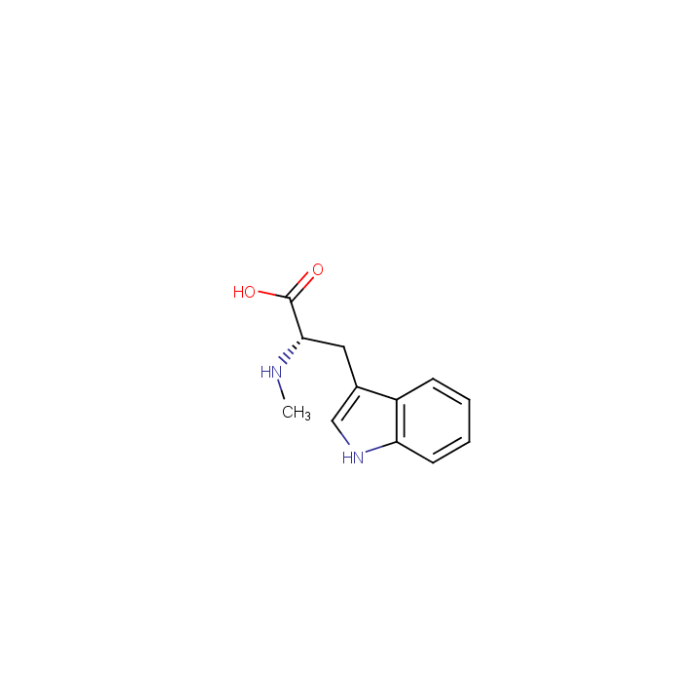
L‑Abrine is the naturally occurring L‑enantiomer of N‑methyltryptophan, an indole‑containing, N‑methylated amino acid (secondary amine) bearing a carboxylic acid.
Item-specific identifiers (from Product Data)
CAS: 526-31-8
SKU: S161197
Category: Life Science (research use only)
InChIKey: Not specified for this item; refer to CoA/Spec Sheet.
SMILES: Not specified for this item; refer to CoA/Spec Sheet.
Literature/computed identifiers (for reference; not item specifications)
Structural features (general chemistry description)
Core indole system (fused benzene + pyrrole) attached via a methylene to the α‑carbon of the amino acid.
α‑amino function is N‑methylated, giving a secondary ammonium under physiological pH; the carboxyl group is deprotonated in water, yielding a zwitterion.
One stereogenic center at the α‑carbon; this product is the L‑configuration.
Starting from the carboxylate carbon, the α‑carbon (L‑configuration) bears: (i) a proton, (ii) an N‑methylamino substituent, and (iii) a –CH2– linker to C3 of an indole ring. The indole nitrogen is embedded in the five‑membered ring and not substituted; the benzene ring is fused ortho to the pyrrolic unit.
Synthetic Utility
L‑Abrine (N‑methyl‑L‑tryptophan) is a versatile chiral building block for peptidomimetics and indole chemistry.
Functional group handles
Secondary amine at the α‑position (protonatable; less nucleophilic than primary amines) and a carboxylic acid enable amide/ester formation and salt chemistry.
Indole nucleus participates in electrophilic substitution (C‑3 most reactive), metal‑catalyzed C–H functionalization, and cross‑coupling after halogenation.
Use in peptide synthesis
Incorporation of N‑methyl residues modulates backbone H‑bonding and can enhance metabolic stability. For SPPS, employ protected analogs (e.g., Fmoc‑N‑Me‑L‑Trp‑OH). Coupling usually requires highly activating reagents (HATU/HOAt, PyBOP, COMU) and careful base choice (DIPEA) to suppress epimerization.
Derivatization pathways
Esterification of the carboxyl group (MeOH/HCl or Steglich conditions) for intermediate protection.
Side‑chain functionalization via indole C‑2/C‑3 after prior protection of the amino/carboxyl functions.
Formation of amide libraries by coupling with diverse acids/activated esters for SAR exploration.
Retrosynthetic value
Serves as a chiral pool precursor where the L‑stereocenter is leveraged to construct more complex frameworks, preserving configuration while diversifying the indole ring or α‑substituent environment.
Analytical considerations
Strong UV absorption near 280 nm aids reaction monitoring; LC‑MS friendly. Chiral HPLC enables rapid assessment of stereointegrity post‑coupling.
Target Specificity
Not applicable. L‑Abrine is a small‑molecule amino acid derivative, not an antibody or affinity reagent. No antigen/epitope or species reactivity is associated with this product.
Perguntas frequentes
What is the purity of this product, and how is it determined?
This product is supplied at ≥98% purity, determined by HPLC. Lot-specific values are stated on the Certificate of Analysis.
How should this product be stored?
Store at room temperature.
How is this product shipped?
This product ships under standard ambient conditions. No temperature-controlled packaging is required.
What are the CAS number, molecular formula and molecular weight?
The CAS Number is 526-31-8, the molecular formula is C12H14N2O2, and the molecular weight is 218.26 g/mol. InChIKey CZCIKBSVHDNIDH-NSHDSACASA-N.
What documentation is provided?
Available product documentation, including Certificates of Analysis (COA), Safety Data Sheets (SDS), and specification sheets, is shown in the product document area. Document availability and access follow the current site policy.
Usamos cookies para garantir o funcionamento adequado do site e, quando permitido, para melhorar a sua experiência. Você pode gerenciar suas preferências a qualquer momento nas Configurações. Saiba mais em nossa Política de Cookies.
Deseja que lhe enviemos uma mensagem quando tivermos descontos disponíveis?
Lembrar-me mais tarde
Obrigado! Por favor, verifique a sua caixa de entrada de e-mail para confirmar.
Products are supplied to verified businesses, institutions, and qualified professionals for research and development use only. Not for use in humans, animals, diagnosis, or therapy.

 A2316071