Determine the necessary mass, volume, or concentration for preparing a solution.
| Activity Type | Activity Value -log(M) | Mechanism of Action | Activity Reference | Publications (PubMed IDs) |
|---|

Moligand™, 10mM in Water Moligand™ for sensitive chromatographic and analytical workflows requiring minimal baseline interference.
Store at -80°C Ships Dry ice packs + Cold packs Check lot-specific COA for exact specifications.
SDS, COA, datasheet, and spec sheet available for download. Lot-specific COA accessible via lot number lookup.
Cited in 784 peer-reviewed publications across chromatography, organic synthesis, and cross-coupling reactions.
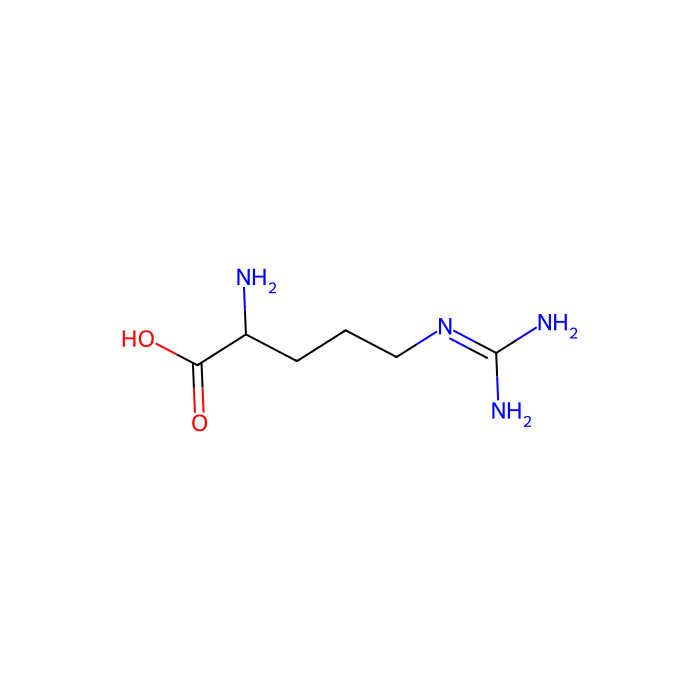
L-Arginine is an essential amino acid and precursor of nitric oxide synthesis that induces vasodilation in vivo. Nitric oxide potentiates insulin-mediated glucose uptake through the increase in blood flow.
A precursor of nitric oxide synthesis that induces vasodilation
Comprehensive hazard, handling, storage, and regulatory compliance document.
Download SDS →Lot-specific quality data. Enter your lot number to retrieve the exact COA.
Look up COA →Full quality attributes and acceptance criteria for this grade.
View spec sheet →Taxonomy Tree
| Kingdom | Organic compounds |
|---|---|
| Superclass | Organic acids and derivatives |
| Classe | Carboxylic acids and derivatives |
| Subclass | Amino acids, peptides, and analogues |
| Intermediate Tree Nodes | Amino acids and derivatives - Alpha amino acids and derivatives - Alpha amino acids |
| Direct Parent | L-alpha-amino acids |
| Alternative Parents | Fatty acids and conjugates Guanidines Amino acids Propargyl-type 1,3-dipolar organic compounds Monocarboxylic acids and derivatives Carboxylic acids Carboximidamides Organopnictogen compounds Organic oxides Monoalkylamines Hydrocarbon derivatives Carbonyl compounds |
| Molecular Framework | Aliphatic acyclic compounds |
| Substituents | L-alpha-amino acid - Fatty acid - Guanidine - Amino acid - Carboxylic acid - Monocarboxylic acid or derivatives - Carboximidamide - Propargyl-type 1,3-dipolar organic compound - Organic 1,3-dipolar compound - Amine - Hydrocarbon derivative - Organic oxide - Primary amine - Organooxygen compound - Organonitrogen compound - Organopnictogen compound - Primary aliphatic amine - Organic oxygen compound - Organic nitrogen compound - Carbonyl group - Aliphatic acyclic compound |
| Descrição | This compound belongs to the class of organic compounds known as l-alpha-amino acids. These are alpha amino acids which have the L-configuration of the alpha-carbon atom. |
| External Descriptors | Common amino acids |
| Activity Type | Activity Value -log(M) | Mechanism of Action | Activity Reference | Publications (PubMed IDs) |
|---|
| Activity Type | Relation | Activity value | Units | Action Type | Journal | PubMed Id | doi | Assay Aladdin ID |
|---|
| Activity Type | Relation | Activity value | Units | Action Type | Journal | PubMed Id | doi | Assay Aladdin ID |
|---|
| Activity Type | Relation | Activity value | Units | Action Type | Journal | PubMed Id | doi | Assay Aladdin ID |
|---|
| Activity Type | Relation | Activity value | Units | Action Type | Journal | PubMed Id | doi | Assay Aladdin ID |
|---|
| Activity Type | Relation | Activity value | Units | Action Type | Journal | PubMed Id | doi | Assay Aladdin ID |
|---|
| Activity Type | Relation | Activity value | Units | Action Type | Journal | PubMed Id | doi | Assay Aladdin ID |
|---|
| Activity Type | Relation | Activity value | Units | Action Type | Journal | PubMed Id | doi | Assay Aladdin ID |
|---|
| Activity Type | Relation | Activity value | Units | Action Type | Journal | PubMed Id | doi | Assay Aladdin ID |
|---|
| Activity Type | Relation | Activity value | Units | Action Type | Journal | PubMed Id | doi | Assay Aladdin ID |
|---|
| Activity Type | Relation | Activity value | Units | Action Type | Journal | PubMed Id | doi | Assay Aladdin ID |
|---|
| Activity Type | Relation | Activity value | Units | Action Type | Journal | PubMed Id | doi | Assay Aladdin ID |
|---|
| Activity Type | Relation | Activity value | Units | Action Type | Journal | PubMed Id | doi | Assay Aladdin ID |
|---|
| Activity Type | Relation | Activity value | Units | Action Type | Journal | PubMed Id | doi | Assay Aladdin ID |
|---|
| Activity Type | Relation | Activity value | Units | Action Type | Journal | PubMed Id | doi | Assay Aladdin ID |
|---|
| Activity Type | Relation | Activity value | Units | Action Type | Journal | PubMed Id | doi | Assay Aladdin ID |
|---|
| Activity Type | Relation | Activity value | Units | Action Type | Journal | PubMed Id | doi | Assay Aladdin ID |
|---|
| Activity Type | Relation | Activity value | Units | Action Type | Journal | PubMed Id | doi | Assay Aladdin ID |
|---|
| Activity Type | Relation | Activity value | Units | Action Type | Journal | PubMed Id | doi | Assay Aladdin ID |
|---|
| Activity Type | Relation | Activity value | Units | Action Type | Journal | PubMed Id | doi | Assay Aladdin ID |
|---|
| Activity Type | Relation | Activity value | Units | Action Type | Journal | PubMed Id | doi | Assay Aladdin ID |
|---|
| Activity Type | Relation | Activity value | Units | Action Type | Journal | PubMed Id | doi | Assay Aladdin ID |
|---|
| Activity Type | Relation | Activity value | Units | Action Type | Journal | PubMed Id | doi | Assay Aladdin ID |
|---|
| Activity Type | Relation | Activity value | Units | Action Type | Journal | PubMed Id | doi | Assay Aladdin ID |
|---|
| Activity Type | Relation | Activity value | Units | Action Type | Journal | PubMed Id | doi | Assay Aladdin ID |
|---|
| Activity Type | Relation | Activity value | Units | Action Type | Journal | PubMed Id | doi | Assay Aladdin ID |
|---|
| Activity Type | Relation | Activity value | Units | Action Type | Journal | PubMed Id | doi | Assay Aladdin ID |
|---|
| Activity Type | Relation | Activity value | Units | Action Type | Journal | PubMed Id | doi | Assay Aladdin ID |
|---|
| Activity Type | Relation | Activity value | Units | Action Type | Journal | PubMed Id | doi | Assay Aladdin ID |
|---|
| Activity Type | Relation | Activity value | Units | Action Type | Journal | PubMed Id | doi | Assay Aladdin ID |
|---|
| Activity Type | Relation | Activity value | Units | Action Type | Journal | PubMed Id | doi | Assay Aladdin ID |
|---|
| Activity Type | Relation | Activity value | Units | Action Type | Journal | PubMed Id | doi | Assay Aladdin ID |
|---|
| Activity Type | Relation | Activity value | Units | Action Type | Journal | PubMed Id | doi | Assay Aladdin ID |
|---|
| Activity Type | Relation | Activity value | Units | Action Type | Journal | PubMed Id | doi | Assay Aladdin ID |
|---|
| Activity Type | Relation | Activity value | Units | Action Type | Journal | PubMed Id | doi | Assay Aladdin ID |
|---|
| Activity Type | Relation | Activity value | Units | Action Type | Journal | PubMed Id | doi | Assay Aladdin ID |
|---|
| Activity Type | Relation | Activity value | Units | Action Type | Journal | PubMed Id | doi | Assay Aladdin ID |
|---|
| Activity Type | Relation | Activity value | Units | Action Type | Journal | PubMed Id | doi | Assay Aladdin ID |
|---|
| Activity Type | Relation | Activity value | Units | Action Type | Journal | PubMed Id | doi | Assay Aladdin ID |
|---|
| Activity Type | Relation | Activity value | Units | Action Type | Journal | PubMed Id | doi | Assay Aladdin ID |
|---|
| Activity Type | Relation | Activity value | Units | Action Type | Journal | PubMed Id | doi | Assay Aladdin ID |
|---|
| Activity Type | Relation | Activity value | Units | Action Type | Journal | PubMed Id | doi | Assay Aladdin ID |
|---|
| Activity Type | Relation | Activity value | Units | Action Type | Journal | PubMed Id | doi | Assay Aladdin ID |
|---|
| Activity Type | Relation | Activity value | Units | Action Type | Journal | PubMed Id | doi | Assay Aladdin ID |
|---|
| Activity Type | Relation | Activity value | Units | Action Type | Journal | PubMed Id | doi | Assay Aladdin ID |
|---|
| Sensibilidade | Air sensitive |
|---|---|
| Rotação específica [α] | 27 ° (C=8, 6mol/L HCl) |
| Ponto de fusão (°C) | 222 °C |
| Peso molecular | 174.200 g/mol |
| XLogP3 | -4.200 |
| Hydrogen Bond Donor Count | 4 |
| Hydrogen Bond Acceptor Count | 4 |
| Rotatable Bond Count | 5 |
| Exact Mass | 174.112 Da |
| Monoisotopic Mass | 174.112 Da |
| Topological Polar Surface Area | 128.000 Ų |
| Heavy Atom Count | 12 |
| Formal Charge | 0 |
| Complexity | 176.000 |
| Isotope Atom Count | 0 |
| Defined Atom Stereocenter Count | 1 |
| Undefined Atom Stereocenter Count | 0 |
| Defined Bond Stereocenter Count | 0 |
| Undefined Bond Stereocenter Count | 0 |
| The total count of all stereochemical bonds | 0 |
| Covalently-Bonded Unit Count | 1 |
General laboratory preparation (literature guidance; not item-specific validation):
Preparation of aqueous stock (1.0 M):
Protein refolding additive screen (example):
Chromatography aid:
Note: Concentrations, pH, and temperatures are starting points from literature and may require optimization for each system.
General biochemistry (literature; not product-specific claims):
Experimental considerations:
Applicability: L-Arginine is not a classical buffer component like phosphate or HEPES, but it is widely employed as an additive in refolding and formulation buffers to mitigate aggregation and improve solubility (literature).
Practical buffer use (literature examples):
Notes:
Context: L-Arginine itself is a bio-based, renewable small molecule (amino acid). Its environmental profile is generally favorable compared to many synthetic auxiliaries. Green considerations focus on sourcing, solvent systems, and process design.
Greener practice options (literature/general):
Comparison (illustrative, literature):
Note: No item-specific environmental certifications or sourcing declarations are provided here; refer to CoA/producer documentation.
Scope: No therapeutic/clinical claims are made. The following are formulation and manufacturing roles reported in the literature for L-arginine and its salts.
Formulation roles (literature):
Regulatory/quality notes:
Manufacturing considerations:
Item-specific specifications: Not specified for this item; refer to CoA/Spec Sheet.
Literature/typical physicochemical data (for L-Arginine, general reference):
Notes for practice:
Item-specific details from Product Data:
Context and guidance:
Scope: As a basic, chiral α-amino acid, L-Arginine is used in biochemistry, formulation science, and as a building block for synthetic chemistry.
Biochemical/formulation applications (literature):
Synthetic/chemical applications (literature):
Practical tips:
General guidance from literature (not item-specific specifications):
Expected outcomes and monitoring:
Note: Replace or adapt solvents/reagents for green chemistry and safety. Always confirm compatibility with your substrates and follow SDS for each reagent.
Item-specific hazard information: Not specified for this item; consult the product SDS for authoritative safety and regulatory details.
General safety guidance (literature/standard lab practice):
Relevance: L-Arginine is a highly polar, basic amino acid. Solvent considerations are primarily about preparing aqueous solutions and adjusting ionic strength/pH.
General solvent behavior (literature):
Practical selection tips:
Comparison (general):
Item-specific storage and shipping (from Product Data):
General guidance (literature/standard practice):
Disposal: Dispose of unused solutions according to institutional and local regulations for non-hazardous aqueous organic waste, unless your process introduces hazardous contaminants.
Brief overview: L-Arginine is a basic, proteinogenic α-amino acid bearing a strongly basic guanidinium side chain. It is chiral (L-configuration) and commonly exists as a zwitterion in water.
Item-specific identifiers (from Product Data):
Literature structural identity (general reference, not item-specific):
Structural features (general chemistry):
Chemical reactivity (literature):
Practical notes:
Not applicable. This product is a small-molecule amino acid, not an antibody or affinity reagent. No antigen/epitope specificity, species reactivity, clone, or isotype information applies.
Our grade selection guide covers purity, stabilizer status, and application suitability for all variants in our catalog.
View Moligand™ grade guide →