L-Canavanine is a selective inhibitor of NOS2 (iNOS). Overproduction of NO by NOS2 plays a crucial role in the pathophysiology of septic shock and chronic inflammation. L-Canavanine is a naturally occurring L-amino acid that interferes with L-arginine-utilizing enzymes due to its structural similarity.
Canavanine is a naturally occurring L-amino acid that interferes with L-arginine-utilizing enzymes due to its structural similarity. It is a selective inhibitor of inducible nitric oxide synthase (iNOS). Excessive NO production by iNOS plays a crucial role in the pathophysiology of septic shock and chronic inflammation.
A naturally occurring L-amino acid that interferes with L-arginine-utilizing enzymes due to its structural similarity. It is a selective inhibitor of inducible nitric oxide synthase (iNOS). Excessive NO production by iNOS plays a crucial role in the pathophysiology of septic shock and chronic inflammation.
Condições de armazenamento de armazenamento
Store at 2-8°C
Enviado em
Wet ice
Este produto requer transporte de cadeia fria. Serviços terrestres e outros serviços econômicos não estão disponíveis.
This compound belongs to the class of organic compounds known as l-alpha-amino acids. These are alpha amino acids which have the L-configuration of the alpha-carbon atom.
External Descriptors
non-proteinogenic L-alpha-amino acid
1. Djoumbou Feunang Y, Eisner R, Knox C, Chepelev L, Hastings J, Owen G, Fahy E, Steinbeck C, Subramanian S, Bolton E, Greiner R, and Wishart DS. ClassyFire: Automated Chemical Classification With A Comprehensive, Computable Taxonomy. Journal of Cheminformatics, 2016, 8:61.
Typical working concentrations: 0.1–10 mM in vitro, depending on enzyme affinity and assay design. Include an L-arginine control curve to benchmark specificity.
Readouts: Activity assays (colorimetric/fluorometric), LC–MS quantification, or electrophoretic mobility shifts for protein incorporation studies.
Microbial selection (research):
Use in defined media to challenge arginine biosynthesis/uptake pathways. Titrate concentration to avoid nonspecific toxicity; include proper biosafety approvals.
These are general, literature-style examples and are not validated, item-specific methods. Optimize conditions for your system.
Biological Roles
General background (literature):
Origin: L-Canavanine is a naturally occurring nonproteinogenic amino acid found notably in certain legumes (e.g., jack bean). It is biosynthesized as part of plant defense.
Structural analogy: It closely resembles L-arginine but bears an O-guanidino substituent, which preserves strong basicity yet alters H-bonding and reactivity.
Antimetabolite action: Competes with L-arginine in aminoacyl-tRNA synthetase charging and can be misincorporated into nascent proteins in place of arginine, typically compromising protein function. This property underlies its biological utility in studies of translational fidelity and protein quality control.
Enzyme interactions: Interacts with arginine-binding enzymes (e.g., amidino transferases; some guanidino-recognizing hydrolases) with altered kinetics compared to arginine, enabling mechanistic investigations.
Cellular responses: Exposure in model systems can trigger stress pathways associated with misfolded proteins and amino-acid starvation responses; it is widely used in controlled, in vitro research contexts to probe these phenomena.
Notes:
The above describes general biological roles reported in the literature and does not imply any clinical or therapeutic application. For this SKU, usage is for research only (per Product Data).
Buffer Applications
L-Canavanine itself is not commonly used as a primary buffering agent. However, as a highly polar, polyfunctional amino-acid analog, it is routinely formulated in common laboratory buffers.
Practical guidance (general):
Dissolution: Readily dissolves in water and standard biological buffers (e.g., phosphate, HEPES, Tris). Adjust pH after dissolution to target range (typically pH 6.8–8.0 for most enzyme assays).
pH considerations: With acidic (carboxyl) and basic (α-amine and O-guanidino) sites, its net charge is strongly pH-dependent. In neutral buffers it will be predominantly cationic/zwitterionic, enhancing solubility.
Ionic strength: High concentrations can contribute to ionic strength; account for this in sensitive biophysical measurements (e.g., ITC, electrophoresis).
Sterility: For cell-free or sterile workflows, 0.22 µm filter immediately after preparation.
Example working solutions (illustrative, not item-specific specifications):
100 mM L-Canavanine in PBS (pH 7.4), prepared by dissolving the weighed solid directly into buffer and adjusting volume. Store refrigerated and use promptly.
Because it is not a classical buffer component with a defined pKa window optimized for buffering capacity, choose standard buffers for pH control and treat canavanine as a solute/analyte.
Green Alternatives
Because L-Canavanine is a solid amino-acid analog rather than a volatile solvent or aggressive reagent, “green” considerations focus on solvent choice for its use, energy-efficient processing, and waste minimization.
Greener dissolution media (general):
Prefer water or aqueous buffers over organic solvents. Avoid unnecessary DMSO or DMF. If an organic co-solvent is required for co-dissolved reagents, ethanol (bio-based) at low percentages can be a greener option.
Process and waste:
Use minimal buffer volumes and optimize concentration to reduce aqueous waste. Where appropriate, combine compatible aqueous streams.
For peptide coupling involving canavanine, select coupling reagents with improved EHS profiles (e.g., COMU vs HATU/HBTU) and consider greener solvents for SPPS (e.g., NBP, GBL, or green DMF alternatives) when method-compatible.
Comparative notes (general):
Versus L-Arginine: If the objective is purely to tune ionic strength or provide a basic amino acid, L-arginine is more common and broadly benign. Use canavanine only when its specific antimetabolite properties are required—this reduces specialized waste and handling.
Packaging and storage:
Store at 2–8°C as provided to avoid degradation and repeat shipments. Prepare aliquots to reduce waste from expired solutions.
All guidance above is general/literature-based sustainability practice and not item-specific specifications.
Pharmaceutical Uses
Item-specific regulatory/compendial status: Not specified for this item; refer to CoA/Spec Sheet.
General notes (non-clinical, research context):
L-Canavanine is primarily a research reagent used in biochemical and cell-free studies as an arginine analog. It is not a common excipient and is not typically included in pharmacopeial monographs.
In preformulation or analytical development research, it may serve as a tool compound to challenge arginine-specific assays, transport studies (e.g., amino acid transporters in vitro), or to probe protein formulation robustness to basic amino-acid analogs.
Manufacturing considerations (general):
If used in non-clinical manufacturing R&D, ensure documentation of optical purity, residual solvents, bioburden, and endotoxin, especially for workflows that contact biological materials.
No medical or therapeutic claims are implied; this product is for research use only (per Product Data).
Physical Properties
Item-specific specifications: Not specified for this item; refer to CoA/Spec Sheet.
Physical state: White to off-white crystalline solid (literature reports)
Melting behavior: Reported to decompose on heating rather than exhibiting a sharp melting point (literature)
Solubility: Highly soluble in water; low solubility in common nonpolar organic solvents (literature)
Acid–base behavior: Zwitterionic near neutral pH; possesses a strongly basic O-guanidino moiety. Typical pKa values for analogous amino/guanidino systems are ca. 2 (carboxyl), 9–10 (α-amine), and ≥11 for guanidino-type basicity (literature, approximate; exact values for canavanine vary by source)
LogP/logD: Expected to be very low/negative at neutral pH due to multiple ionizable functionalities (literature expectation)
Optical rotation: Positive for the L-enantiomer has been reported; magnitude depends on solvent, concentration, and temperature (literature)
Notes:
All numerical values above are provided as general literature guidance and are not item-specific specifications for this SKU. Consult the CoA/SDS for definitive physical data relevant to your lot and use-case.
Quality and Grades
Item-specific grade/purity: Not specified for this item; refer to CoA/Spec Sheet.
Typical interpretations (general guidance):
Research/biochemical grade amino acids are commonly controlled for identity (1H/13C NMR, MS), purity (HPLC), and residual solvents/metals as applicable. For cell and enzyme studies, low bioburden/endotoxin may be relevant.
Optical purity: For L-Canavanine, enantiomeric excess (ee) is critical in biochemical experiments. Vendors may report [α]D or chiral HPLC data—verify in the CoA if stereochemical purity is essential to your protocol.
Water content: Karl Fischer moisture can impact accurate massing and solution prep for highly hygroscopic amino acids. Check CoA if assay-by-titration or KF is reported.
Stabilizers/antioxidants: None typically required for this class; if present, they will be disclosed on the CoA. For this SKU, no stabilizer information is provided in the Product Data.
Documentation: Use the lot-specific CoA for assay (%), impurity profile, and any bioburden/endotoxin claims required for sensitive biological applications.
Reaction and Applications
Research applications (general/literature):
Arginine antimetabolite: Used to probe arginine-dependent pathways, including protein biosynthesis fidelity (competition at arginyl-tRNA synthetase) and nitric oxide–related metabolism in cell-free systems. Incorporation of canavanine into proteins can be studied to assess proteostasis and translational proofreading.
Enzyme studies: Tool compound for investigating arginase, amidino transfer, and guanidino-binding sites. Canavanine’s O-guanidino alters H-bonding and pKa relative to arginine, enabling mechanistic contrasts.
Microbial/plant physiology: Employed to select or characterize arginine auxotrophs and to study defensive secondary metabolism (e.g., legume-derived canavanine) in controlled experiments.
Analytical standards: Occasionally used as a surrogate or internal standard in specialized amino-acid profiling when orthogonal detection is available.
Chemical transformations/derivatizations:
Protection strategies: The α-amine and carboxyl can be protected using standard peptide-protection chemistry (e.g., Fmoc/Boc; methyl/benzyl esters), while the O-guanidino moiety requires tailored protection (e.g., nitro, Pbf-like masks adapted for O-guanidino systems) to prevent side reactions.
Coupling into peptides: Solution- or solid-phase peptide synthesis (SPPS) with carbodiimide (EDC/HOBt) or uronium reagents (HATU/HBTU) under buffered conditions (pH 7.5–8.5 for solution-phase) to minimize guanidino-related side reactions.
Practical tips:
Maintain mildly basic pH during coupling to keep the α-amine nucleophilic, but avoid conditions that could rearrange or hydrolyze the O-guanidino group.
For biochemical assays, prepare fresh solutions due to potential slow hydrolysis or side reactions under extreme pH; verify concentration by UV-derivatization (e.g., OPA/NAC) or ninhydrin-based colorimetry as appropriate.
Reaction Conditions
General, literature-based guidance for common uses of L-Canavanine; not item-specific specifications.
Peptide coupling (solution phase):
Solvent: Aqueous-organic mixtures (e.g., water/DMF or water/MeCN) or pure aqueous media for water-soluble coupling systems.
Reagents: HATU or EDC/Oxyma; base such as DIPEA or bicarbonate to maintain pH 7.5–8.5.
Temperature/time: 0–25°C; 0.5–4 h typical for small-molecule couplings; monitor by LC/MS.
Notes: Protect or mask the O-guanidino group to reduce side reactions; excessive base can lead to side-chain modification.
SPPS incorporation (Fmoc strategy, where a protected derivative of L-Canavanine is used):
Solvent: DMF or greener alternatives (NBP, green DMF substitutes) if resin-compatible.
Activators: HBTU/HATU/DIC+Oxyma; double coupling or extended times may improve incorporation due to steric/electrostatic effects.
Deprotection: Standard 20% piperidine in DMF for Fmoc; final cleavage with TFA cocktails while ensuring stability of the side-chain protecting group.
Derivatization for analytics:
Precolumn derivatization with OPA/NAC or FMOC-Cl for HPLC quantitation under reversed-phase conditions; typical reaction at room temperature for minutes before injection.
Aqueous stability/use:
Prepare fresh solutions near neutral pH for biochemical assays. Avoid prolonged exposure to strong acids/bases or elevated temperatures to minimize potential decomposition of the O-guanidino moiety.
Safety and Handling
Item-specific GHS information: Not specified for this item; refer to SDS.
General safety considerations (literature/typical for amino acid analogs):
Hazards: L-Canavanine is an arginine analog and can act as an antimetabolite in biological systems. While commonly handled as a lab reagent, avoid ingestion, inhalation of dust, and contact with eyes/skin. Actual hazard classification varies by supplier—consult the SDS for authoritative classification and precautionary statements.
PPE: Lab coat, safety glasses, and suitable gloves (e.g., nitrile). Use a dust mask or work in a fume hood when handling powders to minimize inhalation.
Handling: Avoid creating dust. Prepare solutions with gentle stirring to prevent aerosol formation. Label solutions with concentration and pH, as multiple ionizable groups can affect compatibility with other reagents.
Incompatibilities: Strong oxidizing agents may react with the guanidino functionality. Avoid mixing with reactive acylating or alkylating agents unless performing controlled derivatizations.
First aid (general): If inhaled, move to fresh air. In case of skin/eye contact, rinse with water for several minutes; remove contaminated clothing. If swallowed, rinse mouth; do not induce vomiting—seek medical attention. Always follow site-specific EHS procedures.
Environmental: Avoid release to the environment. Collect spills by careful sweeping or HEPA vacuuming; dissolve residues in water and dispose according to local regulations.
Storage conditions (from Product Data): Store at 2–8°C. Shipped on wet ice.
Solvent Selection
L-Canavanine is a highly polar, zwitterionic amino acid analog. Solvent choice is primarily about dissolution and compatibility for biological or coupling chemistries rather than extraction.
Aqueous systems (recommended):
Water: Rapidly soluble at neutral to slightly acidic/basic pH. Degas and filter if using for enzymology.
Buffers: Phosphate, HEPES, Tris, or acetate buffers are commonly used. Select pH based on your application (e.g., pH 7.2–7.5 for most cell-free assays). The guanidino functionality may interact with buffer anions (e.g., phosphate), slightly affecting activity measurements—validate as needed.
Mixed solvents:
Water–alcohol mixtures (e.g., ≤20–30% methanol or ethanol) can aid dissolution of co-solutes while maintaining canavanine in solution. Avoid high organic content which can precipitate zwitterionic amino acids.
DMSO: Generally unnecessary and not preferred; if used as a co-solvent, keep DMSO low (≤5–10%) and verify biological compatibility.
Nonpolar solvents: Not suitable; expect negligible solubility in ethers, alkanes, and chlorinated solvents.
Comparison (general):
L-Canavanine vs L-Arginine: Similar aqueous solubility profiles; however, canavanine’s O-guanidino group may alter ionic interactions slightly. Choose based on desired biological effect (antimetabolite vs substrate/control).
Practical tip: Adjust pH after dissolution to minimize local supersaturation. For sterile applications, dissolve in sterile buffer and 0.22 µm filter immediately before use.
Storage and Reconstitution
Storage (item-specific): Store at 2–8°C. Shipped on wet ice (per Product Data).
Stability (general guidance):
Solid: When kept tightly closed at 2–8°C and protected from excessive humidity, amino acid solids are typically stable for months to years. Check the product label/CoA for retest date.
Solution: Aqueous solutions are best prepared fresh. For short-term storage, 2–8°C for hours to a few days is common. For longer-term storage, aliquot and freeze (−20°C), avoiding repeated freeze–thaw cycles.
Reconstitution (general):
Allow the container to equilibrate to room temperature before opening to avoid condensation.
Dissolve the required amount in water or appropriate buffer. Adjust pH as needed for your application.
For sterile applications, 0.22 µm filter into sterile vials. Label with concentration, pH, date, and storage conditions.
Incompatibilities and precautions:
Avoid strong oxidizers and harsh acidic/basic conditions during storage of solutions, which may compromise the O-guanidino group.
Use clean, non-metallic spatulas to prevent contamination during weighing.
Documentation: For exact shelf-life, assay, and impurity profile, consult the lot-specific CoA/Spec Sheet. This product is for research use only.
Structure and Identity
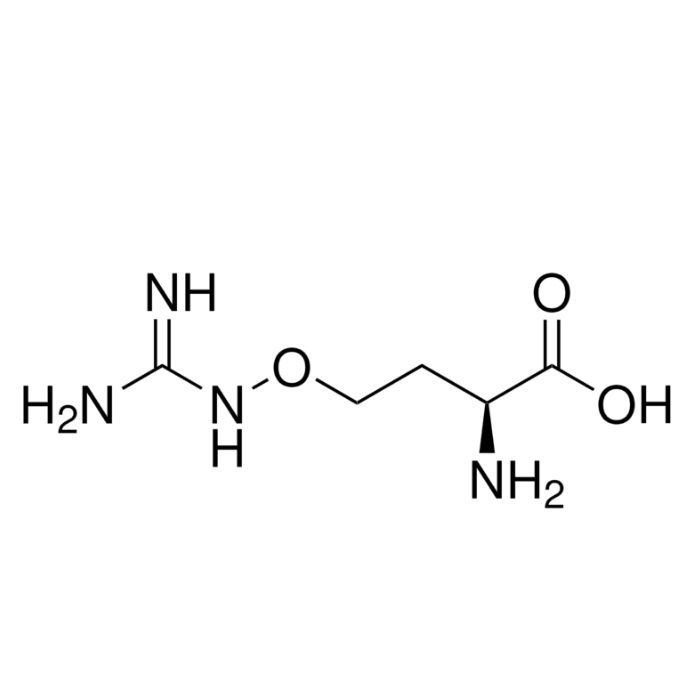
Brief description: L-Canavanine is a nonproteinogenic, L-configured amino acid that is a structural analog of L-arginine bearing an O-guanidino substituent on a four-carbon side chain.
Product Data (item-specific):
SKU: L329592
Product Name: L-Canavanine
CAS: 543-38-4
PubChem CID: 439202
InChIKey: 90707 (as provided in Product Data)
SMILES: Not specified for this item; refer to CoA/Spec Sheet.
Literature/general identifiers and features (for reference only):
Stereochemistry: L-configuration at the α-carbon (S absolute configuration by Cahn–Ingold–Prelog)
Functional groups: α-amino acid (α-NH2, α-CO2H) and a side-chain O-guanidino (–O–C(=NH)–NH2) functionality
2D structural description (general):
Backbone: An α-amino acid with a four-carbon side chain: –CH(NH2)–CH2–CH2–CH2–.
The terminal side-chain carbon bears an O-guanidino substituent (an O-alkoxy guanidine), conferring strong basicity and high polarity akin to, but distinct from, the guanidino group in L-arginine.
Synthetic Utility
Role as a chiral building block (general):
The L-stereocenter at the α-carbon provides a handle for asymmetric synthesis and peptide engineering. L-Canavanine can be incorporated into peptides/proteomimetics to modulate charge distribution and H-bonding via its O-guanidino side chain.
Protection and functionalization:
α-Functionality: Standard amino acid protection applies (e.g., Fmoc/Boc for the α-amine; methyl/benzyl esters for the carboxyl).
O-Guanidino group: Requires specific protection to avoid side reactions during coupling (e.g., acid-labile sulfonyl or bulky carbamate-type protecting groups tailored for guanidino/oxyguanidino chemistry). Reaction planning should consider the basicity and potential for H-bonding that can retard coupling.
Coupling strategies:
Use uronium/phosphonium coupling reagents (HATU/HBTU/TBTU, PyBOP) or carbodiimide systems (EDC with HOAt/HOBt or Oxyma). For SPPS, Fmoc/tBu strategy is common; for solution-phase, control pH (7.5–8.5) to maintain nucleophilicity while minimizing side reactions.
Transformations:
Selective modification of the O-guanidino group (e.g., acylation, carbamoylation) allows access to probe molecules that dissect guanidino-binding interactions.
Conjugation to dyes or affinity tags (via activated esters or click handles introduced at the carboxyl/amine) enables biophysical studies on uptake and binding.
All points above reflect general synthetic practice; consult primary literature for protecting-group specifics compatible with O-guanidino functionality.
Target Specificity
Not applicable for this product. L-Canavanine is a small-molecule amino acid analog, not an antibody or targeted biological. No clone, isotype, or species-reactivity information applies.
Perguntas frequentes
What is the purity of this product?
This product is supplied at ≥98% purity (chemical assay). Lot-specific values are stated on the Certificate of Analysis.
How should this product be stored?
Store at 2–8 °C. Refrigerated storage is required to maintain the specified shelf life.
How is this product shipped?
This product ships chilled on wet ice. Unpack on arrival and transfer it to the storage condition stated above.
What are the CAS number, molecular formula and molecular weight?
The CAS Number is 543-38-4, the molecular formula is C5H12N4O3, and the molecular weight is 176.17 g/mol. InChIKey FSBIGDSBMBYOPN-VKHMYHEASA-N.
What documentation is provided?
Available product documentation, including Certificates of Analysis (COA), Safety Data Sheets (SDS), and specification sheets, is shown in the product document area. Document availability and access follow the current site policy.
Usamos cookies para garantir o funcionamento adequado do site e, quando permitido, para melhorar a sua experiência. Você pode gerenciar suas preferências a qualquer momento nas Configurações. Saiba mais em nossa Política de Cookies.
Deseja que lhe enviemos uma mensagem quando tivermos descontos disponíveis?
Lembrar-me mais tarde
Obrigado! Por favor, verifique a sua caixa de entrada de e-mail para confirmar.
Products are supplied to verified businesses, institutions, and qualified professionals for research and development use only. Not for use in humans, animals, diagnosis, or therapy.

 C2627651