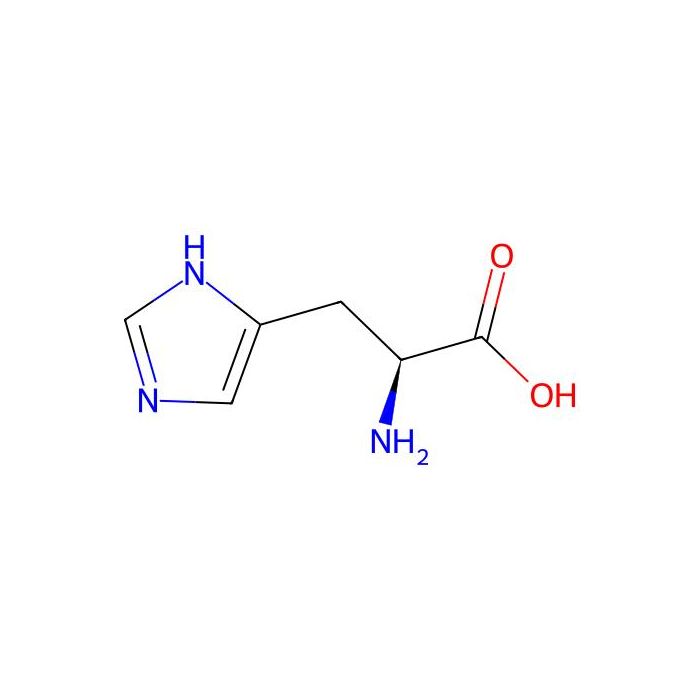
L-Histidine - UltraBio™, ≥99.5%(NT) , CAS No.71-00-1

CAS: 71-00-1 Cat. No.: L755708 Fórmula: C6H9N3O2 Peso molecular: 155.15 Beilstein Registry Number: 84088 Número CE: 200-745-3
Disponível para encomenda
GRADE & PURITY UltraBio™ ? UltraBio™ — Aladdin's line for molecular-biology applications. Use for nuclease-free, high-consistency reagents across molecular workflows. ≥99.5%(NT)
Storage
Room temperature
Shipped In
Normal
★
Size
Alemanha (EU)
USA*
Price
Qty
25g
L755708-25g
—
3 Em stock
139,62€
100g
L755708-100g
—
2 Em stock
419,90€
Enter a quantity for the sizes you want to add.
🧪
Why this grade

UltraBio™, ≥99.5%(NT) UltraBio™ for sensitive chromatographic and analytical workflows requiring minimal baseline interference.

🌡

Storage & shipping

Room temperature Ships Normal Check lot-specific COA for exact specifications.

📋

Quality documents

SDS, COA, datasheet, and spec sheet available for download. Lot-specific COA accessible via lot number lookup.

📚

Literature proof

Cited in 1254 peer-reviewed publications across chromatography, organic synthesis, and cross-coupling reactions.

Visão geral

L-Histidine has been used for characterization of ZnO nanorod in an attempt to develop a technique for the ultra-low level detection of l-histidine.

Specifications

Especificações e pureza
UltraBio™, ≥99.5%(NT)
Mecanismos bioquímicos e fisiológicos
Precursor of histamine by action of histidine decarboxylase.L-Histidine is involved in the one-carbon unit metabolism. It is associated with protein methylation. L-Histidine is a part of hemoglobin structure and function. L-Histidine is a component of dip
Condições de armazenamento de armazenamento
Room temperature
Enviado em
Normal
Grau
UltraBio™
Pureza
≥99.5%(NT)
Nomes e identificadores
Pubchem Sid528765205
PH7.0-8.0 (25 °C, 0.1 M in H 2 O)
Sorrisos canónicosC1=C(NC=N1)CC(C(=O)O)N
IUPAC Name(2S)-2-amino-3-(1H-imidazol-5-yl)propanoic acid
InChIKeyHNDVDQJCIGZPNO-YFKPBYRVSA-N
INCHI1S/C6H9N3O2/c7-5(6(10)11)1-4-2-8-3-9-4/h2-3,5H,1,7H2,(H,8,9)(H,10,11)/t5-/m0/s1
SMILES isoméricas C1=C(NC=N1)C[C@@H](C(=O)O)N
WGK Alemanha 1
RTECS MS3070000
CAS alternativo 71-00-1,26062-48-6
Termos de entrada MeSH Histidine;Histidine, L isomer;Histidine, L-isomer;L-Histidine;L-isomer Histidine
Peso molecular 155.15
Beilstein 84088
Reaxy-Rn 7800
Reaxys-RN_link_address https://www.reaxys.com/reaxys/secured/hopinto.do?context=S&query=IDE.XRN=7800&ln=

Documentation

📋 Safety Data Sheet (SDS)

Comprehensive hazard, handling, storage, and regulatory compliance document.

Download SDS →

✅ Certificate of Analysis (COA)

Lot-specific quality data. Enter your lot number to retrieve the exact COA.

Look up COA →

📊 Datasheet

Quick-reference summary of product specifications and applications.

View datasheet →

🔬 Specification Sheet

Full quality attributes and acceptance criteria for this grade.

View spec sheet →

Advanced Data

Taxonomic Classification

Taxonomy Tree

KingdomOrganic compounds
SuperclassOrganic acids and derivatives
ClasseCarboxylic acids and derivatives
SubclassAmino acids, peptides, and analogues
Intermediate Tree Nodes Amino acids and derivatives - Alpha amino acids and derivatives
Direct ParentHistidine and derivatives
Alternative Parents L-alpha-amino acids  Imidazolyl carboxylic acids and derivatives  Aralkylamines  Heteroaromatic compounds  Amino acids  Monocarboxylic acids and derivatives  Carboxylic acids  Azacyclic compounds  Organopnictogen compounds  Organic oxides  Monoalkylamines  Hydrocarbon derivatives  Carbonyl compounds  
Molecular FrameworkAromatic heteromonocyclic compounds
Substituents Histidine or derivatives - Alpha-amino acid - L-alpha-amino acid - Imidazolyl carboxylic acid derivative - Aralkylamine - Azole - Imidazole - Heteroaromatic compound - Amino acid - Carboxylic acid - Azacycle - Organoheterocyclic compound - Monocarboxylic acid or derivatives - Organic nitrogen compound - Organooxygen compound - Organonitrogen compound - Primary amine - Primary aliphatic amine - Hydrocarbon derivative - Organic oxide - Organopnictogen compound - Carbonyl group - Organic oxygen compound - Amine - Aromatic heteromonocyclic compound
DescriçãoThis compound belongs to the class of organic compounds known as histidine and derivatives. These are compounds containing cysteine or a derivative thereof resulting from reaction of cysteine at the amino group or the carboxy group, or from the replacement of any hydrogen of glycine by a heteroatom.
External Descriptors Common amino acids
Estrutura 3D
Modelo de Estrutura Química Interativa


Certificados(CoA,COO,BSE/TSE e Mapa de Análise)
C of A & Other Certificates(BSE/TSE, COO):
Analytical Chart:

Find and download the COA for your product by matching the lot number on the packaging.

2 results found

Lot NumberCertificate TypeDataItem
C2520300Certificate of AnalysisMar 27, 2025 L755708
C2520180Certificate of AnalysisMar 27, 2025 L755708
Propriedades químicas e físicas
SolubilidadeH 2 O: 0.1 M at 20 °C, clear, colorless
Rotação específica [α]13 ° (C=11, 6mol/L HCl)
Ponto de fusão (°C)282°C
Peso molecular155.150 g/mol
XLogP3-3.200
Hydrogen Bond Donor Count3
Hydrogen Bond Acceptor Count4
Rotatable Bond Count3
Exact Mass155.069 Da
Monoisotopic Mass155.069 Da
Topological Polar Surface Area92.000 Ų
Heavy Atom Count11
Formal Charge0
Complexity151.000
Isotope Atom Count0
Defined Atom Stereocenter Count1
Undefined Atom Stereocenter Count0
Defined Bond Stereocenter Count0
Undefined Bond Stereocenter Count0
The total count of all stereochemical bonds0
Covalently-Bonded Unit Count1
FAQs e artigos
UltraBio™: Defining Excellence in Molecular Biology Applications
Why Did Nickel Agarose Beads Lose Their Color?
How to Optimize Buffer Components for Ni-Agarose Beads
Tuning Logic of Imidazole Heteroaromatic Building Blocks: How Dual Nitrogen Sites and Substitution / Salt Forms / Ring Fusion Modulate Charge, Hydrogen Bonding, and Coordination (with Tables A–E)
Glutaraldehyde-mediated Microbial Inactivation: Chemical Mechanisms, Determinants, and Key Validation Considerations
Invertebrate Oxygen Carrier Proteins in Immunology and Vaccine Research
β-Acyloxy Alkenyl Amides (AAAs): A New Approach to Amide Bond and Peptide Bond Construction Worth Attention
Silicon Reagent-Assisted Peptide Synthesis: Research Progress and Methodological Value of Peptide Bond Formation from Unprotected Substrates
From Analytical Instrument to Synthetic Platform: A New Strategy for Reconstructing Automated Flow Solid-Phase Peptide Synthesis with Standard Analytical HPLC
Analysis of Hydrolyzed Pearl as a Cosmetic Raw Material: Preparation Process, Active Components, and Skincare Formulation Applications
Skin Anti-Aging Mechanisms of Carnosine and Decarboxy Carnosine: Active Carbonyl Scavenging, Oxidative-Stress Buffering, and Inhibition of Collagen Glycation Cross-Linking
Moisturizing Mechanism of Polyglutamic Acid: From the γ-Glutamyl Structure to Hydration Networks and Surface Film-Forming Behavior
Structure, Stratum Corneum Distribution, and Stratum Corneum Conditioning Mechanism of Capryloyl Salicylic Acid: Barrier Effects and Safety Evaluation
Exosome-Related Ingredients in Skincare Products: Sources and Preparation, Quality Control, Evidence of Efficacy, and Safety Assessment
Mechanisms by Which Fructan-Rich Ophiopogon japonicus Tuberous Root Extract Supports Skin Moisturization and Barrier Function
Multilevel Moisturizing Mechanisms of Sodium Hyaluronate and Its Derivatives: Molecular Weight Modulation, Crosslinking, Acetylation, and Major Sites of Action
The Combination Logic of Palmitoyl Tripeptide-1 and Palmitoyl Pentapeptide-4: Skin Delivery, Matrix Signaling, and Regulation of Collagen Homeostasis
Structural Characteristics of Ergothioneine, OCTN1-Mediated Uptake by Skin Cells, and Antioxidant Mechanisms
Copper Tripeptide GHK-Cu and Skin Repair: From Copper Coordination Chemistry to Extracellular Matrix Remodeling
Citations of This Product
Calculadoras de soluções
Revisões

Avaliações dos Clientes

Shall we send you a message when we have discounts available?

Remind me later

Thank you! Please check your email inbox to confirm.

Oops! Notifications are disabled.