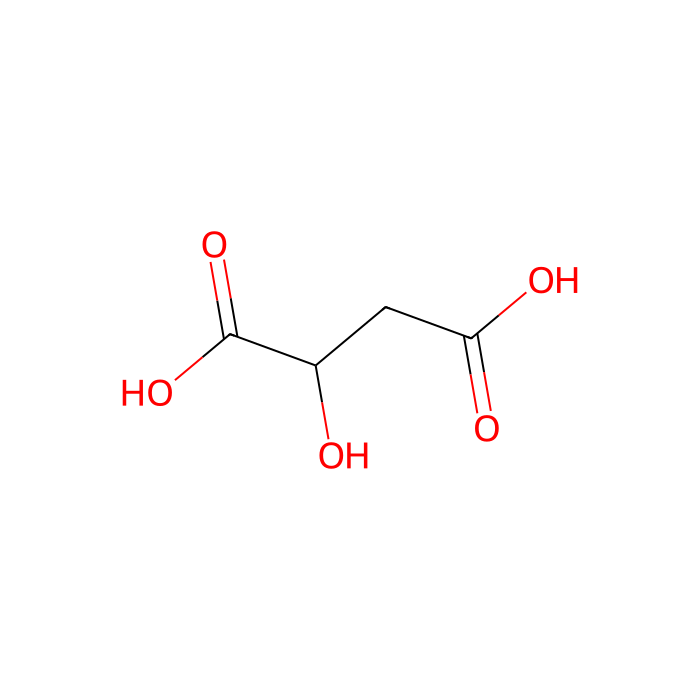
L-(-)-Malic acid is an organic acid that is commonly found in wine. It plays an important role in wine microbiological stability. L-(-)-Malic acid is a selective α-amino protecting reagent for amino acid derivatives. It is also a versatile synthon for the preparation of chiral compounds including κ-opioid receptor agonists, 1α,25-dihydroxyvitamin D3 analogue,and phoslactomycin B.
Application:
L-(-)-Malic acid may be used to prepare: diethyl (S)-malate ethyl (R)-2-hydroxyl-4-phenylbutanoate ethyl (S)-2-hydroxyl-4-phenylbutanoate D-homophenylalanine ethyl ester hydrochloride furo[3,2-i]indolizines
This compound belongs to the class of organic compounds known as beta hydroxy acids and derivatives. These are compounds containing a carboxylic acid substituted with a hydroxyl group on the C3 carbon atom.
External Descriptors
malic acid
1. Djoumbou Feunang Y, Eisner R, Knox C, Chepelev L, Hastings J, Owen G, Fahy E, Steinbeck C, Subramanian S, Bolton E, Greiner R, and Wishart DS. ClassyFire: Automated Chemical Classification With A Comprehensive, Computable Taxonomy. Journal of Cheminformatics, 2016, 8:61.
Determine the necessary mass, volume, or concentration for preparing a solution.
Dilution Calculator
Determine the dilution needed to prepare a stock solution.
Reconstitution Calculator
Revisões
Avaliações dos Clientes
Application Protocols
No assay-specific application protocols are provided for this item; refer to CoA/Spec Sheet.
General lab use examples (literature/practice-oriented, not item-specific):
Preparing 0.1 M malate buffer, pH 5.5: dissolve 6.71 g L-malic acid in ~350 mL water, adjust pH with ~50 mL 1.0 M NaOH to 5.5, QS to 500 mL, filter sterilize (0.22 µm) if needed.
Making a malate salt of a chiral amine (resolution screen): dissolve equimolar L-malic acid and racemic amine in hot ethanol, allow slow cooling and standing to crystallize the diastereomeric salt; collect, analyze ee, and recrystallize if needed.
Fischer diester formation: suspend L-malic acid in absolute methanol with catalytic H2SO4, reflux 6–12 h, remove solvent, neutralize/caution with workup, and purify by distillation or chromatography.
Always adapt conditions to your substrate and scale, and consult primary literature for optimization.
Biological Roles
General biochemical context (no clinical claims):
Central metabolism: L-malic acid (L-malate) is a key tricarboxylic acid (TCA) cycle intermediate, interconverting with oxaloacetate via malate dehydrogenase (NAD+/NADH dependent). This step helps maintain redox balance in aerobic metabolism (literature).
Shuttle systems: In the malate–aspartate shuttle, malate carries reducing equivalents across the mitochondrial membrane, enabling cytosolic–mitochondrial NADH transfer (literature).
Anaplerosis/cataplerosis: Malic enzyme (NADP+-dependent) decarboxylates malate to pyruvate with NADPH production, linking the TCA cycle to lipid biosynthesis and redox metabolism (literature).
Plant metabolism: Malate participates in C4 and CAM photosynthetic pathways as a temporary carbon store; contributes to stomatal regulation and pH homeostasis (literature).
Metal complexation/transport: Malate chelates metals (e.g., Al3+, Fe3+) in biological systems, influencing metal tolerance and mobility (literature).
Note: These roles describe endogenous biochemical functions of the L-isomer; they inform research use (e.g., buffer selection, enzymology), not medical or clinical applications.
Buffer Applications
L-(−)-Malic acid (diprotic) forms effective buffers near its two carboxyl pKa values. Useful for enzymology and general biochemical work where mild chelation is acceptable.
Key parameters (literature):
pKa1 ≈ 3.40; pKa2 ≈ 5.11 at 25 °C
Effective buffering ranges: ~2.4–4.4 (pKa1) and ~4.1–6.1 (pKa2)
Preparation examples (general guidance):
Sodium malate buffer pH 5.5 (0.10 M): dissolve 6.71 g L-malic acid (0.050 mol) in ~350 mL water, titrate to pH 5.5 with ~0.050 mol NaOH (≈2.0 g or 50 mL of 1.0 M NaOH), bring to 500 mL. Verify pH and adjust as needed.
Potassium malate buffers are analogous; use KOH or K2CO3 (with CO2 off-gassing) to the target pH.
Practical notes:
Temperature affects pKa; recheck pH at use temperature. Ionic strength can be controlled with NaCl if required.
Malate is a modest chelator; if metal-sensitive assays are planned, pre-chelate/condition solutions or use plasticware. For assays requiring minimal metal interaction, citrate may be too chelating; acetate may be too weak—malate offers an intermediate profile.
Sterilization: filter (0.22 µm) rather than autoclave when high pH accuracy is required; autoclaving can shift pH slightly.
Item-specific: No fixed buffer specs are provided for this item; consult CoA/Spec Sheet for any available assay/impurity data.
Green Alternatives
Context: L-(−)-Malic acid is a biogenic, biodegradable organic acid, typically producible by fermentation. When selecting an acidulant, chiral building block, or buffer component, consider the following greener options and trade-offs.
Comparison (literature/general):
L-Malic acid: renewable (fermentation routes), readily biodegradable, low toxicity; effective buffer near pH 3–6; one hydroxyl and two carboxyls simplify selective derivatization.
Citric acid: also renewable/biodegradable; triprotic acid with strong chelation—excellent buffer capacity and metal sequestration but increased complexity in selective esterification.
Tartaric acid (L- or meso-): renewable; diprotic with two vicinal hydroxyls; strong chiral pool utility but can require additional protecting-group steps.
Use water or water/alcohol mixtures where feasible; avoid chlorinated solvents for derivatizations.
Drive esterifications by reactive distillation or pervaporation rather than stoichiometric dehydrating agents when possible.
Recover and reuse malate salts (e.g., in resolution) by back-neutralization to minimize waste.
Pharmaceutical Uses
Item-specific pharmacopeial status: Not specified for this item; refer to CoA/Spec Sheet.
General roles in formulation and process development (no therapeutic claims):
Acidulant/pH adjuster: used to adjust and maintain pH in oral liquids, syrups, and effervescent powders; provides a smoother acidity profile than citric in some matrices (literature).
Taste modification: contributes tartness and enhances fruit flavors in R&D of oral dosage forms and nutraceutical prototypes (literature).
Buffer component: malate buffers in the pH 3–6 range for stabilizing pH-sensitive actives.
Salt formation: malate salts with APIs or amines can improve crystallinity, solubility, or stability in preformulation; the L-malate counterion may influence polymorphism (literature).
Processing aids: serves as a chelating and sequestering agent at moderate levels, which can impact oxidation stability of formulations (less aggressive than citrate; literature).
Regulatory notes (general):
Malic acid has compendial monographs (e.g., FCC; some pharmacopeias list Malic Acid) but requirements vary. For GMP or clinical manufacturing, ensure grade, impurity limits (metals, related substances), and optical purity meet the intended use.
Always confirm suitability and specifications with the specific lot CoA and relevant pharmacopeias before use in regulated contexts.
Physical Properties
Item-specific specifications: Not specified for this item; refer to CoA/Spec Sheet.
Literature/general physical data (for L-malic acid):
Appearance: white to off-white crystalline solid (literature)
Melting point: ~130–135 °C (often with decomposition; literature)
Boiling point: not applicable (decomposes before boiling; literature)
Density (solid): ~1.60 g/cm³ at 20 °C (literature)
Solubility: highly soluble in water; soluble in methanol and ethanol; low solubility in nonpolar solvents (literature)
Hygroscopicity: mildly hygroscopic; absorbs moisture from air (literature)
Optical rotation: [α]D can vary with concentration/solvent; typical negative rotation for L-(−)-isomer (literature)
Practical notes (general):
Being a diprotic acid, solution pH is strongly concentration-dependent; buffering is most effective near pH ~3.4 and ~5.1.
Solubility increases with temperature; endothermic dissolution may be observed.
Quality and Grades
Item-specific grade/purity: Not specified for this item; refer to CoA/Spec Sheet.
Context for common grades (general information):
ACS/Reagent grade: suitable for analytical and general lab use; impurities controlled for typical analytical tolerances.
FCC/Food grade: conforms to food chemical codex; low levels of heavy metals and specified impurities; often used as an acidulant/flavor in food R&D (not for clinical use).
Pharmaceutical/excipient grade (e.g., USP/NF): controlled identity, purity, and performance parameters for use as an excipient in development/manufacturing contexts (no therapeutic claims).
Optical purity: for chiral applications, enantiomeric excess (ee) is critical. When relevant, suppliers may report optical rotation or chiral HPLC; if optical data are needed, request the CoA.
Stabilizers/additives:
L-malic acid is typically supplied neat without stabilizers. Moisture control is important due to mild hygroscopicity; desiccation and inert atmosphere (as specified for this item) help maintain consistent mass and flow.
Recommendation:
Verify assay (titrimetric or HPLC), heavy metals, water (Karl Fischer), and optical rotation if your application is sensitive. Use the CoA/Spec Sheet for definitive item-specific specifications.
Reaction and Applications
Chemically, L-(−)-malic acid is an α-hydroxy dicarboxylic acid and a useful chiral pool building block.
Esterification/transesterification: formation of mono- and diesters (e.g., dimethyl malate) under Fischer conditions or via coupling agents. Diastereoselective downstream transformations can exploit the existing S-center.
Resolution of chiral amines: formation of crystalline malate salts to resolve racemic amines; malate salt crystallization can deliver high ee after recrystallization.
Asymmetric synthesis/chiral pool: conversion to protected derivatives (e.g., acetonides, cyclic carbonates/esters) provides access to S-configured intermediates for β-hydroxy acids, 1,2-diols, and β-aminocarboxylic acids. Mitsunobu inversion can generate the D-enantiomer when needed.
Dehydration: acid- or heat-catalyzed dehydration affords fumaric/maleic acid mixtures; careful control and catalysts (e.g., POCl3, SOCl2, p-toluenesulfonic acid) influence E/Z outcomes (literature).
Oxidation/reduction: oxidation to oxaloacetic acid analogs or reduction of carboxyl groups (e.g., to diols via BH3·THF) expands scaffold diversity.
Metal complexation: malate acts as a bidentate chelate through one carboxylate and the α-hydroxyl or through dicarboxylates; used to prepare metal–organic species and tune solubility.
Practical tips:
Maintain anhydrous conditions for esterifications; remove water (Dean–Stark) to drive to completion.
Control pH during salt formation; partial neutralization allows selective mono-malate salt preparation.
Track stereochemical integrity; avoid strongly acidic/high-temperature conditions that could promote racemization at the α-carbon.
Reaction Conditions
General literature guidance (typical, not item-specific specifications):
Fischer esterification (to diesters/monoesters):
Conditions: ROH (MeOH/EtOH/i-PrOH), catalytic H2SO4 or p-TsOH, 0.1–1.0 equiv acid catalyst, reflux 2–24 h.
Water removal: Dean–Stark (for higher alcohols) or molecular sieves. Typical isolated yields: 70–95% for diesters under optimized conditions (literature).
Conditions: DCC (1.1–1.3 equiv), DMAP (0.1 equiv), CH2Cl2 or DMF, 0–25 °C, 2–16 h. Monitor for O→N acyl transfer in amide-forming systems. Yields: 70–90% (literature).
Mitsunobu inversion at α-OH:
Conditions: DIAD (or DEAD), PPh3, alcohol (nucleophile), THF or toluene, 0–25 °C. Followed by hydrolysis to regenerate acids. Inversion at C-2 proceeds with retention of carboxyl protections. Yields: 60–85% (literature).
Dehydration to fumaric/maleic acids:
Conditions: strong acid catalysts (e.g., conc. H2SO4, p-TsOH) or P2O5; 80–180 °C, 1–6 h. The E/Z ratio depends on conditions; fumaric (E) often favored under controlled thermal conditions. Yields: variable (40–85%; literature).
Reduction of carboxyls to alcohols:
Conditions: BH3·THF (2–4 equiv per CO2H), 0 °C to reflux, 1–12 h; or LiAlH4 in THF/Et2O at 0–25 °C. Protect or control the α-OH as needed. Yields: 60–90% (literature).
Salt formation/resolution:
Conditions: dissolve acid and amine in minimal alcohol/water, adjust pH to target protonation, slow cooling to crystallize diastereomeric malates. Enantiomeric enrichments often >90% ee after recrystallization (literature).
Notes:
Monitor for racemization under strongly acidic/high-temperature conditions.
Ensure dryness for coupling reactions; residual water impedes activation of carboxyls.
Safety and Handling
Item-specific hazard details: Not specified for this item; refer to SDS.
General GHS/SDS considerations for L-malic acid (literature; check your SDS for authoritative classification):
GHS classification: often not classified as hazardous or may be classified as Eye Irrit. 2A / Skin Irrit. 3 depending on supplier.
Signal word/pictograms: may be none or Warning (exclamation mark) when classified for irritation.
Safe handling practices (general):
PPE: laboratory coat, safety glasses or goggles, and suitable gloves (e.g., nitrile). Avoid generating dust and inhalation of particulates.
Ventilation: handle powders with local exhaust or in a hood to minimize airborne dust.
Incompatibilities: strong bases (vigorous neutralization/heat evolution), strong oxidizers; reacts with carbonates/bicarbonates releasing CO2. Avoid contact with reactive metals if aqueous acidic conditions could lead to H2 evolution.
Thermal decomposition: heating to decomposition may yield CO/CO2 and organic acids; avoid overheating/drying at elevated temperatures.
First aid (overview): in case of eye/skin contact, rinse with water for several minutes; remove contaminated clothing. If inhaled, move to fresh air. If ingested, rinse mouth. Seek medical attention if symptoms persist.
Waste and environmental notes:
Dispose of in accordance with local regulations; neutralize aqueous residues if appropriate. Low volatility minimizes inhalation risk when properly handled.
Always consult the product-specific SDS prior to use.
Solvent Selection
This product is a solid acid/building block rather than a solvent. Solvent choice is therefore about dissolving or reacting L-malic acid effectively.
General solubility/miscibility guidance (literature):
Highly soluble: water; miscibility increases with temperature. Aqueous solutions exhibit buffering near pH ~3.4 and 5.1.
Poorly soluble: nonpolar hydrocarbons and weakly polar ethers without cosolvents.
Selection tips by application:
Acidulant/buffer prep: use deionized water; adjust pH with NaOH/KOH or appropriate amines to prepare malate buffers or salts (e.g., Na/Li/K malate).
Esterification: anhydrous alcohols (MeOH, EtOH, i-PrOH) with acid catalysis; remove water azeotropically to drive conversion.
Derivatization in organic media: use polar aprotic solvents (DMF/DMSO) or mixed aqueous-organic systems; activate carboxyls (e.g., DCC/EDC) to improve solubility/reactivity.
Comparison (general):
Versus citric/tartaric acids: malic is less polyfunctional than citric (fewer carboxyls) and often offers cleaner esterification profiles; compared to tartaric, it has one OH (vs two), simplifying selective protection strategies.
Store at room temperature, under argon (argon charged), in a desiccated environment; keep cool. Shipped at ambient conditions (Normal).
General storage guidance (complementary):
Keep tightly closed in a moisture-tight container to prevent hygroscopic mass gain and caking.
Protect from prolonged exposure to air to maintain consistent weight and optical properties; inert gas blanket (argon/nitrogen) is beneficial as indicated for this item.
Avoid high heat; material may decompose near/above its melting range.
Reconstitution and solution handling (general):
Water: readily dissolves; prepare solutions with deionized water. Adjust pH with NaOH/KOH or amines to make malate buffers/salts.
Organic media: dissolve in polar solvents (MeOH, EtOH, DMF, DMSO) as required for derivatizations.
Sterilization: filter (0.22 µm). Avoid autoclaving if precise pH is critical.
Storage of solutions: for aqueous malate buffers, store at 2–8 °C when possible; stability depends on pH and microbial control. Add preservatives if compatible or prepare fresh.
Specifications not provided: Assay, water content, metals, and optical rotation are not specified for this item; refer to the lot-specific CoA/Spec Sheet.
Research Use: For research use only.
Structure and Identity
Brief overview: L-(−)-Malic acid is the naturally occurring stereoisomer of 2-hydroxybutanedioic acid, an α‑hydroxy dicarboxylic acid with one stereogenic center (S configuration) and two carboxyl groups.
InChIKey: Not specified for this item; refer to CoA/Spec Sheet.
Notes:
The D/L designation relates to the glyceraldehyde reference; naturally occurring “malate” in metabolism is L-(S).
Synthetic Utility
Functional handle summary (general):
Two carboxyl groups enable selective mono- vs di-activation (acid chloride/anhydride formation, mixed anhydrides, esters, amides).
One secondary alcohol at the α-position (to C-4 carboxyl) offers opportunities for protection (silyl, benzyl, acetonide with a carboxyl), oxidation, or inversion.
Embedded stereocenter (S) provides chiral information transferable to products.
Typical transformations (literature):
Esterification: Fischer conditions in ROH/H+; Steglich/DCC esterification for sensitive substrates. Diesters of malic acid are versatile intermediates.
Cyclic derivatives: intramolecular esterification to five-membered lactones or cyclic carbonates after suitable activation/protection; useful in accessing chiral auxiliaries.
Inversion/deracemization: Mitsunobu reaction at the α-OH furnishes the D-enantiomer derivatives; hydrolysis restores the carboxyl functions while retaining inverted configuration.
Reductive strategies: BH3·THF or LiAlH4 can reduce carboxyls to primary alcohols, delivering stereodefined triol frameworks.
Salt/resolution chemistry: malate forms stable salts with many amines and metal ions, enabling resolution and controlled crystallization.
Retrosynthetic value:
As a chiral pool feedstock, L-malic acid provides access to S-configured β-hydroxy acids, β-amino acids (via oxidation/amination), and 1,2-oxygenated fragments common in natural products and agrochemical scaffolds.
Target Specificity
Not applicable. This product is a small-molecule organic acid, not an antibody or affinity reagent. No target, epitope, clone, isotype, or species reactivity applies. For research applications, refer to Reaction & Applications, Synthetic Utility, and Buffer Applications.
Perguntas frequentes
What is the purity of this product?
This product is supplied at ≥98% purity (chemical assay). Lot-specific values are stated on the Certificate of Analysis.
How should this product be stored?
Store in a cool place, desiccated, under argon. It is supplied under an argon blanket; reseal under inert gas after each use.
How is this product shipped?
This product ships under standard ambient conditions. No temperature-controlled packaging is required.
What are the CAS number, molecular formula and molecular weight?
The CAS Number is 97-67-6, the molecular formula is C4H6O5, and the molecular weight is 134.09 g/mol. InChIKey BJEPYKJPYRNKOW-REOHCLBHSA-N.
What documentation is provided?
Available product documentation, including Certificates of Analysis (COA), Safety Data Sheets (SDS), and specification sheets, is shown in the product document area. Document availability and access follow the current site policy.
Usamos cookies para garantir o funcionamento adequado do site e, quando permitido, para melhorar a sua experiência. Você pode gerenciar suas preferências a qualquer momento nas Configurações. Saiba mais em nossa Política de Cookies.
Deseja que lhe enviemos uma mensagem quando tivermos descontos disponíveis?
Lembrar-me mais tarde
Obrigado! Por favor, verifique a sua caixa de entrada de e-mail para confirmar.
Products are supplied to verified businesses, institutions, and qualified professionals for research and development use only. Not for use in humans, animals, diagnosis, or therapy.

 K2609232