Determine the necessary mass, volume, or concentration for preparing a solution.
Taxonomy Tree
| Kingdom | Organic compounds |
|---|---|
| Superclass | Lipids and lipid-like molecules |
| Classe | Glycerophospholipids |
| Subclass | Glycerophosphocholines |
| Intermediate Tree Nodes | Not available |
| Direct Parent | Phosphatidylcholines |
| Alternative Parents | Phosphocholines Fatty acid esters Dialkyl phosphates Dicarboxylic acids and derivatives Tetraalkylammonium salts Carboxylic acid esters Organopnictogen compounds Organic salts Organic oxides Hydrocarbon derivatives Carbonyl compounds Amines |
| Molecular Framework | Aliphatic acyclic compounds |
| Substituents | Diacylglycero-3-phosphocholine - Phosphocholine - Fatty acid ester - Dialkyl phosphate - Dicarboxylic acid or derivatives - Organic phosphoric acid derivative - Phosphoric acid ester - Alkyl phosphate - Fatty acyl - Quaternary ammonium salt - Tetraalkylammonium salt - Carboxylic acid ester - Carboxylic acid derivative - Organic oxygen compound - Organic nitrogen compound - Carbonyl group - Organooxygen compound - Organonitrogen compound - Organic oxide - Organopnictogen compound - Amine - Organic salt - Hydrocarbon derivative - Aliphatic acyclic compound |
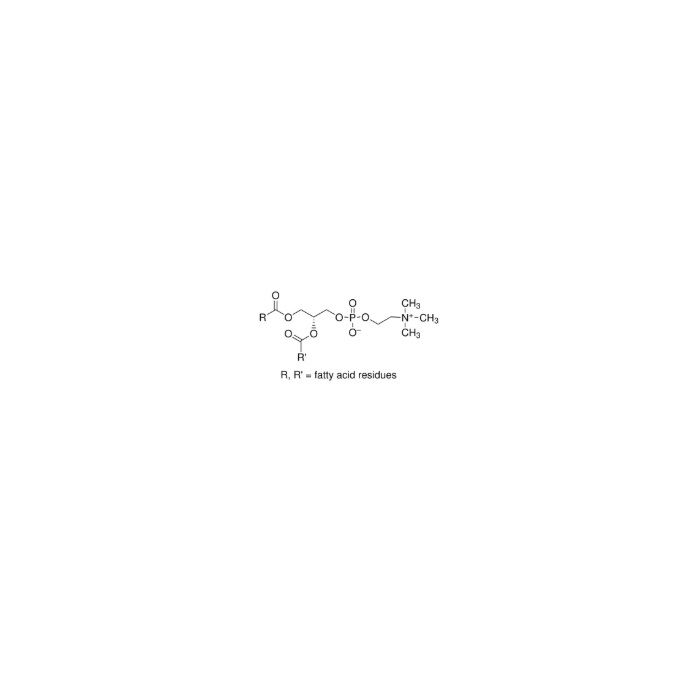
| Descrição | This compound belongs to the class of organic compounds known as phosphatidylcholines. These are glycerophosphocholines in which the two free -OH are attached to one fatty acid each through an ester linkage. |
| External Descriptors | Diacylglycerophosphocholines |
Find and download the COA for your product by matching the lot number on the packaging.
| Lot Number | Certificate Type | Data | Item |
|---|---|---|---|
| Certificate of Analysis | Jun 08, 2026 | L434223 | |
| Certificate of Analysis | Jun 08, 2026 | L434223 | |
| Certificate of Analysis | Apr 03, 2026 | L434223 | |
| Certificate of Analysis | Jun 14, 2025 | L434223 | |
| Certificate of Analysis | Jun 14, 2025 | L434223 | |
| Certificate of Analysis | Jun 14, 2025 | L434223 | |
| Certificate of Analysis | Jun 14, 2025 | L434223 | |
| Certificate of Analysis | Aug 02, 2023 | L434223 | |
| Certificate of Analysis | Aug 02, 2023 | L434223 | |
| Certificate of Analysis | Aug 02, 2023 | L434223 | |
| Certificate of Analysis | Aug 02, 2023 | L434223 |
| Peso molecular | 758.1 |
|---|---|
| XLogP3 | 12.900 |
| Hydrogen Bond Donor Count | 0 |
| Hydrogen Bond Acceptor Count | 8 |
| Rotatable Bond Count | 40 |
| Exact Mass | 757.562 Da |
| Monoisotopic Mass | 757.562 Da |
| Topological Polar Surface Area | 111.000 Ų |
| Heavy Atom Count | 52 |
| Formal Charge | 0 |
| Complexity | 940.000 |
| Isotope Atom Count | 0 |
| Defined Atom Stereocenter Count | 1 |
| Undefined Atom Stereocenter Count | 0 |
| Defined Bond Stereocenter Count | 2 |
| Undefined Bond Stereocenter Count | 0 |
| The total count of all stereochemical bonds | 2 |
| Covalently-Bonded Unit Count | 1 |
Item-specific, validated protocols are not provided in the Product Data. Below are general, literature-style procedures to guide use; adjust to your system.
SUV preparation by probe sonication (general)
LUV preparation by extrusion (general)
Ethanol injection (general)
Note: These are general guidelines for research use only. Optimize parameters (lipid concentration, temperature, cycles) for your formulation and instrumentation.
(General literature context; no clinical claims)
Membrane architecture
Metabolic pathways
Biophysical properties
Functional relevance in research
Choline reservoir
Phosphatidylcholine is not a buffering agent. However, buffer choice is critical for preparing stable PC dispersions and liposomes.
Common hydration buffers (literature/general)
Practical tips
Additives
While L-α-Phosphatidylcholine itself is a biogenic material, its handling often involves chlorinated solvents. Greener workflows can reduce environmental impact without sacrificing performance.
| Use case | Conventional choice | Greener alternative | Trade-offs | |---|---|---|---| | Thin-film dissolution | Chloroform:methanol (2:1) | Ethanol or isopropanol (absolute) | Lower solubility; may require warming; possible residual solvent unless dialyzed. | Liposome formation | Organic film hydration | Ethanol injection or microfluidic solvent exchange | Simpler, avoids chlorinated solvents; may yield broader size distributions unless extruded. | Cleaning glassware | Dichloromethane/hexane | Ethanol, isopropanol, acetone | Might need longer soaking; ensure complete drying. | Antioxidant strategy | BHT/toluene storage | Inert gas blanketing, amber vials, cold chain | Avoids additive contamination; requires rigorous technique.
Practical guidance
Notes
(Formulation/excipient context only; no therapeutic claims)
Roles in dosage forms (literature/general)
Compendial considerations
Process notes
Regulatory awareness
Item-specific specifications
General/literature properties for phosphatidylcholines (mixtures such as egg/soy PC)
Practical notes
Item-specific
Interpreting grades for phosphatidylcholines (general guidance)
What to verify on the CoA (recommended)
Practical implications
Core research applications (literature/general)
Chemical/enzymatic transformations (literature)
Practical notes
General working conditions for common laboratory uses of phosphatidylcholine (literature; adapt to your SOPs):
Thin-film hydration and liposome formation
Ethanol injection
Enzymatic conversions
Oxidation control
Analytical QC
GHS/SDS status (item-specific)
Storage and transport (item-specific)
General safety considerations (literature/best practice)
First-aid overview (consult SDS for authoritative guidance)
Handling tips
L-α-Phosphatidylcholine is amphiphilic and best handled in chlorinated/aromatic alcohol solvent systems or as aqueous bilayer dispersions.
Polarity/miscibility (literature)
Typical use scenarios
Choosing among options
Practical tips
L-α-Phosphatidylcholine (commonly referred to as lecithin/PC) is a glycerophospholipid class material comprising mixtures of molecular species differing in fatty acyl chains.
Item-specific (Product Data)
Structural description (general, literature)
2D structure in words (general)
Although L-α-Phosphatidylcholine is primarily used as a functional material rather than a reagent, it has defined synthetic and biocatalytic utility (literature/general):
As a substrate
As a reactant/medium
Analytical chemistry
Retrosynthetic perspective
Practical considerations
Not applicable. This product is a lipid mixture, not a biological probe or antibody. No target specificity information is provided in the Product Data.