GRAU & PUREZAMoligand™?Moligand™ — Aladdin's line of ligands and bioactive small molecules. Use for receptor, pathway, and binding studies needing defined small-molecule tools.≥99%
This compound belongs to the class of organic compounds known as valine and derivatives. These are compounds containing valine or a derivative thereof resulting from reaction of valine at the amino group or the carboxy group, or from the replacement of any hydrogen of glycine by a heteroatom.
External Descriptors
Common amino acids
1. Djoumbou Feunang Y, Eisner R, Knox C, Chepelev L, Hastings J, Owen G, Fahy E, Steinbeck C, Subramanian S, Bolton E, Greiner R, and Wishart DS. ClassyFire: Automated Chemical Classification With A Comprehensive, Computable Taxonomy. Journal of Cheminformatics, 2016, 8:61.
Determine the necessary mass, volume, or concentration for preparing a solution.
Dilution Calculator
Determine the dilution needed to prepare a stock solution.
Reconstitution Calculator
Revisões
Avaliações dos Clientes
Application Protocols
Item-specific tested applications, recommended dilutions, or assay protocols: Not specified for this item; refer to any method notes in your laboratory SOPs or to the literature for application-specific procedures.
General guidance (non-item-specific):
Preparing aqueous stocks: Weigh the required amount, add ~70–80% of final volume of water, stir with gentle warming (≤40 °C). Adjust pH away from pI (e.g., to pH 2–3 with HCl or pH 9–10 with NaOH) to accelerate dissolution, then bring to volume. Filter-sterilize (0.22 µm) for cell culture use if appropriate and if grade supports sterile work.
Peptide coupling (conceptual): Prefer protected derivatives (Fmoc-/Boc-L-Val-OH). For free acid couplings in solution, use standard carbodiimide chemistry (e.g., EDCI/HOBt or DIC/Oxyma) in polar aprotic solvents; monitor by TLC/HPLC and verify stereochemistry.
These are illustrative only; adapt to your specific system and consult the CoA/SDS for constraints.
Biological Roles
General biochemistry (no medical claims):
Proteinogenic amino acid: L-Valine is one of the 20 standard amino acids encoded by the genetic code (codons GUU, GUC, GUA, GUG). Its hydrophobic, branched isopropyl side chain promotes protein core packing, influencing folding, stability, and interactions in α-helices and β-sheets.
Essential amino acid in many organisms: Cannot be synthesized de novo by humans and numerous animals; obtained from diet. In microbes and plants, biosynthesis proceeds from pyruvate via acetolactate synthase pathways (branching also to leucine/isoleucine).
Metabolic fate (literature):
Transamination via branched-chain aminotransferases (BCAT) to corresponding α-ketoisovalerate.
Oxidative decarboxylation by the branched-chain α-keto acid dehydrogenase complex (BCKDH) yields isobutyryl-CoA, proceeding to propionyl-CoA and ultimately to succinyl-CoA via the methylmalonyl-CoA pathway (anaplerotic entry into the TCA cycle).
Participates in nitrogen shuttling and amino acid homeostasis.
Structural/functional motifs:
Enrichment of valine residues at hydrophobic interaction interfaces; may modulate membrane protein topology due to side-chain volume.
In peptide design, valine residues influence secondary structure propensity and aggregation due to β-branching sterics.
Biotechnological relevance:
Component of defined media recipes and feeds for microbial fermentation and mammalian cell culture (formulation role). Concentration optimization is critical to productivity and product quality attributes in bioprocess development.
Note: These are literature-based roles for L-Valine in general; they are not item-specific performance claims.
Buffer Applications
L-Valine is not a dedicated buffering agent. As a simple α-amino acid without an ionizable side chain, its buffering capacity is limited to regions near its functional group pKa values and is generally inferior to purpose-designed buffers.
General (literature):
pKa (COOH) ≈ 2.3 and pKa (NH3+) ≈ 9.6–9.8; isoelectric point pI ≈ 5.96.
Effective buffering windows are roughly pKa ± 1 pH unit; therefore, valine could weakly buffer around pH ~1–3 and ~9–11 but is rarely used due to low capacity and solubility constraints versus dedicated buffers.
Practical guidance:
For protein or enzyme work, use established buffers (e.g., acetate pH 4–5.5, MES pH 5.5–6.7, MOPS pH 6.5–7.9, HEPES pH 6.8–8.2, Tris pH 7–9) and add L-Valine as a component only if required for biochemical reasons (e.g., media formulation).
If formulating amino acid-containing solutions, maintain ionic strength with compatible salts (NaCl) and adjust pH with HCl/NaOH while avoiding precipitation near the isoelectric region if other amino acids/proteins are present.
Recipes: Not typically applicable; choose a standard buffer system and add L-Valine as a supplement if needed.
Conclusion: Use conventional buffering agents for pH control and consider L-Valine primarily as a nutrient or structural component, not as a buffer.
Green Alternatives
L-Valine itself is a bio-based, biodegradable molecule, often produced by fermentation, aligning with green chemistry principles. Consider the following when selecting formats and processes:
Sourcing and format (general):
Prefer fermentation-derived L-Valine with documented supply-chain sustainability (where available). Request statements on residual solvents and impurities to minimize downstream EHS burdens.
Use aqueous media where possible to avoid hazardous organics.
Process substitutions (literature examples):
Peptide couplings: Favor less hazardous coupling systems (e.g., DIC + OxymaPure) over benzotriazole-based reagents; minimize DMF by using greener solvents like NBP (N-butylpyrrolidone) or GBL where compatible.
Protection strategies: Boc/Fmoc protocols can be optimized to reduce solvent consumption (microwave or flow SPPS, solvent recycling, or solvent-saving washing sequences).
Solubilization: Before resorting to DMSO/DMF, test dissolution by mild pH adjustment and moderate warming in water.
Comparison (general, qualitative):
Free L-Valine vs ester/protected derivatives:
Free L-Valine: Water compatible, minimal solvent hazards, but limited in organic syntheses.
Protected derivatives (Fmoc-/Boc-): Enable organic-phase chemistry but increase solvent and reagent footprint. Optimize for minimal waste and safer solvents.
Waste and energy:
Use aqueous workups and recover solvents where possible.
Implement atom-economical couplings and avoid excess reagents to limit E-factor.
Trade-offs: While greener solvents and coupling reagents reduce hazard, verify compatibility with optical purity retention and yield; perform small-scale trials prior to scale-up.
Pharmaceutical Uses
No medical or therapeutic claims are made. The following are formulation/manufacturing roles of amino acids like L-Valine (general literature; not item-specific performance):
Excipient roles:
Stabilizer/tonicity modulator: Amino acids can stabilize proteins/peptides by preferential hydration and can contribute to tonicity; selection depends on compatibility and target osmolality.
pH and ionic environment: While not strong buffers, amino acids influence microenvironments and can mitigate aggregation in biopharmaceutical formulations.
Lyophilization aids: As co-solutes/cryoprotectants (alongside sugars/polyols), amino acids may affect cake structure and reconstitution behavior.
Process/media components:
Used in chemically defined cell culture media and feeds in biomanufacturing to support cell growth and product quality (concentration optimized per process).
Nutrient component in microbial fermentation for precursor supply and metabolic balance.
Quality considerations when selecting a grade for formulation or processing (consult CoA/Spec):
Identity and assay (HPLC/qNMR), specific rotation (optical purity), bioburden/endotoxin, residual solvents, metal content, and particulate burden.
Consistency across lots, and compatibility with sterilization (filtration) and depyrogenation strategies.
Regulatory context:
Pharmacopeial monographs (e.g., for valine) exist in some compendia; if compendial compliance is required, verify grade and tests. This product’s compendial status is not specified; refer to CoA/Spec Sheet.
Physical Properties
Item-specific numerical specifications (BP, MP, water content, UV cutoff, metal limits, etc.): Not specified for this item; refer to CoA/Spec Sheet.
Literature/general reference values for L-Valine (for planning only; not item specs):
Appearance: White crystalline solid (literature)
Melting point: ~315–320 °C (decomp., literature)
pKa values (25 °C, water, literature): pKa1 (COOH) ≈ 2.3; pKa2 (NH3+) ≈ 9.6–9.8; isoelectric point pI ≈ 5.96
Solubility (25 °C, literature): Water: moderately soluble (on the order of 5–10 g/100 mL; reported values vary by ionic strength and temperature); insoluble to sparingly soluble in most organic solvents (MeOH slightly, EtOH very slight)
LogP (neutral form, literature): not typically reported; amino acids are highly polar/zwitterionic at neutral pH; logD7.4 << 0
Optical rotation (literature, L-form): negative specific rotation in aqueous solution; magnitude depends on concentration, wavelength, and temperature (consult primary data if needed)
Hygroscopicity: generally low; forms stable zwitterionic crystals; may cake under high humidity (general observation)
Notes for experimentalists (general):
Dissolution is facilitated by slight warming and/or adjusting pH away from pI.
In peptide work, free L-Valine may be converted to Fmoc- or Boc-protected derivatives for higher solubility in organic media.
For precise physical constants applicable to your lot, consult the item’s CoA/SDS.
Quality and Grades
Item-specific quality attributes provided:
Grade/Purity: Moligand™ (brand/line designation as provided)
Appearance: Not specified for this item; refer to CoA/Spec Sheet.
Interpretation and practical implications (general):
The Moligand™ designation indicates the supplier’s product line; however, exact analytical specifications (assay/purity %, optical purity ee/er, elemental/metals profile, residual solvents, bioburden/endotoxin, UV profile) are not specified here. For critical applications (e.g., peptide synthesis, bioconjugation, media preparation), request and review the CoA and, if needed, a detailed Specification Sheet covering:
Assay (HPLC, titration, or qNMR)
Specific rotation or chiral HPLC (to confirm L-configuration and optical purity)
Water content (KF), residual solvents
Heavy metals/trace elements (ICP-MS) when relevant to bioapplications
Microbial/bioburden/endotoxin (if used in sensitive biological workflows)
Research Use Note: For research use only.
Stabilizers/additives: Not specified for this item; refer to CoA/Spec Sheet.
Batch-to-batch consistency tips (general):
Verify peptide-coupling performance with a small-scale test if using free L-Valine in derivatization workflows.
Store as directed (room temperature) to minimize moisture uptake and maintain flowability.
Record lot numbers in all experimental records to ensure traceability.
Reaction and Applications
Without item-specific application notes provided, the following describes common research uses of L-Valine (general literature):
Building block for peptide synthesis:
Typically converted to Fmoc- or Boc-protected forms for SPPS/LPPS. Side-chain protection is not required for valine (no nucleophilic side-chain functionality).
Coupling reagents: HATU, HBTU, TBTU, DIC/Oxyma, EDCI/HOAt, etc.
Racemization: Low for valine under modern coupling conditions; still minimize base exposure and heat.
Chiral pool synthesis:
The (S)-configured α-carbon serves as a chiral source to access non-racemic amines, amino alcohols, and β-branched motifs via reduction, Curtius/Schmidt rearrangements (from protected derivatives), and amide transformations.
Derivatization and functional materials:
Esterification (Fischer, under acidic conditions) to afford methyl/ethyl esters used as more soluble intermediates.
Formation of amides/dipeptides for organocatalysts or chiral auxiliaries.
Ionic liquids or deep eutectic solvents (DES) comprising amino acids and choline-based donors (exploratory, literature) for greener media.
Bioprocess and analytical contexts:
Component in defined media or feeds for microbial/animal cell culture (formulation use; consult quality/microbial specs as needed).
LC pre-column derivatization (e.g., OPA, FMOC-Cl) for amino acid profiling.
Practical tips:
For aqueous reactions, buffer near pH 8–9 to activate carboxylates; for esterifications, dry alcohol and acid catalysts under anhydrous conditions.
Convert to protected derivatives to access broader solvent space and higher coupling efficiencies.
Reaction Conditions
General literature guidance for common transformations involving L-Valine (not item-specific specifications):
Amide bond formation (peptide coupling):
Solvents: DMF, NMP, DCM/DMF, or greener options like NBP/EtOAc blends for SPPS.
Reagents: HATU or HBTU (3–5 eq) with DIPEA (2–5 eq); or DIC (2–3 eq) + OxymaPure (2–3 eq). Typical times: 30–120 min per coupling in SPPS; monitor with Kaiser/chloranil tests.
Temperature: Ambient to 50 °C (microwave or heated SPPS may reduce times). Minimize base exposure to avoid epimerization.
Boc protection of amine:
Reagents: Boc2O (1.1–1.5 eq), NaHCO3/Na2CO3 aqueous or biphasic dioxane/water; 0–25 °C, 1–3 h.
Fmoc protection:
Reagents: Fmoc-Cl (1.1–1.5 eq), Na2CO3 (aq), dioxane/water, 0–25 °C; or Fmoc-OSu in mildly basic aqueous media.
Esterification (to improve organic solubility):
Fischer: MeOH or EtOH with catalytic HCl or H2SO4, 0–25 °C to reflux; protect amine first (e.g., Boc) to prevent salt formation.
Alternative: DCC/DMAP with ROH at 0–25 °C under anhydrous conditions.
Curtius route to isocyanate/amine (from acid derivative):
Convert to acyl azide (via DPPA or hydrazide/NaNO2 pathway), then thermolysis to isocyanate; trap with alcohols/amines or hydrolyze to amine. Maintain low temperatures initially; carefully manage gas evolution.
Reductions:
LAH/borane reductions on protected amides/esters at 0–25 °C to give amino alcohols/amines; strict anhydrous technique required.
Always verify stereochemical integrity (chiral HPLC, [α]D) post-transformation. Optimize equivalents/temperatures on small scale before scale-up.
Safety and Handling
Item-specific hazard classifications and statements: Not specified for this item; refer to the SDS for authoritative safety information.
General laboratory safety guidance for amino acids (literature/general):
GHS classification: Many simple amino acids are not classified as hazardous under GHS at typical concentrations; however, always verify the specific SDS for this product/lot.
Likely hazards: Low acute toxicity; dust may cause mechanical eye/respiratory irritation. Avoid generating dust clouds.
PPE: Laboratory coat, safety glasses, and appropriate gloves (e.g., nitrile). Use dust mask/respirator if airborne particulates may form.
Handling: Avoid inhalation of dust; avoid contact with eyes. Use in well-ventilated area. Prevent contamination of containers to maintain product quality for research workflows.
Incompatibilities (general): Strong oxidizers, strong acids or bases may lead to decomposition or racemization under forcing conditions. Avoid nitrosating conditions (amines can form N-nitrosamines under harsh nitrosation chemistry, not typical for standard lab use).
First aid (overview; consult SDS):
Inhalation: Move to fresh air; seek medical attention if symptoms persist.
Skin contact: Wash with soap and water.
Eye contact: Rinse cautiously with water for several minutes; remove contact lenses if present and easy to do; seek medical advice if irritation continues.
Ingestion: Rinse mouth; obtain medical advice if unwell.
Fire safety: Organic solid; use water spray, CO2, foam, or dry chemical as appropriate to surroundings.
Environmental: Low environmental hazard expected; avoid release of large quantities to drains.
Solvent Selection
As a zwitterionic α-amino acid, L-Valine is primarily handled in aqueous media; solubility in most aprotic organic solvents is poor.
Polarity/miscibility (general literature):
Water: Moderately soluble at ambient temperature; solubility increases with temperature and away from pI (≈5.96) via pH adjustment.
Alcohols: Slightly soluble in methanol; very limited in ethanol/isopropanol.
Aprotic solvents (DMF, DMSO): Variable; free amino acids exhibit limited solubility, but dissolution can improve in highly polar, hydrogen-bond-accepting solvents (DMSO > DMF). Salt formation or protecting groups (Fmoc/Boc/OMe) are common strategies to increase solubility in organic media.
Practical selection guidance:
For stock solutions: Use water or buffered aqueous solutions. Adjust pH to ~2–3 (protonate amine) or ~9–10 (deprotonate carboxyl) to enhance dissolution relative to pI. Gentle warming (≤40 °C) and stirring aid dissolution.
For peptide coupling/derivatization: Convert to protected derivatives (e.g., Fmoc-L-Val-OH, Boc-L-Val-OH) which dissolve in DMF, NMP, DCM/DMF mixtures.
For analytical work: Aqueous mobile phases (with formic acid or ammonium buffers) are typical. For LC-MS, minimize nonvolatile salts.
Comparison (general):
L-Valine vs L-Leucine/L-Isoleucine: Valine is typically more water-soluble than leucine and similar to/is slightly more soluble than isoleucine, easing preparation of aqueous stocks.
Free amino acid vs protected forms: Protected forms trade water solubility for organic solubility and coupling compatibility.
Storage and Reconstitution
From Product Data (item-specific):
Storage Conditions: Room temperature
Shipped In: Normal
Additional item-specific storage notes (appearance, stabilizers, shelf-life): Not specified for this item; refer to CoA/Spec Sheet.
General guidance (non-item-specific):
Store tightly closed in a clean, dry container at ambient temperature, protected from excessive humidity to prevent caking. Use desiccant in long-term storage if the container is frequently opened.
For solution preparation, dissolve in purified water with stirring; mild warming (≤40 °C) can help. Adjust pH slightly acidic (pH 2–3) or basic (pH 9–10) to enhance solubility if needed, then readjust to target pH.
For sterile applications, prepare solutions under aseptic conditions and filter through 0.22 µm membranes. Record lot numbers and preparation dates; assign appropriate in-use shelf-life per your quality system.
Reconstitution specifics (concentration limits, exact solubility): Not specified for this item; verify empirically at your target conditions or consult literature.
Always consult the SDS for handling precautions and the CoA for lot-specific quality attributes.
Structure and Identity
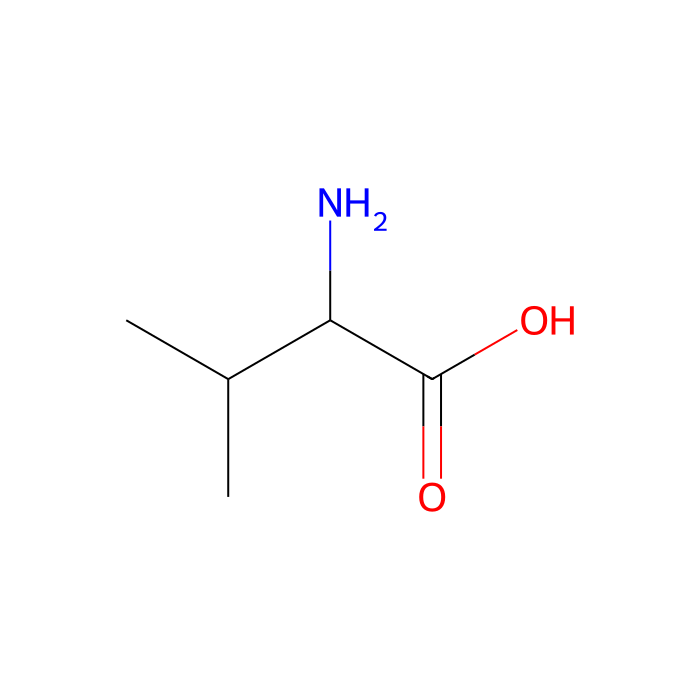
A branched-chain, proteinogenic α-amino acid with a chiral center, L-Valine features an isopropyl side chain on the β-carbon, an α-amino group, and a terminal carboxylic acid (zwitterionic at neutral pH).
From Product Data (item-specific):
Product Name: L-Valine
CAS: 72-18-4
CID: 6287
InChIKey: 193904 (as provided)
Grade: Moligand™
Literature/computed identifiers (for reference; not item-specific specifications):
Common name: L-Valine; IUPAC: (2S)-2-amino-3-methylbutanoic acid
Structural features (general chemistry knowledge):
Functional groups: α-amino (primary amine), carboxylic acid; forms a zwitterion (–NH3+, –COO–) near neutral pH.
Stereochemistry: Single stereocenter at the α-carbon; this product name specifies the L-configuration (S absolute configuration by CIP for valine).
Side chain: Hydrophobic, branched (isopropyl), contributing to protein packing and β-sheet/α-helix stabilization.
2D description in words: A four-carbon chain bearing at C2 a carboxylate and amino substituent (α-amino acid framework), with a methyl substituent at C3 (overall an isopropyl group on the β-carbon).
Synthetic Utility
L-Valine is a versatile chiral pool building block. Key reactivity derives from the α-amino and carboxylic acid groups and the β-branched, hydrophobic side chain.
Functional group transformations (general):
Protection: Boc- or Fmoc-protection on the amine; conversion to methyl/ethyl esters or benzyl esters on the acid for orthogonal strategies.
Coupling: Amide bond formation to give peptides/peptidomimetics (HATU/HBTU/DIC–Oxyma). Valine’s β-branching may slightly reduce coupling rates; activating additives (e.g., Oxyma) and excess coupling reagent help minimize epimerization and incomplete coupling.
Reductive routes: From protected valine amides/esters to chiral amines or amino alcohols via Curtius rearrangement (from acid azides), Schmidt reactions, or borane/LAH reductions (on suitably protected derivatives).
Esterification: Fischer esterification under acid catalysis; benzyl esters via BnOH/DCC or via BnCl after prior conversion to acid chloride (mind racemization).
Chiral relay and auxiliaries:
Use of valine-derived oxazolines/oxazolidinones or amides as chiral auxiliaries for enantioselective alkylations or additions (literature precedents).
Late-stage diversification:
N-acylation, urea/thiourea formation, and peptoid-like backbones from valine-derived amines expand chemical space for libraries.
Retrosynthetic value:
Ready availability in enantiopure form simplifies target planning for β-branched motifs; strategic protection manages chemoselectivity during multistep sequences.
Note: For optimal selectivity, keep reactions dry, control temperature, and minimize strong base exposure to suppress racemization at the α-stereocenter.
Target Specificity
Not applicable to this product type. L-Valine is a small-molecule amino acid, not an antibody, probe, or targeted binding reagent.
Item-specific data: None provided for antigens/epitopes/clones/isotypes.
For biochemical work, consider the Biological Roles and Synthetic Utility sections for relevant context.
Perguntas frequentes
How should this product be stored?
Store at room temperature.
What is the purity of this product?
This product is supplied at ≥99% purity (chemical assay). Lot-specific values are stated on the Certificate of Analysis.
What is Moligand??
Moligand? is one of Aladdin Scientific's premium product lines, formulated for high-purity applications across multiple workflows. Compared to standard grades in the same workflow, Moligand? products typically offer tighter specifications, more rigorous QC, and stronger lot-to-lot consistency.
How is this product shipped?
This product ships under standard ambient conditions. No temperature-controlled packaging is required.
What are the CAS number, molecular formula and molecular weight?
The CAS Number is 72-18-4, the molecular formula is C5H11NO2, and the molecular weight is 117.15 g/mol. InChIKey KZSNJWFQEVHDMF-BYPYZUCNSA-N.
What documentation is provided?
Available product documentation, including Certificates of Analysis (COA), Safety Data Sheets (SDS), and specification sheets, is shown in the product document area. Document availability and access follow the current site policy.
Usamos cookies para garantir o funcionamento adequado do site e, quando permitido, para melhorar a sua experiência. Você pode gerenciar suas preferências a qualquer momento nas Configurações. Saiba mais em nossa Política de Cookies.
Deseja que lhe enviemos uma mensagem quando tivermos descontos disponíveis?
Lembrar-me mais tarde
Obrigado! Por favor, verifique a sua caixa de entrada de e-mail para confirmar.
Products are supplied to verified businesses, institutions, and qualified professionals for research and development use only. Not for use in humans, animals, diagnosis, or therapy.

 E2618532