
Determine the necessary mass, volume, or concentration for preparing a solution.
| Activity Type | Activity Value -log(M) | Mechanism of Action | Activity Reference | Publications (PubMed IDs) |
|---|
Information
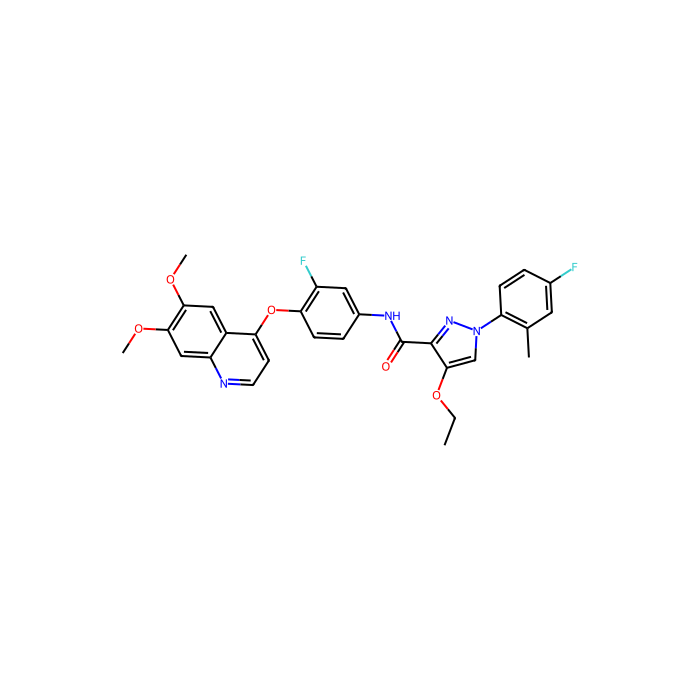
LDC1267 LDC1267 is a highly selective TAM kinase inhibitor with IC50 of <5 nM, 8 nM, and 29 nM for Mer, Tyro3, and Axl, respectively. Displays lower activity against Met, Aurora B, Lck, Src, and CDK8.
Targets
Mer (Cell-free assay); Tyro3 (Cell-free assay); Axl (Cell-free assay) <5 nM; 8 nM; 29 nM
In vitro
LDC1267 moderately affects cell proliferation in 11 of 95 different cell lines with IC50 of >5μM. In NKG2D-activated NK cells, LDC1267 abolishes the inhibitory effects of Gas6 stimulation.
In vivo
In B16F10 melanoma-bearing mice, LDC1267 (20 mg/kg, i.p.) efficiently enhances anti-metastatic NK cell activity, and rejects tumor metastases without serious cytotoxicity.
Cell Research(from reference)
Cell lines:A panel of 93 cancer cell lines and two primary cells (x axis, IMR90 and human peripheral blood mononuclear cells)
Concentrations:~30 μM
Incubation Time:72 hours
Taxonomy Tree
| Kingdom | Organic compounds |
|---|---|
| Superclass | Benzenoids |
| Classe | Benzene and substituted derivatives |
| Subclass | Anilides |
| Intermediate Tree Nodes | Not available |
| Direct Parent | Aromatic anilides |
| Alternative Parents | Phenylpyrazoles Diarylethers Quinolines and derivatives Pyrazole-5-carboxamides Phenoxy compounds 2-heteroaryl carboxamides Anisoles Toluenes Alkyl aryl ethers Fluorobenzenes Pyridines and derivatives Aryl fluorides Heteroaromatic compounds Secondary carboxylic acid amides Azacyclic compounds Hydrocarbon derivatives Organic oxides Organofluorides Organonitrogen compounds |
| Molecular Framework | Aromatic heteropolycyclic compounds |
| Substituents | Aromatic anilide - Diaryl ether - Phenylpyrazole - Quinoline - 2-heteroaryl carboxamide - Phenoxy compound - Phenol ether - Pyrazole-5-carboxamide - Anisole - Halobenzene - Fluorobenzene - Alkyl aryl ether - Toluene - Pyridine - Aryl halide - Aryl fluoride - Heteroaromatic compound - Pyrazole - Azole - Secondary carboxylic acid amide - Carboxamide group - Azacycle - Organoheterocyclic compound - Carboxylic acid derivative - Ether - Organooxygen compound - Organic oxygen compound - Organic nitrogen compound - Hydrocarbon derivative - Organic oxide - Organonitrogen compound - Organofluoride - Organohalogen compound - Aromatic heteropolycyclic compound |
| Descrição | This compound belongs to the class of organic compounds known as aromatic anilides. These are aromatic compounds containing an anilide group in which the carboxamide group is substituted with an aromatic group. They have the general structure RNC(=O)R', where R= benzene, and R = aryl group. |
| External Descriptors | Not available |
| Activity Type | Activity Value -log(M) | Mechanism of Action | Activity Reference | Publications (PubMed IDs) |
|---|
| Activity Type | Activity Value -log(M) | Mechanism of Action | Activity Reference | Publications (PubMed IDs) |
|---|
| Activity Type | Activity Value -log(M) | Mechanism of Action | Activity Reference | Publications (PubMed IDs) |
|---|
| Activity Type | Relation | Activity value | Units | Action Type | Journal | PubMed Id | doi | Assay Aladdin ID |
|---|
| Activity Type | Relation | Activity value | Units | Action Type | Journal | PubMed Id | doi | Assay Aladdin ID |
|---|
| Activity Type | Relation | Activity value | Units | Action Type | Journal | PubMed Id | doi | Assay Aladdin ID |
|---|
| Activity Type | Relation | Activity value | Units | Action Type | Journal | PubMed Id | doi | Assay Aladdin ID |
|---|
| Activity Type | Relation | Activity value | Units | Action Type | Journal | PubMed Id | doi | Assay Aladdin ID |
|---|
| Activity Type | Relation | Activity value | Units | Action Type | Journal | PubMed Id | doi | Assay Aladdin ID |
|---|
| Activity Type | Relation | Activity value | Units | Action Type | Journal | PubMed Id | doi | Assay Aladdin ID |
|---|
| Activity Type | Relation | Activity value | Units | Action Type | Journal | PubMed Id | doi | Assay Aladdin ID |
|---|
| Activity Type | Relation | Activity value | Units | Action Type | Journal | PubMed Id | doi | Assay Aladdin ID |
|---|
| Activity Type | Relation | Activity value | Units | Action Type | Journal | PubMed Id | doi | Assay Aladdin ID |
|---|
| Activity Type | Relation | Activity value | Units | Action Type | Journal | PubMed Id | doi | Assay Aladdin ID |
|---|
| Activity Type | Relation | Activity value | Units | Action Type | Journal | PubMed Id | doi | Assay Aladdin ID |
|---|
| Activity Type | Relation | Activity value | Units | Action Type | Journal | PubMed Id | doi | Assay Aladdin ID |
|---|
| Activity Type | Relation | Activity value | Units | Action Type | Journal | PubMed Id | doi | Assay Aladdin ID |
|---|
| Activity Type | Relation | Activity value | Units | Action Type | Journal | PubMed Id | doi | Assay Aladdin ID |
|---|
| Activity Type | Relation | Activity value | Units | Action Type | Journal | PubMed Id | doi | Assay Aladdin ID |
|---|
| Activity Type | Relation | Activity value | Units | Action Type | Journal | PubMed Id | doi | Assay Aladdin ID |
|---|
| Activity Type | Relation | Activity value | Units | Action Type | Journal | PubMed Id | doi | Assay Aladdin ID |
|---|
| Activity Type | Relation | Activity value | Units | Action Type | Journal | PubMed Id | doi | Assay Aladdin ID |
|---|
| Activity Type | Relation | Activity value | Units | Action Type | Journal | PubMed Id | doi | Assay Aladdin ID |
|---|
| Activity Type | Relation | Activity value | Units | Action Type | Journal | PubMed Id | doi | Assay Aladdin ID |
|---|
| Activity Type | Relation | Activity value | Units | Action Type | Journal | PubMed Id | doi | Assay Aladdin ID |
|---|
| Activity Type | Relation | Activity value | Units | Action Type | Journal | PubMed Id | doi | Assay Aladdin ID |
|---|
| Activity Type | Relation | Activity value | Units | Action Type | Journal | PubMed Id | doi | Assay Aladdin ID |
|---|
| Activity Type | Relation | Activity value | Units | Action Type | Journal | PubMed Id | doi | Assay Aladdin ID |
|---|
| Activity Type | Relation | Activity value | Units | Action Type | Journal | PubMed Id | doi | Assay Aladdin ID |
|---|
| Activity Type | Relation | Activity value | Units | Action Type | Journal | PubMed Id | doi | Assay Aladdin ID |
|---|
| Activity Type | Relation | Activity value | Units | Action Type | Journal | PubMed Id | doi | Assay Aladdin ID |
|---|
| Activity Type | Relation | Activity value | Units | Action Type | Journal | PubMed Id | doi | Assay Aladdin ID |
|---|
| Activity Type | Relation | Activity value | Units | Action Type | Journal | PubMed Id | doi | Assay Aladdin ID |
|---|
| Activity Type | Relation | Activity value | Units | Action Type | Journal | PubMed Id | doi | Assay Aladdin ID |
|---|
| Activity Type | Relation | Activity value | Units | Action Type | Journal | PubMed Id | doi | Assay Aladdin ID |
|---|
| Activity Type | Relation | Activity value | Units | Action Type | Journal | PubMed Id | doi | Assay Aladdin ID |
|---|
| Activity Type | Relation | Activity value | Units | Action Type | Journal | PubMed Id | doi | Assay Aladdin ID |
|---|
| Activity Type | Relation | Activity value | Units | Action Type | Journal | PubMed Id | doi | Assay Aladdin ID |
|---|
| Activity Type | Relation | Activity value | Units | Action Type | Journal | PubMed Id | doi | Assay Aladdin ID |
|---|
| Activity Type | Relation | Activity value | Units | Action Type | Journal | PubMed Id | doi | Assay Aladdin ID |
|---|
| Activity Type | Relation | Activity value | Units | Action Type | Journal | PubMed Id | doi | Assay Aladdin ID |
|---|
| Activity Type | Relation | Activity value | Units | Action Type | Journal | PubMed Id | doi | Assay Aladdin ID |
|---|
| Activity Type | Relation | Activity value | Units | Action Type | Journal | PubMed Id | doi | Assay Aladdin ID |
|---|
| Activity Type | Relation | Activity value | Units | Action Type | Journal | PubMed Id | doi | Assay Aladdin ID |
|---|
| Activity Type | Relation | Activity value | Units | Action Type | Journal | PubMed Id | doi | Assay Aladdin ID |
|---|
| Activity Type | Relation | Activity value | Units | Action Type | Journal | PubMed Id | doi | Assay Aladdin ID |
|---|
| Activity Type | Relation | Activity value | Units | Action Type | Journal | PubMed Id | doi | Assay Aladdin ID |
|---|
| Activity Type | Relation | Activity value | Units | Action Type | Journal | PubMed Id | doi | Assay Aladdin ID |
|---|
Find and download the COA for your product by matching the lot number on the packaging.
| Lot Number | Certificate Type | Data | Item |
|---|---|---|---|
 C2331533 | Certificate of Analysis | Jan 20, 2026 | L413798 |
| C2331534 | Certificate of Analysis | Jan 20, 2026 | L413798 |
| C2331535 | Certificate of Analysis | Jan 20, 2026 | L413798 |
| C2331539 | Certificate of Analysis | Jan 20, 2026 | L413798 |
| C2331619 | Certificate of Analysis | Jan 20, 2026 | L413798 |
| C2331627 | Certificate of Analysis | Jan 20, 2026 | L413798 |
| C2331632 | Certificate of Analysis | Jan 20, 2026 | L413798 |
| C23081514 | Certificate of Analysis | Dec 10, 2025 | L413798 |
| C23081516 | Certificate of Analysis | Dec 10, 2025 | L413798 |
| C23081518 | Certificate of Analysis | Dec 10, 2025 | L413798 |
| C23081528 | Certificate of Analysis | Dec 10, 2025 | L413798 |
| C2331558 | Certificate of Analysis | Dec 19, 2022 | L413798 |
| C2510007 | Certificate of Analysis | Dec 19, 2022 | L413798 |
| C2508025 | Certificate of Analysis | Nov 25, 2022 | L413798 |
| Solubilidade | Solubility (25°C) In vitro DMSO: 100 mg/mL warmed with 50ºC Water: bath (178.39 mM); Ethanol: 2 mg/mL warmed with 50ºC Water: bath (3.56 mM); Water: Insoluble; |
|---|---|
| DMSO (mg/mL) Solubilidade máxima | 100 |
| DMSO (mM) Solubilidade máxima | 178.396218 |
| Água (mg/mL) Solubilidade máxima | <1 |
| Peso molecular | 560.5 |
| XLogP3 | 5.700 |
| Hydrogen Bond Donor Count | 1 |
| Hydrogen Bond Acceptor Count | 9 |
| Rotatable Bond Count | 9 |
| Exact Mass | 560.187 Da |
| Monoisotopic Mass | 560.187 Da |
| Topological Polar Surface Area | 96.700 Ų |
| Heavy Atom Count | 41 |
| Formal Charge | 0 |
| Complexity | 860.000 |
| Isotope Atom Count | 0 |
| Defined Atom Stereocenter Count | 0 |
| Undefined Atom Stereocenter Count | 0 |
| Defined Bond Stereocenter Count | 0 |
| Undefined Bond Stereocenter Count | 0 |
| The total count of all stereochemical bonds | 0 |
| Covalently-Bonded Unit Count | 1 |
No item-specific, validated application protocols are provided for this product.
General guidance (for research use only; adapt to your system and consult literature on LDC1267):
Note: These outlines are generic and must be tailored to the verified biological target and assay design. Always verify solubility and stability under your specific assay conditions.
Context from the literature: LDC1267 is widely cited as a small-molecule kinase inhibitor probe. It has been reported as a tool compound for interrogating signaling pathways associated with specific receptor tyrosine kinases (e.g., entries connected to PubChem CID 56847486). No item-specific biological validation data are provided in this listing.
Use cases in chemical biology (general):
Best practices:
Note: This product is for research use only. No claims are made regarding therapeutic, diagnostic, or clinical utility.
This product is not a buffering agent and is not used to control solution pH.
Practical notes for assay buffers (general):
Item-specific buffer recipes or pH ranges: Not applicable. Refer instead to your assay’s buffer system and the literature on LDC1267 usage.
As a small-molecule research ligand, LDC1267 itself is the active material and not a process solvent or reagent that typically invites greener substitutes. However, greener considerations apply to the choice of dissolution and processing solvents around its use.
Greener handling considerations (general):
Illustrative comparison for solution preparation (general):
Waste management:
This product is supplied strictly for research use only and is not intended for human or veterinary use, clinical diagnostics, or as an excipient in commercial formulations.
Context (general information):
Formulation considerations for laboratory research (general, non-clinical):
Item-specific excipient role or compendial status: Not specified for this item; refer to CoA/Spec Sheet. No claims are made for clinical or manufacturing use.
Only limited item-specific physico-chemical data are provided in this listing.
Item-specific specifications:
Literature/general reference values for LDC1267 (context only; verify before use):
Practical notes (general):
What Moligand™ signifies (general description):
Implications for use:
Best practices:
This compound is primarily utilized as a research ligand/probe in chemical biology rather than as a synthetic reagent. Consequently, conventional synthetic reaction families (e.g., cross-couplings, condensations) are not the typical use case for LDC1267 as a substrate or solvent.
Application contexts (general, literature-based):
Practical tips:
Note: No item-specific application protocols or performance guarantees are provided; consult the literature on LDC1267 for target-specific guidance.
Conventional synthetic reaction conditions are not typically applicable to the end-use of this product, which is supplied as a finalized research ligand rather than a reagent or substrate for chemical transformations.
General guidance related to use in assays (not synthetic reactions):
If employing LDC1267 in any chemical transformation or conjugation chemistry:
Item-specific reaction data: Not applicable/Not specified for this item; refer to CoA/Spec Sheet and primary literature if undertaking derivative synthesis.
Hazard classification for this specific item has not been provided in the listing.
Item-specific safety data:
General laboratory handling guidance (not a substitute for the SDS):
Always consult the product’s SDS for authoritative and complete safety information.
This product is supplied as a solid small molecule (appearance not specified). For small-molecule ligands of this class, solvent choice is often driven by the need to achieve concentrated stock solutions and maintain assay compatibility.
General guidance (literature/experience-based):
Comparison (general):
Item-specific solubility data: Not specified for this item; determine empirically and consult CoA/Spec Sheet if available.
Item-specific conditions:
Best practices (general):
Reconstitution (general guidance for small-molecule ligands):
Disposal: Dispose of unused solutions and contaminated materials as organic chemical waste in accordance with institutional and local regulations.
Brief summary: LDC1267 is a cataloged small‑molecule research ligand (Moligand grade) commonly referenced in the chemical biology literature as a kinase-targeted probe. Item-specific identifiers for structural confirmation are limited in this listing.
Structural features (general, literature-based context):
2D-structure description (general):
LDC1267 is offered as a finished research ligand, not as a general synthetic building block. Consequently, its direct use in multi-step synthetic sequences is limited compared with standard reagents.
General considerations (where relevant):
Summary: Treat this product primarily as a tool compound for assays. If derivatization or conjugation is intended, confirm structural details and assess IP/usage rights before synthesis work.
Target/antigen specificity data (antibody-style metadata such as antigen, clone, isotype, species reactivity) are not applicable to this small-molecule product.
Item-specific target data provided in this listing: None.
General literature context:
Recommendation:
O nosso guia de seleção de graus abrange pureza, estado do estabilizador e adequação à aplicação para todas as variantes do nosso catálogo.
Ver o guia de graus Moligand™ →