GRADE & PURITYMoligand™?Moligand™ — Aladdin's line of ligands and bioactive small molecules. Use for receptor, pathway, and binding studies needing defined small-molecule tools.10 mM in DMSO
Moligand™, 10 mM in DMSO Moligand™ for sensitive chromatographic and analytical workflows requiring minimal baseline interference.
🌡
Storage & shipping
Store at -80°C Ships Dry ice packs + Cold packs Check lot-specific COA for exact specifications.
📋
Quality documents
SDS, COA, datasheet, and spec sheet available for download. Lot-specific COA accessible via lot number lookup.
📚
Literature proof
Cited in 0 peer-reviewed publications across chromatography, organic synthesis, and cross-coupling reactions.
Visão geral
Levomepromazine (Methotrimeprazine) is an orally active antipsychotic compound and Ca 2+ release inducer. Levomepromazine inhibits SERCA pump and induces an increase in cytoplasmic Ca 2+ levels. Levomepromazine has antagonistic effects on a variety of neurotransmitter receptors , including dopamine , cholinergic , serotonin , and histamine receptors . Levomepromazine can induce adaptive ER stress and autophagy . In addition, Levomepromazine has antiviral , anti-inflammatory, neuroprotective and analgesic, sedative and anti-injurious activities. Levomepromazine can be used in the study psychiatric disorders and relieving nausea and vomiting .
Specifications
Especificações e pureza
Moligand™, 10 mM in DMSO
Condições de armazenamento de armazenamento
Store at -80°C
Enviado em
Dry ice packs + Cold packs
Este produto requer transporte de cadeia fria. Serviços terrestres e outros serviços econômicos não estão disponíveis.
Grau
Moligand™
Nomes e identificadores
SMILES isoméricas
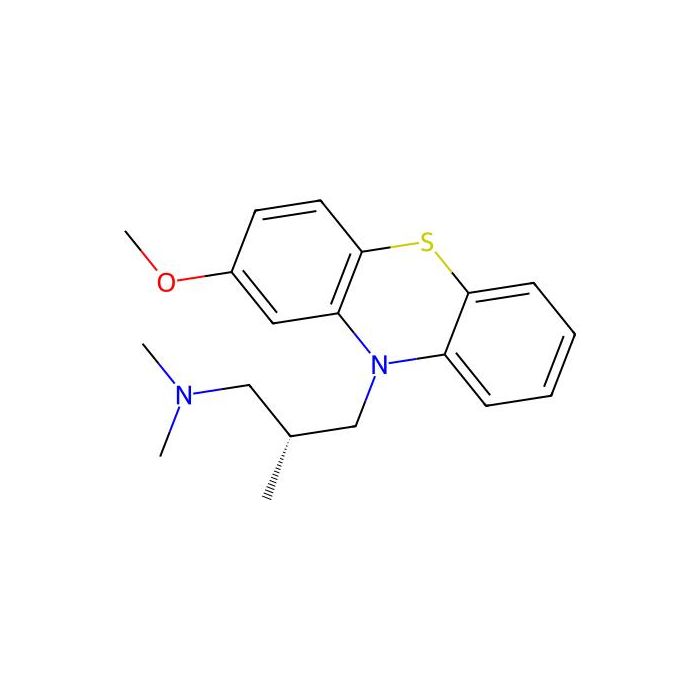
C[C@@H](CN1C2=CC=CC=C2SC3=C1C=C(C=C3)OC)CN(C)C
PubChem CID
72287
Peso molecular
328.47
Documentation
📋 Safety Data Sheet (SDS)
Comprehensive hazard, handling, storage, and regulatory compliance document.
Determine the necessary mass, volume, or concentration for preparing a solution.
Dilution Calculator
Determine the dilution needed to prepare a stock solution.
Reconstitution Calculator
Revisões
Avaliações dos Clientes
Application Protocols
No vendor-validated application protocols are provided for this item in the Product Data.
General guidance for small-molecule screening stocks (for research use only):
Stock preparation: Dissolve in anhydrous DMSO to 10–20 mM. Vortex and, if needed, sonicate briefly. Filter through a 0.22 µm PTFE syringe filter if particulate persists.
Aliquoting: Dispense single-use aliquots (e.g., 10–50 µL) in amber vials or 96‑well plates to minimize freeze–thaw. Backfill headspace with inert gas if long-term storage is required.
Working solutions: Dilute into assay buffer immediately before use; maintain final DMSO concentration at or below the assay’s tolerated limit.
Controls: Include vehicle controls, orthogonal readouts (to detect optical interference), and detergent controls (to mitigate aggregation artifacts).
These steps are provided as general laboratory practices for lipophilic amines and do not constitute product-specific validated methods.
Biological Roles
General literature context (no medical or clinical claims; for research/lab use only):
Target class interactions: Levomepromazine belongs to the phenothiazine class, many members of which are documented ligands across multiple receptor families, including dopaminergic, adrenergic, histaminergic, cholinergic (muscarinic), and serotonergic receptors. Reported activities vary by assay system and conditions; consult primary literature for quantitative Ki/IC50 values.
Polypharmacology considerations: The tertiary amine and aromatic scaffold promote cation–π and hydrophobic interactions in GPCR binding pockets. This polypharmacology can be advantageous in phenotypic screens but requires careful counter-screening to separate primary from off-target effects.
Transport and metabolism (class-level, literature): Phenothiazines are substrates/inhibitors of certain CYP isoforms and can undergo N‑demethylation, S‑oxidation, and O‑demethylation. Efflux transporters (e.g., P‑gp) may influence disposition in cell-based systems; verify transporter expression in your model.
Biophysical/assay notes:
Aggregation risk: Lipophilic amines may form colloidal aggregates at micromolar levels; include nonionic detergents (e.g., 0.01% Tween‑20) or use detergent-free orthogonal assays to confirm activity.
Fluorescence/absorbance: The phenothiazine chromophore can interfere with certain optical readouts (blue/green channels). Use appropriate blanks and spectral controls.
Always corroborate target engagement with orthogonal methods (e.g., radioligand binding, BRET, thermal shift) and report exact salt form and solvent content in publications.
Buffer Applications
This compound is a small-molecule library member and not a buffering agent. It does not define a useful conjugate acid/base pair for classical laboratory buffer preparation.
Practical note: If aqueous work is required, improved solubility is typically achieved by preparing an acid-addition salt (e.g., dilute HCl) and adjusting to an acidic pH (commonly pH 4.5–6 in literature) compatible with your assay. Use standard buffers (citrate, acetate, phosphate) to maintain pH; validate that buffer components do not interact with the compound or assay readout.
For dedicated buffering systems, refer to established buffers such as phosphate, HEPES, MOPS, Tris, or acetate depending on the desired pH range and compatibility.
Green Alternatives
Because this SKU is a small-molecule library member rather than a process solvent or reagent, “green alternatives” primarily concern solvent and workup choices when preparing or handling solutions.
Solvent selection (greener options; general guidance):
Prefer ethanol or isopropanol over chlorinated solvents where solubility permits.
Replace DMF/NMP with safer polar aprotics such as Cyrene or propylene carbonate in method development, recognizing potential solubility limits for lipophilic bases.
Use water or aqueous buffers for dilutions when the compound is in a protonated/salt form (adjust pH to maintain solubility).
Comparison (general, not item specifications):
DMSO vs DMF: DMSO has a more favorable environmental and toxicological profile and is widely accepted in bioassays.
Ethanol vs acetonitrile: ethanol is renewable and safer; acetonitrile offers superior volatility for LC but has supply-chain and toxicity considerations.
Operational greening:
Minimize DMSO stock concentrations to what your assay requires and aliquot to reduce waste.
Employ microscale assays and 96/384‑well formats to reduce solvent use.
Use amber, reusable glass vials to avoid single-use plastics when compatible.
Note: Verify solubility/stability when changing solvents; strong acids/bases or oxidants used to alter solubility may introduce additional EHS burdens.
Pharmaceutical Uses
This product is supplied strictly for research use only (as stated in Product Data). No medical, diagnostic, or therapeutic use is intended or implied.
Formulation context (general/literature, non-clinical): Phenothiazine derivatives are often handled as acid-addition salts to enhance aqueous solubility and stability. For in vitro research formulations, stock solutions are commonly prepared in DMSO and diluted into buffered media immediately before use.
Excipient status: Not applicable—levomepromazine is a pharmacologically active small molecule in the literature and is not used as a pharmaceutical excipient.
Analytical/formulation development in research settings:
Determine salt form and counterion from the CoA; salt form strongly influences solubility and assay behavior.
Use LC–MS compatible vehicles (e.g., water/acetonitrile with 0.1% formic acid) for quantitation; include internal standards where available.
Evaluate adsorption to plastics; pre-rinse or use low-bind vessels to minimize loss at low concentrations.
Any references to pharmacopeial monographs or clinical applications are outside the scope of this catalog entry and should not be inferred.
Physical Properties
Item-specific specifications (for this catalog SKU):
Appearance: Not specified for this item; refer to CoA/Spec Sheet.
Molecular weight: Not specified for this item; refer to CoA/Spec Sheet.
Literature/typical properties for levomepromazine (general reference values, not product specifications):
Physical state: typically a crystalline solid (free base or as salts in research/analytical use) (literature).
Solubility: free base is sparingly soluble in water and readily soluble in polar aprotic organic solvents (e.g., DMSO, DMF) and alcohols; salt forms (e.g., hydrochloride/maleate, where applicable in literature) show increased aqueous solubility (literature).
Acid–base behavior: tertiary amine pKa for related phenothiazines is commonly in the ~9–10 range, leading to predominant protonation under physiological pH; exact pKa for levomepromazine varies by source (literature; consult primary references for numeric values).
Partitioning: phenothiazine derivatives are generally lipophilic (high logP) as free bases; salt formation reduces apparent logD in aqueous systems (literature).
UV–Vis: phenothiazine chromophores show strong absorption in the near-UV with tails into the visible; exact maxima depend on substitution and solvent (literature).
Notes for practitioners:
For quantitative work (stock solutions, logD/pKa determinations), verify salt form and water content on the accompanying CoA before use.
If handling as a free base, warm gently and sonicate with dry DMSO or ethanol to accelerate dissolution; avoid prolonged exposure to light/air to minimize oxidative discoloration (general guidance).
Quality and Grades
Catalog grade: Moligand™ (as listed in Product Data)
Description (program-level, general): Moligand™ denotes inclusion in Aladdin’s small-molecule/compound library designed for screening, profiling, and ligand-discovery workflows. Compounds are curated for identity and suitability in high-throughput screening (HTS) and follow-on structure–activity studies.
What it implies for users: Batch traceability, confirmed structure/identity, and suitability for discovery assays. Numeric impurity limits (e.g., residual solvents, water content, metals, UV cutoff) are Not specified for this item; refer to CoA/Spec Sheet.
Appearance: Not specified for this item; refer to CoA/Spec Sheet.
Stabilizers/additives: None indicated in the Product Data. If stabilizers are present, they will be listed on the CoA/Spec Sheet.
Practical guidance for this SKU:
Verify the exact form (free base vs specific salt) and any counterions on the CoA before analytical quantitation or biological screening.
For LC/UV or LC–MS applications, consult the CoA for UV absorbance/blank profiles and recommended diluents to control baseline drift and ion suppression.
If your workflow requires defined particle size, dryness, or salt form, request this information or reprocess in-house (e.g., convert to a defined salt, recrystallize, or dry under high vacuum) after confirming compatibility.
Reaction and Applications
This product is offered as a research compound (Moligand™ library) rather than a general-purpose reagent. It is not commonly used as a stoichiometric reagent or catalyst. Nevertheless, understanding its chemical behavior can guide handling and potential derivatization studies.
Research applications (general):
Ligand screening and phenotypic assays: leverage the basic tertiary amine and phenothiazine chromophore for binding studies across GPCRs, ion channels, and transporters (literature; no claims about efficacy or suitability for therapy).
Analytical reference: retention-time and fragmentation benchmarking in LC–MS for phenothiazine-class comparators.
Chemical reactivity (literature):
Oxidation: sulfur can undergo stepwise oxidation (sulfide → sulfoxide → sulfone) under peracids or catalytic aerobic conditions; nitrogen N-oxides can form under strong oxidants.
O‑demethylation: the 2‑methoxy substituent is susceptible to demethylation (e.g., BBr3, strong Lewis acids) to give the corresponding phenol for SAR elaboration.
Side-chain transformations: quaternization of the tertiary amine (alkyl halides), acylation to amide salts, or conversion to various acid-addition salts.
Electrophilic aromatic substitution: deactivated relative to benzene but directed by the methoxy; halogenation/nitration require controlled conditions.
Practical tips:
Protect from light and air during reactions to limit background oxidation.
Employ inert atmosphere for sensitive steps and consider antioxidants if compatible.
Confirm structure by multi-nuclear NMR and HRMS; monitor for sulfoxide formation by LC–MS (Δ+16 Da).
Reaction Conditions
As supplied, levomepromazine is intended as a research compound rather than a reagent. If you pursue derivatization or stability studies, the following general, literature-based conditions are commonly reported for phenothiazine scaffolds (not product specifications):
O‑demethylation: BBr3 (1–3 eq) in dry dichloromethane at −78 to 0 °C, 1–4 h, then quench to afford the phenol; yields vary (40–85%) depending on substitution.
Sulfur oxidation: mCPBA (1.0–1.2 eq) in DCM or EtOAc at 0–25 °C for sulfoxide; excess oxidant or higher temperature/time leads to sulfone; monitor by LC–MS (Δ+16 or +32 Da).
Quaternization: alkyl halide (e.g., MeI, BnBr) in MeCN/acetone at room temperature to 60 °C, 2–24 h; isolate ammonium salt by precipitation.
Salt formation: dissolve base in minimal ethanol or acetone and treat with stoichiometric HCl or other acids (e.g., maleic, fumaric) in ether/EtOAc to precipitate defined salts; dry under vacuum, protect from light.
Operational notes:
Protect from light and oxygen; use amber glass and inert atmosphere when feasible.
Ensure rigorous drying of solvents for Lewis-acid steps; tertiary amines can complex with reagents and alter stoichiometry.
Validate conditions on milligram scale; phenothiazines can discolor upon over-oxidation and may foul chromatographic media—use buffered or basic modifiers during purification where appropriate.
Safety and Handling
Item-specific safety designations:
GHS classification: Not specified for this item; refer to SDS.
Signal word / pictograms / H-statements: Not specified for this item; refer to SDS.
General safety guidance for phenothiazine tertiary amines (literature/general):
Hazards: May cause irritation to eyes/skin/respiratory tract; phenothiazines can undergo photo-oxidation leading to colored byproducts—manage light exposure. Avoid dust generation and inhalation of particulates.
PPE: Use lab coat, safety glasses, and appropriate chemically resistant gloves (e.g., nitrile). Work in a fume hood for weighing, solution prep, and any operation that could aerosolize powder.
Handling: Minimize exposure to air and light; use amber glassware when practical. Prepare solutions freshly and store aliquots under inert gas for sensitive assays.
Incompatibilities: Strong oxidizers may promote sulfoxidation of the phenothiazine sulfur; strong acids/bases will alter protonation state—evaluate compatibility with your assay medium.
First aid (overview; defer to SDS): If on skin/eyes, rinse with water for several minutes; remove contaminated clothing. If inhaled, move to fresh air. If ingested or in case of exposure symptoms, seek medical attention and show SDS.
Waste: Collect organic solutions and contaminated materials as hazardous waste; do not discharge to drains.
Always consult the product’s SDS for authoritative hazard classification, exposure limits, and emergency procedures.
Solvent Selection
Levomepromazine is a basic, lipophilic phenothiazine. Solvent choice strongly affects assay performance and stability.
Polarity and miscibility (literature/general):
Free base: sparingly water-soluble; readily soluble in DMSO, DMF, acetonitrile to a moderate extent, and lower alcohols (methanol/ethanol/isopropanol).
Protonated salts (where applicable): improved aqueous solubility in acidic buffers; consider pH ≤ 5–6 to maintain solubilization.
Typical solvent choices by application:
Screening stocks: anhydrous DMSO (e.g., 10–20 mM) with amber vials; dilute into assay buffer just before use, maintaining final DMSO ≤ 0.1–1% as your biology permits.
Analytical standards: methanol or acetonitrile/water with 0.1% formic acid for LC–MS; include an antioxidant (e.g., ascorbate) only if validated not to interfere.
Spectroscopy: ethanol or acetonitrile for UV–Vis; DMSO‑d6 or CDCl3 for NMR depending on form.
Comparison notes (general):
DMSO vs DMF: DMSO offers broader solubilization and better biocompatibility at low percentages; DMF can extract plasticizers—use glassware.
Aqueous buffers: if precipitation occurs upon dilution, pre-acidify the buffer (e.g., 10–50 mM citrate/phosphate at pH 4.5–6) or co-solubilize with 1–5% DMSO.
Always confirm actual solubility and stability with small-scale tests; consult the CoA to verify the supplied form.
Storage and Reconstitution
Storage conditions (as provided in Product Data):
Store at −80 °C.
Shipped on dry ice packs + cold packs.
Appearance: Not specified for this item; refer to CoA/Spec Sheet.
Reconstitution (general guidance for research use; not product specifications):
Preferred solvents: anhydrous DMSO for concentrated stocks; ethanol or methanol as alternates when compatible with downstream use.
Target stock concentration: commonly 10–20 mM; adjust based on solubility and assay needs.
Technique: Allow vial to equilibrate to room temperature in a desiccator before opening to prevent moisture condensation. Weigh quickly, protect from light, and cap promptly after solvent addition. Mix by gentle vortexing and, if necessary, brief sonication.
Aliquoting and stability (general):
Dispense single-use aliquots in amber vials or plates; minimize headspace and consider inert gas overlay.
Avoid repeated freeze–thaw cycles; thaw on ice or at room temperature and use immediately.
Store solutions at ≤ −20 °C (short term) or −80 °C (long term) as compatible with your solvent system; verify stability by LC–MS/HPLC before critical experiments.
For definitive specifications (form, purity, residual solvents, water content), consult the lot-specific CoA/Spec Sheet. Research use only.
Structure and Identity
Levomepromazine is a tricyclic phenothiazine derivative typically described as a 2-methoxy-substituted phenothiazine bearing a 3-dimethylaminopropyl side chain on the ring nitrogen (N-10). It is widely referenced in chemical and pharmacological literature under the synonym methotrimeprazine.
Item-specific identifiers
CAS: 60-99-1 (Product Data)
CID: 72287 (Product Data)
InChIKey: Not specified for this item; refer to CoA/Spec Sheet.
SMILES: Not specified for this item; refer to CoA/Spec Sheet.
Molecular formula: Not specified for this item; refer to CoA/Spec Sheet.
Molecular weight: Not specified for this item; refer to CoA/Spec Sheet.
Structural features (general literature description)
Core: phenothiazine tricyclic scaffold (two benzene rings fused to a central thiazine, containing S and N in the central ring).
Substitution: methoxy group at the 2-position of the aromatic system; tertiary amine side chain (–(CH2)3–N(CH3)2) attached at N-10.
Functional groups: tertiary aliphatic amine (basic), thioether-like sulfur within the phenothiazine ring, anisole (aryl–O–CH3) ether.
Protonation state: typically forms stable salts under acidic conditions due to the tertiary amine; the free base is neutral and lipophilic.
2D structure in words
Two fused benzene rings flank a central S– and N–containing six-membered ring (thiazine). The ring nitrogen bears a three-carbon chain terminating in a dimethylamino group, while one of the peripheral aromatic carbons bears a methoxy substituent. The overall framework is planar-aromatic with a pendant flexible, basic side chain.
Synthetic Utility
Although sold here as a screening compound, levomepromazine’s scaffold and functional groups can be leveraged in synthetic and derivatization studies (literature/general):
Functional group handles:
Tertiary amine: amenable to quaternization (alkyl halides), salt formation with mineral/organic acids, reductive amide formation after prior activation, or conversion to carbamates/ureas via chloroformates/isocyanates.
Aryl methoxy: susceptible to demethylation (BBr3, AlCl3/thiols) to the phenol, enabling further etherification, carbamate formation, or cross-coupling via triflate formation.
Phenothiazine sulfur/nitrogen: controlled oxidation (sulfoxide/sulfone) or N-oxidation to modulate electronics and solubility for SAR.
Representative transformations (named or common):
O‑demethylation → phenolic analog followed by Mitsunobu or Williamson ether synthesis to access substituted ethers.
Electrophilic aromatic substitution on suitably activated positions for halogenation, followed by Suzuki/Negishi cross-coupling (after aryl halide installation) to diversify the ring periphery.
Side‑chain elaboration via quaternary ammonium formation for probe development (e.g., permanent cation LC–MS standards) or photoaffinity tag introduction.
Analytical utility:
The phenothiazine chromophore provides UV activity aiding HPLC method development and stability-indicating assays; monitor for oxidative impurities (sulfoxide, dealkylated species).
These transformation notes are provided for conceptual planning; they are not recommendations for manufacturing and should be validated at small scale.
Target Specificity
Item-specific target data are not provided for this SKU.
Product Data status: Not specified for this item; refer to CoA/Spec Sheet.
General literature context (not specific to this lot/SKU; no medical claims):
Phenothiazine derivatives, including levomepromazine, have been reported as ligands across multiple GPCR families (e.g., dopaminergic, adrenergic, histaminergic, serotonergic). Binding affinities and functional effects are assay- and system-dependent and should be confirmed under your experimental conditions.
For definitive target specificity, please consult primary literature and generate in-house binding/function data using validated standards and controls.
Need help choosing the grade?
Our grade selection guide covers purity, stabilizer status, and application suitability for all variants in our catalog.
We use cookies to ensure the website functions properly and, where permitted, to improve your experience. You can manage your preferences at any time in Settings. Learn more in our Cookie Policy.
Shall we send you a message when we have discounts available?
Remind me later
Thank you! Please check your email inbox to confirm.
Products are supplied to verified businesses, institutions, and qualified professionals for research and development use only. Not for use in humans, animals, diagnosis, or therapy.