
Determine the necessary mass, volume, or concentration for preparing a solution.
| Activity Type | Relation | Activity value | Units | Action Type | Journal | PubMed Id | doi | Assay Aladdin ID |
|---|
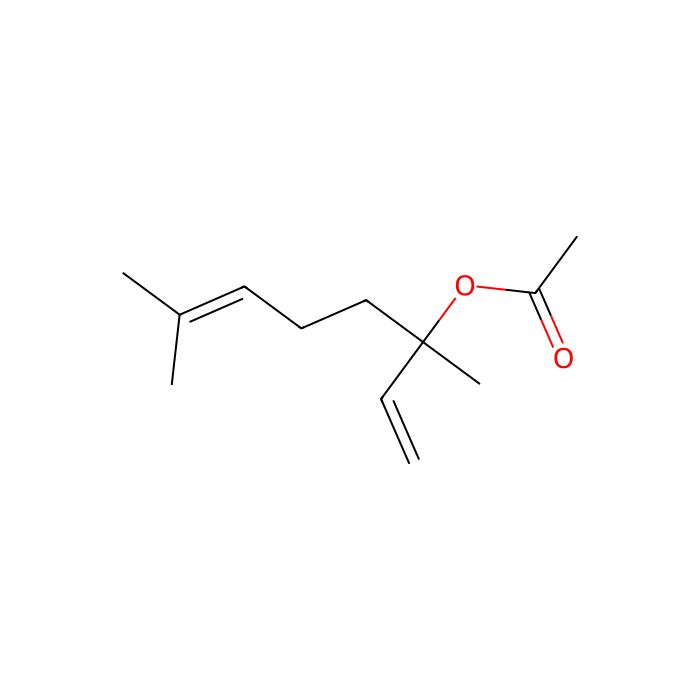
Linalyl acetate is the main component of many plant essential oils such as lavender oil.It can be used as a flavoring agentand fragrance ingredient.
Taxonomy Tree
| Kingdom | Organic compounds |
|---|---|
| Superclass | Lipids and lipid-like molecules |
| Classe | Prenol lipids |
| Subclass | Monoterpenoids |
| Intermediate Tree Nodes | Not available |
| Direct Parent | Acyclic monoterpenoids |
| Alternative Parents | Carboxylic acid esters Monocarboxylic acids and derivatives Organic oxides Hydrocarbon derivatives Carbonyl compounds |
| Molecular Framework | Aliphatic acyclic compounds |
| Substituents | Acyclic monoterpenoid - Carboxylic acid ester - Monocarboxylic acid or derivatives - Carboxylic acid derivative - Organic oxygen compound - Organic oxide - Hydrocarbon derivative - Organooxygen compound - Carbonyl group - Aliphatic acyclic compound |
| Descrição | This compound belongs to the class of organic compounds known as acyclic monoterpenoids. These are monoterpenes that do not contain a cycle. |
| External Descriptors | acetate ester - monoterpenoid |
| Activity Type | Relation | Activity value | Units | Action Type | Journal | PubMed Id | doi | Assay Aladdin ID |
|---|
| Activity Type | Relation | Activity value | Units | Action Type | Journal | PubMed Id | doi | Assay Aladdin ID |
|---|
| Activity Type | Relation | Activity value | Units | Action Type | Journal | PubMed Id | doi | Assay Aladdin ID |
|---|
| Activity Type | Relation | Activity value | Units | Action Type | Journal | PubMed Id | doi | Assay Aladdin ID |
|---|
| Activity Type | Relation | Activity value | Units | Action Type | Journal | PubMed Id | doi | Assay Aladdin ID |
|---|
| Activity Type | Relation | Activity value | Units | Action Type | Journal | PubMed Id | doi | Assay Aladdin ID |
|---|
| Activity Type | Relation | Activity value | Units | Action Type | Journal | PubMed Id | doi | Assay Aladdin ID |
|---|
| Activity Type | Relation | Activity value | Units | Action Type | Journal | PubMed Id | doi | Assay Aladdin ID |
|---|
Find and download the COA for your product by matching the lot number on the packaging.
| Lot Number | Certificate Type | Data | Item |
|---|---|---|---|
 F2609569 | Certificate of Analysis | May 29, 2026 | L101415 |
| F2609383 | Certificate of Analysis | May 29, 2026 | L101415 |
| F2609601 | Certificate of Analysis | May 29, 2026 | L101415 |
| F2609570 | Certificate of Analysis | May 29, 2026 | L101415 |
| F2609384 | Certificate of Analysis | May 29, 2026 | L101415 |
| F2609382 | Certificate of Analysis | May 29, 2026 | L101415 |
| A1709031 | Certificate of Analysis | Aug 05, 2024 | L101415 |
| C1918154 | Certificate of Analysis | Jan 11, 2023 | L101415 |
| F2309007 | Certificate of Analysis | Dec 14, 2022 | L101415 |
| E2512017 | Certificate of Analysis | Dec 14, 2022 | L101415 |
| D2621092 | Certificate of Analysis | Dec 14, 2022 | L101415 |
| C2328848 | Certificate of Analysis | Dec 14, 2022 | L101415 |
| C2328815 | Certificate of Analysis | Dec 14, 2022 | L101415 |
| C2328748 | Certificate of Analysis | Dec 14, 2022 | L101415 |
| C2328727 | Certificate of Analysis | Dec 14, 2022 | L101415 |
| H2512033 | Certificate of Analysis | Dec 14, 2022 | L101415 |
| H2217403 | Certificate of Analysis | Aug 04, 2022 | L101415 |
| H2217404 | Certificate of Analysis | Aug 04, 2022 | L101415 |
| Índice de refração | 1.453 |
|---|---|
| Ponto de inflamação (°F) | 201.2 °F |
| Ponto de inflamação (°C) | 94 °C |
| Ponto de ebulição (°C) | 220°C |
| Peso molecular | 196.29 |
| XLogP3 | 3.300 |
| Hydrogen Bond Donor Count | 0 |
| Hydrogen Bond Acceptor Count | 2 |
| Rotatable Bond Count | 6 |
| Exact Mass | 196.146 Da |
| Monoisotopic Mass | 196.146 Da |
| Topological Polar Surface Area | 26.300 Ų |
| Heavy Atom Count | 14 |
| Formal Charge | 0 |
| Complexity | 237.000 |
| Isotope Atom Count | 0 |
| Defined Atom Stereocenter Count | 0 |
| Undefined Atom Stereocenter Count | 1 |
| Defined Bond Stereocenter Count | 0 |
| Undefined Bond Stereocenter Count | 0 |
| The total count of all stereochemical bonds | 0 |
| Covalently-Bonded Unit Count | 1 |
H315:Causes skin irritation
H319:Causes serious eye irritation
H335:May cause respiratory irritation
P261:Avoid breathing dust/fume/gas/mist/vapors/spray.
P264:Wash hands [and …] thoroughly after handling.
P272:Contaminated work clothing should not be allowed out of the workplace.
P280:Wear protective gloves/protective clothing/eye protection/face protection.
P321:Specific treatment (see ... on this label).
P302+P352:IF ON SKIN: wash with plenty of water.
P305+P351+P338:IF IN EYES: Rinse cautiously with water for several minutes. Remove contact lenses if present and easy to do - continue rinsing.
P333+P313:IF SKIN irritation or rash occurs: Get medical advice/attention.
P362+P364:Take off contaminated clothing and wash it before reuse.
P501:Dispose of contents/container to an approved waste disposal plant.
P264+P265:Wash hands [and …] thoroughly after handling. Do not touch eyes.
P337+P317:If eye irritation persists: Get medical help.
P332+P317:If skin irritation occurs: Get medical help.
No assay-specific, item-validated protocols are provided in the Product Data. The following general laboratory protocols are offered as literature-style guidance for working with hydrophobic volatile esters; adapt to your needs.
Note: These are generic examples, not validated for this SKU. For regulated/quantitative work, generate in-house validation and consult the product’s CoA/SDS.
General biochemistry background (literature; not specific to this SKU):
No medical or clinical claims are made. Use is restricted to research and laboratory studies as indicated by the Research Use Note.
This compound is a hydrophobic monoterpene ester and is not used as a buffering agent or pH standard.
For pH control, select established buffer systems (e.g., phosphate, HEPES, acetate) appropriate to your application.
Although linalyl acetate itself is the substrate, many workflows employ solvents and reagents with varying environmental profiles. Consider greener choices surrounding its use.
Greener solvent swaps (literature-guided; choose based on your chemistry):
Comparison highlights (general):
Trade-offs:
Note: Always validate alternatives on small scale and verify that any green choice does not promote unwanted hydrolysis/isomerization of this allylic ester.
No therapeutic or clinical claims are made for this product. The following describes general formulation roles for monoterpene esters in research and development contexts (literature-based, not item-specific specifications):
Formulators should confirm suitability, residual limits, and impurity specifications via the item’s CoA and relevant regulatory guidance. For any product intended beyond laboratory research, obtain appropriate regulatory-grade materials and documentation.
Item-specific physicochemical specifications are not provided in the Product Data. Do not treat the following as specifications for this lot; they are typical literature values for linalyl acetate (CAS 115-95-7) to assist with method planning.
Item-specific values (this SKU):
Context for professional users (general guidance):
Bottom line: Use the CoA to set acceptance criteria for your workflow. If your application is oxidation- or hydrolysis-sensitive, consider blanketing with inert gas and performing a quick GC or NMR check upon receipt.
This allylic acetate is a versatile substrate for studying terpenoid chemistry and for synthetic method development (research use only).
Practical tips:
General literature-guided conditions for common transformations of linalyl acetate (for planning only; optimize for your system):
Monitoring and analysis:
Safety information specific to this item is not provided in the Product Data. Always consult the product SDS for authoritative, item-specific guidance.
General laboratory safety considerations for linalyl acetate (literature/typical for monoterpene esters):
Disposal: Follow local regulations for organic solvent/organic waste; avoid release to the environment.
Linalyl acetate is not typically used as a solvent; it is a hydrophobic reactant/standard. However, selecting an appropriate solvent for handling, analysis, or reaction is important.
Note: Solvent choice should also consider downstream purification (e.g., ease of removal under reduced pressure vs potential co-distillation with a 220+ °C ester).
Good-practice handling (general recommendations for allylic esters; not item-specific requirements):
Reconstitution guidance: If needed for analytical stocks, prepare solutions in suitable organic solvents (e.g., hexane, isooctane, EtOH) under dry, inert conditions. Label with preparation date and solvent; store cold and protected from light if stability is critical.
Research Use Note (item-specific): For research use only.
Linalyl acetate is a monoterpene allylic acetate widely encountered in plant essential oils (research/lab use only here).
Note: Where precise identifiers are required for regulatory documentation, consult the item’s CoA/Spec Sheet and SDS.
From a synthetic perspective, linalyl acetate is an allylic acetate embedded in a monoterpene scaffold, enabling several valuable transformations (literature context):
Practical considerations:
Not applicable. This product is a small-molecule monoterpene ester, not an affinity reagent or antibody. No antigen/epitope specificity, clone, isotype, or species reactivity applies.