≥99.995% metals basis, lumps,10mm max. lump size,weight 20g para fluxos de trabalho cromatográficos e analíticos sensíveis que exigem interferência mínima da linha de base.
🌡
Armazenamento e envio
Room temperature Envio FedEx DG Service. Consulte o COA específico do lote para obter as especificações exatas.
📋
Documentos de qualidade
SDS, COA, ficha técnica e folha de especificações disponíveis para download. COA específico do lote acessível por meio de pesquisa por número de lote.
📚
Comprovação documental
Citado em 2193 publicações revisadas por pares nas áreas de cromatografia, síntese orgânica e reações de acoplamento cruzado.
Visão geral
Application: Lithium fluoride can be used: As an additive to fabricate SiO@C/graphite composite anode materials for Li-ion batteries. LiF stabilizes solid electrolyte interphase (SEI) and enhances initial coulombic efficiency. As a critical component in SEI for stabilizing the SEI layer and improving the cycling efficiency of Li metal batteries. To fabricate electron contacts for high-efficiency n-type crystalline silicon solar cells. To prepare solid-state light sources for radiation imaging detectors. To synthesize highly crystalline MXene for asymmetric supercapacitor applications. And also, lightweight, flexible, and hydrophobic MXene foam with reasonable strength, high electrical conductivity, and an outstanding EMI-shielding performance. As an electron-injection layer to fabricate ITO/PEDOT:PSS/perovskite/B3PYMPM/ LiF/Al OLED device with a quantum efficiency of 20%.
Alkali metal fluoride - Inorganic lithium salt - Inorganic salt
Descrição
This compound belongs to the class of inorganic compounds known as alkali metal fluorides. These are inorganic compounds in which the largest halogen atom is fluorine, and the heaviest metal atom is an alkali metal.
External Descriptors
Not available
1. Djoumbou Feunang Y, Eisner R, Knox C, Chepelev L, Hastings J, Owen G, Fahy E, Steinbeck C, Subramanian S, Bolton E, Greiner R, and Wishart DS. ClassyFire: Automated Chemical Classification With A Comprehensive, Computable Taxonomy. Journal of Cheminformatics, 2016, 8:61.
Determine the necessary mass, volume, or concentration for preparing a solution.
Dilution Calculator
Determine the dilution needed to prepare a stock solution.
Reconstitution Calculator
Revisões
Avaliações dos Clientes
Application Protocols
Not applicable: This item is not an antibody, enzyme, or assay kit. There are no WB/IHC/IF/FC protocols or recommended dilutions associated with lithium fluoride. For materials processing or synthesis workflows, refer to the Reaction Conditions and Synthetic Utility sections for practical guidance.
Biological Roles
Applicability
Lithium fluoride is an inorganic salt; it has no intrinsic biological role as a macromolecule or metabolite. However, its anion (fluoride) and cation (lithium) have documented biological interactions.
Literature/General notes (not product-specific; no clinical claims)
Fluoride ion: At low concentrations, interacts with calcium phosphate mineral phases; at higher concentrations, inhibits metalloenzymes (e.g., enolase) by complexing metal cofactors. Fluoride forms HF in acidic environments, which can penetrate membranes and disrupt cellular processes.
Lithium ion: Monovalent cation that can modulate certain signaling enzymes (e.g., glycogen synthase kinase-3) in biological studies; these observations are context-dependent and not specific to LiF as a delivery form due to its poor aqueous solubility.
Toxicology overview: Soluble fluoride salts exhibit dose-dependent systemic effects; LiF’s limited solubility reduces immediate bioavailability compared with NaF, but ingestion or inhalation of dust can still pose risks.
Laboratory relevance
In biochemistry, fluoride is sometimes employed as a phosphatase inhibitor (commonly as NaF). LiF is rarely chosen for this purpose because of its lower solubility.
This product is intended strictly for research/laboratory use. For any work involving biological systems, consult the SDS and institutional safety guidelines regarding fluoride handling and exposure limits.
Buffer Applications
Applicability
Lithium fluoride is not typically used as a buffering agent. The fluoride/hydrofluoric acid conjugate pair buffers near pH ~3.2 (pKa of HF, literature), but safe handling constraints and the low solubility of LiF make it impractical for routine buffering.
Literature/General guidance
If a fluoride-containing acidic buffer is required (e.g., specialized etching or surface treatments), laboratories typically employ ammonium bifluoride or carefully prepared HF solutions under strict safety controls, not LiF.
For enzyme inhibition in biochemical assays, sodium fluoride is commonly used as an additive rather than as a buffer component.
For most laboratory buffering needs across pH 4–10, select conventional systems (e.g., acetate, phosphate, Tris, HEPES) instead.
Green Alternatives
Choice of fluoride source impacts safety and sustainability; consider solubility, toxicity, and process conditions.
Context (literature/general)
LiF is non-volatile, non-combustible, and thermally stable but offers very limited solubility, reducing its utility as a nucleophilic fluoride in solution. Its primary risks relate to fluoride toxicity and potential HF generation with acids.
Alternatives by use-case
Homogeneous fluoride in organic synthesis: Prefer KF or CsF (often with 18-crown-6) or polymer-supported quaternary ammonium fluorides. These avoid HF-based systems and can be easier to handle than TBAF·xH2O while offering effective reactivity.
Desilylation and micro-scale fluorination: TBAF (in THF) is effective but moisture sensitive; consider TBAT (tetrabutylammonium difluorotriphenylsilicate) for milder, less corrosive conditions.
High-temperature salts/heat transfer: LiF–NaF–KF (FLiNaK) eutectics reduce operating temperatures relative to pure LiF, improving energy efficiency while maintaining low vapor pressure.
Optical windows: Alternatives include MgF2 and CaF2, which can be less sensitive to moisture cycling and easier to polish, depending on wavelength requirements.
Tradeoffs (general)
KF/CsF increase solubility/reactivity but may raise cost and introduce heavier alkali contaminants.
Quaternary ammonium fluorides improve solubility yet can decompose to release HF and organic residues; waste handling is more complex.
FLiNaK eutectics lower operating temperatures but introduce multicomponent control and potential corrosion with certain alloys.
Adopt solvent-free or molten-salt processing where feasible to minimize VOC use and improve atom economy.
Pharmaceutical Uses
Applicability
Lithium fluoride is not commonly employed as a pharmaceutical excipient or processing aid.
Literature/General context (no therapeutic claims)
Fluoride sources used in regulated formulations are typically well-characterized salts with established pharmacopeial monographs (e.g., sodium fluoride in certain dental products). LiF generally lacks such monograph support and is avoided due to limited solubility and lithium content considerations.
In radiochemistry and advanced materials for medical devices, fluoride-containing ceramics or coatings may be prepared using inorganic fluorides as precursors; selection focuses on purity, trace metals, and particle properties rather than any pharmacological role.
Recommendation
If considering LiF for device, coating, or diagnostic material development, verify regulatory acceptability, impurity profiles, and biocompatibility with appropriate standards. For drug product formulation or processing, alternative fluoride sources with compendial status are typically preferred.
Physical Properties
Item-specific (from Product Data)
Appearance: Not specified for this item; refer to CoA/Spec Sheet.
Low aqueous solubility distinguishes LiF from other alkali fluorides (e.g., KF, CsF), influencing its usefulness as a fluoride source in solution-phase chemistry.
High melting point and chemical inertness make LiF valuable as a component of molten-salt media and optical windows extending deep into the UV.
Note: When specifications are critical (e.g., optical grade, particle size, trace-metal content), consult the item’s CoA/Spec Sheet.
Quality and Grades
Item-specific (from Product Data)
Grade/Purity: Not specified for this item; refer to CoA/Spec Sheet.
Appearance: Not specified for this item; refer to CoA/Spec Sheet.
Interpreting common grades for lithium salts and inorganic fluorides (general guidance)
Analytical Reagent (AR) / ACS grade: Controlled impurity profile suitable for routine analytical work; metal contaminants are typically minimized but not necessarily ultra-trace.
Semiconductor/Optical grade: Very low alkali/transition metal and particulate content; tight control of inclusions and water; critical for optical windows, scintillators, and thin-film deposition.
Battery/Materials grade: Trace-metal limits tailored for electrochemical performance (e.g., Na, K, transition metals) and moisture specification; relevant for molten-salt and ceramic processing.
Pharma/USP grade: Rare for LiF; when present, conforms to pharmacopeial monographs (not typical for this salt).
Stabilizers/additives
Lithium fluoride is generally supplied additive-free; stabilizers are not typical. Any anti-caking agents or particle-size modifiers would be disclosed on the CoA if used.
What to check on receipt
Moisture content, particle size distribution, and trace-metal analysis (ICP-OES/ICP-MS) as required by your application. For optics, verify birefringence, inclusions, and absorption in the UV.
For specification-critical applications, rely on the item’s CoA/Spec Sheet for exact impurity limits and test methods.
Reaction and Applications
Focus: Materials science and inorganic processing, consistent with the product category.
Optical materials: LiF single crystals and polycrystalline windows transmit deep UV to IR; used for spectroscopic optics and radiation windows due to low refractive index and wide band gap.
Ceramic/flux: Functions as a flux to lower sintering temperatures and modify melt viscosity in oxide and fluoride ceramics; incorporated in glass-ceramic formulations to tailor crystallization.
Molten-salt media: Component of fluoride eutectics (e.g., LiF–NaF–KF, FLiNaK) for high-temperature heat transfer, electrorefining, and materials synthesis.
Scintillators/detectors: Doped LiF (e.g., LiF:Mg,Ti; LiF:Eu) is used in thermoluminescent dosimetry and neutron detection when combined with ZnS (literature context; no clinical claims).
Battery/energy: LiF presence in solid–electrolyte interphases (SEI) is beneficial; LiF powders can serve as precursors or additives in cathode coatings and solid electrolytes.
Organic synthesis context (literature/general)
Heterogeneous additive: LiF can influence catalytic cross-couplings (e.g., Suzuki–Miyaura variants) as a halide scavenger or support, though KF/CsF are more common.
Silyl chemistry: Limited activity for desilylation or silyl transfer in highly polar media; performance generally inferior to soluble quaternary ammonium fluorides.
Practical tips
For flux/melt work, pre-dry under vacuum at 200–300 °C to remove adsorbed moisture.
Use high-purity grades for optics/electronics; trace metals can affect optical absorption and electrical properties.
Avoid acid contamination; HF generation is hazardous and corrodes equipment.
Molten-salt processing: LiF-containing eutectics (e.g., FLiNaK: LiF–NaF–KF) melt in the ~450–500 °C range, enabling solid-state reactions at 500–800 °C under inert atmosphere (Ar/N2). Pre-dry salts at 200–300 °C under vacuum to remove moisture.
Flux crystal growth: Add 5–30 wt% LiF as flux to oxide/fluoride charges; heat to 700–1000 °C to dissolve precursors, then cool slowly (0.1–5 °C/h) to crystallize target phases. Use compatible crucibles (Pt, Ni-based alloys, graphite) chosen to resist fluoride corrosion.
Heterogeneous additive in organics (literature/general)
Solvents: DMF, DMSO, NMP, or acetonitrile; reactions benefit from high polarity. Anhydrous conditions minimize hydrolysis and side reactions.
Temperatures: Ambient to 120 °C depending on transformation; extended times may be necessary due to low fluoride availability.
Catalysts: If used in Pd-catalyzed couplings or silyl-transfer chemistry, select established catalyst systems (e.g., Pd(PPh3)4, Pd-PEPPSI) and assess LiF as an optional additive vs KF/CsF controls.
Safety/engineering
Avoid acids and maintain dry, inert conditions for high-temperature work. Off-gas scrubbing may be required to capture any fluoride-containing volatiles from side reactions.
Corrosion control: Fluoride melts can attack silica and some steels; employ fluoride-compatible materials and conduct corrosion coupons where needed.
All parameters above are literature-based general guidance and must be optimized for each specific substrate/system.
Safety and Handling
Item-specific (from Product Data)
GHS/Signal word/H-statements/Pictograms: Not specified for this item; refer to SDS.
Storage: Room temperature (as provided)
Shipping: FedEx DG Service (dangerous goods) as provided
Literature/General safety guidance (not a substitute for the SDS)
Hazard overview: Fluoride salts can be harmful if swallowed and may cause eye and skin irritation. Ingestion can result in systemic fluoride toxicity (hypocalcemia). Dust may irritate the respiratory tract.
Incompatibilities: Strong acids (release of hydrogen fluoride, HF); contact with strong oxidizers should be avoided. Avoid generating dust; keep away from acids and moisture.
PPE: Use lab coat, safety glasses or goggles, and appropriate chemical-resistant gloves (e.g., nitrile). Handle powders in a fume hood to minimize inhalation.
First aid (general): If inhaled, move to fresh air; seek medical attention if symptoms persist. If on skin/eyes, rinse with water for at least 15 minutes; remove contaminated clothing; seek medical advice. If swallowed, rinse mouth; do not induce vomiting; seek immediate medical attention.
Fire behavior: Non-combustible; use extinguishing media suitable for surrounding fire. Thermal decomposition in presence of acids can liberate HF.
Spill response: Avoid dust formation; collect mechanically; place in appropriate container for disposal per local regulations.
Always consult and follow the product-specific SDS for authoritative hazard classification, exposure limits, and emergency procedures.
Solvent Selection
Lithium fluoride is a sparingly soluble inorganic salt; solvent considerations focus on enabling ion availability or processing in suspensions.
Polarity and miscibility (literature/general)
Water: very low solubility; dissolution is slow and limited at ambient temperature.
Polar aprotics (DMF, DMSO, NMP, acetonitrile): essentially insoluble without complexants; can be used as heterogeneous media where surface fluoride suffices.
Alcohols/ethers/hydrocarbons: insoluble; use only as suspension media when needed.
HF and certain molten salts: increased solubility; relevant for specialized inorganic syntheses (exercise extreme caution with HF).
Strategies to access fluoride in solution (general)
Phase-transfer/complexation: 18-crown-6 is ineffective for Li+; cryptands selective for Li+ are uncommon. Fluoride activation is better achieved with TBAF, KF/CsF + crown, or quaternary ammonium fluorides when solution-phase nucleophilicity is required.
Heterogeneous catalysis/additives: Finely powdered LiF can act as a heterogeneous promoter or fluoride reservoir in some coupling and silyl-transfer reactions conducted in polar aprotics.
When to choose LiF vs alternatives (general)
Choose LiF for high-temperature molten-salt work, glass/ceramic fluxing, optical crystal growth, or as an inert fluoride component in composites.
Prefer KF, CsF, or TBAF for homogeneous nucleophilic fluorination or desilylation chemistry.
Small comparison (literature/general)
LiF: very low solubility; high lattice energy; thermally robust.
KF/CsF: higher solubility (esp. with crown ethers); stronger nucleophilic fluoride in organics.
TBAF: highly soluble in polar aprotics; moisture sensitive; generates HF upon acid exposure.
Storage and Reconstitution
Item-specific (from Product Data)
Storage conditions: Room temperature
Literature/General handling guidance
Containerization: Store in a tightly closed container to minimize moisture uptake and contamination; while LiF is not strongly hygroscopic, dryness is important for high-temperature and optical applications.
Atmosphere: Ambient storage is typically acceptable; for ultra-dry requirements, keep under desiccation or inert gas.
Shelf life: Inorganic fluorides are stable over extended periods when kept dry and free from acids; verify periodically for caking or contamination.
Reconstitution/Preparation
Aqueous: LiF is sparingly soluble; to prepare saturated solutions, add excess solid to deionized water and stir for extended periods; filter to remove undissolved solids. Measure fluoride concentration analytically if critical.
Non-aqueous: Generally used as a solid or suspension in polar aprotic solvents; for molten-salt work, dry under vacuum at 200–300 °C prior to charging.
Incompatibilities: Keep away from acids to prevent HF formation; avoid storage in glass with acidic vapors and avoid contact with strong oxidizers.
Always consult the product’s CoA and SDS for item-specific instructions on storage stability and any moisture/impurity specifications relevant to your application.
Structure and Identity
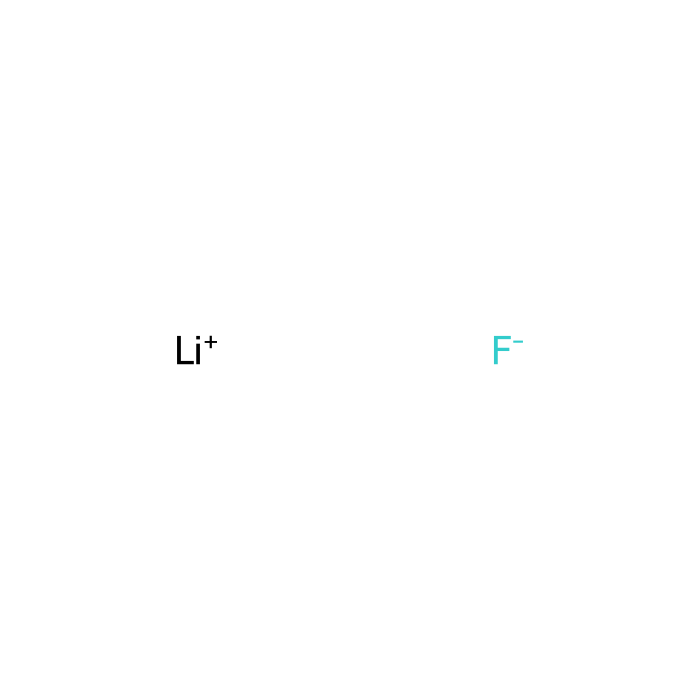
Brief description: Lithium fluoride is an inorganic, ionic binary salt composed of lithium cations and fluoride anions; it crystallizes in the rock-salt (NaCl) structure and is widely used in optics and materials science.
Item-specific (from Product Data)
SKU: L485394
Product name: Lithium fluoride
CAS: 7789-24-4
InChIKey: 284761 (as provided)
Storage conditions: Room temperature
Shipped in: FedEx DG Service
Category: Materials Science (全部 / 可售 / 材料科学)
Research use note: For research use only
Literature/General identifiers (for reference; not item specifications)
Ionic compound with monatomic ions: Li+ (small, hard cation), F− (hard base); strong lattice energy.
Crystallography: Face-centered cubic (Fm3̅m) rock-salt lattice; each ion octahedrally coordinated (6:6 coordination).
2D depiction: A lattice of alternating Li+ and F− nodes; no covalent bonds or stereocenters; no ring systems or functional groups in the organic sense.
Notes for users
The provided InChIKey string is non-standard in length; consult the CoA/SDS for definitive registry metadata if needed for informatics workflows.
Flux and mineralizer: LiF lowers liquidus temperatures and modifies melt structures in oxide/fluoride systems, enabling crystal growth (e.g., perovskites, phosphors) and densification of ceramics at reduced temperatures.
Molten-salt medium: Serves as a component in molten fluoride baths (eutectics with NaF, KF) for high-temperature synthesis, electrorefining, and surface treatments; inertness and low vapor pressure are advantageous.
Optical and scintillator precursor: LiF provides F− in forming mixed-metal fluorides (e.g., rare-earth-doped hosts) with controlled stoichiometry and low hydroxide content.
Organic synthesis roles (literature/general; limited due to solubility)
Heterogeneous additive in cross-coupling: In some Pd-catalyzed couplings, solid fluoride can sequester halide or activate boron reagents; KF/CsF are more typical, but LiF may be used where minimal fluoride activity is desired.
Silicon chemistry: Under strongly polar conditions, LiF can participate in Si–O/Si–C bond transformations, though reactivity is generally weaker than quaternary ammonium fluorides.
Retrosynthetic value
As a robust, non-volatile fluoride source, LiF is suited to processes where high-temperature stability and low solubility are assets (e.g., solid-state routes), rather than solution-phase nucleophilic fluorination.
Practical considerations
Particle size influences kinetics in heterogeneous roles; milling to fine powders can enhance surface-mediated effects.
Strict exclusion of acids prevents HF formation and equipment corrosion.
Target Specificity
Not applicable: Lithium fluoride is an inorganic salt, not an affinity reagent or biological targeting molecule. No antigen/epitope specificity, species reactivity, clone, or isotype information applies to this product.
Perguntas frequentes
What does the trace-metals specification mean?
This product is specified at ≥99.995% on a trace-metals basis. That figure describes metallic impurity content rather than overall chemical assay, so it is the relevant specification for ICP-MS, semiconductor and battery applications. Lot-specific values are stated on the Certificate of Analysis.
How should this product be stored?
Store at room temperature.
How is this product shipped?
This product is classified as dangerous goods and ships via FedEx DG Service. Ground and other economy services are not available, and delivery to some destinations or address types may be restricted.
What are the CAS number, molecular formula and molecular weight?
The CAS Number is 7789-24-4, the molecular formula is LiF, and the molecular weight is 25.94 g/mol. InChIKey PQXKHYXIUOZZFA-UHFFFAOYSA-M.
What documentation is provided?
Available product documentation, including Certificates of Analysis (COA), Safety Data Sheets (SDS), and specification sheets, is shown in the product document area. Document availability and access follow the current site policy.
Usamos cookies para garantir o funcionamento adequado do site e, quando permitido, para melhorar a sua experiência. Você pode gerenciar suas preferências a qualquer momento nas Configurações. Saiba mais em nossa Política de Cookies.
Deseja que lhe enviemos uma mensagem quando tivermos descontos disponíveis?
Lembrar-me mais tarde
Obrigado! Por favor, verifique a sua caixa de entrada de e-mail para confirmar.
Products are supplied to verified businesses, institutions, and qualified professionals for research and development use only. Not for use in humans, animals, diagnosis, or therapy.