GRADE & PURITYUltraBio™?UltraBio™ — Aladdin's line for molecular-biology applications. Use for nuclease-free, high-consistency reagents across molecular workflows.≥99%(T)
UltraBio™, ≥99%(T) UltraBio™ for sensitive chromatographic and analytical workflows requiring minimal baseline interference.
🌡
Storage & shipping
Room temperature Ships Normal Check lot-specific COA for exact specifications.
📋
Quality documents
SDS, COA, datasheet, and spec sheet available for download. Lot-specific COA accessible via lot number lookup.
📚
Literature proof
Cited in 20 peer-reviewed publications across chromatography, organic synthesis, and cross-coupling reactions.
Visão geral
Crystallographic studies in molecular biology: Lithium sulfate monohydrate is crucial in the preparation of crystal structures for biochemical assays, facilitating the deciphering of complex biological structures such as the novel NEIL1 nanobody, which has significant implications for genetic research and pharmaceutical applications (Thompson et al., 2023).
Enhanced nuclear magnetic resonance spectroscopy: Utilized in multiple-quantum magic-angle spinning spectroscopy, lithium sulfate monohydrate improves the resolution and quality of NMR studies. This application is vital for advancing molecular characterization techniques used in pharmaceutical synthesis and material science research (Rovnyak et al., 2003).
Alkali metal sulfate - Inorganic lithium salt - Inorganic oxide - Inorganic salt
Descrição
This compound belongs to the class of inorganic compounds known as alkali metal sulfates. These are inorganic compounds in which the largest oxoanion is sulfate, and in which the heaviest atom not in an oxoanion is an alkali metal.
External Descriptors
Not available
1. Djoumbou Feunang Y, Eisner R, Knox C, Chepelev L, Hastings J, Owen G, Fahy E, Steinbeck C, Subramanian S, Bolton E, Greiner R, and Wishart DS. ClassyFire: Automated Chemical Classification With A Comprehensive, Computable Taxonomy. Journal of Cheminformatics, 2016, 8:61.
Determine the necessary mass, volume, or concentration for preparing a solution.
Dilution Calculator
Determine the dilution needed to prepare a stock solution.
Reconstitution Calculator
Revisões
Avaliações dos Clientes
Application Protocols
No antibody/assay-specific protocols apply to this inorganic salt. For practical laboratory use, consider these general steps:
Preparing a 1.0 M aqueous stock (example)
Calculate mass using the monohydrate formula weight (literature ~127.96 g/mol). For 100 mL of 1.0 M solution, weigh ~12.796 g and bring to volume with DI water. Verify hydration state against the CoA.
Mix until fully dissolved; optional 0.22 µm filtration for sterility/clarity.
Protein crystallization screening (general)
Prepare a matrix of Li2SO4 concentrations (e.g., 0.1–2.0 M) across buffer pH 4–9. Combine with precipitants (PEGs) as per standard sparse-matrix screens.
Conductivity standard (general)
Prepare defined molarity in freshly degassed water; measure at controlled temperature (e.g., 25 °C). Use calibrated conductivity cell and document cell constant.
These are illustrative, literature-style workflows and not validated methods for this specific item. Adjust to your application and consult primary protocols.
Biological Roles
General notes (literature; not product specifications)
Sulfate (SO4^2−) is a common inorganic anion in biology, derived from sulfur metabolism; however, sulfate itself is not a biological buffer in the physiological pH range.
Lithium ion (Li+) is not a physiological cation; it can interact with enzymes and signaling pathways in ways that differ from Na+ and K+, often through competition at monovalent cation-binding sites or by altering hydration shells and protein stability. These effects are highly context-dependent and concentration dependent.
Laboratory relevance
In vitro, Li+ is used as a probe ion to study ion-specific (Hofmeister) effects on proteins, nucleic acids, and membranes.
In crystallography and structural biology, varying the monovalent cation (Li+, Na+, K+) can change crystal forms or diffracting quality.
Cautions
Do not infer any medical or clinical utility from the above; this product is for research use only (as stated in Product Data).
For cell-based experiments, carefully assess osmolarity and specific ion effects; lithium is not typically used to mimic physiological conditions.
Practical tip
When comparing biological outcomes across monovalent cations, maintain constant ionic strength and osmolarity to isolate ion-specific effects.
Buffer Applications
Applicability
Lithium sulfate monohydrate is not a buffering reagent. It provides ionic strength and sulfate anion but has negligible buffering capacity in the biological pH range.
Practical laboratory uses (literature/general)
Ionic strength adjustment in enzyme assays and kinetic studies where sulfate is preferred as a non-complexing counterion.
Precipitation and crystallization screens for proteins and nucleic acids, where salt type and concentration modulate solubility and nucleation.
Conductivity standards or reference electrolytes in aqueous systems.
Working solutions
Typical preparation ranges for stock solutions: 0.1–2.0 M in deionized water (choose based on your application). Calculate concentration using the monohydrate formula weight; verify hydration state.
For sterile applications, dissolve in sterile water and filter through 0.22 µm; store aliquots to minimize contamination.
Compatibility
Generally compatible with common biological buffers (HEPES, Tris, MOPS) and salts, but high concentrations can precipitate with certain anions (e.g., carbonate) or shift equilibria; confirm solubility when mixing with concentrated phosphate or carbonate buffers.
Green Alternatives
Lithium sulfate monohydrate is an inorganic salt used predominantly in water; its environmental profile is largely governed by sulfate load and lithium content.
Greener choice considerations (general)
Solvent system: Aqueous media already align with green chemistry principles compared to organic solvent systems.
Toxicological perspective: Lithium salts should be managed to prevent environmental release; sodium or potassium sulfate may be preferred where lithium offers no performance advantage.
Alternatives and trade-offs (literature/general)
Sodium sulfate (Na2SO4): Lower toxicity concerns relative to lithium; similar sulfate chemistry. May alter protein/surface interactions due to larger, less strongly solvated cation.
Potassium sulfate (K2SO4): Useful where potassium compatibility with biomacromolecules or cells is needed (e.g., mimicking intracellular K+), but solubility differs from Li2SO4.
Ammonium sulfate ((NH4)2SO4): Highly effective for protein precipitation and crystallization; generates ammonia upon decomposition and adds nitrogen burden.
Comparison (general, qualitative)
Li2SO4·H2O: Strongly hydrated Li+; good for specific crystallization effects; manage lithium in waste.
Na2SO4/K2SO4: Greener from a toxicity standpoint; different Hofmeister positioning and solubility behavior.
Waste/handling
Collect sulfate-containing aqueous waste separately if local regulations restrict lithium discharge. Neutralize and reduce salt load before disposal per institutional and regulatory guidance.
Pharmaceutical Uses
Scope
This product is for research use only. No medical or clinical claims are made.
Formulation/excipient context (general)
Lithium sulfate is not typically used as a pharmaceutical excipient due to lithium’s pharmacological activity and narrow safety margins. For applications requiring sulfate counterions, sodium or potassium sulfate are more common excipient choices.
Process/manufacturing chemistry (general)
In non-clinical manufacturing R&D, inorganic sulfates may be employed for crystallization control, salt screening (counterion selection in API salt forms), and as processing aids to adjust ionic strength during purification.
Regulatory notes
There is no compendial excipient monograph commonly leveraged for lithium sulfate in major pharmacopeias for formulation purposes; if considering any GMP-adjacent use, a formal risk assessment and impurity control strategy are essential.
Practical guidance
For any preclinical formulation R&D that explores sulfate salts, begin with Na+/K+ analogs unless Li+ is mechanistically required for the experiment.
Document elemental impurity profiles (ICH Q3D) and residual solvent status (not applicable to neat salts but relevant to solution concentrates) per internal quality systems.
Physical Properties
Item-specific values: Not specified for this item; refer to CoA/Spec Sheet.
Literature/handbook values and general descriptions (for reference only; not product specifications)
Hydration state: monohydrate (one equivalent of water of crystallization) (literature).
Solubility: readily soluble in water; limited solubility in lower alcohols; essentially insoluble in nonpolar solvents (literature). Many sulfate salts exhibit retrograde solubility behavior with temperature; lithium sulfate shows moderate water solubility that changes with temperature (literature).
Density: typical for hydrated inorganic sulfates; exact value depends on crystal form (literature; specific value not provided here).
Melting/decomposition: hydrates generally dehydrate on heating prior to melting; anhydrous lithium sulfate has a high melting point; the monohydrate loses water on heating (literature qualitative note).
Hygroscopicity: mild tendency to exchange/lose lattice water depending on humidity and temperature (literature qualitative note).
pH (aqueous): near-neutral to slightly acidic/basic depending on concentration and CO2 absorption; sulfate is the conjugate base of a strong acid and contributes little to pH (literature qualitative note).
Practical notes
Prepare solutions by dissolving in deionized water with stirring; gentle warming can accelerate dissolution.
Filter sterilization (0.22 µm) is preferred for biological workflows where sterility is required.
Quality and Grades
Item-specific grade
UltraBio™ grade (as listed): A premium research-use grade intended for life science and biochemistry workflows where consistent purity and low bioburden are important. Specific impurity limits (metals, endotoxin/bioburden, organics) are Not specified for this item; refer to CoA/Spec Sheet.
What this means in practice (general guidance)
Sourcing an UltraBio-type salt typically supports reproducibility in sensitive biological assays (e.g., enzyme work, protein crystallization screens, or ionic-strength controls) by minimizing adventitious contaminants that can chelate metals or inhibit enzymes.
For chromatography or crystallography, consistent hydration state and low particulates help ensure batch-to-batch reliability. If your method is hydration-sensitive, verify water-of-crystallization via CoA or perform a Karl Fischer/thermogravimetric check in-house.
Stabilizers/additives
None indicated for this item. If a stabilizer or anti-caking agent is present, it will be listed on the CoA; otherwise, assume neat salt. Any stabilizers: Not specified for this item; refer to CoA/Spec Sheet.
Documentation
For compliance-heavy workflows (QM, GLP-like), retain the CoA/Spec Sheet for this lot, which will define exact specifications, acceptance criteria, and test methods used.
Suitability notes
For analytical applications (ICP-MS background, ion chromatography), verify trace metal and anion/cation background levels on the CoA to ensure they meet your method’s limits.
Reaction and Applications
Applications below are literature/general guidance for lithium sulfate salts; they are not item specifications.
Inorganic/analytical chemistry
Electrolyte in aqueous electrochemistry and conductivity standards, where a non-complexing anion is desired.
Supporting electrolyte for kinetic studies and ionic strength control in reaction rate measurements (e.g., Debye–Hückel corrections).
Materials and crystallization
Component in inorganic and protein crystallization screens; Li+ can influence nucleation and crystal habit differently than Na+/K+.
Precursor in solid-state syntheses (e.g., as a lithium source for some ceramic/sulfate phases) where sulfate decomposition pathways are leveraged.
Synthetic chemistry
Additive in certain organic transformations conducted in biphasic/aqueous media to modulate ionic strength or activity coefficients.
Reagent for sulfate exchange or as a benign counterion in ion-exchange processes.
Biochemical workflows
Salt for modulating enzyme activity or protein solubility through Hofmeister effects; choice of Li+ vs Na+/K+ may subtly affect stability and aggregation.
Practical tips
Prepare stock solutions gravimetrically. Verify hydration state (monohydrate) to calculate exact molarity.
Filter sterilize for biological applications; avoid autoclaving concentrated sulfate solutions in contact with metals susceptible to corrosion.
Monitor pH independently; sulfate does not provide buffering capacity.
Reaction Conditions
General, literature-based guidance for laboratory use (not product specifications):
Solution preparation
Typical stock concentrations: 0.1–2.0 M in deionized water; warm gently to aid dissolution. Verify final volume after dissolution to ensure accurate molarity.
Electrochemistry (aqueous)
Solvent: Water; optional pH buffers compatible with sulfate (e.g., HEPES, phosphate at controlled ionic strengths).
Temperature: Ambient to 60 °C common for conductivity studies.
Electrodes: Graphite, platinum, glassy carbon are generally compatible; avoid materials sensitive to sulfate at extremes of potential/pH.
Protein crystallization/precipitation
Screens may span 0.1–2.0 M Li2SO4 with varied pH buffers (pH 4–9) and co-solvents. Effects are protein-specific; use standard design-of-experiment approaches.
Kinetics/ionic strength control
Maintain constant ionic strength by adding Li2SO4 as a background electrolyte (e.g., 0.1–1.0 M), adjusting activity corrections via Debye–Hückel where appropriate.
Solid-state synthesis
As a lithium source, combine with metal sulfates/oxides; temperatures often >300 °C after controlled dehydration. Atmosphere and ramp rates depend on target phase; consult phase diagrams.
Expected outcomes
Yields and rates are system-dependent; sulfate typically acts as a spectator anion. Validate conditions with small-scale trials before scale-up.
Compatibility cautions
High concentrations may salt out organics or proteins unpredictably. Avoid mixing concentrated sulfate with barium/lead/strontium salts (insoluble sulfates form).
Safety and Handling
GHS/Regulatory (item-specific)
Signal Word: Not specified for this item; refer to SDS.
Hazard Statements (H-Statements): Not specified for this item; refer to SDS.
GHS Classification/Pictograms: Not specified for this item; refer to SDS.
General laboratory safety (literature/good practice; not a substitute for SDS)
Hazard profile: Inorganic lithium salts can be harmful if swallowed and may cause irritation to eyes, skin, and respiratory tract. Avoid dust formation and inhalation.
PPE: Wear lab coat, safety glasses or splash goggles, and appropriate chemical-resistant gloves (e.g., nitrile). Use in a well-ventilated area; handle powders in a fume hood or ventilated enclosure to minimize dust.
First aid (overview): If inhaled, move to fresh air; seek medical attention if symptoms persist. In case of skin contact, wash with soap and water. For eye exposure, rinse cautiously with water for several minutes and seek medical evaluation. If ingested, rinse mouth; do not induce vomiting; seek medical attention.
Incompatibilities: Strong acids/bases (can change speciation), strong oxidizers (general caution), and sources of moisture at elevated temperatures (may alter hydration state). Avoid contact with aluminum at high pH due to possible corrosion by alkaline solutions.
Environmental: Prevent uncontrolled release to waterways; sulfate increases ionic strength and can affect aquatic systems.
Always consult the current SDS for authoritative hazard classification, exposure limits, and emergency procedures.
Solvent Selection
Lithium sulfate monohydrate is an inorganic, highly polar salt designed for use in aqueous systems.
Polarity/miscibility (literature/general)
Class: Inorganic electrolyte; non-volatile solid.
Miscibility: Readily dissolves in water; limited solubility in lower alcohols; insoluble in nonpolar organic solvents.
Dielectric considerations: Dissolution requires high-dielectric media (water); addition to mixed aqueous/organic systems increases ionic strength and conductivity.
Practical solvent choices
Primary: Deionized water (resistivity ≥18 MΩ·cm for sensitive biochemical/analytical work). Sterile water for cell-adjacent assays where sterility matters.
Secondary: Water–alcohol mixtures for specialized crystallization/precipitation protocols where reduced water activity is desired. Verify solubility empirically.
When to choose lithium sulfate vs alternatives
Compared with Na2SO4 or K2SO4, Li2SO4 contributes Li+—a small, strongly solvated cation that can subtly affect protein solubility, nucleation in crystallography, and ion-pairing phenomena differently than Na+/K+.
For “salting-out,” ammonium sulfate remains the strongest, but lithium sulfate may be preferred where ammonium is undesirable (e.g., amine-sensitive enzymes or where volatile buffering is not wanted).
Compatibility notes
Avoid mixing with buffers that precipitate lithium salts (e.g., concentrated carbonate/phosphate at certain ratios) without prior solubility checks.
For electrochemical use in water, confirm conductivity window and electrode compatibility; sulfate is generally non-complexing and stable.
Storage and Reconstitution
Item-specific storage/shipping
Storage Conditions: Room temperature (from Product Data).
Shipped In: Normal (from Product Data).
General storage guidance (good practice)
Keep tightly closed in a clean, dry container. Protect from excessive humidity to preserve the specified hydration state. If critical, store in a desiccator and equilibrate to room temperature before opening to minimize condensation.
Avoid prolonged exposure to strongly acidic or basic vapors that could alter composition.
Reconstitution/preparation
Solvent: Deionized water is recommended. For sterile applications, use sterile water and filter through a 0.22 µm membrane after dissolution.
Calculation: Use the monohydrate formula weight for molarity calculations; verify with CoA. Adjust pH with compatible buffers—do not rely on sulfate for buffering capacity.
Filtration: If particulate matter is observed, filter using 0.45 µm (clarification) or 0.22 µm (sterilization) filters.
Stability of solutions (general)
Aqueous solutions are typically stable at room temperature for routine laboratory timelines. For extended storage, keep at 2–8 °C in clean, inert containers. Inspect for evaporation or crystallization; remix or remake as needed.
Research Use Note
For research use only (per Product Data). Not for human or animal therapeutic or diagnostic use.
Structure and Identity
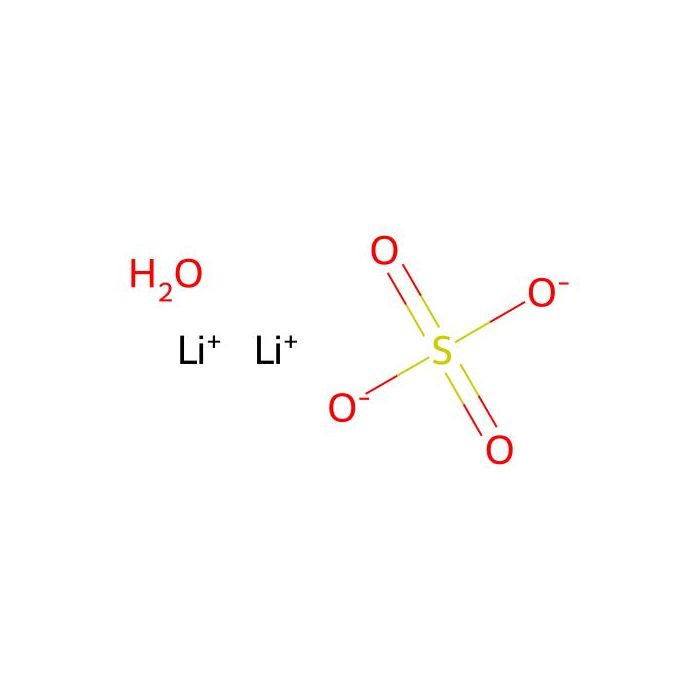
Brief overview: Lithium sulfate monohydrate is an inorganic sulfate salt comprising two lithium cations and one sulfate dianion with one equivalent of coordinated water per formula unit.
Item-specific identifiers (from Product Data)
CAS: 10102-25-7
SKU: L755615
Grade: UltraBio™
InChIKey: Not specified for this item; refer to CoA/Spec Sheet.
SMILES: Not specified for this item; refer to CoA/Spec Sheet.
Literature identity (for reference; not item specifications)
Structural features (general chemistry description)
Inorganic salt composed of a tetrahedral sulfate anion (S(VI) center bound to four oxygen atoms) charge-balanced by two lithium cations.
The monohydrate contains one lattice water molecule; in many crystal forms Li+ exhibits high coordination to oxygen donors (sulfate oxygens and water), yielding polymeric ionic lattices.
2D depiction in words: central SO4 tetrahedron (S=O×4) with two Li+ counterions; one H2O is included in the lattice and can coordinate to Li+ as a donor.
Stereochemistry: Not applicable (inorganic salt with no stereocenters).
Non-coordinating/non-nucleophilic sulfate anion; strongly solvated Li+ cation with high charge density. Useful where a “spectator” electrolyte is desired to influence ionic strength without introducing coordinating anions.
Roles in synthesis and separations
Supporting electrolyte in aqueous-phase electrochemistry; can stabilize current flow without participating in redox under moderate potentials.
Additive to tune rates/selectivities in phase-transfer or micellar catalysis by modifying medium polarity and activity coefficients.
Inorganic precursor in solid-state reactions that require a lithium source with a sulfate counterion (e.g., preparation of mixed-metal sulfates or as a flux under defined conditions).
Ion-exchange and metathesis: provides Li+ or SO4^2− for exchanging counterions in inorganic/organometallic systems where chloride or nitrate would be undesirable.
Retrosynthetic/value considerations
As a benign counterion, Li2SO4·H2O can replace halide or nitrate salts to minimize halide-sensitive side reactions or avoid nitrate redox concerns.
Practical tips
Account for hydration state in stoichiometric calculations.
Maintain aqueous media for best solubility; if using mixed solvents, determine solubility empirically to avoid precipitation that can bias reaction kinetics.
Target Specificity
Not applicable. This product is an inorganic salt, not an affinity reagent or antibody. No target, epitope, species reactivity, clone, or isotype information applies.
We use cookies to ensure the website functions properly and, where permitted, to improve your experience. You can manage your preferences at any time in Settings. Learn more in our Cookie Policy.
Shall we send you a message when we have discounts available?
Remind me later
Thank you! Please check your email inbox to confirm.
Products are supplied to verified businesses, institutions, and qualified professionals for research and development use only. Not for use in humans, animals, diagnosis, or therapy.