GRADE & PURITYMoligand™?Moligand™ — Aladdin's line of ligands and bioactive small molecules. Use for receptor, pathway, and binding studies needing defined small-molecule tools.10 mM in DMSO
Moligand™, 10 mM in DMSO Moligand™ for sensitive chromatographic and analytical workflows requiring minimal baseline interference.
🌡
Storage & shipping
Protected from light,Argon charged,Store at -80°C Ships Dry ice packs + Cold packs Check lot-specific COA for exact specifications.
📋
Quality documents
SDS, COA, datasheet, and spec sheet available for download. Lot-specific COA accessible via lot number lookup.
📚
Literature proof
Cited in 0 peer-reviewed publications across chromatography, organic synthesis, and cross-coupling reactions.
Visão geral
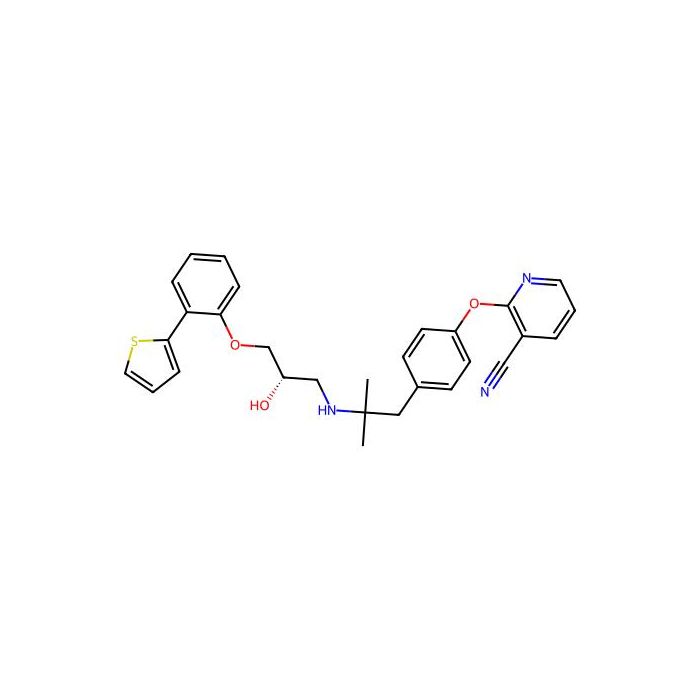
Lubabegron is a potent modulator of β-adrenergic receptor ( β -AR ). Lubabegron demonstrates antagonistic behavior at the β 1 and β 2 receptor subtypes and agonistic behavior at the β 3 receptor subtype in cattle. Lubabegron reduces NH 3 gas emissions from an animal or its waste.
Specifications
Especificações e pureza
Moligand™, 10 mM in DMSO
Condições de armazenamento de armazenamento
Protected from light,Argon charged,Store at -80°C
Enviado em
Dry ice packs + Cold packs
Este produto requer transporte de cadeia fria. Serviços terrestres e outros serviços econômicos não estão disponíveis.
Determine the necessary mass, volume, or concentration for preparing a solution.
Dilution Calculator
Determine the dilution needed to prepare a stock solution.
Reconstitution Calculator
Revisões
Avaliações dos Clientes
Application Protocols
No vendor-validated application protocols (e.g., Western blot, IHC, IF, flow cytometry) are applicable to this small-molecule product, and none are provided in the Product Data.
General protocol guidance for small-molecule assay use
Stock solution preparation: Dissolve in DMSO to 10–50 mM under low light; vortex and, if needed, sonicate briefly. Filter (0.22 µm PTFE) or centrifuge to remove particulates.
Aliquoting and storage: Dispense single-use aliquots (10–50 µL) into amber vials or 96‑well plates, overlay with inert gas, and store at −80°C.
Working solutions: Dilute into assay buffer immediately before use, keeping final DMSO ≤0.1–0.5% v/v depending on assay tolerance. Inspect for precipitation.
Documentation: Record batch/lot, concentration, vehicle, pH, and storage history for each experiment. Include negative vehicle controls.
For analytics
Prepare calibration standards in matched matrix; assess short- and long-term stability (autosampler at 4–10°C; bench-top at RT; freeze–thaw) with acceptance criteria defined in your SOPs.
Biological Roles
No biological function, pathway assignment, or target specificity is provided in the Product Data for this catalog lot. The following guidance is general for small-molecule ligands and should not be interpreted as a verified property of this item.
General considerations for evaluating biological roles
If the compound acts as a receptor or enzyme ligand (as suggested by its inclusion in a ligand library grade), characterize activity using standardized biochemical and cellular assays. Determine potency (e.g., IC50, EC50), efficacy, and selectivity across related targets.
Establish mode of action where feasible by kinetics (competitive vs non-competitive), binding thermodynamics (ITC, SPR), or signaling pathway analyses (second messengers, phosphoproteomics, transcriptomics).
Evaluate off-target profiles using broad panels (e.g., GPCRome, kinome, hERG, CYPs) if cell-based interpretations are critical.
ADME and stability: Measure microsomal/hepatocyte stability and plasma/serum stability to inform exposure in cellular systems; characterize photostability and oxidative liability given the item is supplied protected from light and under argon.
Important caveat
Any literature-reported biological role for “Lubabegron” should be verified against the exact chemical identity, salt form, and purity of this catalog lot. For research use only; not for diagnostic, therapeutic, or in vivo veterinary/human administration.
Buffer Applications
This product is a small-molecule ligand and is not a buffering agent. As such, it is not typically used to set or maintain pH in biochemical systems.
Practical guidance
Prepare assay buffers according to your biological system (e.g., HEPES, PBS, Tris) and dissolve the compound in a compatible vehicle (commonly DMSO) before spiking into the buffer.
Verify compound stability across the intended pH range and ionic strength, as some small molecules can undergo hydrolysis or oxidation under alkaline or acidic conditions, especially when light/oxygen sensitive.
Filter or centrifuge working solutions to remove particulates after dilution into buffer to prevent assay artifacts.
Green Alternatives
While Lubabegron itself is a target compound rather than a solvent or reagent, greener choices can be made for its handling and analysis, particularly in dissolution, chromatography, and assay setup.
Greener solvent choices for dissolution (general guidance)
Prioritize minimal DMSO usage and keep final assay concentrations ≤0.1% when biologically compatible.
Consider ethanol or isopropanol as co-solvents at low percentages where compound solubility permits and where assay biology tolerates these vehicles.
For preparative work, evaluate 2‑MeTHF or ethyl acetate instead of chlorinated solvents; ensure the compound’s stability in these media.
Chromatography considerations
Use water–acetonitrile gradients with formic acid or ammonium formate buffers; where possible, replace acetonitrile partially with ethanol or methanol acknowledging pressure/viscosity impacts and detector compatibility.
Example comparison (general; not item-specific specs)
DMSO vs DMF: DMSO is preferred due to lower volatility and better biocompatibility; DMF is less desirable environmentally and biologically.
Acetonitrile vs Methanol: Acetonitrile offers lower viscosity and UV transparency; methanol is typically considered greener but may impact backpressure and selectivity.
Operational practices
Scale down experiments, adopt microplate formats to reduce solvent volumes, and implement solvent recycling where validated. Document solvent selection rationale as part of green chemistry KPIs.
Pharmaceutical Uses
No pharmacopeial listing, excipient role, or manufacturing specification is provided in the Product Data for this lot. The compound is supplied strictly for research use only.
How it may be used in a pharmaceutical R&D context (general guidance)
Reference material: Utilize as a research reference or comparator compound in analytical method development (LC–MS/MS, stability-indicating HPLC) and in vitro pharmacology assays.
Impurity/degradation studies: If relevant to your program, use as a marker compound in forced-degradation studies to validate specificity of analytical methods.
Formulation screening (in vitro only): Explore enabling formulations (cosolvent, micellar, cyclodextrin) to support solubility-limited in vitro assays; document vehicle effects on assay readouts.
Solid-state characterization: Assess polymorph/solvate forms (PXRD, DSC/TGA) to understand storage stability; these are not specifications for this item unless listed on the CoA.
Restrictions
No clinical, diagnostic, or veterinary use is intended or permitted. Do not incorporate into dosage forms for administration to humans or animals.
Physical Properties
Item-specific physical constants are not provided in the Product Data for this catalog entry. Do not treat the following as specifications; consult the CoA/Spec Sheet for lot-specific values.
Item-specific (from Product Data)
Appearance: Not specified for this item; refer to CoA/Spec Sheet.
Molecular weight: Not specified for this item; refer to CoA/Spec Sheet.
Commonly reported or inferred measurement approaches (general, literature-level guidance for small molecules)
Melting point: Determine by DSC or capillary method after drying under high vacuum; note polymorphism and solvate formation can shift MP.
Solubility: Start with DMSO (analytical- or cell-culture grade) at 10–50 mM stock; assess aqueous compatibility by cosolvent dilution (DMSO 0.1–1% v/v) or by preparing acid/base salts if the molecule is ionizable. Measure kinetic vs. thermodynamic solubility.
LogP/logD and pKa: If needed for ADME modeling, determine by potentiometric titration or shake-flask, or compute with validated software; confirm experimentally for decision-critical work.
UV–Vis and fluorescence: Record spectra (200–800 nm) to enable HPLC-DAD tracking and to check for photolability.
Hygroscopicity/photostability: Product Data indicates “Protected from light; Argon charged,” suggesting potential light/oxygen sensitivity—verify by stability-indicating HPLC after light/air exposure.
All numerical values for this item are Not specified; refer to CoA/Spec Sheet.
Quality and Grades
Supplied grade: Moligand™ — a screening/ligand library-oriented grade intended for discovery research, assay development, and medicinal chemistry exploration.
What Moligand™ typically implies (general guidance; not item-specific specs)
Purity: Emphasis on high chemical purity suitable for bioassays and screening; exact assay (e.g., HPLC area %) and acceptance criteria are Not specified for this item; refer to CoA/Spec Sheet.
Identity confirmation: Typically supported by MS and/or NMR. For decision-critical programs, confirm with orthogonal methods (HRMS, 1H/13C NMR, HPLC/UPLC, water/solvent content by KF/GC as needed).
Salt form/solvate: Verify the exact form (free base/acid, salt, solvate, polymorph) on the CoA, as potency and solubility can depend on form.
Stabilization: No stabilizer is disclosed in Product Data. The product is argon-charged and light-protected, suggesting sensitivity to air/light; handle accordingly.
UV cutoff, metal content, residual solvents, and other analytical limits: Not specified for this item; refer to CoA/Spec Sheet.
Fit-for-purpose guidance
For biochemical assays and cell-based work, filter or centrifuge stocks to remove particulates; verify endotoxin is not controlled unless stated.
For LC/UPLC analytics, record UV profile to select detection wavelengths and check for coeluting impurities.
If used as a reference material, establish an internal qualification report capturing purity, identity, and stability data under your storage and use conditions.
Reaction and Applications
This catalog item is supplied as a bioactive small-molecule ligand for research use, not primarily as a synthetic reagent. Accordingly, its most relevant applications are in discovery and analytical workflows rather than stoichiometric transformations.
Research and assay applications (general for small-molecule ligands)
Target engagement studies: Evaluate binding to candidate receptors or enzymes using biochemical assays (radioligand displacement, SPR, ITC, DSF) or cell-based readouts (reporter assays, cAMP, Ca2+ flux), as appropriate to your target class.
Reference/benchmark control: Use as a positive or comparative control in screening cascades, provided you qualify identity, potency, and purity under your local conditions.
ADME profiling: Assess aqueous solubility, microsomal stability, plasma protein binding, and permeability (PAMPA/MDCK/LLC‑PK1) to contextualize activity data.
Analytical development: Develop LC–MS/MS quantitation methods for exposure or stability studies; establish calibration curves from DMSO stocks.
Caveats
No mechanism-of-action, target class, or activity data are provided in the Product Data for this lot. Do not assume pharmacology without verification.
If literature suggests light/oxygen sensitivity, perform assay preparations under reduced light and inert gas where feasible.
If considering synthetic modification
Derivatization for probe development (biotinylation, photoaffinity tags) may be feasible depending on functional handles; confirm structure first and assess SAR liabilities before conjugation.
Reaction Conditions
This product is supplied as a finished small-molecule ligand for research and assay use, not as a reagent for running chemical reactions. Therefore, there are no recommended synthetic “reaction conditions” specific to this item.
If you plan to derivatize the molecule (general guidance)
Solvents: Begin with dry DMSO, DMF, MeCN, 2‑MeTHF, or toluene as dictated by functional groups once structure is confirmed.
Atmosphere and light: The Product Data specifies storage under argon and protection from light; perform any transformations under inert atmosphere and subdued light until stability is established.
Temperature: Start at 0–25°C; scale cautiously. Use stability-indicating HPLC to monitor conversions and detect degradation.
Workup: Favor mild quench conditions and minimal exposure to air/aqueous base if the compound is oxidation- or hydrolysis-prone.
Expected yields, catalysts, and times are highly structure-dependent and are not provided or inferable for this lot. For any planned chemistry, consult primary literature once the precise structure and functional groups are verified.
Safety and Handling
GHS and hazard statements
Signal word: Not specified for this item; refer to SDS.
H-Statements / GHS classification / Pictograms: Not specified for this item; refer to SDS.
General laboratory precautions for small-molecule ligands
Handle in a chemical fume hood; avoid inhalation, ingestion, and skin/eye contact. Use appropriate PPE: lab coat, safety glasses, and nitrile gloves. For milligram-scale weighing, consider a balance enclosure or local exhaust.
Light/oxygen sensitivity: Product is shipped under cold conditions and “Argon charged” with “Protected from light,” indicating potential degradation by photolysis and/or oxidation. Minimize exposure to ambient light and air; recap vials promptly and, when feasible, maintain an inert headspace.
Dust and aerosol control: If powdered, avoid generating dust; dissolve directly in closed containers when preparing stock solutions.
Incompatibilities (general): Avoid strong oxidizers and strong acids/bases unless required for controlled transformations or salt formation. Confirm compatibility with plastics and elastomers when preparing concentrated DMSO stocks.
First-aid (overview; defer to SDS): In case of skin contact, wash with soap and water; for eye exposure, rinse with water for several minutes and seek medical evaluation; if inhaled, move to fresh air; if ingested, rinse mouth and seek medical attention.
Waste: Collect solutions and solids as halogenated or non-halogenated organic waste per your institution’s policy; do not discharge to drain.
Always consult the official SDS for authoritative safety data before use.
Solvent Selection
Because structure-specific solubility data are not provided, begin with a conservative, assay-friendly solvent strategy common to small-molecule ligands.
Recommended starting approach
Primary solvent: DMSO (anhydrous, ≥99.9%) for 10–50 mM frozen stocks. Thaw on ice, mix gently, and avoid repeated freeze–thaw (aliquoting recommended).
Aqueous work: Dilute DMSO stocks into assay buffer to ≤0.1–0.5% v/v DMSO final, verifying absence of precipitation by visual check or nephelometry.
Alternative vehicles (screening): 1:1 DMSO:water, DMSO:buffer; for low-permeability assays consider co-solvents such as ethanol or acetonitrile at ≤1–2% v/v if biologically compatible.
Solubility screening workflow (general)
Small-scale tiered test (0.5–2 mg): sequentially attempt dissolution in DMSO, DMF, MeOH, EtOH, acetonitrile, isopropanol, 2‑MeTHF, and aqueous buffers (with pH adjustment if ionizable). Use ultrasonication at room temperature; avoid heating if compound is thermolabile or light sensitive.
If ionizable: Create salt stocks (e.g., HCl salt in water/MeOH; sodium salt in water) to enhance solubility; confirm form by NMR/MS.
Adsorption/carryover: Pre-rinse plasticware with solvent to minimize loss for lipophilic compounds.
Comparison notes (general)
DMSO vs DMF: DMSO preferred for biological compatibility; DMF reserved for synthetic or analytical prep.
Alcohols (MeOH/EtOH): Useful for spectroscopy and some analytics; monitor evaporation and water uptake.
Green options: See Green Alternatives tab for lower-toxicity co-solvents appropriate for dissolution and handling.
Storage and Reconstitution
Item-specific instructions (from Product Data)
Storage: Store at −80°C, protected from light, with an argon headspace (argon charged).
Shipping: Dry ice packs + cold packs to maintain low temperature during transit.
Best practices for this item
Upon receipt: Keep container sealed; equilibrate to −20°C or 4°C before opening to minimize condensation ingress. Open under inert atmosphere or quickly reseal to preserve the argon blanket.
Working stocks: Reconstitute in dry, oxygen-poor DMSO unless your internal data indicate a superior solvent. Prepare 10–50 mM stocks, distribute into single-use amber aliquots, flush with inert gas, and refreeze at −80°C.
Light protection: Use amber vials/tubes and minimize exposure during weighing and solution prep.
Freeze–thaw: Avoid repeated cycles; discard aliquots after one thaw. If multiple thaws are unavoidable, validate stability by HPLC/LC–MS.
Solid stability: If supplied as a solid, store tightly capped with desiccant at −80°C. If hygroscopic or light/oxygen sensitive (suggested by handling instructions), limit time at ambient conditions.
Not specified for this item; refer to CoA/Spec Sheet
Appearance (solid/oil, color), water content, residual solvents, and exact solvent system (if supplied in solution) are not provided and should be verified on the CoA prior to critical use.
Structure and Identity
Product name: Lubabegron (SKU: L1495488)
CAS: 391920-32-4
PubChem CID: 60085980
Grade: Moligand™ (screening/ligand library grade)
Item-specific identifiers
Molecular formula: Not specified for this item; refer to CoA/Spec Sheet.
Molecular weight: Not specified for this item; refer to CoA/Spec Sheet.
SMILES: Not specified for this item; refer to CoA/Spec Sheet.
InChI / InChIKey: Not specified for this item; refer to CoA/Spec Sheet.
Structural features (general statement)
Functional group and ring details are not provided in the product data. Without a structure string, precise functional motifs (e.g., phenethylamine scaffold, heterocycles, stereocenters) cannot be asserted for this catalog lot.
Practical notes for identity confirmation (general guidance for small molecules)
Verify identity by orthogonal methods prior to use in screening: high-resolution MS (ESI±), 1H/13C NMR (CDCl3, DMSO‑d6, or CD3OD as solubility allows), and HPLC/UPLC purity profiling with diode-array detection.
If chirality is relevant (literature-dependent), assess enantiopurity by chiral HPLC or VCD; confirm salt form (free base vs. salt) by 1H NMR and elemental analysis.
Match retention time and MS with a qualified reference standard when available and document chromatographic conditions (column, mobile phase, gradient, detection).
Synthetic Utility
This catalog item is furnished as a research ligand/target compound and is not positioned as a general-purpose building block. Detailed functional group information is not provided in the Product Data, so specific reactivities cannot be outlined for this lot.
Potential uses in a synthetic chemistry program (general guidance)
Analytical/benchmark standard: Employ as a comparator during structure–activity relationship (SAR) campaigns and to qualify bioassays or analytical methods while analogs are synthesized.
Probe development: If structural handles are present (to be ascertained from structure data), derivatives could be prepared for target identification (e.g., photoaffinity probes, clickable tags) or for immobilization on affinity matrices. Perform retrosynthetic analysis once the exact functional groups are confirmed.
Stability mapping: Conduct small-scale stress chemistry (acid/base, redox, light, heat) to identify degradation pathways; this informs both storage and any planned semisynthetic modifications.
Caveat
Without confirmed structure (SMILES/InChI), do not assume compatibility with common transformations (e.g., cross-coupling, amide coupling). Verify the presence of reactive handles and protecting-group strategies before attempting derivatization.
Target Specificity
No target, isoform, or selectivity profile is provided in the Product Data for this lot. This section is typically applicable to biologics or thoroughly characterized probe molecules.
Guidance for researchers
If used as a putative ligand, establish target specificity empirically via binding/functional assays across a relevant panel of targets and close homologs. Determine potency and selectivity metrics under consistent conditions and report assay buffers, temperature, and substrate/ligand concentrations to enable reproducibility.
Confirm the exact chemical identity, salt form, and purity of your working material prior to biological testing to avoid misattribution of activity.
Need help choosing the grade?
Our grade selection guide covers purity, stabilizer status, and application suitability for all variants in our catalog.
We use cookies to ensure the website functions properly and, where permitted, to improve your experience. You can manage your preferences at any time in Settings. Learn more in our Cookie Policy.
Shall we send you a message when we have discounts available?
Remind me later
Thank you! Please check your email inbox to confirm.
Products are supplied to verified businesses, institutions, and qualified professionals for research and development use only. Not for use in humans, animals, diagnosis, or therapy.