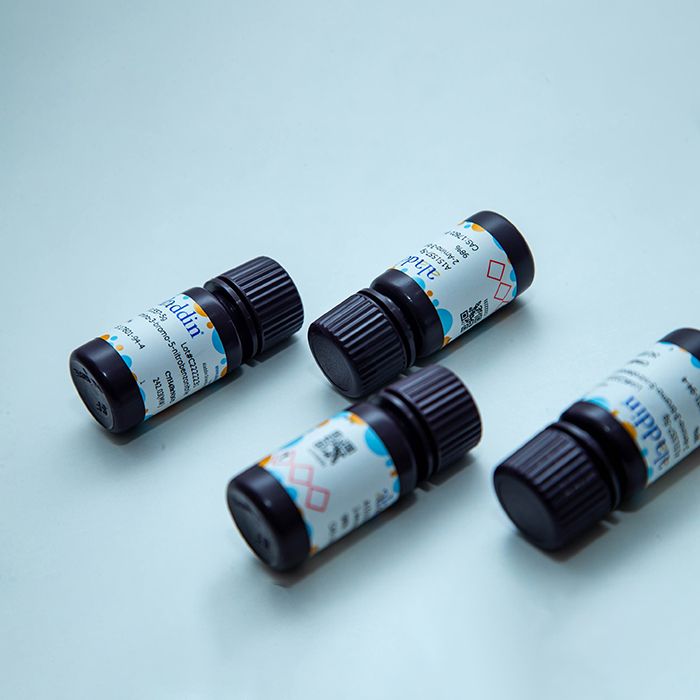
≥96% para fluxos de trabalho cromatográficos e analíticos sensíveis que exigem interferência mínima da linha de base.
🌡
Armazenamento e envio
Protected from light,Store at -20°C,Argon charged Envio Ice chest + Ice pads. Consulte o COA específico do lote para obter as especificações exatas.
📋
Documentos de qualidade
SDS, COA, ficha técnica e folha de especificações disponíveis para download. COA específico do lote acessível por meio de pesquisa por número de lote.
📚
Comprovação documental
Citado em 0 publicações revisadas por pares nas áreas de cromatografia, síntese orgânica e reações de acoplamento cruzado.
Visão geral
Lurbinectedin-d 3 is deuterium labeled Lurbinectedin. Lurbinectedin (PM01183) is a DNA minor groove covalent binder with potent anti-tumour activity; inhibits RMG1 and RMG2 cell growth with IC50 values of 1.25 and 1.16 nM, respectively.
Appearance:Solid
Biological Activity:Lurbinectedin-d 3 is deuterium labeled Lurbinectedin. Lurbinectedin (PM01183) is a DNA minor groove covalent binder with potent anti-tumour activity; inhibits RMG1 and RMG2 cell growth with IC50 values of 1.25 and 1.16 nM, respectively.
Especificações
Especificações e pureza
≥96%
Condições de armazenamento de armazenamento
Protected from light,Store at -20°C,Argon charged
Enviado em
Ice chest + Ice pads
Este produto requer transporte de cadeia fria. Serviços terrestres e outros serviços econômicos não estão disponíveis.
DMSO : 3.57 mg/mL (4.53 mM; ultrasonic and warming and heat to 60°C)
Calculadoras de soluções
Molarity Calculator
Determine the necessary mass, volume, or concentration for preparing a solution.
Dilution Calculator
Determine the dilution needed to prepare a stock solution.
Reconstitution Calculator
Revisões
Avaliações dos Clientes
Application Protocols
Use-case: LC–MS(/MS) quantitation of lurbinectedin with Lurbinectedin-d3 internal standard (general example; optimize per instrument and matrix)
Stock and working solutions
Prepare a primary stock of Lurbinectedin-d3 in anhydrous DMSO or methanol (e.g., mM-range). Store aliquots at −20 °C, protected from light.
Prepare calibration standards of unlabeled lurbinectedin in solvent (e.g., 50:50 water:ACN or MeOH) spanning the expected quantitation range. Add a fixed concentration of the d3 internal standard to all calibrators, QCs, and study samples.
Sample preparation (typical options)
Protein precipitation: Add 3–4 volumes of cold ACN or MeOH containing the internal standard to biological sample. Vortex, incubate on ice, centrifuge, and collect supernatant. Optionally dilute with mobile phase A.
SPE: Condition, load (with internal standard spiked pre-load), wash, and elute with high-organic solvent. Evaporate gently under N2/Ar at room temperature or ≤40 °C; reconstitute in initial mobile phase.
LC–MS conditions (outline)
Column: RP C18; mobile phases: A = water + volatile modifier; B = ACN or MeOH + same modifier. Gradient adjusted to elute the analyte with good peak shape.
MS: ESI+, monitor transitions/masses for analyte and +3 Da internal standard. Verify ion ratios and absence of interferences.
Validation checkpoints
Linearity, accuracy, precision, selectivity, matrix effects, recovery, carryover, and stability (bench-top, autosampler, freeze–thaw). Document lot-specific parameters from the CoA.
Note: This is a general workflow; adhere to your institutional SOPs and regulatory guidance where applicable.
Biological Roles
Item-specific facts (from Product Data)
No biological role information is provided for this item. For research use only.
Literature/general context on the unlabeled parent (not item specifications and not a medical claim)
Lurbinectedin is a synthetic analog in the ecteinascidin family of tetrahydroisoquinoline alkaloids. In biochemical studies, compounds of this class have been reported to bind the DNA minor groove at selected GC-rich sequences and to modulate transcriptional activity by affecting transcription-coupled processes and associated DNA repair pathways. These interactions can trigger DNA damage responses in proliferating cells (literature reports).
Relevance of deuteration
The -d3 isotopologue is chemically and biologically analogous to the unlabeled compound for most in vitro interactions; the primary difference is mass (+3 Da) for mass spectrometric discrimination. Deuteration generally does not change target engagement in a measurable way at analytical concentrations, though subtle isotope effects on retention or fragmentation may occur in LC–MS/MS.
Applications in bioanalytical workflows
Lurbinectedin-d3 serves as a stable-isotope internal standard in studies that quantify parent compound exposure in biological matrices (e.g., metabolism, transport, intracellular accumulation). It enables correction for matrix effects, ion suppression, and variable extraction recovery.
Note
No clinical or therapeutic claims are made for this product. Any biological mechanism statements above are general literature descriptions of the parent compound and should be used only to inform assay design.
Buffer Applications
Not typically applicable
Lurbinectedin-d3 is not a buffering reagent and is not used to control pH in biochemical assays.
Practical guidance
When deploying this internal standard in aqueous systems, choose LC–MS–compatible buffers (e.g., ammonium formate/acetate at low millimolar concentrations) and volatile modifiers (formic acid) that support efficient ionization. Maintain organic content sufficient to keep the analyte and internal standard in solution (often ≥20% acetonitrile or methanol).
Avoid non-volatile buffers (e.g., phosphate) for ESI-based mass spectrometry, as they can suppress signals and complicate source maintenance.
Green Alternatives
Context
As an analytical standard, Lurbinectedin-d3 is used in very small quantities; however, solvent and consumable choices can significantly impact the environmental footprint of routine LC–MS assays.
Greener solvent considerations (general; not item-specific specifications)
Replace/reduce acetonitrile with methanol where chromatographically feasible; MeOH is often regarded as a greener solvent with lower supply risk. Expect changes in selectivity and potentially broader peaks—re-optimize gradients and temperature.
Consider water-rich mobile phases with microflow or UHPLC to reduce total solvent consumption while maintaining sensitivity.
For sample preparation, minimize chlorinated solvents. Protein precipitation with MeOH or ACN can often replace liquid–liquid extraction using halogenated solvents.
Operational practices
Implement miniaturized workflows (reduced injection volumes, 2.1 mm or sub-2.1 mm ID columns) to lower solvent use by 50–80%.
Use reusable glassware and compatible low-adsorption glass vials to reduce plastic waste, provided carryover and adsorption are controlled.
Optimize washing protocols to avoid excessive needle-wash volumes without compromising carryover.
Trade-offs
Methanol vs. acetonitrile: greener but higher viscosity; may increase backpressure—consider elevated column temperature or shorter particle columns to compensate.
Aqueous mobile phases reduce solvent waste but can increase on-column degradation for labile analytes—validate stability and adjust pH/modifier accordingly.
Bottom line
Maintain data quality while adopting greener mobile phases and scaled-down methods; validate any change to ensure quantitation of lurbinectedin with the d3 internal standard remains robust.
Pharmaceutical Uses
Scope
No therapeutic or clinical use is claimed for this product. It is supplied strictly for research and analytical applications.
Analytical and manufacturing relevance (general)
Stable-isotope internal standard for QC: Lurbinectedin-d3 can be used in pharmaceutical quality control laboratories to develop and validate LC–MS/MS methods for assay, content uniformity, related substances (via isotope-dilution), and stability-indicating studies of lurbinectedin drug substance or product.
Process development support: Employed to track recovery during purification steps and to evaluate adsorption/hold-up in processing equipment and filters by spiking known quantities and measuring recoveries.
Reference material practices: For regulated environments, document lot-specific identity, purity, and isotopic enrichment from the CoA. Establish traceability through internal qualification (e.g., HRMS for mass shift confirmation, qNMR for purity, and chromatographic purity checks).
Formulation studies (non-clinical)
The internal standard can assist in solubility profiling and forced-degradation mapping of the unlabeled parent by providing stable quantitation under stress conditions (light, oxidative, hydrolytic), thereby supporting formulation selection and packaging decisions.
Compliance notes
Follow applicable pharmacopeial general chapters for reference standards and analytical method validation (e.g., system suitability, linearity, accuracy, precision, robustness) as they pertain to isotope-dilution assays.
Physical Properties
Item-specific facts (from Product Data)
No item-specific physicochemical specifications were provided for this listing.
Properties for this item
Molecular formula: Not specified for this item; refer to CoA/Spec Sheet.
Molecular weight: Not specified for this item; refer to CoA/Spec Sheet.
Appearance: Not specified for this item; refer to CoA/Spec Sheet.
Melting point, boiling point, density, refractive index, UV cut-off: Not specified for this item; refer to CoA/Spec Sheet.
Solubility: Not specified for this item; refer to CoA/Spec Sheet.
Literature/general expectations for this compound class (for planning only; not specifications)
Complex polycyclic alkaloids of this family are typically non-volatile solids with high thermal sensitivity; analytical use favors solution-phase handling rather than melting/boiling characterization.
Solubility profile (literature): often sparingly soluble in water; readily soluble in polar aprotic organic solvents such as DMSO and DMF, and moderately soluble in methanol and acetonitrile. Stock solutions for LC–MS are commonly prepared in anhydrous DMSO or MeOH at µM–mM concentrations, then diluted into aqueous mobile phases containing organic modifier and 0.1% volatile acid/base.
LogP/logD values for related scaffolds suggest significant hydrophobic character with ionizable centers; retention on reversed-phase (C18) is generally strong, requiring moderate-to-high organic content for elution.
Practical notes
Prepare dilute working solutions fresh to minimize adsorption to plastics and to mitigate light/oxidative degradation. Use amber vials and low-bind consumables. Confirm actual solubility and stability empirically under your exact conditions.
Quality and Grades
Item-specific facts (from Product Data)
Grade/Purity: Not specified for this item; refer to CoA/Spec Sheet.
Supplied under argon, protected from light; shipped cold. These features emphasize preservation of chemical integrity for analytical applications.
How to interpret quality for an isotopically labeled reference standard (general guidance)
Isotopic enrichment: For deuterated internal standards, two key parameters are (a) chemical purity and (b) isotopic purity/enrichment at labeled positions. The CoA typically reports %D incorporation and positional labeling details. Higher enrichment reduces isotopic cross-talk and improves quantitation accuracy.
Residual unlabeled analogue: Trace amounts of unlabeled lurbinectedin in the labeled standard can bias assays—CoAs often specify the unlabeled fraction. Method validation should evaluate potential interference.
Counter-ions/solvent content: If provided as a salt or in solution, residual solvent/water content and counter-ion stoichiometry can affect gravimetric preparations. Confirm by CoA.
Chromatographic suitability: Analytical/reference grade materials are expected to show a single dominant peak by HPLC/UPLC with low levels of related substances. HPLC/LC–MS chromatograms on the CoA help assess suitability for regulated workflows.
Best practices
Upon receipt, verify identity (LC–MS exact mass shift of +3 Da relative to native) and purity against your method. Document lot-specific values from the CoA in your validation records. If your application is trace-level quantitation, consider performing an orthogonal purity check (qNMR or HRMS).
Reaction and Applications
Item-specific facts (from Product Data)
Manufacturer Applications: Not specified.
Analytical applications (literature/practice; not item-specific claims)
Stable-isotope internal standard (SIS) for LC–MS(/MS): Lurbinectedin-d3 provides a co-eluting analogue with a +3 Da mass shift, enabling accurate isotope-dilution quantitation of lurbinectedin in complex matrices (e.g., cell lysates, media, plasma extracts) by compensating for matrix effects, extraction efficiency, and ionization variability.
Method development: Use to establish recovery, carryover, and process efficiency in sample preparation workflows (protein precipitation, SPE, LLE). Spike-before and spike-after experiments help distinguish extraction losses from ion suppression.
System suitability: Monitor retention time stability, peak shape, and ion ratio consistency of the labeled standard before analyzing critical samples.
Practical tips
Spike strategy: Add Lurbinectedin-d3 early in the workflow (pre-extraction) for true internal standard correction of recovery and matrix effects. For instrument drift monitoring, a post-extraction spike can be used in addition.
Calibration: Prepare matched calibration curves with a constant internal standard concentration. Verify linearity across expected concentration ranges; evaluate back-calculated accuracies with acceptance criteria per your SOP.
Isotopic interference: Assess potential hydrogen–deuterium exchange under strongly protic or high-temperature conditions. Maintain neutral-to-acidic media and avoid extended residence times at elevated temperatures to minimize D→H exchange.
Chromatography/ionization: Reversed-phase C18 with ESI+ is commonly effective for this scaffold. Fine-tune organic gradient and modifier concentration to balance sensitivity and resolution.
Reaction Conditions
Not chemical-reaction focused
This product is intended for analytical use, not as a reagent in synthetic transformations. No item-specific reaction conditions are provided.
General LC–MS method conditions for this class (literature/practice; for guidance only)
Chromatography: Reversed-phase C18 columns (e.g., 2.1 mm ID, sub-2–3 µm) with water (A) and acetonitrile or methanol (B) containing 0.1% formic acid or low-mM ammonium formate/acetate. Employ a shallow-to-moderate gradient to resolve the analyte from matrix components.
Ionization/detection: ESI in positive mode is frequently optimal for tetrahydroisoquinoline alkaloids. Tune source parameters to balance desolvation and minimize in-source fragmentation. Monitor the +3 Da mass shift for the internal standard. Select MRM/PRM transitions that are free of interferences; verify ion ratios across matrix lots.
Sample preparation: Protein precipitation (ACN or MeOH), SPE (mixed-mode or reversed-phase), or dilute-and-shoot for clean matrices. Spike the internal standard pre-extraction for full process correction. Dry at ambient or ≤40 °C under nitrogen/argon; avoid intense light.
Carryover and adsorption: Include high-organic washes and needle rinses; evaluate recovery from common plastics and filters. Consider glass inserts and low-bind tips if losses are observed.
Performance expectations
Establish calibration over the relevant concentration range for your application, validating precision, accuracy, selectivity, matrix effects, and stability per your SOP or applicable guidelines. All parameters must be empirically optimized on your instrumentation.
Safety and Handling
Item-specific facts (from Product Data)
Storage: Protected from light; Store at −20 °C; Argon charged. Shipped in an ice chest with ice pads.
GHS/Signal word/H-statements/Pictograms: Not specified for this item; refer to SDS.
Authoritative source
Always consult the product-specific Safety Data Sheet (SDS) for definitive hazard classification, exposure limits, and first-aid measures.
General safety guidance for this compound class (literature/practice; not item-specific)
Potent, bioactive polycyclic alkaloids and their labeled standards may present acute toxicity risks. Handle in a certified chemical fume hood or containment enclosure (e.g., Class II BSC when appropriate). Avoid inhalation, ingestion, and skin/eye contact.
Recommended PPE: lab coat, safety glasses, and double nitrile gloves (change outer gloves frequently). Use dedicated tools/liners to minimize cross-contamination. Consider closed-transfer devices for stock solutions.
Incompatibilities: strong oxidizers; prolonged exposure to light, moisture, and air (oxygen) can promote degradation. The argon-charged note indicates sensitivity to air/light—maintain an inert atmosphere during handling when feasible and keep containers tightly closed.
First aid (overview; defer to SDS): in case of skin contact, wash with plenty of water; remove contaminated clothing. Eye contact: rinse cautiously with water for several minutes. If inhaled: move to fresh air. If swallowed: rinse mouth; do not induce vomiting; seek medical attention. Provide the SDS to medical personnel.
Spill/leak response: absorb with inert material, avoid aerosolization, clean with suitable solvent while maintaining containment. Dispose of waste as hazardous organic chemical waste in accordance with institutional and regulatory requirements.
Decontamination: wipe work surfaces with appropriate solvent followed by detergent/water; verify effectiveness if working at low ng levels (e.g., by swab LC–MS).
Solvent Selection
Item-specific facts (from Product Data)
No solvent specifications were provided for this listing.
General solvent guidance for lurbinectedin-class standards (literature/practice; not specifications)
Primary stock solvents: Anhydrous DMSO or methanol are commonly used due to good solubility and chemical compatibility for LC–MS. Acetonitrile is also suitable for working dilutions.
Aqueous behavior: Expect low intrinsic water solubility. For aqueous working solutions, prepare a concentrated stock in DMSO/MeOH, then dilute into water or buffer containing 20–60% organic (ACN or MeOH) and a volatile modifier (e.g., 0.1% formic acid or ammonium formate) to aid ionization and reduce adsorption.
Adsorptive losses: Hydrophobic, polyfunctional molecules can adsorb to plastics. Use glass vials with low-adsorption caps, or certified low-bind plastics. Include a small amount of organic co-solvent (≥5%) to mitigate losses.
Stability considerations: Protect from light; minimize exposure to air and elevated temperature. Avoid prolonged storage in basic solutions to limit hydrolysis of ester/lactam-like moieties reported in related scaffolds.
Quick comparison (general)
DMSO: highest solvating power; can suppress ESI at high %—keep final DMSO ≤1–2% in injection.
Methanol: good solvent, promotes ESI+, miscible with water; can influence retention vs ACN.
Acetonitrile: strong eluent for RP LC, low viscosity; slightly lower solubility for some polycyclic alkaloids than MeOH, but improves peak shape.
Always optimize solvent choice empirically under your chromatographic and ionization conditions.
Storage and Reconstitution
Item-specific facts (from Product Data)
Storage conditions: Protected from light; Store at −20 °C; Argon charged.
Shipping: Ice chest with ice pads.
Best practices for this item (expanding on provided instructions)
Primary storage: Keep the unopened container tightly sealed under inert gas (argon) at −20 °C in the dark (amber secondary containment recommended). Avoid repeated warming/cooling cycles.
Aliquoting: Upon first opening, allow vial to equilibrate to room temperature under inert atmosphere to prevent condensation. Prepare small aliquots (e.g., 10–100 µL) of concentrated stock solution to minimize freeze–thaw cycles. Flush headspace with argon before re-closing.
Reconstitution: If supplied as a solid, dissolve in anhydrous DMSO or methanol to prepare a concentrated stock. If supplied as a solution, verify solvent and concentration on the label/CoA. Mix gently; avoid vigorous vortexing that can introduce air.
Working solutions: Prepare just-in-time dilutions in LC–MS–compatible solvents or mobile phases. Protect from light (foil-wrap vials) and keep in an autosampler at 4–10 °C if runs extend over several hours. Assess stability by bracketed QC samples.
Stability checks: Establish bench-top and autosampler stability for your method. Discard aliquots showing precipitation, discoloration, or unexpected chromatography/mass spectra.
Container materials: Use amber glass vials with PTFE-lined caps; for plastics, select certified low-bind materials to reduce adsorption.
Note
For exact lot-specific concentration, solvent, purity, and stability limits, consult the CoA/Spec Sheet. For safety, refer to the SDS. For research use only.
Structure and Identity
Item-specific facts (from Product Data)
Product name: Lurbinectedin-d3 (SKU: L659394)
CAS: L659394 (internal listing)
Molecular formula: Not specified for this item; refer to CoA/Spec Sheet.
Molecular weight: Not specified for this item; refer to CoA/Spec Sheet.
SMILES: Not specified for this item; refer to CoA/Spec Sheet.
InChIKey: Not specified for this item; refer to CoA/Spec Sheet.
Literature/general description (for context; not item specifications)
Lurbinectedin-d3 is the trideuterated isotopologue of lurbinectedin, used primarily as a stable-isotope internal standard for quantitative LC–MS workflows. The three deuterium atoms replace three protium atoms at defined positions without altering the compound’s charge or core connectivity, enabling co-elution with slight, predictable mass shift (+3 Da).
Structural class (literature): a complex polycyclic tetrahydroisoquinoline-derived alkaloid bearing multiple heteroatoms (nitrogen, oxygen) and functional groups (amide/imide and ester-like linkages). The architecture contains fused ring systems and a pendant side chain; overall, the scaffold is rigid and conformationally constrained, a hallmark of this natural-product–inspired class.
2D structural features in words (literature): a densely functionalized, multi-ring framework with embedded tertiary/secondary amines, lactam-like substructures, and oxygenated substituents distributed around two main polycyclic domains. Deuterium substitution does not change the valence structure and is depicted as D labels at specific aliphatic positions.
Notes
Where exact positions of deuteration, formal formula, and definitive identifiers are required, consult the product CoA/Spec Sheet for this batch.
Synthetic Utility
Applicability
Lurbinectedin-d3 is not generally used as a synthetic building block; its primary role is as an analytical internal standard. Nevertheless, understanding isotopic labeling utility can aid method development and mechanistic studies.
General utility of deuterated analogues (literature/practice)
Mechanistic probes: Deuterium labeling can help evaluate metabolic soft spots via tracking H/D exchange or monitoring specific fragment ions in MS/MS. Although the goal here is quantitation, the label can, in principle, inform site-specific stability if the labeled positions are susceptible to exchange.
Isotope-dilution quantitation: Enables accurate mass-balance in recovery studies, adsorption assessments (to plastics/filters), and matrix-effect correction across sample prep workflows.
Fragmentation mapping: In tandem MS, deuterium placement can shift fragment ion masses, aiding structural elucidation or confirmation of fragmentation pathways for the parent compound in method development.
Cautions
Avoid strongly protic/basic conditions and elevated temperatures that may facilitate H/D back-exchange, eroding isotopic enrichment. Maintain neutral-to-slightly acidic conditions and minimize reaction residence times when the internal standard is present.
Takeaway
Use Lurbinectedin-d3 to enhance the reliability of analytical data around the synthesis, purification, and stability studies of the unlabeled parent, rather than as a precursor/intermediate in chemical synthesis.
Target Specificity
Not applicable
This product is a small-molecule analytical standard, not an antibody, enzyme, or affinity reagent. No antigen/epitope, species reactivity, clone, or isotype information applies.
Usamos cookies para garantir o funcionamento adequado do site e, quando permitido, para melhorar a sua experiência. Você pode gerenciar suas preferências a qualquer momento nas Configurações. Saiba mais em nossa Política de Cookies.
Deseja que lhe enviemos uma mensagem quando tivermos descontos disponíveis?
Lembrar-me mais tarde
Obrigado! Por favor, verifique a sua caixa de entrada de e-mail para confirmar.
Products are supplied to verified businesses, institutions, and qualified professionals for research and development use only. Not for use in humans, animals, diagnosis, or therapy.