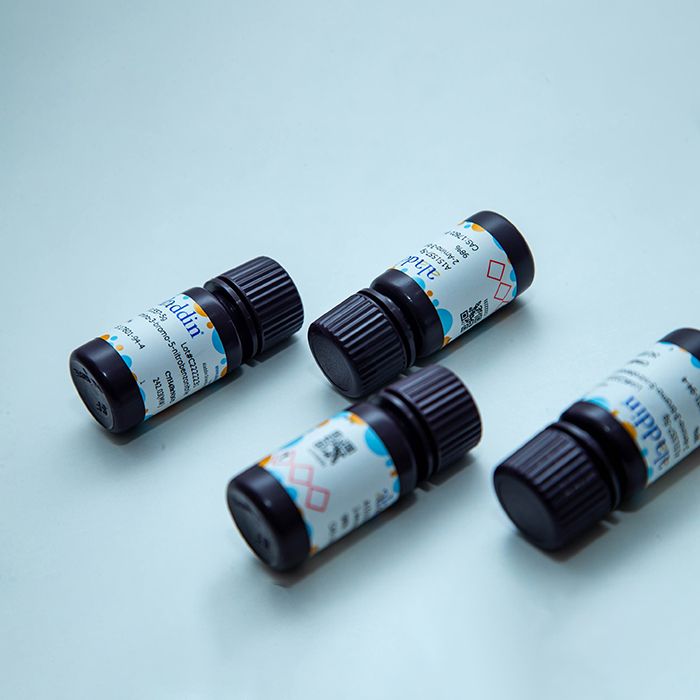
M2e, human TFA, consisting of the 23 extracellular residues of M2 (the third integral membrane protein of influenza A), has been remarkably conserved in all human influenza A. M2e, human TFA is a valid and versatile vaccine candidate to protect against an
Appearance:Solid
Biological Activity:M2e, human TFA, consisting of the 23 extracellular residues of M2 (the third integral membrane protein of influenza A), has been remarkably conserved in all human influenza A. M2e, human TFA is a valid and versatile vaccine candidate to protect against an
Especificações
Especificações e pureza
≥99%
Condições de armazenamento de armazenamento
Desiccated,Store at -80°C
Enviado em
Dry ice packs + Cold packs
Este produto requer transporte de cadeia fria. Serviços terrestres e outros serviços econômicos não estão disponíveis.
Pureza
≥99%
Nomes e identificadores
Peso molecular
2738.83
Dados avançados
Certificados(CoA,COO,BSE/TSE e Mapa de Análise)
C of A & Other Certificates(BSE/TSE, COO):
Analytical Chart:
Propriedades químicas e físicas
Solubilidade
DMSO : 100 mg/mL (36.51 mM; Need ultrasonic)
Calculadoras de soluções
Molarity Calculator
Determine the necessary mass, volume, or concentration for preparing a solution.
Dilution Calculator
Determine the dilution needed to prepare a stock solution.
Reconstitution Calculator
Revisões
Avaliações dos Clientes
Application Protocols
No tested applications or recommended dilutions are provided in the product data for this item.
General research-use examples (non-validated, literature)
ELISA peptide coating: Dissolve peptide to 0.5–2.0 mg/mL in carbonate–bicarbonate buffer (pH ~9.6), dilute to 1–10 μg/mL, add 100 μL/well, incubate 2 h at 25 °C or overnight at 4 °C; block and proceed per assay design.
SPR/BLI: Prepare 0.1–1.0 mg/mL stocks; immobilize via amine coupling to carboxylated sensor chips at pH 4.5–5.5; optimize ligand density to avoid mass transport limits.
LC–MS control: Spike peptide into matrix at 10–1000 ng/mL; use 0.1% formic acid mobile phase to avoid TFA suppression of ionization.
Important
Treat the above only as general guidance. Optimize conditions empirically for your specific sequence and platform. Refer to the item’s CoA/Spec Sheet for any sequence-specific recommendations if available.
Biological Roles
General background (literature)
“M2e” denotes the ectodomain of the Influenza A virus M2 protein, a proton channel involved in viral uncoating. The ectodomain is short and relatively conserved across many Influenza A strains (literature).
Synthetic M2e peptides are widely used as defined antigens in immunochemical research to study protein–peptide recognition, epitope mapping, and binding kinetics in vitro (research context only).
Biochemical properties (general)
As a linear peptide, M2e exhibits sequence-dependent amphipathicity and may interact with membrane mimetics or detergents in biophysical assays.
The peptide bond chromophore absorbs at ~214 nm; if aromatic residues (Trp/Tyr/Phe) are present in the specific sequence, additional absorbance near 257–280 nm may be observed (literature).
Research relevance (non-clinical)
Useful as a tool analyte for developing and validating peptide capture, enrichment, and detection methods (e.g., SPR, BLI, ELISA, LC–MS) and for benchmarking peptide immobilization protocols.
Note
No item-specific sequence, modifications, or activity are provided in the product data; consult the CoA/Spec Sheet for exact biological context of this lot.
Buffer Applications
Not typically applicable as a buffering reagent. Peptides do not serve as primary pH buffers in laboratory practice.
Practical notes (general)
When formulating this peptide into assay buffers, choose a conventional buffer system (e.g., PBS, HEPES, acetate) suitable for your detection method and protein partners.
Be aware that the TFA counterion can slightly acidify low-ionic-strength solutions; confirm and adjust pH after dissolution if necessary.
Green Alternatives
Green chemistry context (general for peptide handling)
Peptide work typically relies on aqueous buffers; when organic cosolvents are needed for dissolution, prefer water-miscible, lower-toxicity options and minimize volumes.
Solvent choice guidance (general)
Prefer: Water, PBS, and acetate/HEPES buffers (low hazard, biodegradable).
Use with care: DMSO (good solvency, but handle to avoid environmental release); ethanol as an alternative cosolvent in some assays.
Avoid where possible: Large volumes of acetonitrile or halogenated solvents for routine dissolution; reserve for analytics where required.
TFA counterion reduction (greener practice)
TFA has persistence and toxicity concerns. If compatible with your application, exchange TFA for acetate or chloride using small desalting columns or lyophilization from dilute HCl/AcOH to lower fluorinated waste (general technique).
Comparison (general)
Aqueous buffer vs. ACN/water: Aqueous systems reduce VOC use and hazards; ACN improves solubility for hydrophobic sequences but increases waste burden. Choose the minimum necessary ACN fraction and recover solvent where possible.
Operational tips
Scale down screening solubility tests (100–500 μL) to limit solvent consumption.
Consolidate analytical runs to reduce ACN consumption in LC workflows.
Pharmaceutical Uses
This product is supplied strictly for research use only (per product data). No clinical or therapeutic applications are claimed or supported.
General formulation context (non-clinical)
Synthetic peptides may serve as process controls or reference materials in analytical method development for peptide-containing products.
Counterion considerations: Trifluoroacetate is common after purification but is often exchanged to acetate or chloride in downstream development due to regulatory and performance considerations (general industry practice).
Excipients and vehicles (general research use)
For in vitro work, peptides are commonly prepared in sterile water or isotonic buffers; carrier proteins (e.g., BSA) may be added at low percentages to reduce adsorption losses when working at low μg/mL levels.
No pharmacopeial status, dosage forms, or GMP details are provided for this specific item; refer to CoA/Spec Sheet if applicable.
Physical Properties
Item-specific values
Appearance: Not specified for this item; refer to CoA/Spec Sheet.
Exact molecular weight (MW): Not specified for this item; refer to CoA/Spec Sheet.
Elemental analysis / water content / residual solvents: Not specified for this item; refer to CoA/Spec Sheet.
General peptide properties (literature/general guidance)
Physical form: Typically supplied as a lyophilized powder or film; hygroscopic to varying degrees depending on sequence.
Solubility behavior: Sequence-dependent. Many M2e peptides dissolve in water, aqueous buffers (pH 6–8), or with minimal organic cosolvent (e.g., DMSO) before dilution into buffer (literature). Salt form (TFA) increases initial water-wetting but may introduce acidity.
pI/logP: Sequence-dependent; not universal. For unmodified linear peptides, logP is not a meaningful descriptor; amphipathicity is dictated by side-chain composition (general).
Stability: Solid-state peptides are generally stable when desiccated at ≤−20 °C; enhanced stability at −80 °C minimizes backbone/side-chain degradation (literature). Avoid repeated temperature cycling.
Spectral characterization: Peptides are commonly verified by LC–MS and analytical RP-HPLC; UV absorbance at 214 nm for peptide bond, and at 280 nm if Trp/Tyr/Phe present (literature). Exact values are sequence-dependent.
Quality and Grades
Item-specific grade/purity: Not specified for this item; refer to CoA/Spec Sheet.
Typical quality attributes for catalog peptides (general)
Purity reporting: Often by analytical RP-HPLC at 214 nm; purity thresholds (e.g., ≥90%, ≥95%) reflect the major peak area percentage (literature). Co-eluting TFA and water are not included in purity calculations.
Identity confirmation: LC–MS or MALDI-TOF with observed [M+H]+ within acceptable tolerance of theoretical monoisotopic/average mass; sequence may be supported by MS/MS or amino acid analysis.
Counterion content: TFA counterion is common from HPLC purification with TFA mobile phase. Residual TFA can be quantified (ion chromatography or 19F NMR). If your assay is TFA-sensitive, consider counterion exchange (acetate, Cl−) prior to use.
Residual solvents/water: Common for lyophilized peptides; Karl Fischer for water and GC for volatile residuals are typical but item-specific values should be taken from the CoA.
What the listing implies for this item
The product name includes “TFA,” indicating the trifluoroacetate salt form at shipment. No additional grade terms are supplied in the product data; consult the CoA for exact purity, identity, and counterion specifications.
Reaction and Applications
This product is a peptide reagent supplied for research use. No specific reaction applications are provided in the product data. The following are general laboratory uses for synthetic peptides of the M2e type (literature/general):
Biochemical assays: Use as a defined antigenic peptide in ELISA plate coating, solution competition assays, or binding studies with peptide-recognizing proteins or synthetic binders.
Analytical standards: Calibrant or positive control in LC–MS or HPLC methods assessing peptide detection and recovery.
Conjugation studies: Model substrate for coupling chemistries to carriers (e.g., KLH, BSA) or surfaces via N-terminus/C-terminus or side chains using EDC/NHS, NHS-esters, isothiocyanates, or click handles if present.
Structural/biophysical studies: Circular dichroism, fluorescence (if aromatic residues present), or NMR to evaluate peptide conformation and interactions with membranes or proteins.
Practical tips (general)
Use low-binding plastics and pre-wet pipette tips to minimize adsorption losses.
If the peptide foams during dissolution, gently vortex/sonicate; avoid vigorous aeration to limit oxidation of sensitive residues.
Aliquot concentrated stocks to single-use portions to prevent repeated freeze–thaw.
Reaction Conditions
No item-specific reaction conditions are provided. The following are general conditions for peptide bioconjugation in aqueous media (literature/general):
NHS-ester coupling to amines
Buffer: 50 mM PBS or carbonate, pH 7.5–8.5 (avoid primary amine buffers like Tris during activation/ligation).
Stoichiometry: 1.2–5 equiv NHS-ester per amine site.
Temperature/time: 4–25 °C, 0.5–2 h for small-molecule coupling; longer for surfaces.
EDC/NHS activation of carboxyl groups
Buffer: 50 mM MES, pH 5.0–6.5 (stabilizes O-acylisourea; add NHS or sulfo-NHS to form active ester).
Stoichiometry: 1–5 equiv EDC and 2–10 equiv NHS to carboxyl site.
Temperature/time: 0–25 °C, 15–60 min activation; 1–2 h coupling with amine partners.
Maleimide–thiol coupling (if a thiol handle is present)
Buffer: 50 mM phosphate, pH 6.5–7.2; degassed to minimize disulfide formation.
Stoichiometry: 1.1–2 equiv maleimide to thiol.
Temperature/time: 4–25 °C, 15–60 min.
General tips
Desalt/remove TFA prior to sensitive conjugations to avoid acid-catalyzed hydrolysis and maleimide ring opening.
Use inert atmosphere for oxidation-prone residues; add antioxidants (e.g., 0.1 mM TCEP for thiols) as appropriate.
Verify progress by LC–MS or SDS-PAGE (for protein conjugates).
Safety and Handling
GHS classification and hazard statements: Not specified for this item; refer to SDS for authoritative safety information.
General considerations for research peptides (non-hazard-classified unless noted)
Avoid inhalation of dust and contact with skin/eyes. Use in a fume hood or well-ventilated area when weighing.
Personal protective equipment: laboratory coat, nitrile gloves, and safety glasses as a baseline. Change gloves frequently when handling TFA-containing materials.
TFA counterion note: Trace trifluoroacetate can impart acidity to solutions and may be irritating. Neutralize or exchange counterions if needed for sensitive assays. Avoid mixing concentrated peptide–TFA with strong bases without appropriate controls (CO2/heat may evolve upon neutralization in carbonate systems).
Incompatibilities (general)
Strong oxidizers and strong acids/bases can degrade peptides. Metal ions may catalyze oxidation of sensitive residues (e.g., Met, Cys) — use chelators if appropriate.
Moisture can cause hydrolysis or aggregation in certain sequences; keep desiccated until use.
First-aid overview (general)
Inhalation: move to fresh air; seek medical attention if symptoms persist.
Skin/eye contact: rinse with water for ≥15 minutes; remove contaminated clothing.
Ingestion: rinse mouth; seek medical advice. Provide SDS to responders.
Waste disposal: Follow institutional guidelines; aqueous peptide/TFA waste may be acidic; neutralize if permitted and dispose as chemical waste.
Solvent Selection
Solubility strategy (general for peptides)
Start small: Add a minimal volume of solvent (e.g., water, buffer, or DMSO) to create a concentrated stock, then dilute into the final medium to avoid aggregation.
Sequence-driven choice: Hydrophilic sequences often dissolve in water or PBS (pH 7.2–7.4). Hydrophobic sequences may require a cosolvent (e.g., 10–30% acetonitrile or DMSO) or brief sonication.
pH leverage: Adjust pH near 7–8 to enhance solubility of acidic peptides; use mildly acidic buffer (pH 4–6) for basic peptides. Avoid extremes that can promote degradation.
Counterion considerations
TFA salts acidify water; if pH-sensitive, neutralize gently with dilute base or perform counterion exchange (e.g., dissolve in water and pass through a small acetate-form ion-exchange cartridge) prior to critical assays (general practice).
Compatibility notes
For bioassays: Keep final organic solvent below assay tolerance (commonly ≤1–2% DMSO). Filter through a 0.22 μm membrane only if the peptide is fully soluble to avoid adsorption losses.
Quick comparison (general)
Water/PBS: Biocompatible, ideal for polar peptides; TFA may lower pH initially.
DMSO: High solvating power; use as intermediate stock, dilute promptly.
Acetonitrile/water (10–30%): Helpful for moderately hydrophobic sequences; compatible with many analytical workflows.
Storage and Reconstitution
Storage conditions (from product data)
Desiccated; Store at −80 °C.
Shipped on dry ice packs + cold packs to maintain low temperature and dryness.
Handling
Equilibrate the sealed vial to room temperature in a desiccator before opening to avoid condensation.
Work quickly in low humidity; reseal under inert gas or vacuum if possible.
Reconstitution (general guidance for peptides)
Initial solvent: Use sterile water, PBS, or appropriate buffer based on sequence hydrophobicity; for difficult sequences, pre-wet with a minimal volume of DMSO or 10–30% acetonitrile, then dilute into aqueous buffer.
Concentration: Prepare a concentrated stock (e.g., 1–10 mg/mL) to minimize adsorption losses; verify complete dissolution visually and by UV at 214/280 nm if applicable.
pH: Check and adjust pH after dissolution due to TFA acidity; avoid strong bases that can cause side reactions.
Aliquoting and stability
Aliquot into single-use portions; store at −80 °C. Avoid repeated freeze–thaw.
For short-term use (≤1 week), −20 °C storage may suffice; verify solution stability for your assay. Add carrier protein (e.g., 0.1% BSA) or 0.05% Tween-20 only if compatible and adsorption is problematic.
Shelf-life
No item-specific shelf-life is provided; monitor by analytical HPLC/LC–MS at intervals. Refer to CoA/Spec Sheet for any lot-specific stability data.
Structure and Identity
Item-specific identifiers
CAS: Not specified for this item; refer to CoA/Spec Sheet. (Catalog shows “M659031” as SKU/CAS placeholder.)
Molecular formula: Not specified for this item; refer to CoA/Spec Sheet.
Molecular weight: Not specified for this item; refer to CoA/Spec Sheet.
SMILES / InChIKey: Not specified for this item; refer to CoA/Spec Sheet.
Name and type
Product name: M2e, human TFA
Compound type: Peptide (trifluoroacetate salt form)
Counterion: TFA− (trifluoroacetate), typically present from HPLC purification with TFA; relevant for mass spec and certain bioassays.
Structural features (general, literature)
“M2e” denotes the ectodomain peptide segment of the Influenza A M2 proton channel. Human-consensus M2e peptides are short (≈20–25 residues) and acid/amide-terminated variants are common in catalogs (literature).
Linear polypeptide chain with standard L-α-amino acid residues connected via trans-amide linkages; no assumption of post-translational modifications unless specified.
Stereochemistry (general)
Peptide stereocenters typically L-configuration at α-carbons unless otherwise noted. No item-specific configuration provided here.
Synthetic Utility
Functional group handles (general for peptides)
N-terminus (amine) and C-terminus (carboxyl or amide) provide orthogonal points for conjugation. Side chains (e.g., Lys, Asp/Glu, Tyr) can be selectively derivatized depending on sequence and protecting strategies.
Common transformations (literature/general)
Amide coupling: NHS-ester conjugation to primary amines on surfaces, proteins (e.g., BSA), or polymers.
Carbodiimide chemistry: EDC/NHS activation of peptide carboxylates for coupling to amines on carriers.
Click approaches: If an azide/alkyne handle is present or introduced, CuAAC or SPAAC enables site-specific ligation.
Oxime/hydrazone formation: With introduced aldehyde/ketone tags (e.g., via N-terminal transamination or periodate-oxidized handles).
Analytical/retrosynthetic value
Serves as a defined linear sequence to benchmark purification, LC retention modeling, and mass calibration.
Note
Specific modifiable residues and protecting-group history are not provided for this item; plan conjugation strategies based on the exact sequence and termini from the CoA/Spec Sheet.
Target Specificity
Not specified for this item; no target, antigen, clone, or species reactivity information is provided in the product data.
General note (context only)
“M2e” commonly refers to a peptide corresponding to the Influenza A M2 ectodomain used as an antigenic sequence in research; however, no item-specific epitope mapping or validation data are supplied here. Consult the CoA/Spec Sheet for any available characterization.
Usamos cookies para garantir o funcionamento adequado do site e, quando permitido, para melhorar a sua experiência. Você pode gerenciar suas preferências a qualquer momento nas Configurações. Saiba mais em nossa Política de Cookies.
Deseja que lhe enviemos uma mensagem quando tivermos descontos disponíveis?
Lembrar-me mais tarde
Obrigado! Por favor, verifique a sua caixa de entrada de e-mail para confirmar.
Products are supplied to verified businesses, institutions, and qualified professionals for research and development use only. Not for use in humans, animals, diagnosis, or therapy.