Determine the necessary mass, volume, or concentration for preparing a solution.
| Activity Type | Activity Value -log(M) | Mechanism of Action | Activity Reference | Publications (PubMed IDs) |
|---|

10mM in DMSO for sensitive chromatographic and analytical workflows requiring minimal baseline interference.
Store at -80°C Ships Dry ice packs + Cold packs Check lot-specific COA for exact specifications.
SDS, COA, datasheet, and spec sheet available for download. Lot-specific COA accessible via lot number lookup.
Cited in 4 peer-reviewed publications across chromatography, organic synthesis, and cross-coupling reactions.
Information
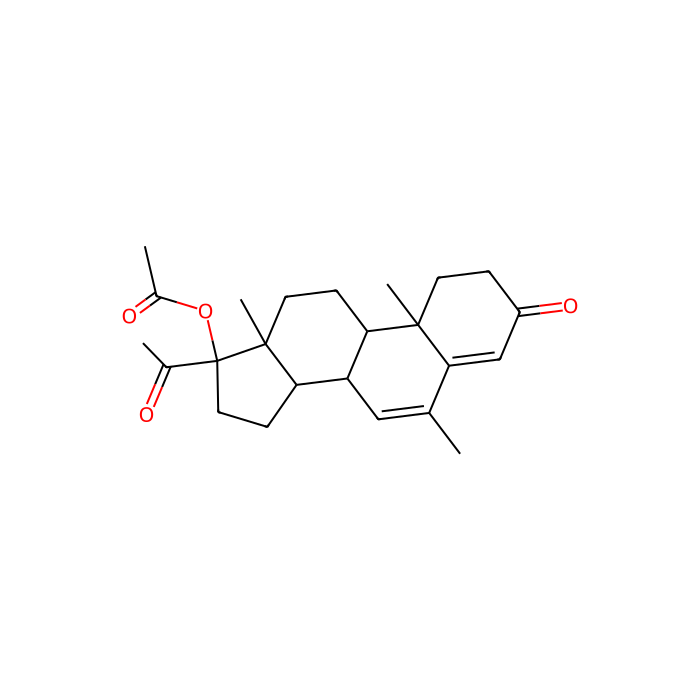
Megestrol acetate (BDH1298, SC10363) is a syntheticprogestogen, used to treat breast cancer and loss of appetite.
In vitro
Megestrol acetate inhibits the expression of cytoplasmic aromatase through nuclear C/EBPβ in reperfusion injury-induced ischemic rat hippocampus. Megestrol acetate significantly increases the proliferation, migration, and adipogenic differentiation of adipose-derived stem cells (ASCs) in a dose-dependent manner. Megestrol acetate also upregulates genes downstream of glucocorticoid receptor (GR) in ASCs.
In vivo
Megestrol acetate significantly decreases the circulating concentrations of estradiol (E2) and testosterone (T) in female fish or 11-ketotestosterone (11-KT) in male fish. Megestrol acetate exposure significantly downregulates the transcription of certain genes along the hypothalamic-pituitary-gonadal (HPG) axis. Megestrol acetate produces a progressive deterioration in glucose tolerance, with a significant increase in mean fasting plasma glucose concentrations and decrease in mean plasma glucose clearance rates after 6 months and 12 months of treatment in cats. Megestrol acetate also produces a progressive decrease in both resting plasma cortisol concentrations and cortisol concentrations after ACTH stimulation in cats. Megestrol acetate (50 mg/kg/day) for 9 days significantly increases food and water intake compared with untreated controls. Megestrol acetate (50 mg/kg/day) significantly (90-140%) increases in neuropeptide Y concentrations in the arcuate nucleus (where neuropeptide Y is synthesized), in the lateral hypothalamic area (through which arcuate neurones project) and in the medial preoptic area, ventromedial nucleus and dorsomedial nucleus in rats.
Cell Data
cell lines:HCT116, MDA-MB-231, SNU-5, and MKN45 cells
Concentrations:
Incubation Time:
Powder Purity:≥99%
| SMILES isoméricas | CC1=C[C@@H]2[C@H](CC[C@]3([C@H]2CC[C@@]3(C(=O)C)OC(=O)C)C)[C@@]4(C1=CC(=O)CC4)C |
|---|---|
| RTECS | TU4075000 |
| Peso molecular | 384.52 |
| Beilstein | 8(4)2431 |
| Reaxy-Rn | 3489305 |
| Reaxys-RN_link_address | https://www.reaxys.com/reaxys/secured/hopinto.do?context=S&query=IDE.XRN=3489305&ln= |
Comprehensive hazard, handling, storage, and regulatory compliance document.
Download SDS →Lot-specific quality data. Enter your lot number to retrieve the exact COA.
Look up COA →Full quality attributes and acceptance criteria for this grade.
View spec sheet →| Activity Type | Activity Value -log(M) | Mechanism of Action | Activity Reference | Publications (PubMed IDs) |
|---|
| Solubilidade | Solubility (25°C) In vitro |
|---|---|
| Rotação específica [α] | 11° (C=2,CHCl3) |
| Ponto de fusão (°C) | 218 °C |