
Determine the necessary mass, volume, or concentration for preparing a solution.
🌎 Enviar para: United States
340,000+ produtos de pesquisa · Triple ISO certified · COA & SDS Disponível para todos os produtos · Envio no mesmo dia em itens em estoque
Por que este grau
Ultra dry, ≥99.9%, water≤30 ppm Ultra dry para fluxos de trabalho cromatográficos e analíticos sensíveis que exigem interferência mínima da linha de base.
Armazenamento e envio
Room temperature Envio FedEx DG Service. Consulte o COA específico do lote para obter as especificações exatas.
Documentos de qualidade
SDS, COA, ficha técnica e folha de especificações disponíveis para download. COA específico do lote acessível por meio de pesquisa por número de lote.
Comprovação documental
Citado em 7070 publicações revisadas por pares nas áreas de cromatografia, síntese orgânica e reações de acoplamento cruzado.
Visão geral
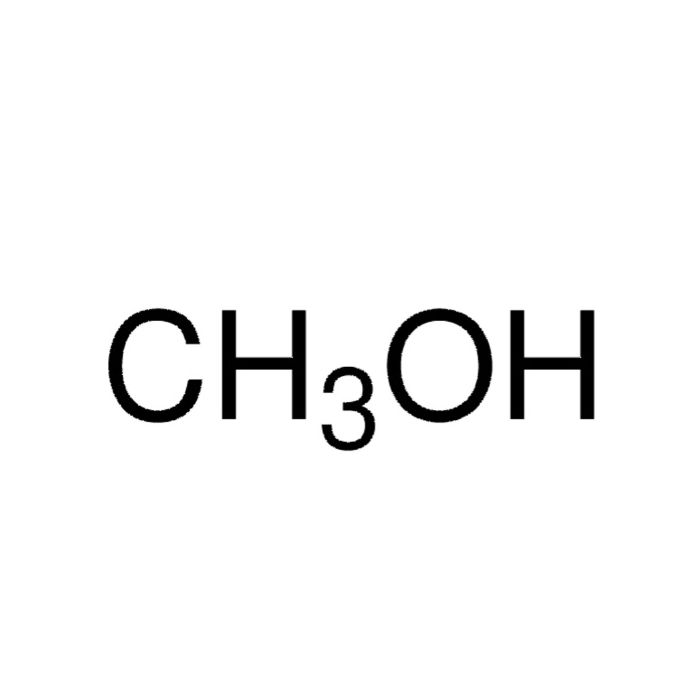
Methanol is an industrial organic solvent commonly used in organic synthesis. It is being considered as a potential hydrogen source in fuel cell technology due to its high H/C ratio, low propensity for soot generation, relatively low reforming temperature and its liquid state at room temperature. The olefins (ethylene or propylene) formed from methanol via MTO (methanol-to-olefins) process, can be an alternative to oil and gas to produce hydrocarbon fuels.
Application
Methanol has been used for fixing the tissues during preparation of thin giemsa stained blood smears. It has been used in the purification step during the synthesis of pyocyanin, a toxic compound found in Pseudomonas aeruginosa . Methanol has been used in following applications: Used for the synthesis and purification of pyocyanin, spectrophotometric estimation of pyocyanin concentration, and the calculation of pyocyanin molar concentration using spectrophotometer absorption data. Used as a component of staining solution used in karyotyping. Used as a component of staining solution to stain cell colonies in colony formation assay.
Especificações
Especificações e pureza
Ultra dry, ≥99.9%, water≤30 ppm
Condições de armazenamento de armazenamento
Room temperature
Enviado em
FedEx DG Service
Grau
Ultra dry
Pureza
≥99.9%
Nomes e identificadores
Sorrisos canónicos
CO
IUPAC Name
methanol
InChIKey
OKKJLVBELUTLKV-UHFFFAOYSA-N
INCHI
1S/CH4O/c1-2/h2H,1H3
SMILES isoméricas
CO
WGK Alemanha
1
RTECS
1
Número UN
1230
Grupo de embalagem
II
Peso molecular
32.04
Beilstein
3662861
Documentação
📋 Ficha de dados de segurança (FDS)
Documento abrangente sobre perigos, manuseamento, armazenamento e conformidade regulamentar.
<<<<<<< HEAD Baixar SDS → ======= Baixar SDS → >>>>>>> release248-p3✅ Certificado de análise (COA)
Dados de qualidade específicos do lote. Introduza o número de lote para obter o COA exato.
Consultar COA →📊 Ficha técnica
Resumo de referência rápida das especificações e aplicações do produto.
Ver ficha técnica →🔬 Folha de especificações
Atributos de qualidade completos e critérios de aceitação para este grau.
Ver folha de especificações →Dados avançados
Taxonomic Classification
Taxonomy Tree
- Kingdom Organic compounds
- Superclass Organic oxygen compounds
- Classe Organooxygen compounds
- Subclass Alcohols and polyols
- Classe Organooxygen compounds
- Superclass Organic oxygen compounds
| Kingdom | Organic compounds |
|---|---|
| Superclass | Organic oxygen compounds |
| Classe | Organooxygen compounds |
| Subclass | Alcohols and polyols |
| Intermediate Tree Nodes | Not available |
| Direct Parent | Primary alcohols |
| Alternative Parents | Hydrocarbon derivatives |
| Molecular Framework | Aliphatic acyclic compounds |
| Substituents | Hydrocarbon derivative - Primary alcohol - Aliphatic acyclic compound |
| Descrição | This compound belongs to the class of organic compounds known as primary alcohols. These are compounds comprising the primary alcohol functional group, with the general structure RCOH (R=alkyl, aryl). |
| External Descriptors | a short-chain alcohol |
Estrutura 3D
Modelo de Estrutura Química Interativa
Certificados(CoA,COO,BSE/TSE e Mapa de Análise)
C of A & Other Certificates(BSE/TSE, COO):
Analytical Chart:
Find and download the COA for your product by matching the lot number on the packaging.
| Lot Number | Certificate Type | Data | Item |
|---|---|---|---|
 I2624112 | Certificate of Analysis | Oct 13, 2026 | M1521045 |
| I2624113 | Certificate of Analysis | Oct 10, 2026 | M1521045 |
| G2618039 | Certificate of Analysis | Aug 01, 2026 | M1521045 |
| G2618040 | Certificate of Analysis | Aug 01, 2026 | M1521045 |
| E2614127 | Certificate of Analysis | May 20, 2026 | M1521045 |
| E2614128 | Certificate of Analysis | May 20, 2026 | M1521045 |
Propriedades químicas e físicas
| Índice de refração | 1.329 |
|---|---|
| Ponto de inflamação (°F) | 49.5 °F |
| Ponto de inflamação (°C) | 9.7 °C |
| Ponto de ebulição (°C) | 64.7°C |
| Ponto de fusão (°C) | -97.8°C |
| Peso molecular | 32.042 g/mol |
| XLogP3 | -0.500 |
| Hydrogen Bond Donor Count | 1 |
| Hydrogen Bond Acceptor Count | 1 |
| Rotatable Bond Count | 0 |
| Exact Mass | 32.0262 Da |
| Monoisotopic Mass | 32.0262 Da |
| Topological Polar Surface Area | 20.200 Ų |
| Heavy Atom Count | 2 |
| Formal Charge | 0 |
| Complexity | 2.000 |
| Isotope Atom Count | 0 |
| Defined Atom Stereocenter Count | 0 |
| Undefined Atom Stereocenter Count | 0 |
| Defined Bond Stereocenter Count | 0 |
| Undefined Bond Stereocenter Count | 0 |
| The total count of all stereochemical bonds | 0 |
| Covalently-Bonded Unit Count | 1 |
FAQs e artigos
Citations of This Product
Calculadoras de soluções
Revisões
Avaliações dos Clientes
Precisa de ajuda para escolher o grau?
O nosso guia de seleção de graus abrange pureza, estado do estabilizador e adequação à aplicação para todas as variantes do nosso catálogo.
Ver o guia de graus Ultra dry →Produtos Relacionados
Methanol - ≥99.9%, for GC/MS analysis of volatile organics , CAS No.67-56-1
Methanol - ≥99.9%(GC) , CAS No.67-56-1
Methanol - anhydrous, ≥99.8%, H2O≤100ppm , CAS No.67-56-1
Methanol - AR, ≥99.5% , CAS No.67-56-1
Methanol - PureSpectra™, ACS, Spectrum pure, ≥99.9% , CAS No.67-56-1
Methanol - Ultra dry, ≥99.8%, H2O≤20ppm , CAS No.67-56-1
Methanol - HPLC Plus Grade, ≥99.9% , CAS No.67-56-1
Metanol - Grau cromatográfico, ≥99,9% , CAS No.67-56-1
Metanol - ACS , CAS No.67-56-1
Methanol - Standard for GC, ≥99.9%(GC) , CAS No.67-56-1
Methanol - analytical standard, ≥99.9% , CAS No.67-56-1
Methanol - Column Chromatography Elution Grade , CAS No.67-56-1
Lembrar-me mais tarde
Products are supplied to verified businesses, institutions, and qualified professionals for research and development use only. Not for use in humans, animals, diagnosis, or therapy.
Copyright © 2023–present Aladdin Scientific Corporation. All rights reserved.