This compound belongs to the class of organic compounds known as benzoic acid esters. These are ester derivatives of benzoic acid.
External Descriptors
acetate ester - benzoate ester
1. Djoumbou Feunang Y, Eisner R, Knox C, Chepelev L, Hastings J, Owen G, Fahy E, Steinbeck C, Subramanian S, Bolton E, Greiner R, and Wishart DS. ClassyFire: Automated Chemical Classification With A Comprehensive, Computable Taxonomy. Journal of Cheminformatics, 2016, 8:61.
Determine the necessary mass, volume, or concentration for preparing a solution.
Dilution Calculator
Determine the dilution needed to prepare a stock solution.
Reconstitution Calculator
Revisões
Avaliações dos Clientes
Application Protocols
No tested bioassay or immunoassay applications are specified for this item. As a synthetic building block, typical procedures involve standard organic synthesis operations such as:
Dissolving in an appropriate organic solvent (e.g., DCM, EtOAc, MeCN)
Performing deprotection or coupling steps under the Reaction Conditions outlined above
Workup by aqueous quench, extraction, drying, and concentration
Purification by crystallization or flash chromatography
For any application-specific protocol, consult methodological literature and adapt conditions to your system. Item-specific procedural parameters are not provided; refer to CoA/Spec Sheet for any available guidance.
Biological Roles
This compound is a synthetic, O-acetyl-protected derivative of methyl p-hydroxybenzoate and does not have a known endogenous biological role.
General/literature context (non-clinical):
Paraben motif: The underlying p-hydroxybenzoate scaffold (after deacetylation) is widely encountered in nature as a biosynthetic intermediate and as part of polyesters (e.g., lignin-related structures). However, methyl 4-acetoxybenzoate itself is not a natural metabolite.
Hydrolysis behavior: In aqueous biological environments, esters may undergo enzymatic or chemical hydrolysis. The aryl O-acetyl group is typically more labile than the aryl benzoate methyl ester under mild basic/enzymatic conditions.
Research-use framing: Any discussion here is for chemical/biochemical research only. This product is supplied strictly for research use; no medical or clinical use is intended or implied.
Buffer Applications
Not typically applicable. Methyl 4-acetoxybenzoate is a neutral, sparingly water-soluble aromatic ester and is not used as a buffering agent. For aqueous work, it is usually dissolved in organic co-solvents or processed in biphasic systems. See Solvent Selection and Reaction Conditions for practical guidance.
Green Alternatives
While this product is a solid building block/protecting-group intermediate rather than a solvent, greener choices can be made around its use and transformations.
Protecting-group strategy (greener choices):
Use catalytic transesterification for deacetylation (e.g., Na2CO3 in MeOH/EtOH at ambient temperature) instead of stoichiometric strong bases, minimizing salt waste.
Consider carbonate protecting groups (e.g., dimethyl carbonate-based protection) when a fully benign cleavage profile is required; however, acetates are simpler to install and remove and generate only acetate byproducts.
Solvent selection (process mass intensity):
Prefer ethyl acetate, 2-MeTHF, or MeCN (where suitable) over chlorinated solvents. For crystallizations, EtOAc/hexanes or EtOAc/heptane systems often replace DCM.
Workup/waste:
Employ aqueous bicarbonate washes for neutralization and recover/recycle EtOAc where facilities permit.
Performance with aromatic esters: both dissolve well; EtOAc can sometimes participate in base-catalyzed transesterification—control base strength and time.
Base-mediated deprotection
Aqueous Na2CO3 (green, mild) vs NaOMe/MeOH (strong, higher risk of benzoate saponification). Choose the mildest base that achieves the target rate.
Pharmaceutical Uses
No pharmacopeial grade or excipient designation is provided for this item. Not specified for this item; refer to CoA/Spec Sheet.
General formulation/manufacturing context (non-clinical, literature-based):
Synthetic intermediate: The compound serves as a protected form of methyl p-hydroxybenzoate, a paraben-class excipient used as a preservative. In process chemistry, such protected intermediates can facilitate selective transformations on the aromatic core prior to deprotection.
Deprotection step: Mild base-catalyzed deacetylation yields methyl p-hydroxybenzoate, enabling downstream esterification/transesterification to other paraben derivatives if required.
Compliance note: This product is offered for research use only and is not intended for use in drug products or for diagnostic procedures.
Physical Properties
Item-specific specifications are not provided in the Product Data for this SKU. For authoritative values, consult the CoA/Spec Sheet.
Literature/general reference values (non-spec, typical for identity/reference only):
Molecular weight: ~194.18 g/mol (calculated from C10H10O4)
Physical state: aromatic diester; typically a low-melting solid or viscous oil depending on purity/crystallinity (literature, varies by source). Exact MP/BP: Not specified for this item; refer to CoA/Spec Sheet.
Solubility: sparingly soluble in water; soluble in common organic solvents such as methanol, ethanol, acetone, ethyl acetate, dichloromethane, and toluene (literature, qualitative).
Acid/base: neutral ester; no ionizable centers under physiological pH. Hydrolyzes under strong acid/base to methyl p-hydroxybenzoate (phenol) and/or p-acetoxybenzoic acid depending on conditions (literature behavior).
LogP, refractive index, density, UV cutoff: Not specified for this item; refer to CoA/Spec Sheet.
Notes for use:
Two ester carbonyls confer moderate polarity; choose solvents accordingly (see Solvent Selection). Avoid prolonged exposure to strong aqueous base or acid if ester integrity must be preserved.
Quality and Grades
Item-specific grade/purity: Not specified for this item; refer to CoA/Spec Sheet.
Stabilizers/inhibitors: Not specified for this item; refer to CoA/Spec Sheet.
General guidance for this compound class:
Research grade aromatic esters are commonly supplied with assay specifications (e.g., by GC/HPLC) and impurity profiles (residual solvents, moisture). For applications in synthesis, typical acceptance criteria target high purity to avoid side reactions in acyl-transfer or hydrolysis steps.
If used in quantitative synthesis or materials work, review the lot-specific CoA for assay, water content (Karl Fischer), and any relevant trace impurities (e.g., residual acetic acid or methyl p-hydroxybenzoate from partial hydrolysis). Where UV detection is used, low-UV-absorbing solvent residues are preferred.
If a stabilizer is mentioned on the CoA, it may be present to limit hydrolysis; verify compatibility with your intended reaction and remove if necessary by washing or recrystallization.
Reaction and Applications
Methyl 4-acetoxybenzoate is a protected derivative of methyl p-hydroxybenzoate (methyl paraben), useful where temporary masking of the phenolic OH is required while retaining the benzoate methyl ester.
Key application themes (literature/general):
Protecting-group strategy:
The acetyl group serves as an easily cleavable O-protecting group for the para-phenol. It is stable to many neutral and mildly acidic conditions and removable under mild basic or catalytic transesterification conditions.
Orthogonality: the acetyl can be removed selectively (e.g., Na2CO3/MeOH, K2CO3/MeOH) while leaving the methyl benzoate intact; stronger basic conditions will eventually saponify the aryl benzoate as well.
Precursor for functional materials:
Provides access to p-hydroxybenzoate motifs after deacetylation, important in polymer chemistry (e.g., liquid crystalline polyesters) and as building blocks for esters and carbonates.
Dual deactivation by para ester substituents reduces EAS rates; nitration/sulfonation typically require harsher conditions and give meta to each carbonyl director. The para relationship is fixed; substitution tends to occur at positions 3 and 5.
Cross-coupling and further elaboration:
After deprotection to the phenol, conversion to aryl triflates/halides enables Pd-catalyzed couplings (Suzuki, Buchwald–Hartwig) at the ipso position.
Acyl transfer chemistry:
Under transesterification conditions, the acetoxy can serve as an acyl donor to nucleophiles (alcohols, amines) with catalysts (e.g., DMAP), though the aryl–O bond is generally less labile than aliphatic acetates.
Practical tips:
Dry, neutral conditions preserve both esters. Avoid strong base or prolonged heating in protic solvents unless deprotection is intended. Monitor reactions by TLC/LC with UV detection near 254–280 nm (aromatic chromophore).
Reaction Conditions
General literature guidance for common transformations of methyl 4-acetoxybenzoate (non-spec):
Selective deacetylation to methyl p-hydroxybenzoate:
Base-catalyzed: K2CO3 (1.1–2.0 equiv) in MeOH or EtOH, 0–25 °C, 0.5–4 h. Monitor by TLC/LC; the methyl benzoate typically survives these mild conditions.
Nucleophilic catalysis: Catalytic DMAP (5–10 mol%) in MeOH/EtOH at rt can accelerate transesterification to the phenol.
Aqueous mild base: NaHCO3/MeOH–H2O mixtures at ambient temperature for sensitive substrates.
Global saponification (if desired):
NaOH (2–5 equiv) in MeOH/H2O or THF/H2O, 25–60 °C, 2–12 h leads to hydrolysis of both the O-acetate (fast) and the methyl benzoate (slower) to p-hydroxybenzoic acid.
Formation of coupling handles from the phenol (after deacetylation):
Triflation: Tf2O (1.2 equiv), pyridine or 2,6-lutidine, DCM, −20 to 0 °C, 0.5–2 h → aryl triflate for Pd-catalyzed cross-couplings.
Alkylation: NaH (1.1–1.5 equiv) in DMF/THF, 0–25 °C, then alkyl halide to afford aryl ethers.
Stability notes:
Avoid strong acids/bases at elevated temperature if acetate retention is required. In protic solvents with base, O-acetate cleavage is typically faster than methyl benzoate hydrolysis.
Yields: Reaction yields vary with substrate and scale; consult primary literature and perform small-scale optimization. The above are typical starting conditions for method development.
Safety and Handling
Item-specific GHS classification and hazard statements are not provided. Refer to the product SDS for definitive safety information.
General laboratory guidance for aromatic esters (literature-based, non-spec):
Likely hazards: May cause skin/eye irritation and respiratory tract irritation if dust/aerosols are generated. Avoid inhalation, ingestion, and contact with skin/eyes.
Personal protective equipment (PPE): laboratory coat, safety glasses or goggles, and suitable chemical-resistant gloves (e.g., nitrile). Use in a fume hood when handling powders or preparing solutions.
Incompatibilities: Strong bases and acids (risk of ester hydrolysis); strong nucleophiles; strong oxidizers. Moisture can promote slow hydrolysis over time under basic conditions.
First aid overview: Rinse eyes/skin with water for several minutes in case of contact; remove contaminated clothing. If inhaled, move to fresh air. If swallowed, rinse mouth; do not induce vomiting; seek medical attention. Always follow institutional SOPs.
Spill/cleanup: Avoid dust formation; collect solids by gentle sweeping or HEPA vacuum; wash area with appropriate solvent while observing compatibility and waste rules.
Fire safety: Organic ester; treat as combustible. Use CO2, dry chemical, or foam. Thermal decomposition may release CO/CO2.
Waste: Dispose in accordance with local regulations; segregate from oxidizers and strong bases/acids.
Deferral: SDS is the authoritative source for GHS pictograms, signal word, and H-statements for this SKU.
Solvent Selection
This product is a moderately polar aromatic diester. It is typically soluble in common organic solvents and only sparingly soluble in water.
Limited: hexanes/alkanes (solubility increases with warming or co-solvents).
Poor: water.
Selection guidance:
For chromatography: start with EtOAc/hexanes gradients; polarity similar to methyl benzoate but increased by the para-acetoxy group. For normal-phase, 10–40% EtOAc in hexanes often gives good elution; adjust to sample load.
For reactions preserving both esters: use aprotic solvents (DCM, toluene, MeCN, EtOAc). Avoid prolonged base in alcoholic solvents to limit transesterification/hydrolysis.
For deprotection (acetate cleavage): alcoholic solvents (MeOH, EtOH) with catalytic base accelerate O-acetyl hydrolysis; see Reaction Conditions.
Brief comparison (qualitative):
DCM vs EtOAc: DCM offers higher solubility and inertness; EtOAc is greener and compatible with workups but may participate in transesterification under strong base.
MeOH vs MeCN: MeOH may promote transesterification/hydrolysis; MeCN is more inert toward esters.
Storage and Reconstitution
Storage (item-specific from Product Data): Store at room temperature. Shipped under normal conditions.
Container: Keep tightly closed in a dry, well-ventilated place. Use amber or opaque containers to minimize light exposure if long-term storage is anticipated.
Handling to preserve quality: Minimize exposure to moisture and strong bases/acids to limit hydrolysis. Reseal promptly after use; consider desiccant in secondary containment for humid environments.
Reconstitution/solubilization (general guidance): Dissolve in suitable organic solvents such as dichloromethane, ethyl acetate, acetone, methanol, ethanol, acetonitrile, or toluene. Water solubility is low; use co-solvents if an aqueous phase is required.
Stock solutions: Prepare at convenient concentrations (e.g., 10–100 mg/mL) in dry solvent; store sealed. For prolonged storage, consider refrigeration of solutions and protect from moisture; verify stability before use.
Freeze–thaw: Typically not applicable to solids. For solutions, avoid repeated freeze–thaw cycles; aliquot if necessary.
For guaranteed item-specific stability data (shelf life, impurity limits, water content), Not specified for this item; refer to CoA/Spec Sheet.
Research Use Note: For research use only.
Structure and Identity
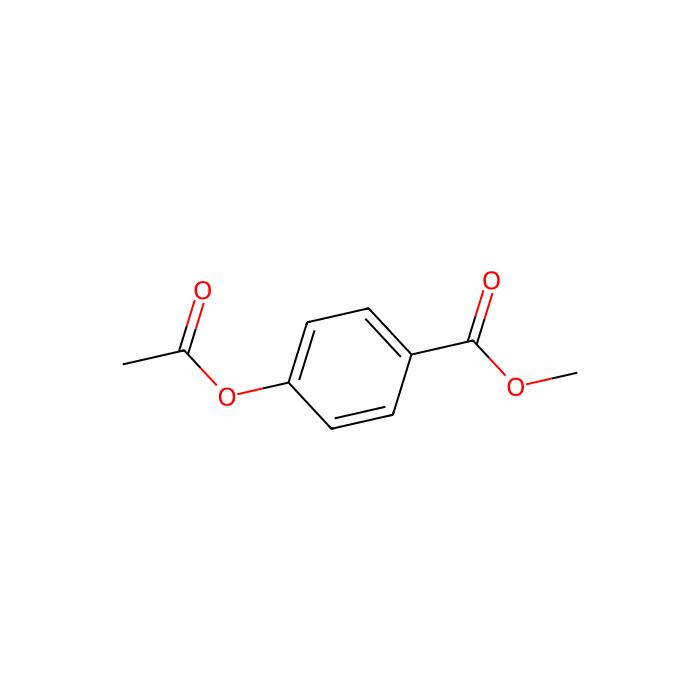
Methyl 4-Acetoxybenzoate is an aromatic diester: a methyl benzoate core bearing a para-acetoxy substituent on the ring.
Item-specific identifiers (from Product Data)
CAS: 24262-66-6
InChIKey: 276682 (as provided)
Storage/Shipping: Room temperature; shipped under normal conditions (see Storage & Reconstitution)
Literature/computed identifiers and descriptors (non-spec, for reference)
Aromatic ring (benzene) bearing two para-disposed electron-withdrawing ester functions: one ring carboxylate esterified as methyl benzoate, and one phenolic oxygen acetylated (acetoxy group).
Overall, a para-disubstituted benzene with two carbonyl-containing substituents connected via ester linkages; no stereocenters.
2D depiction in words: MeO–C(=O)–Ph–O–C(=O)–Me with the methyl benzoate at C1 and the O-acetyl at C4 (para).
Synthetic Utility
Functional groups and reactivity (literature-based):
Phenolic O-acetate (Ar–O–C(=O)Me):
Protects the phenolic OH against electrophilic reagents and coupling conditions.
Cleavable under mild basic or nucleophilic conditions (e.g., K2CO3/MeOH, Na2CO3/MeOH, catalytic DMAP/transesterification), often leaving the benzoate methyl ester untouched.
Aryl benzoate methyl ester (Ar–C(=O)OMe):
More resistant to base than the O-acetate; saponifies to p-acetoxybenzoic acid under stronger basic conditions (e.g., NaOH, refluxing aqueous alcohols).
Strategic uses:
Stepwise functionalization of the ring after selective deprotection to phenol, allowing installation of activating/handle groups (e.g., triflation to make a coupling handle), followed by cross-coupling (Suzuki, Sonogashira, Buchwald–Hartwig) and subsequent ester manipulations.
Access to monomers: deacetylation generates methyl p-hydroxybenzoate, convertible to diesters/carbonates for polymer precursors and specialty materials.
Limited EAS due to deactivation by two ester substituents; when required, employ stronger Lewis/Brønsted acid catalysts, higher temperatures, or directed strategies after converting the phenol to activating derivatives (e.g., aryl ethers or triflates).
Purification/handling:
Typically amenable to crystallization or flash chromatography (EtOAc/hexanes). Monitor for partial hydrolysis products; keep silica neutral/basic if acetate integrity is critical.
Target Specificity
Not applicable. This product is a small-molecule chemical intermediate, not a biological targeting reagent (e.g., antibody, enzyme inhibitor with defined target panel). No target, epitope, species reactivity, clone, or isotype information is relevant.
We use cookies to ensure the website functions properly and, where permitted, to improve your experience. You can manage your preferences at any time in Settings. Learn more in our Cookie Policy.
Shall we send you a message when we have discounts available?
Remind me later
Thank you! Please check your email inbox to confirm.
Products are supplied to verified businesses, institutions, and qualified professionals for research and development use only. Not for use in humans, animals, diagnosis, or therapy.

 G2419271