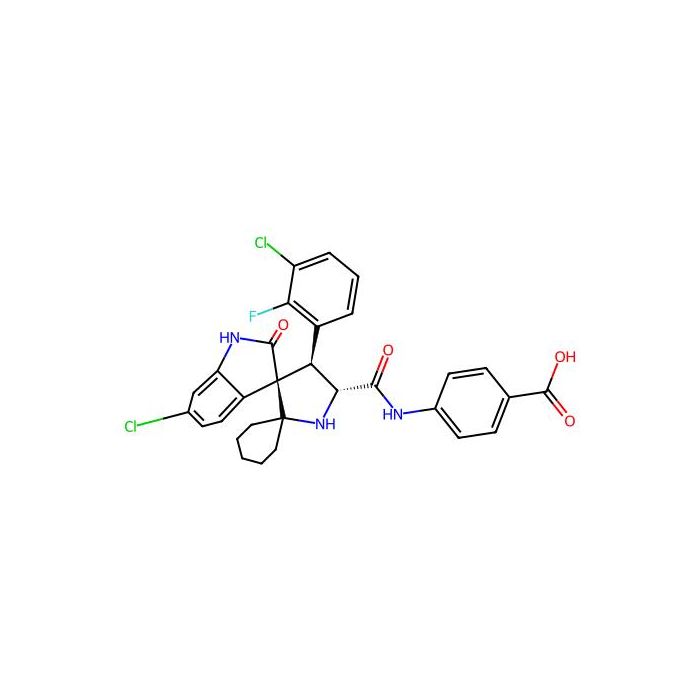
MI-1061 is a potent, orally bioavailable, and chemically stable MDM2 (MDM2-p53 interaction) inhibitor ( IC 50 =4.4 nM; K i =0.16 nM). MI-1061 potently activates p53 and induces apoptosis in the SJSA-1 xenograft tumor tissue in mice. Anti-tumor activity
In Vitro
MI-1061 achieves IC 50 =100 and 250 nM in the SJSA-1 and HCT-116 p53 +/+ cell lines, respectively, and has IC 50 >10000 nM in the p53 knockout cell line HCT-116 p53 –/– cell line. MCE has not independently confirmed the accuracy of these methods. They are for reference only.
In Vivo
MI-1061 (100 mg/kg; p.o.; daily for 14 days) is capable of achieving tumor regression in the SJSA-1 xenograft tumor model in mice . MCE has not independently confirmed the accuracy of these methods. They are for reference only. Animal Model: SCID mice bearing SJSA-1 osteosarcoma xenografts Dosage: 100 mg/kg Administration: P.o.; daily for 14 days Result: Demonstrated strong antitumor activity and achieved significant tumor regression.
MI-1061 is a potent, orally bioavailable, and chemically stable MDM2 (MDM2-p53 interaction) inhibitor ( IC 50 =4.4 nM; K i =0.16 nM). MI-1061 potently activates p53 and induces apoptosis in the SJSA-1 xenograft tumor tissue in mice. Anti-tumor activity [1
Condições de armazenamento de armazenamento
Store at -80°C
Enviado em
Dry ice packs + Cold packs
Este produto requer transporte de cadeia fria. Serviços terrestres e outros serviços econômicos não estão disponíveis.
Determine the necessary mass, volume, or concentration for preparing a solution.
Dilution Calculator
Determine the dilution needed to prepare a stock solution.
Reconstitution Calculator
Revisões
Avaliações dos Clientes
Application Protocols
No item-specific, validated application protocols are provided in the Product Data. The following outlines general, non-clinical practices for using research small molecules in biochemical or cell-based assays.
Stock solution preparation (general):
Weigh compound quickly to minimize moisture exposure.
Dissolve in anhydrous DMSO to 10–50 mM; sonicate briefly if needed.
Aliquot into low-bind tubes or sealed plates; store at −80 °C to minimize freeze–thaw.
Biochemical assay dosing (general):
Prepare serial dilutions in DMSO (e.g., 3-fold) and transfer to assay buffer to achieve final DMSO ≤0.1–0.5% v/v.
Include vehicle controls and, if available, a positive control compound for benchmarking.
Cell-based assay dosing (general):
Confirm compound compatibility with culture media; pre-warm media to reduce precipitation.
Titrate concentrations to span at least 8–10 points around the anticipated activity range; monitor for cytotoxicity/assay interference.
Analytical verification:
Verify concentration by UV (if chromophore known) or LC–MS quantification of working solutions.
Check for precipitation or adsorption losses in plasticware; consider glassware for hydrophobic compounds.
These are general guidelines only. For MI-1061, consult the CoA/Spec Sheet for any item-specific instructions if provided.
Biological Roles
Item-specific biological target, mode of action, or pathway engagement for MI-1061 is not provided in the Product Data. Therefore, no definitive biological role can be stated for this item.
General considerations for research-use small molecules (not item-specific; verify independently for this CAS if needed):
Potential roles can range from enzyme inhibition/activation, receptor modulation, ion channel blocking/opening, to perturbation of protein–protein interactions. Without confirmed annotation, treat MI-1061 as an uncharacterized bioactive candidate in your workflow.
When characterizing unknowns:
Start with broad profiling (e.g., thermal shift assays, differential scanning fluorimetry, biochemical panels) if a hypothesized target family exists.
Use phenotypic assays coupled with transcriptomics/proteomics to infer pathway-level effects.
Establish preliminary solubility, permeability (PAMPA/MDCK), microsomal stability, and plasma protein binding as applicable to your research objectives.
Important: No medical or clinical claims are made, and no target specificity is provided for this product. Consult the CoA/Spec Sheet or primary literature (via CAS 1410737-34-6 or CID 70677271) if you require a definitive biological annotation before experimental use.
Buffer Applications
Not typically applicable. MI-1061 is a discrete small molecule rather than a buffering agent. No pKa or buffer-capable acid/base pair information is provided in the Product Data.
Practical notes (general, for assay preparation):
When dosing into aqueous buffers (e.g., PBS, HBSS, assay media), prepare a concentrated DMSO stock and dilute into the buffer with vigorous mixing to prevent precipitation. Maintain a consistent final solvent percentage across control and treated samples.
If MI-1061 is later identified as ionizable (from CoA or literature), limited pH-adjusted solubility enhancement may be possible. Absent such data, avoid aggressive pH shifts that may risk compound degradation.
Green Alternatives
Because MI-1061 is a discrete small-molecule research compound (not a solvent or bulk reagent), the conventional concept of “green alternatives” does not directly apply to replacing the substance itself. However, greener practices can be applied to its handling and use.
Greener solvent choices for stock preparation (general guidance):
Prefer aqueous-compatible vehicles with minimal organic fraction when feasible. Use the lowest DMSO percentage consistent with solubility (e.g., ≤0.1–0.5% v/v in final assay wells).
Avoid high-toxicity aprotic solvents (e.g., NMP) unless essential; if used, minimize volumes and ensure proper waste segregation.
Process/waste minimization:
Use micro-scale assays and miniaturized screening plates (384- to 1536-well) to reduce solvent consumption and chemical waste.
Employ sealed plates and low-evaporation lids to limit solvent loss and VOC emissions.
Energy and storage optimization:
Consolidate freezer space (−80 °C) with organized aliquots to reduce door-open time and energy load. Batch shipments on dry ice + cold packs as provided in the Product Data limit additional cold-chain impacts.
Comparison table (general, not item-specific):
DMSO vs DMF: DMSO generally preferred for biocompatibility and lower hazard classification; DMF may offer higher solubility but is less desirable environmentally and toxicologically.
Aqueous buffers vs alcohol cosolvents: Aqueous systems are greener; use alcohols sparingly and recover via solvent recycling programs when available.
Note: No substitutions for MI-1061 itself are proposed here; evaluate greener workflows around its use.
Pharmaceutical Uses
No pharmacopeial status, excipient role, or manufacturing use is provided for MI-1061 in the Product Data. This product is supplied strictly for research use only.
General, non-clinical context (not item-specific):
Early discovery workflows may employ such compounds as tool molecules for target validation or SAR exploration. Any formulation-like activities at this stage (e.g., preparing DMSO concentrates, simple vehicles for in vitro testing) remain strictly preclinical and research-focused.
If your program requires developability-style data (solubility across pH 1–7.4, chemical stability in simulated gastric/intestinal fluids, solid-state form screening), these must be generated in-house; there are no item-specific specifications here.
Compliance note: Do not use MI-1061 in human or veterinary applications. No therapeutic or diagnostic claims are made or implied.
Physical Properties
Item-specific (Product Data):
Appearance: Not specified for this item; refer to CoA/Spec Sheet.
Molecular weight: Not specified for this item; refer to CoA/Spec Sheet.
Literature/computed properties (for the exact CAS/CID) are not provided here. If needed, consult primary databases (e.g., PubChem for CID 70677271) and verify any values against the CoA.
Typical property checklist to obtain (literature/computed; verify against CoA before use):
Melting point (solid small molecules often supplied as powders): Not specified for this item.
Boiling point (if applicable): Not specified for this item.
Density: Not specified for this item.
LogP/logD, pKa values (if ionizable): Not specified for this item.
Aqueous and organic solubility (DMSO/DMF/EtOH/water): Not specified for this item.
UV–vis absorption λmax/ε (useful for quantification): Not specified for this item.
Refractive index (for liquids): Not applicable/Not specified.
Practical guidance (general, not item-specific):
For novel screening compounds, begin with a DMSO solubility test (1–10 mg/mL) at room temperature, with brief sonication. If needed, use DMF or a cosolvent mix (DMSO:water or DMSO:PBS) to achieve working concentrations.
Quantification can be done by gravimetry into pre-tared vials, or spectroscopically if a UV band is available (determine empirically). Always cross-check with CoA/Spec Sheet for any item-specific constraints (e.g., hydrate/salt form).
Quality and Grades
Item-specific (from Product Data):
Grade/Purity: Not specified for this item; refer to CoA/Spec Sheet.
How to interpret quality for screening/bioactive small molecules (general guidance):
Purity reporting: Vendors commonly provide HPLC/UPLC area% purity (e.g., >95%) with orthogonal identity confirmation (1H NMR, MS). Because no numeric specification is listed here, do not assume a value—verify on the CoA.
Form and counterion: Many discovery compounds are supplied as free bases/acids or as salts (e.g., HCl, TFA). The counterion and hydration state affect molecular weight, solubility, and dosing—confirm on the CoA.
Stabilizers: Not specified for this item. If present in some products, stabilizers/antioxidants will be disclosed on the CoA; absence here should not be taken as confirmation of none.
Fit-for-purpose: For biochemical/cell assays, low residual solvents/metals/peroxides and low UV background are beneficial; specific numerical limits are Not specified for this item; refer to CoA/Spec Sheet.
Trace analyses: If regulatory-style documentation is required (not typical for research-only compounds), you may request extended QC (water content by KF, residual solvents by GC, identity by HRMS). No such data are specified here.
Recommendation: Prior to critical experiments, verify identity/purity in-house (e.g., LC-MS retention time match and purity check; quick 1H NMR) to confirm batch integrity and assess any polymorph/solvate state.
Reaction and Applications
This product is categorized as a research-use small molecule/compound library member rather than a general synthetic reagent. No item-specific reactivity profile or application notes are provided in the Product Data.
Not typically applicable (item-specific synthetic reactivity): Without a disclosed structure, guidance on nucleophilicity/electrophilicity, redox behavior, or compatibility with common transformations (e.g., cross-couplings) cannot be derived.
Relevant use case (general for screening compounds):
Tool compound for target or pathway interrogation in biochemical or cell-based assays.
Inclusion in screening decks (fragment-to-lead, phenotypic screening, chemogenomics) with standardized DMSO stocks and barcoded sample management.
Potential use in affinity-based profiling or thermal shift assays if a target association is known from external literature (not specified here; verify independently).
Practical tips (general):
Prepare concentrated DMSO stocks (e.g., 10–50 mM), aliquot in low-bind tubes/plates, and minimize freeze–thaw cycles.
Implement plate mapping and edge-control strategies for HTS.
When assessing activity, include vehicle controls and solubility/aggregation counterscreens (e.g., detergent controls, DLS, Nephelometry).
Use orthogonal assays (biochemical vs cellular) to validate hits and rule out assay interference (e.g., redox cycling, fluorescence quenchers).
Reaction Conditions
Not applicable for this product as a reagent. MI-1061 is offered as a discrete research-use small molecule, not as a catalyst, base, ligand, or general reactant.
General handling conditions for solution preparation (not item-specific):
Stock preparation: Commonly 10–50 mM in anhydrous DMSO; brief sonication may aid dissolution. If necessary, warm gently (≤40 °C) and avoid prolonged heating/light.
Working solutions: Dilute into assay buffer/media to the desired concentration while keeping final DMSO low (e.g., ≤0.1–0.5% v/v), matching vehicle in controls.
Stability checks: Conduct short-term stability at room temperature and at 4 °C in your intended vehicle; monitor by LC–MS/UPLC for degradation or precipitation.
If you intend to use MI-1061 in a chemical transformation, first obtain and verify the structure (via CAS/CID and primary literature) and confirm compatibility with your planned conditions.
Safety and Handling
Item-specific safety (from Product Data):
GHS Classification: Not specified for this item; refer to SDS.
Signal word: Not specified for this item; refer to SDS.
Hazard (H) statements: Not specified for this item; refer to SDS.
Pictograms: Not specified for this item; refer to SDS.
General laboratory precautions for research-use small molecules (not item-specific; defer to SDS as authoritative):
Personal protective equipment: Use lab coat, safety glasses, and appropriate chemical-resistant gloves (e.g., nitrile). Handle powders in a fume hood to avoid inhalation/ingestion.
Avoid: Inhalation of dust/aerosols, skin/eye contact. Prevent environmental release until hazards are known.
Storage incompatibilities: Until structure-specific data are confirmed, segregate from strong oxidizers and acids/bases. Keep tightly closed, moisture-free, and avoid prolonged light exposure as a precaution.
First aid overview: If on skin/eyes, rinse with water for 15 minutes and remove contaminated clothing; if inhaled, move to fresh air; if ingested, seek medical attention. Provide SDS to healthcare providers.
Spill response: For small spills, dampen to minimize dust; collect with inert absorbent and dispose per institutional guidelines. For unknown toxicity, escalate to EH&S.
Special risks: Unknown sensitization, mutagenicity, or organ toxicity cannot be ruled out without SDS. Treat as potentially harmful—minimize exposure and use closed handling/aliquoting techniques.
Always consult the product-specific SDS and your institution’s safety program for definitive controls and waste disposal guidance.
Solvent Selection
Item-specific solubility and polarity data are not provided for MI-1061; therefore, the following is general, best-practice guidance for dissolving research-use small molecules of unknown/undisclosed structure.
Primary stock solvent hierarchy (general):
DMSO: First choice for biological screening stocks due to broad solubilizing power and biocompatibility at ≤0.5% v/v in assays.
DMF or NMP: Useful for poorly soluble compounds; consider cytotoxicity and hygroscopic nature.
Ethanol or isopropanol: Viable for moderately lipophilic compounds; ensure assay compatibility.
Aqueous buffers (PBS, HBSS): Only if compound is sufficiently polar/ionized; often used after making a DMSO concentrate followed by dilution.
Practical workflow:
Start with DMSO at 10–50 mM target; sonicate briefly and warm gently (≤40 °C) if needed. Avoid prolonged heating.
If insoluble, trial cosolvent systems (e.g., DMSO:water 1:1, or DMSO:EtOH 1:1) and adjust pH if ionizable groups are known (not specified here).
Filter sterilize through PTFE/nylon (0.22 µm) if required by your application and the compound is stable.
Comparisons (general, not item-specific):
DMSO vs DMF: DMSO typically preferred for biological assays; DMF may improve solubility but can be more cytotoxic.
DMSO vs EtOH: EtOH easier to remove by evaporation but may offer lower solubility for very lipophilic scaffolds.
Note: Always confirm the compound’s salt form and stability from the CoA/Spec Sheet to avoid precipitation during aqueous dilution.
Storage and Reconstitution
Item-specific (from Product Data):
Storage conditions: Store at −80 °C.
Shipped in: Dry ice packs + Cold packs.
Appearance: Not specified for this item; refer to CoA/Spec Sheet.
General reconstitution guidance (not item-specific; verify with CoA):
Upon receipt: Keep frozen. Allow shipping container to equilibrate in a −20 °C or −80 °C environment for 1–2 hours before unpacking to reduce condensation.
Handling: If supplied as a solid, allow the sealed vial to warm to room temperature in a desiccator before opening to prevent moisture uptake. If supplied in solution, keep on dry ice during aliquoting.
Stock preparation: Dissolve in anhydrous DMSO to a convenient concentration (e.g., 10–50 mM). Mix gently; brief sonication may assist. Record exact concentration and any observed insolubility.
Aliquoting: Dispense single-use aliquots in low-bind, airtight tubes or sealed plates to avoid repeated freeze–thaw cycles. Purge headspace with inert gas if oxidative sensitivity is suspected (not specified here).
Storage: Return aliquots promptly to −80 °C. Avoid temperature cycling. Track stability with periodic LC–MS/UPLC checks for key assays.
Light/moisture sensitivity: Not specified for this item; as a precaution, protect from light and humidity.
Note: For all item-specific parameters not listed here (e.g., solubility limits, salt form, hydrate state), refer to the CoA/Spec Sheet. Research use only.
Structure and Identity
Brief overview: MI-1061 (SKU M656173) is offered as a research-use small molecule. Structural identifiers beyond CAS/CID are not provided in the product data.
Item-specific (from Product Data)
Product name: MI-1061
SKU: M656173
CAS: 1410737-34-6
PubChem CID: 70677271
InChIKey: Not specified for this item; refer to CoA/Spec Sheet.
SMILES: Not specified for this item; refer to CoA/Spec Sheet.
Molecular formula: Not specified for this item; refer to CoA/Spec Sheet.
Molecular weight: Not specified for this item; refer to CoA/Spec Sheet.
Structural features (general guidance, not item-specific)
Without a provided structure (SMILES/InChIKey), specific functional groups, ring systems, or stereochemical elements cannot be stated for this item.
If you have the structure from an external database (using the CAS or CID), typical documentation for your lab notebook should include: heteroatom content (N/O/S/halogen), aromatic vs. aliphatic character, H-bond donor/acceptor counts, formal charge, and any chiral centers.
2D structure description (general instruction)
Describe the scaffold (core ring system or linker), annotate substituent positions, and identify ionizable groups relevant to solubility and formulation. In absence of item-specific structure in this listing, consult the CoA/Spec Sheet or authoritative databases for confirmation before experimental planning.
Synthetic Utility
Not typically applicable. MI-1061 is sold as a finished small-molecule research compound rather than a building block or reagent, and the Product Data do not disclose functional groups or handles suitable for downstream derivatization.
General considerations (if derivatization is intended, verify structure independently):
If a structure is obtained externally (via CAS/CID), evaluate presence of cross-coupling handles (aryl halides, boronates), nucleophiles/electrophiles, or protected groups for late-stage diversification.
Purification strategies for analog generation commonly include preparative LC with MS detection; verify UV chromophores and ionization mode (ESI±) after you obtain the structure.
For SAR studies, maintain consistent salt forms and solid-state characterization (PXRD/DSC/TGA) across analogs to avoid confounding potency with form effects.
Because no item-specific structural information is provided here, no specific named-reaction guidance (e.g., Suzuki, Buchwald–Hartwig, amide coupling) can be offered for this product.
Target Specificity
Item-specific target information is not provided in the Product Data for MI-1061.
Target, pathway, or binding partner: Not specified for this item; refer to CoA/Spec Sheet and primary literature.
Species selectivity, Kd/IC50/EC50, or functional profile: Not specified for this item.
Guidance (general, not item-specific):
If you source target annotations externally (e.g., from curated databases or publications via CAS 1410737-34-6 / CID 70677271), verify batch identity and purity against the provided CoA before relying on potency values.
Use orthogonal assays and counterscreens to confirm specificity and to identify off-target liabilities.
Perguntas frequentes
How should this product be stored?
Store at ?80 °C. Ultra-low temperature storage is required to maintain the specified shelf life.
How is this product shipped?
This product ships frozen with dry ice and cold packs. Unpack on arrival and transfer it to the storage condition stated above; handle dry ice with insulated gloves in a ventilated area.
What are the CAS number, molecular formula and molecular weight?
The CAS Number is 1410737-34-6, the molecular formula is C30H26Cl2FN3O4, and the molecular weight is 582.45 g/mol.
What documentation is provided?
Available product documentation, including Certificates of Analysis (COA), Safety Data Sheets (SDS), and specification sheets, is shown in the product document area. Document availability and access follow the current site policy.
Usamos cookies para garantir o funcionamento adequado do site e, quando permitido, para melhorar a sua experiência. Você pode gerenciar suas preferências a qualquer momento nas Configurações. Saiba mais em nossa Política de Cookies.
Deseja que lhe enviemos uma mensagem quando tivermos descontos disponíveis?
Lembrar-me mais tarde
Obrigado! Por favor, verifique a sua caixa de entrada de e-mail para confirmar.
Products are supplied to verified businesses, institutions, and qualified professionals for research and development use only. Not for use in humans, animals, diagnosis, or therapy.