GRADE & PURITYMoligand™?Moligand™ — Aladdin's line of ligands and bioactive small molecules. Use for receptor, pathway, and binding studies needing defined small-molecule tools.10 mM in DMSO
Determine the necessary mass, volume, or concentration for preparing a solution.
Dilution Calculator
Determine the dilution needed to prepare a stock solution.
Reconstitution Calculator
Revisões
Avaliações dos Clientes
Application Protocols
No vendor-tested application protocols are provided for this item.
General protocol framework for small-molecule screening
Stock preparation: Dissolve in anhydrous DMSO to a convenient concentration (e.g., 10 or 50 mM) after confirming solubility; filter (0.22 µm PTFE) if needed. Prepare single-use aliquots.
Biochemical assay dosing: Serially dilute stocks in assay buffer to achieve desired concentrations with constant final DMSO (≤0.5–1% v/v typical). Include vehicle controls and positive/negative assay controls.
Cell-based assays: Titrate across a broad range (e.g., 0.03–30 µM) with viability counterscreens. Check for precipitation or color/fluorescence interference.
Data quality: Run in technical triplicates, repeat at least twice biologically, and confirm hits with fresh material or independent lot.
Note
Adjust specifics (buffers, incubation times, temperature) to the biology of your target system. Refer to your institutional SOPs for detailed steps.
Biological Roles
Item-specific biological function, mechanism of action, and target engagement data are not provided for this product.
General considerations for small-molecule screening compounds
Treat as a putative bioactive tool only after confirming identity, purity, and stability under your assay conditions.
Establish baseline physicochemical and ADME-relevant properties (solubility in assay media, stability in buffer and microsomes/plasma if applicable, and permeability) before interpreting biological outcomes.
Implement orthogonal assays to confirm on-target effects and exclude artifacts (e.g., redox cycling, covalent reactivity, colloidal aggregation). Add nonionic detergent where appropriate to test for aggregation-mediated inhibition.
If literature data exist for the same CAS or CID, validate that the salt form, stereochemistry, and polymorph match your material to ensure comparable activity profiles.
Disclaimer
No clinical or therapeutic claims are made. This material is provided strictly for research use.
Buffer Applications
This product is not a buffering reagent and is not typically used to prepare biochemical buffer systems.
Practical note
If using in biochemical assays, prepare stocks in a suitable solvent (often DMSO) and dilute into pre-made buffers (e.g., PBS, HEPES, Tris) that are already optimized for your biological system. Maintain constant final co-solvent percentage across control and treatment conditions.
Do not attempt to use this material to control pH; select a dedicated buffer with an appropriate pKa and buffering range for your assay.
Green Alternatives
Green considerations here primarily relate to solvent choice for dissolution, handling, and assay preparation, since the compound itself is a screening molecule rather than a process reagent.
Greener solvent choices (general guidance)
Prefer water or buffered aqueous media when solubility and stability allow (pH adjusted appropriately). If an organic co-solvent is needed, minimize to the lowest effective percentage.
Among organics, consider ethanol or 2-propanol for less hazardous profiles when compatible with the assay. For water-immiscible needs, ethyl acetate can be more benign than chlorinated solvents in workups or extractions.
Illustrative comparison (general)
DMSO vs ethanol: DMSO often provides higher solubility but is more persistent and hygroscopic; ethanol is greener and volatile, aiding removal, but affords lower solubility for very lipophilic solids.
ACN vs MeOH: ACN has strong elution power in chromatography but higher toxicity; MeOH is generally considered a greener alternative where chromatographic performance permits.
Operational tips
Use microscale preparations to reduce solvent consumption.
Capture solvent usage data and favor recovery/recycling on preparative operations when feasible.
Follow institutional green-chemistry frameworks (e.g., GSK or CHEM21 solvent guides) when adapting methods.
Pharmaceutical Uses
No pharmacopeial status, excipient role, or GMP-related manufacturing information is provided for this item. It is supplied strictly for research use only.
Research-facing utility (general)
May serve as a reference compound or tool molecule in preclinical discovery workflows, analytical method development (e.g., LC–MS retention time markers in a focused series), or as a comparator in SAR studies.
Compliance note
Not intended for use in humans or animals. Not certified to ICH/GMP specifications. For any regulated use (GLP/GMP), obtain appropriate grade material and documentation.
Documentation
For impurity profiles, residual solvents, elemental analysis, and stability data, consult the CoA/Spec Sheet for this specific lot or request additional QA documentation if required by your quality system.
Physical Properties
Appearance: Not specified for this item; refer to CoA/Spec Sheet.
Melting point: Not specified for this item; refer to CoA/Spec Sheet.
Boiling point: Not specified for this item; refer to CoA/Spec Sheet.
Density: Not specified for this item; refer to CoA/Spec Sheet.
Refractive index: Not applicable/unknown for solids; Not specified for this item; refer to CoA/Spec Sheet.
Aqueous solubility: Not specified for this item; refer to CoA/Spec Sheet.
Solubility in organic solvents: Not specified for this item; refer to CoA/Spec Sheet.
LogP/logD, pKa: Not specified for this item; refer to CoA/Spec Sheet.
General guidance (literature/practice)
For small-molecule screening compounds, typical reconstitution solvents include anhydrous DMSO, DMF, or ethanol. Conduct a small-scale solubility check before preparing bulk stocks.
If hygroscopic or sensitive to oxidation/hydrolysis (unknown here), prepare single-use aliquots and minimize headspace to reduce degradation.
Determine solution stability empirically by LC–MS/UPLC at your intended storage temperature (e.g., −20 °C, −80 °C) and concentration.
What Moligand™ typically implies (general description)
Intended for small-molecule screening, chemical biology, and SAR exploration where structural identity and practical purity are prioritized for discovery workflows.
Emphasis on provenance, traceability, and suitability for plate-based assays and biophysical methods. UV background and residual solvent specifications may be controlled to support HTS, though exact values are item-specific.
Item-specific notes
Purity, stabilizers, residual solvents, metal content, and water content: Not specified for this item; refer to CoA/Spec Sheet.
Any salt form, polymorph, or solvate state: Not specified for this item; refer to CoA/Spec Sheet.
Recommendations for QC on receipt (best practice)
Verify identity by LC–MS and compare retention/mass to the CoA reference.
Assess purity by HPLC/UPLC with orthogonal detection (UV and MS). If biological screening is planned, confirm absence of assay-interfering impurities (e.g., reactive impurities, PAINS motifs) under your assay conditions.
If you require chromatography-grade characteristics (e.g., low UV cutoff for HPLC mobile-phase use), confirm suitability first—Moligand™ is formulated for screening, not as a chromatography solvent/reagent.
Reaction and Applications
This product is positioned as a small-molecule screening compound for discovery research rather than a synthetic reagent.
Representative applications (general for screening compounds)
Biochemical and biophysical screening: enzyme inhibition/activation assays, binding assays (e.g., SPR, MST, DSF), or thermal shift profiling, contingent on verified solubility and stability.
Cell-based phenotypic assays: assess pathway modulation and phenotypic readouts at carefully titrated concentrations, with DMSO controls and cytotoxicity counterscreens.
Reference/control material: use as a comparator in SAR series or to validate computational docking/hit-triage pipelines.
Practical tips
Prepare single-use aliquots to limit freeze–thaw cycles; confirm integrity by LC–MS before critical experiments.
For plate-based work, equilibrate solutions to room temperature to avoid precipitation upon dilution; perform serial dilutions in assay-compatible diluent.
Run orthogonal counterscreens to detect aggregation-based or redox-driven artifacts (e.g., with detergent present, or using dynamic light scattering).
Note
No specific reaction chemistry (e.g., coupling, reductions) is indicated for this item. If derivatization is desired for probe synthesis, develop structure-informed protection/activation strategies once the exact functional groups are confirmed from the CoA/structure record.
Reaction Conditions
No item-specific synthetic or transformation conditions are provided because this product is not supplied as a reagent but as a screening compound.
General considerations if chemical modification is pursued
Solvents: Choose based on functional group compatibility (e.g., polar aprotic for cross-couplings, alcohols for transesterifications). Dry, oxygen-free conditions may be required for air/moisture-sensitive steps.
Temperatures: Ambient to reflux depending on transformation; monitor by TLC/UPLC to avoid overreaction or decomposition.
Catalysts/bases: Select per transformation class (e.g., Pd catalysts and phosphine ligands for C–C couplings, mild inorganic bases such as K2CO3 for alkylations), ensuring compatibility with any potentially labile motifs.
Workup: Quench carefully, use minimal chlorinated solvents where possible, and purify by flash chromatography or preparative HPLC as dictated by polarity and stability.
Reminder
Validate each modified intermediate and final product by NMR/HRMS and assess purity by UPLC to confirm suitability for biological experiments.
Safety and Handling
GHS classification: Not specified for this item; refer to SDS.
Signal word / H-statements / Pictograms: Not specified for this item; refer to SDS.
Research use: For research use only (not for human or veterinary use).
General laboratory precautions (defer to SDS for authoritative guidance)
Wear appropriate PPE: lab coat, safety glasses, and chemical-resistant gloves. Use a certified fume hood for weighing and solution prep until volatility and dusting tendency are known.
Avoid inhalation of dust/aerosols and contact with skin/eyes. Wash thoroughly after handling.
Incompatibilities: Unknown for this item; avoid strong oxidizers, strong acids/bases, and reactive reducing agents until compatibility is established.
First aid (general): If inhaled—move to fresh air. Skin/eye contact—rinse with water for at least 15 minutes. If swallowed—rinse mouth; seek medical advice. Always follow site SOPs and SDS.
Spill/cleanup: Contain solids with damp disposable wipes/absorbent; avoid dust generation. Dispose according to local regulations and institutional policies.
Special risks: Stability and decomposition pathways are not provided for this item. If storing solutions, protect from light and moisture as a precaution and monitor by LC–MS for degradation.
Solvent Selection
Because structure-specific solubility data are not provided for this item, solvent choice should be guided by a short empirical screen and your downstream application.
Practical workflow
Start with small-scale tests (100–500 µL) at your target stock concentration (e.g., 10–50 mM) in: DMSO (anhydrous), DMF (anhydrous), ethanol (absolute), acetonitrile, and, if appropriate, aqueous buffers with co-solvent.
If precipitate forms, apply gentle warming (30–40 °C) and vortex/sonication. Avoid prolonged heating that may induce degradation.
For biochemical assays, DMSO is often preferred for primary stocks; limit final assay DMSO to ≤0.5–1% v/v when possible.
Comparison considerations (general)
DMSO: Broad solubilizing power; hygroscopic; may affect enzyme kinetics at >1–2%.
DMF/ACN: Useful for poorly soluble compounds; confirm assay compatibility and toxicity profile for cells/enzymes.
Ethanol: Acceptable for some biochemical and cell assays at low percentages; watch for volatility.
Aqueous buffers: Use only if compound is sufficiently polar/ionizable; pH adjustment can improve solubility when pKa is favorable (not specified here).
Tip
Document the solvent lot, water content, and final pH/ionic strength. Filter sterilize through 0.22 µm if sterility is required for your workflow.
Storage and Reconstitution
Storage conditions (as supplied): Store at −80 °C.
Shipping: Shipped on dry ice packs + cold packs.
Long-term stability: Not specified for this item; refer to CoA/Spec Sheet.
Reconstitution and handling (general best practice)
Allow the container to equilibrate to room temperature in a desiccator before opening to avoid moisture condensation on cold solids.
Prepare concentrated stocks in an appropriate solvent (commonly anhydrous DMSO) only after confirming solubility; record concentration and solvent lot.
Aliquot into amber, low-bind vials; purge headspace with inert gas if oxidation-sensitive (unknown here). Store aliquots at −80 °C to minimize degradation and freeze–thaw cycles.
Thaw on ice or at room temperature; mix thoroughly to ensure homogeneity. Avoid repeated freeze–thaw by using single-use aliquots.
Aqueous working solutions should be prepared fresh and used promptly. If extended storage is necessary, validate stability by LC–MS/UPLC at the intended temperature.
Disposal
Dispose of unused material and waste according to institutional guidelines and local regulations.
Note
For any item-specific stabilizers, salt forms, or hygroscopicity: Not specified for this item; refer to CoA/Spec Sheet.
Structure and Identity
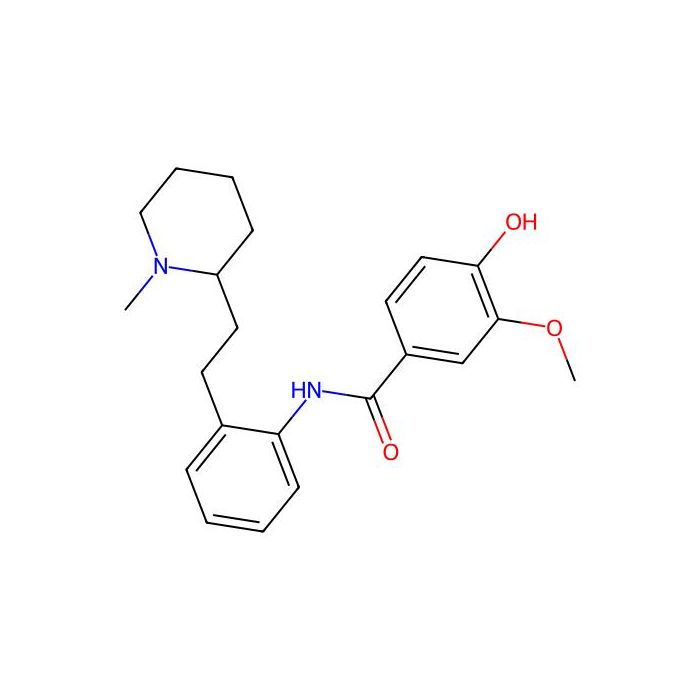
Product: Modecainide (SKU: M1493445)
CAS: 81329-71-7
PubChem CID: 54737
Molecular formula: Not specified for this item; refer to CoA/Spec Sheet.
Molecular weight: Not specified for this item; refer to CoA/Spec Sheet.
SMILES: Not specified for this item; refer to CoA/Spec Sheet.
InChIKey: Not specified for this item; refer to CoA/Spec Sheet.
Structural features
Functional groups, ring systems, and stereochemistry: Not specified for this item; refer to CoA/Spec Sheet.
2D/3D depiction: Not provided here. For unambiguous identity confirmation, consult the CoA/SDS or the PubChem record (CID 54737) and cross-verify against your internal reference standards.
Notes for identity confirmation (general best practice)
Cross-check CAS, exact mass, and high-resolution MS with a qualified standard.
Acquire 1H/13C NMR and LC–MS under your method to confirm purity and absence of isomers or degradants.
If target- or assay-facing work is planned, retain a digital structure file (SDF/MOL) from a trusted database and verify stereochemistry when applicable.
Synthetic Utility
This product is offered as a finished small molecule for screening and is not positioned as a general synthetic building block.
If derivatization is desired (general guidance)
Once the exact functional groups are confirmed from the structure (refer to CoA/structure file), identify handles amenable to modification (e.g., aryl halides for cross-coupling, amines for acylation/alkylation, alcohols for esterification/etherification).
Consider late-stage diversification to create analog panels for SAR: amide scans, bioisosteric ring substitutions, or heteroatom swaps, applying standard named reactions (e.g., Suzuki–Miyaura, Buchwald–Hartwig, reductive amination), subject to compatibility with the molecule’s functional group set.
Protect sensitive functionalities during multistep transformations and validate each step by LC–MS/NMR to monitor potential rearrangements or hydrolysis.
Note
Without item-specific structural details, no concrete synthetic routes or reactivities can be recommended. Establish a retrosynthetic plan only after confirming the exact scaffold and substitution pattern.
Target Specificity
Target, binding partner, or pathway specificity is not provided for this item.
Guidance for establishing specificity (general)
Use orthogonal binding/functional assays to confirm on-target activity (e.g., biochemical IC50 with orthogonal substrate/reporters, biophysical binding such as SPR/MST/ITC).
Incorporate selectivity panels against related targets to quantify off-target risk.
If literature attributes a target to the same CAS/CID, confirm that your material’s salt form and stereochemical configuration match the referenced entity before extrapolating specificity.
Need help choosing the grade?
Our grade selection guide covers purity, stabilizer status, and application suitability for all variants in our catalog.
We use cookies to ensure the website functions properly and, where permitted, to improve your experience. You can manage your preferences at any time in Settings. Learn more in our Cookie Policy.
Shall we send you a message when we have discounts available?
Remind me later
Thank you! Please check your email inbox to confirm.
Products are supplied to verified businesses, institutions, and qualified professionals for research and development use only. Not for use in humans, animals, diagnosis, or therapy.