MW 5000 Da for sensitive chromatographic and analytical workflows requiring minimal baseline interference.
🌡
Storage & shipping
Protected from light,Store at -20°C Ships Ice chest + Ice pads Check lot-specific COA for exact specifications.
📋
Quality documents
SDS, COA, datasheet, and spec sheet available for download. Lot-specific COA accessible via lot number lookup.
📚
Literature proof
Cited in 0 peer-reviewed publications across chromatography, organic synthesis, and cross-coupling reactions.
Visão geral
Nanocs' amino acid and peptide PEG conjugates were made from the covalent attachment of PEG to various amino acid derivatives. Conjugates were provided in lyophilized powder form.
Specifications
Product Name
mPEG Glutathione
Especificações e pureza
MW 5000 Da
Tipo de molécula
Peptide
Armazenamento e envio
Concentração
MW 5000 Da
Condições de armazenamento de armazenamento
Protected from light,Store at -20°C
Enviado em
Ice chest + Ice pads
Documentation
📋 Safety Data Sheet (SDS)
Comprehensive hazard, handling, storage, and regulatory compliance document.
Determine the necessary mass, volume, or concentration for preparing a solution.
Dilution Calculator
Determine the dilution needed to prepare a stock solution.
Reconstitution Calculator
Revisões
Avaliações dos Clientes
Application Protocols
No vendor-validated application protocols were provided for this item. The following are general, non-binding procedures to help initiate use; optimize for your system.
Preparation of aqueous stock (general)
Equilibrate vial to room temperature in a desiccator to prevent condensation. Protect from light.
Add sterile PBS (pH 7.4) to achieve 10 mg/mL. Gently invert until dissolved (5–15 min). If needed, warm to 25–30 °C. Avoid excessive heating.
Optional: 0.22 μm filter to sterilize. Aliquot and store at −20 °C; avoid repeated freeze–thaw cycles.
Surface functionalization (general example)
To NHS-activated surfaces: Rinse surface with coupling buffer (pH 7.8). Apply mPEG–GSH solution (1–5 mg/mL) for 1 h at RT. Rinse thoroughly; quench residual NHS with 1 M ethanolamine, pH 8.5, 15 min. Rinse and store hydrated at 4 °C.
Nanoparticle ligand exchange (general example)
To a citrate-stabilized AuNP dispersion (pH ~7), add mPEG–GSH solution dropwise to a final 10–100 μM ligand equivalents relative to nanoparticle surface sites.
Incubate 2–12 h with gentle mixing; gradually increase ionic strength (e.g., NaCl to 10–50 mM) to improve packing.
Purify by centrifugation or diafiltration to remove excess ligand.
Item-specific tested applications, concentrations, and controls: Not specified for this item; refer to CoA/Spec Sheet.
Biological Roles
This section provides biological context for the glutathione motif; it is not a claim about the specific product’s performance in vivo.
Glutathione in biology (literature overview)
Glutathione (GSH; γ-L-Glu-L-Cys-Gly) is the predominant low-molecular-weight thiol in most cells, functioning as a redox buffer and antioxidant. It participates in disulfide exchange, detoxification of electrophiles, and maintenance of protein thiol status.
GSH is a co-substrate for glutathione S-transferases (GSTs), which catalyze conjugation of GSH to xenobiotics, enhancing their solubility and excretion (biochemical pathway perspective).
The cysteinyl thiol (pKa ~8–9) cycles between reduced (GSH) and oxidized (GSSG) forms; the cellular GSH/GSSG ratio is a marker of redox state.
Rationale for presenting GSH on PEG scaffolds (general)
PEG minimizes nonspecific interactions and prolongs residence in aqueous systems, enabling controlled presentation of the GSH motif on surfaces, nanoparticles, or soluble polymers for biochemical investigations.
Multivalent or spatially controlled display can modulate binding avidity to GSTs and other GSH-recognizing proteins in vitro.
Caveats for interpretation
Biological recognition depends sharply on conjugation site and accessibility of the γ-Glu–Cys–Gly arrangement and the thiol state. For this SKU, the conjugation topology is Not specified; verify with the supplier’s CoA/Spec Sheet before designing mechanistic studies.
Buffer Applications
mPEG Glutathione is not a conventional buffering agent. It does not define a standard pH buffering system, though ionizable groups in the glutathione moiety can modestly contribute to solution buffering near their pKa values.
Applicability
Not typically used to set or maintain pH in biochemical assays. Choose established buffers such as PBS (pH 7.2–7.4), HEPES (pH 6.8–8.2), or Tris (pH 7–9) depending on your application.
Practical guidance for dissolution (general)
Recommended media: PBS, HEPES, or Tris buffers at pH 7–8 to maintain peptide stability and reduce risk of hydrolysis. Avoid strong acids/bases.
Typical working concentrations: 0.1–10 mg/mL depending on surface loading or ligand density targets. Optimize empirically.
If maintaining a reduced environment is critical (e.g., to preserve free thiol elsewhere in your system), include a mild reductant (e.g., 0.5–2 mM TCEP) compatible with your assay. Do not add reductants unless required; they may alter downstream reactions.
Item-specific buffer/solubility data: Not specified for this item; refer to CoA/Spec Sheet.
Green Alternatives
PEG–peptide conjugates are typically processed in benign, water-rich media, which aligns well with green chemistry principles. Optimizing solvent and process choices can further improve sustainability.
Preferred media (general guidance)
Water and aqueous buffers (pH 6–8) are the default green solvents for dissolution, coupling (e.g., aqueous carbodiimide chemistry), and purification (dialysis/UF, SEC).
Bio-based alcohols (ethanol) can be used for co-solvation or precipitation if needed.
Process improvements
Avoid chlorinated and high-toxicity aprotic solvents (e.g., dichloromethane, NMP) unless strictly necessary. If solubilization challenges arise, consider brief use of ethanol or isopropanol before transitioning to water.
Employ room-temperature processes and ambient pressure where possible; PEG conjugates dissolve readily without heating.
Use catalytic rather than stoichiometric reagents when modifying surfaces (e.g., enzymatic ligations where compatible).
Comparison table (general; not product specifications)
Favor aqueous workups; segregate metal-containing wastes from nanoparticle work. Recover and recycle alcohols where feasible.
Pharmaceutical Uses
For research use only. This product is not intended for human or veterinary use.
Formulation and excipient context (general, non-clinical)
PEG conjugation is widely used in research-scale formulations to enhance aqueous solubility, reduce protein adsorption, and adjust colloidal stability of nanoparticles or surfaces. Introducing a glutathione terminus can add a biochemical recognition element for in vitro studies.
In pre-formulation research, PEG–peptide conjugates can serve as model ligands to study affinity capture (e.g., GST-binding) or as stabilizers/capping agents for nanomaterials in aqueous carriers.
Regulatory and compendial status
No pharmacopeial monograph is assumed for this specific conjugate. Any clinical or GMP use would require dedicated qualification, impurity profiling, and regulatory assessment well beyond research grade.
Manufacturing considerations (research scale)
Key quality attributes include average molecular weight (Mn/Mw), PDI, residual solvents/salts, endotoxin/bioburden (if applicable), and verified degree of substitution.
Sterile filtration and aseptic handling may be employed for cell-adjacent research applications.
Item-specific claims about clinical use, dosage forms, or excipient grade: Not specified for this item; refer to CoA/Spec Sheet.
Physical Properties
As a PEG–peptide conjugate, mPEG Glutathione exhibits polymer-like distributions rather than single-point small-molecule constants.
Item-specific (from Product Data)
Molecular weight: Not specified for this item; refer to CoA/Spec Sheet.
Appearance: Not specified for this item; refer to CoA/Spec Sheet.
Literature/general expectations for mPEG–peptide conjugates (informational, not product specifications)
Physical state: Typically an amorphous, hygroscopic solid or waxy material depending on PEG Mn.
Solubility: Highly soluble in water and aqueous buffers due to PEG; also soluble in polar organics (e.g., methanol, ethanol) and miscible with DMSO. Solubility can increase with ionic strength and temperature.
Density: PEG solids ~1.1–1.2 g/mL (literature, varies with Mn and temperature).
Glass transition: PEG Tg ~−60 to −30 °C; peptide conjugation may shift transitions (literature).
pKa: The conjugate overall has multiple acid/base functionalities from GSH (carboxylates pKa ~2–4; amine pKa ~8–9; thiol pKa ~8–9 in free GSH). Actual ionization depends on the conjugation site (literature values; not specific to this item).
Partition behavior: PEGylation confers hydrophilicity and reduces logP; effective distribution strongly favors aqueous phase (literature trend).
Viscosity: Aqueous solutions can be moderately viscous at high concentration due to PEG chain entanglement (literature observation).
Refractive index and UV behavior (literature)
PEG shows low UV absorbance above ~220 nm; peptide UV absorbance is minimal except for peptide bonds (~190–210 nm) as GSH lacks aromatic residues. Therefore, monitoring concentration is often via ninhydrin/Ophthaldialdehyde assays or sulfur-based analytics rather than UV at 280 nm.
Quality and Grades
Understanding quality parameters for PEG–peptide conjugates ensures reproducibility and suitability for your application.
Item-specific (from Product Data)
Grade/purity: Not specified for this item; refer to CoA/Spec Sheet.
Typical quality attributes for mPEG–bioconjugates (general guidance)
Identity and composition: Confirmed by a combination of techniques such as MALDI-TOF/ESI-MS (shows polymer distribution envelopes), 1H/13C NMR (PEG methylene and peptide resonances), and HPLC/UPLC profiling.
Molecular weight distribution: Reported as Mn, Mw, and polydispersity index (PDI). For PEG reagents, narrow PDI (e.g., 1.02–1.10) is often targeted; exact values vary with synthesis.
Purity metrics: Peptide and polymer-related impurities, residual salts/solvents, and unreacted PEG or peptide may be reported by HPLC and GPC/SEC.
Functional substitution: Degree of conjugation (e.g., moles of GSH per mole of PEG chain) verified by amino acid analysis, Ellman’s assay (if thiol remains), or elemental analysis. The exact functional count for this SKU is Not specified for this item; refer to CoA/Spec Sheet.
Bioburden/endotoxin: For cell-contact applications, suppliers may report endotoxin (EU/mg) and bioburden; values for this SKU are Not specified for this item; refer to CoA/Spec Sheet.
Implications for use
Narrow PDI and well-defined substitution improve batch-to-batch consistency in nanoparticle surface modification, affinity ligands, and biomaterials.
Low UV background and cleanliness (low metals/oxidants) help maintain glutathione integrity during storage and use.
Reaction and Applications
mPEG Glutathione serves as a versatile hydrophilic ligand and surface modifier where the glutathione motif is desired while leveraging PEG’s stealth and solubilizing properties.
Representative research applications (general; expand as relevant)
Nanomaterials and surfaces: Ligand for stabilizing metal nanoparticles (e.g., Au, Ag) and oxide surfaces via peptide carboxylates/amine, while PEG provides colloidal stability, reduced nonspecific adsorption, and resistance to protein fouling.
Affinity interfaces: Presentation of the glutathione motif on resins, membranes, or particle surfaces for binding glutathione S-transferases (GSTs) or GSH-recognizing proteins in biochemical workflows. Note: Binding strength depends on how GSH is displayed; verify orientation and accessibility for your specific construct.
Redox-responsive systems: Incorporation into materials where the GSH motif participates in redox interactions; PEGylation enhances water compatibility and processability.
Analytical/assay tools: Standard or competitor ligand in studies of GSH-binding sites, or as a capping/terminating reagent for maleimide- or NHS-activated surfaces to introduce a GSH terminus.
Practical tips (general)
Orientation matters: Conjugation site on GSH (e.g., via amine vs carboxylate vs thiol) alters the motif’s recognition. For this SKU, the linkage type is Not specified; check the CoA/Spec Sheet before designing binding assays.
Solution handling: Prepare fresh aqueous solutions; protect from light; minimize air exposure if free thiol remains in the construct.
Characterization: Use SEC for hydrodynamic size, HPLC for purity, and functional binding assays to confirm GST interaction where applicable.
Reaction Conditions
Typical conditions below are general literature guidance for PEG–peptide conjugates and may aid in using mPEG Glutathione as a ligand or in further immobilization steps. They are not specifications for this item.
Dissolution and stock preparation (general)
Solvent: Water, PBS, or HEPES, pH 7.0–7.8. Concentrations: 1–50 mg/mL depending on viscosity and application.
Mixing: Gentle inversion or orbital shaking; avoid vigorous vortexing that can entrain air.
Coupling to surfaces or matrices (if residual groups are available; verify for this SKU)
Amide formation: EDC (0.1–0.4 M) with sulfo-NHS (10–50 mM) in MES buffer, pH 5.0–6.0, 30–120 min activation; couple to amines at pH 7.0–8.0 for 1–4 h at RT. Thoroughly rinse to remove carbodiimide byproducts.
NHS-ester reactions: pH 7.5–8.5, 0–25 °C, 0.5–2 h with molar excess of ligand; quench with ethanolamine.
Maleimide–thiol (if thiol is present and not consumed): pH 6.5–7.0, RT, 0.5–2 h under inert atmosphere to limit oxidation.
Nanoparticle functionalization (general)
Gold colloids: Add aqueous mPEG–GSH slowly to citrate-stabilized AuNPs at pH 6.5–7.5; incubate 1–12 h; salt age gradually to improve packing; purify by centrifugation or diafiltration.
Expected outcomes
High aqueous stability and reduced nonspecific adsorption due to PEG corona; functional display of GSH depends on conjugation site and density.
Item-specific conditions or yields: Not specified for this item; refer to CoA/Spec Sheet.
Safety and Handling
Handle mPEG Glutathione as a laboratory research chemical. While PEG–peptide conjugates are generally considered to have low acute hazards, appropriate precautions are required.
Item-specific (from Product Data)
GHS classification, pictograms, signal word, H-statements: Not specified for this item; refer to SDS.
Research use: For research use only.
Storage: Protect from light; store at −20 °C. Shipped cold (ice chest + ice pads).
General safety guidance (consult SDS for authoritative instructions)
PPE: Wear lab coat, gloves (nitrile), and safety glasses. Use in a clean area to avoid bioburden if sterility is a concern.
Handling: Avoid generating dust/aerosols. Work quickly to minimize moisture uptake; PEG conjugates can be hygroscopic. If sterile solutions are needed, dissolve in sterile buffer and 0.22 μm filter.
Incompatibilities: Avoid strong oxidizers (can oxidize sulfur-containing residues), strong acids/bases that may hydrolyze linkages, and metal catalysts that promote thiol oxidation (if any unreacted thiol is present).
First aid (general): Inhalation—move to fresh air; Skin—wash with soap/water; Eyes—rinse with water for several minutes; Ingestion—rinse mouth; seek medical advice. Provide SDS to responders.
Environmental: Prevent uncontrolled release to drains; dispose per institutional and local regulations.
Stability considerations
Protect from light to limit photo-oxidation of sulfur-containing peptide residues.
Minimize freeze–thaw cycles; aliquot stocks. Store desiccated to reduce hydrolysis and aggregation.
Solvent Selection
mPEG Glutathione combines the hydrophilicity of PEG with the ionic/ionizable groups of glutathione, favoring aqueous media.
Polarity and miscibility (general/literature)
Aqueous systems: High water solubility is typical; dissolves readily in PBS, HEPES, Tris, and saline (pH 6–8). Adjust pH gradually; avoid extremes that could cleave linkages.
Polar organics: Compatible with water-miscible solvents (DMSO, DMF, methanol, ethanol). Minimal DMSO is recommended for bio-facing applications (≤5–10% v/v) to maintain biological compatibility.
Nonpolar solvents: Poorly soluble in hydrocarbons and chlorinated solvents due to PEG and peptide polarity.
Practical guidance
Preferred solvent: Water or buffered saline at near-neutral pH. Start with 5–10 mg/mL and increase with gentle mixing. Warm to room temperature to accelerate dissolution; avoid excessive heating.
Salt effects: Moderate ionic strength (e.g., PBS) can aid dissolution by screening charged residues; very high salt can precipitate peptides (salting out).
Filtration: 0.22 μm filtration is feasible owing to good aqueous solubility.
Comparison (general)
Versus free glutathione: The mPEG conjugate is less prone to rapid cellular uptake or oxidation in simple solutions and exhibits improved solubility in mixed aqueous/organic systems.
Versus unmodified PEG: Provides biochemical functionality (GSH motif) and potential metal-binding or enzyme-recognition capacity at interfaces.
Item-specific solubility/density/refractive index: Not specified for this item; refer to CoA/Spec Sheet.
Storage and Reconstitution
Follow the item-specific storage guidance to maintain material integrity.
Item-specific (from Product Data)
Storage conditions: Protected from light; store at −20 °C.
Shipping: Ice chest + ice pads.
General storage recommendations for PEG–peptide conjugates
Keep tightly sealed in the original container with desiccant to limit moisture uptake and hydrolysis. Avoid prolonged exposure to ambient humidity.
For long-term storage, consider an inert atmosphere (e.g., nitrogen) to limit oxidative processes, especially if any sulfur-containing groups remain reactive.
Minimize freeze–thaw: Prepare single-use aliquots of stock solutions. Avoid repeated temperature cycling.
Reconstitution (general procedure)
Allow the vial to warm to room temperature in a desiccator before opening to prevent condensation.
Dissolve in water or buffer (e.g., PBS, HEPES, pH 7–8). Start at 5–10 mg/mL and adjust as needed. Gentle mixing typically suffices.
Optional sterile filtration (0.22 μm) for cell-adjacent research.
Aliquot and store solutions at −20 °C protected from light. For multi-day use, 2–8 °C may be acceptable; confirm stability empirically.
Stability notes
Aqueous stability is generally good at neutral pH; avoid strong acids/bases and oxidizing agents. Discard if discoloration, precipitation, or significant performance drift is observed.
Any item-specific stabilizers, excipients, or shelf-life claims: Not specified for this item; refer to CoA/Spec Sheet.
Structure and Identity
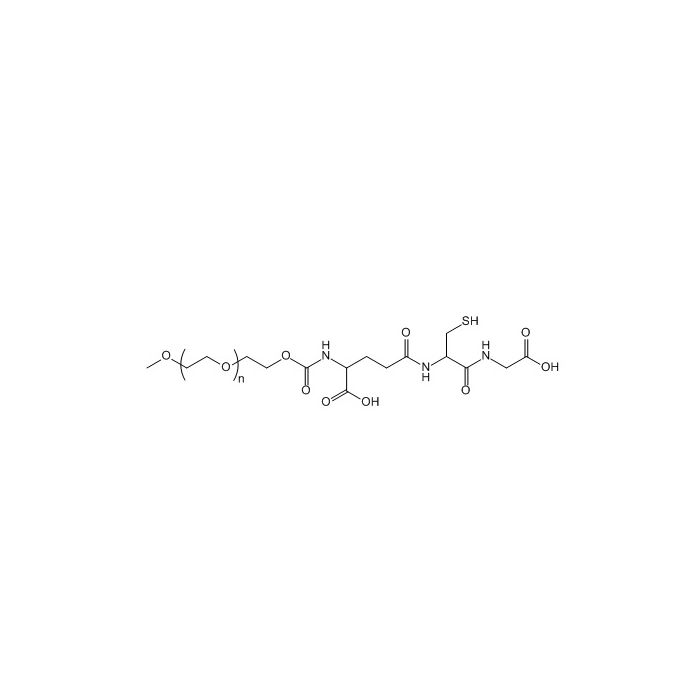
Brief overview: mPEG Glutathione is a PEG–peptide conjugate consisting of a methoxy-terminated polyethylene glycol (mPEG) chain covalently linked to the tripeptide glutathione (γ-L-Glu-L-Cys-Gly). As a polymer–biomolecule hybrid, it is polydisperse and does not have a single, well-defined small-molecule structure.
Item-specific (from Product Data)
Chemical identity specifics (CAS, SMILES, InChIKey, Molecular Formula, Molecular Weight): Not specified for this item; refer to CoA/Spec Sheet.
Storage: Protected from light; Store at −20 °C.
Shipping: Ice chest + ice pads.
Structural features (general/literature description)
PEG block: a repeat of –CH2–CH2–O– units terminated by a methoxy group (–O–(CH2CH2O)n–CH3). Degree of polymerization n defines average molecular weight (not provided here).
Glutathione moiety: a tripeptide with a γ-peptide bond between glutamate and cysteine; functional groups include two carboxylates (Glu α-CO2H, Gly CO2H), one primary amine (Glu α-NH2), and a cysteinyl thiol (–SH) in the reduced form in native GSH. In conjugates, one of these groups participates in linkage to PEG.
Conjugation topology: Vendors commonly couple mPEG to peptides via amide, thioether, or carbamate linkages; the exact linkage site and residual functional groups for this SKU are Not specified for this item; refer to CoA/Spec Sheet.
2D structure in words (general)
Linear, flexible PEG chain bearing a terminal methoxy at one end and the glutathione tripeptide at the other end through a single covalent linker. No defined stereochemistry in PEG; L-stereochemistry is present in the peptide residues.
Synthetic Utility
mPEG Glutathione can be leveraged as a functional polymeric ligand or as a building block in assembling biomaterials and affinity interfaces.
Functional group landscape (general)
PEG terminus: Methoxy-capped on one end; the opposite end is connected to the glutathione motif via a linker/chemistry that is Not specified for this item.
Glutathione residues: Depending on conjugation topology, residual groups may include a primary amine (Glu), one or two carboxylates (Glu and/or Gly), and potentially a thiol if not consumed in linkage. Verify available groups via CoA or analytical tests (e.g., TNBS for amines, Ellman’s for thiols).
Representative transformations/uses
Surface immobilization: Coupling remaining carboxylates or amines to activated substrates (EDC/sulfo-NHS, NHS-esters, epoxy surfaces) to create GSH-presenting interfaces.
Multivalent assembly: Reaction of available groups with heterobifunctional crosslinkers to generate dendritic or polymeric displays.
Metal/nanomaterial capping: Exploit carboxylate/amine coordination and PEG sterics to stabilize colloids; tune ionic strength to modulate adsorption.
Retrosynthetic perspective
View the construct as PEG (solubilizing handle) + bioactive headgroup (GSH). Backward design focuses on maintaining γ-Glu–Cys–Gly orientation and ensuring the recognition face is unperturbed by the linker.
Analytics to confirm utility
SEC/GPC for hydrodynamic size; HPLC for purity; elemental sulfur and amino acid analysis to estimate loading; functional assays for GST binding if relevant.
Target Specificity
This section is not typically applicable to polymer–peptide reagents such as mPEG Glutathione and is intended for biologics like antibodies where clone, isotype, and antigen specificity are defined.
Item-specific target details (antigen/epitope/specificity): Not applicable; none provided in Product Data.
Note
If using the glutathione motif to probe protein interactions (e.g., GST studies), binding characteristics will depend on presentation, conjugation site, and assay format rather than a fixed “target specificity” inherent to the reagent.
Perguntas frequentes
How should this product be stored?
Store at ?20 °C, protected from light. The material is light-sensitive — keep it in its original opaque or amber container.
How is this product shipped?
This product ships in an insulated container with ice pads. Unpack on arrival and transfer it to the storage condition stated above.
What documentation is provided?
Available product documentation, including Certificates of Analysis (COA), Safety Data Sheets (SDS), and specification sheets, is shown in the product document area. Document availability and access follow the current site policy.
We use cookies to ensure the website functions properly and, where permitted, to improve your experience. You can manage your preferences at any time in Settings. Learn more in our Cookie Policy.
Shall we send you a message when we have discounts available?
Remind me later
Thank you! Please check your email inbox to confirm.
Products are supplied to verified businesses, institutions, and qualified professionals for research and development use only. Not for use in humans, animals, diagnosis, or therapy.
 A2416500
