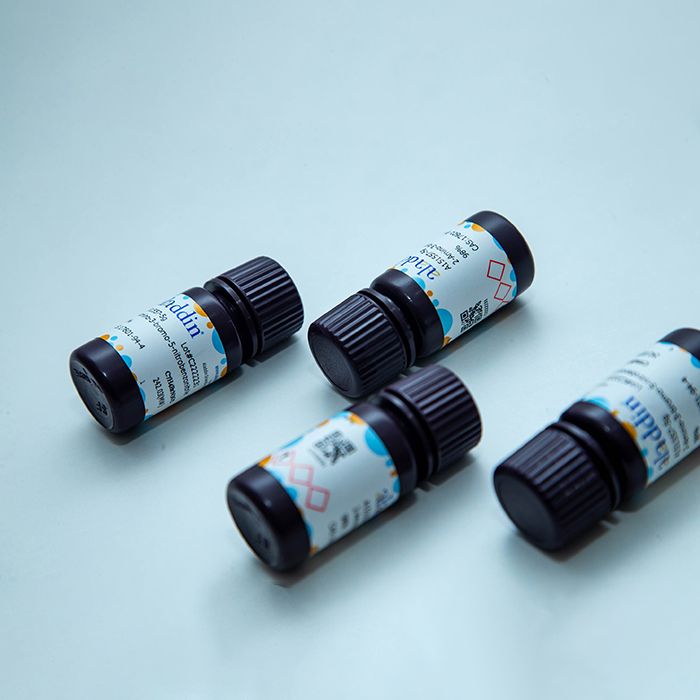
Nadecnemab is an IgG4κ antibody targeting to GFRA3 , glial cell derived neurotrophic factor family receptor alpha 3 . Nadecnemab can be used for research of osteoarthritis of the knee/pain.
Biological Activity:Nadecnemab is an IgG4κ antibody targeting to GFRA3 , glial cell derived neurotrophic factor family receptor alpha 3 . Nadecnemab can be used for research of osteoarthritis of the knee/pain.
Especificações
Especificações e pureza
≥95%
Condições de armazenamento de armazenamento
Store at -80°C,Avoid repeated freezing and thawing
Enviado em
Dry ice packs + Cold packs
Este produto requer transporte de cadeia fria. Serviços terrestres e outros serviços econômicos não estão disponíveis.
Tipo de ação
INHIBITOR
Pureza
≥95%
Dados avançados
Certificados(CoA,COO,BSE/TSE e Mapa de Análise)
C of A & Other Certificates(BSE/TSE, COO):
Analytical Chart:
Calculadoras de soluções
Molarity Calculator
Determine the necessary mass, volume, or concentration for preparing a solution.
Dilution Calculator
Determine the dilution needed to prepare a stock solution.
Reconstitution Calculator
Revisões
Avaliações dos Clientes
Application Protocols
Tested applications and conditions for this item are not provided in the Product Data. Accordingly, no validated protocols (e.g., WB, IHC, IF, FC, ELISA) or recommended dilutions can be specified for this SKU. Refer to the product CoA/Spec Sheet.
General guidance (literature/practice):
Begin with small-scale pilot titrations to identify optimal antibody concentration and blocking conditions.
For ELISA/SPR/BLI, ensure the antigen is available in a correctly folded state and that the assay buffer matches the antibody’s stability profile.
For conjugates, validate degree of labeling and confirm retained binding before scaling.
These are generic recommendations and not specific to this product.
Biological Roles
Item-specific biological target/role: Not specified for this item; refer to CoA/Spec Sheet.
General/literature overview of monoclonal antibodies in biology:
Binding function: mAbs recognize specific epitopes via complementary-determining regions (CDRs) within the Fab domains, enabling high-affinity and selective antigen binding in vitro.
Effector functions: The Fc region can interact with Fcγ receptors and complement component C1q, mediating ADCC/CDC in appropriate systems; these activities depend on isotype, glycosylation, and assay setup.
Biochemical tools: Antibodies serve as capture/detection reagents in ELISA and western blot, affinity ligands in immunoprecipitation, and targeting moieties in imaging or payload delivery when conjugated.
Structure–function dependencies: pH, ionic strength, and glycan composition influence antigen affinity, thermal stability, and solubility. Engineering (e.g., Fc mutations) can alter half-life and receptor interactions.
In vitro pathway interrogation: By blocking or clustering specific proteins, antibodies can modulate signaling pathways in cell-based assays, providing mechanistic insights without genetic manipulation.
All points above are general background; the specific antigen, isotype, and functional activity of “Nadecnemab” are not provided in the Product Data and should not be inferred.
Buffer Applications
This product is an antibody; it is not a buffering agent. Classical buffer recipes and pH ranges are therefore not directly applicable to the substance itself.
General guidance (literature/practice) for buffers used with antibodies:
Common systems: Histidine (pH ~5.0–6.5), acetate (pH ~4.5–5.5), citrate (pH ~3.5–6.5), and phosphate (pH ~6.0–7.4). Selection depends on the antibody’s stability profile and intended assay.
Additives: 50–150 mM NaCl to manage ionic strength; 0.01–0.05% polysorbate 20/80 to reduce interfacial stress; sugars (sucrose/trehalose) for lyoprotection.
Practical tips: Avoid divalent cations with phosphate buffers to prevent precipitation; for conjugations requiring higher pH, use bicarbonate (pH 8.3–8.5) freshly prepared.
Item-specific buffer composition/reconstitution guidance: Not specified for this item; refer to CoA/Spec Sheet.
Green Alternatives
While “green alternatives” typically refer to solvent/process substitution, for antibodies the sustainability focus is on cold-chain efficiency, buffer selection, and minimizing single-use plastics (general guidance):
Opportunities and tradeoffs (general/literature):
Cold-chain optimization: Consolidate shipments, use phase-change materials, and right-size packaging to reduce dry ice usage while maintaining −80 °C integrity.
Buffer choices: Favor buffers with lower environmental impact where feasible (e.g., histidine vs. phosphate mined at scale), and avoid unnecessary use of azide when sterile filtration is practical.
Concentration/form: Higher-concentration stocks in smaller aliquots can reduce freeze–thaw cycles and waste.
Single-use reduction: Employ reusable cold blocks, validated washable ice packs, and glass vials when adsorption is controlled.
Comparison snapshot (general):
Sodium azide preservation vs. sterile filtration: Azide reduces microbial risk but poses toxicity and wastewater concerns; filtration avoids azide but requires asepsis and validated sterility.
Polysorbate 80 vs. 20: Both mitigate interfacial stress; selection based on stability and peroxide profile. Using high-quality, low‑peroxide grades can reduce oxidative stress and waste.
For this specific item, detailed formulation and excipient information are not specified; refer to the CoA/Spec Sheet to identify opportunities for greener handling specific to the supplied form.
Pharmaceutical Uses
No clinical or therapeutic claims are made for this product. It is supplied for research use only.
General/formulation-related uses of monoclonal antibodies in pharmaceutical R&D (literature; not specific to this item):
Analytical reference: Use as a system suitability or method development surrogate in chromatographic and biophysical assays (SEC, CE‑SDS, icIEF) when the target is known and standards are available.
Preformulation studies: Screening of pH/excipients, thermal and colloidal stability, and stress-degradation pathways to guide developability assessments.
Device/material compatibility: Interaction testing with container-closure systems (glass, COP/COC, elastomers) and surfactant adsorption/desorption.
Conjugate development: As a carrier for research-grade ADC or imaging conjugates to optimize linker chemistry and payload-to-antibody ratios.
Item-specific regulatory status, pharmacopeial references, and formulation details are not provided for this SKU; consult the CoA/Spec Sheet. Not for human or veterinary use.
Physical Properties
Item-specific properties:
Appearance: Not specified for this item; refer to CoA/Spec Sheet.
Molecular Weight: Not specified for this item; refer to CoA/Spec Sheet.
General/literature properties for IgG-class monoclonal antibodies (for context only; not product specifications):
Approximate molecular mass: ~150 kDa (IgG1/IgG2 typical), variable with glycosylation.
Isoelectric point (pI): Often in the 6–9 range depending on sequence/glycoform.
Solubility: Highly soluble in aqueous buffers; solubility profile depends on pH, ionic strength, and excipients (e.g., histidine, citrate, phosphate, NaCl, sugars, polysorbates).
Thermal behavior: Unfolding transitions typically observed between ~60–75 °C for many IgGs (DSC), influenced by formulation.
Viscosity: Concentration-dependent; high concentrations (>100 mg/mL) can become highly viscous.
Aggregation: Sensitive to pH extremes, elevated temperature, interfacial stress, light, and freeze–thaw cycling.
Handling notes (general):
Avoid foaming and vigorous mixing to limit air–liquid interfacial stress.
Filter sterilization typically via 0.22 µm PVDF or PES if required (protein-compatible); avoid cellulose acetate if binding observed.
All numeric values above are literature/general and NOT specifications for this item. For definitive parameters, consult the product’s CoA/Spec Sheet.
Quality and Grades
Item-specific status:
Grade/Purity: Not specified for this item; refer to CoA/Spec Sheet.
Context and expectations for monoclonal antibody quality (general/literature; not specific to this SKU):
Identity & integrity: Confirmed by intact mass, reducing/non-reducing SDS‑PAGE, and peptide mapping.
Purity/aggregates: Size-exclusion chromatography (SEC) for monomer content; dynamic light scattering (DLS) for aggregate detection.
Potency/binding: ELISA, surface plasmon resonance (SPR), or bio‑layer interferometry (BLI) to measure affinity/kinetics against the defined antigen. Target not specified for this item.
Host cell/impurity controls: Residual host cell proteins (HCP), DNA, Protein A leachate, endotoxin (LAL assay), and bioburden.
Glycosylation: Fc glycan profiling by LC‑MS or HILIC.
Charge variants: CEX or icIEF to profile acidic/basic species.
Stability: Accelerated and real-time stability indicating assays (SEC, CE‑SDS, subvisible particles) across temperatures and stress conditions.
What the “grade” typically implies:
Research-use antibodies may prioritize binding activity and purity suitable for in vitro work but are not manufactured under GMP and are not intended for human or veterinary use.
For this specific item, consult the CoA/Spec Sheet for assay results, concentration, buffer composition, endotoxin limits, and sterility status.
Reaction and Applications
Chemical reaction applications are not typical for intact antibodies; however, mAbs are frequently used in bioconjugation and assay development (general/literature). No target or assay validations are provided for this item.
Representative research applications (general):
Bioconjugation: NHS‑ester labeling of lysines; maleimide coupling to reduced cysteines; site-selective methods (e.g., enzymatic glycan remodeling, Fc‑affinity handles, click chemistry via azide/alkyne incorporation).
Analytical: Use as a binding protein in ELISA, SPR/BLI, flow cytometry, or immunoprecipitation once the target is known (not specified here).
Materials/diagnostics: Immobilization onto sensors or chromatography media via Protein A/G or covalent chemistries (e.g., EDC/NHS to carboxylated surfaces).
Practical tips (general):
Maintain near-neutral pH (7.2–8.5) for NHS ester reactions; keep protein concentrations 0.5–10 mg/mL to balance kinetics and aggregation risk.
Control degree of labeling (DOL) to preserve binding; excessive lysine modification can reduce affinity.
Desalt/remove unconjugated label via SEC or spin desalting columns; verify by UV/Vis, MS, or HIC.
These uses are general guidance only. This item’s specific binding target, validated applications, and performance characteristics are not specified; consult the CoA/Spec Sheet.
Reaction Conditions
General conditions for common antibody bioconjugations (literature guidance; not product specifications):
NHS‑ester labeling (lysines):
Buffer: 50 mM phosphate or bicarbonate, pH 7.5–8.5, no primary amines.
Temp/Time: 4–25 °C, 15–120 min.
Protein conc.: 0.5–10 mg/mL.
Quench with Tris or ethanolamine; remove excess label by SEC.
Maleimide–thiol coupling (reduced cysteines):
Partial reduction: TCEP 0.25–5 mM at pH ~7.0; avoid excess to limit over‑reduction.
Conjugation: pH 6.5–7.2, 4–25 °C, 30–120 min.
Cap residual maleimide; polish by SEC/HIC.
Click chemistry (azide–alkyne CuAAC or SPAAC):
Introduce azide/alkyne via prior labeling or enzymatic tagging.
SPAAC: pH 6.5–7.5, 4–25 °C, 0.5–4 h; CuAAC requires copper catalyst and ligands with careful control to avoid protein damage.
Surface coupling (EDC/NHS to carboxylated chips/beads):
Activate at pH 4.5–5.5; immobilize antibody in low‑ionic strength buffer near pI to orient and optimize binding.
Expected outcomes depend on sequence, buffer, and reagent stoichiometry. For this specific item, no conjugation validations or DOL ranges are provided; consult CoA/Spec Sheet and perform small‑scale pilots.
Safety and Handling
Item-specific hazard data:
GHS Classification: Not specified for this item; refer to SDS.
Signal Word / H-Statements / Pictograms: Not specified for this item; refer to SDS.
General guidance for protein biologics/antibodies (literature/practice):
Expected hazards: Most purified antibodies are not classified as hazardous chemicals under GHS; nonetheless, handle as a laboratory reagent of unknown toxicity.
PPE: Use lab coat, gloves (nitrile), and safety glasses. Avoid aerosol generation; work in a clean area to prevent contamination.
First aid: If skin/eye contact occurs, rinse with water. If inhaled as aerosol, move to fresh air. If ingested, rinse mouth. Seek medical attention as appropriate. Defer to SDS for authoritative instructions.
Incompatibilities: Avoid strong oxidizers and proteases. Surfactant-containing formulations may interact with some plastics; verify compatibility.
Special risks: Proteins can denature/aggregate due to heat, freeze–thaw, shear, or interfacial exposure. Minimize vigorous vortexing and repeated needle passes.
Biohazard note: Non-sterile antibody preparations can support microbial growth. Maintain aseptic technique if sterility is required.
Storage/transport (item-specific):
Store at −80 °C; avoid repeated freezing and thawing.
Shipped on dry ice packs + cold packs, consistent with maintaining the cold chain.
Always consult the product SDS and institutional biosafety policies before use.
Solvent Selection
This product is a protein biologic (antibody), not a solvent; classical solvent selection does not apply.
General formulation guidance for antibodies (literature/general):
Common buffers: Histidine, acetate, citrate, or phosphate at pH ~5.0–7.4 depending on stability; ionic strength often 50–150 mM NaCl.
Stabilizers/excipients: Sucrose, trehalose, arginine, methionine, polysorbate 20/80 can mitigate aggregation, oxidation, and interfacial stress.
Compatibility: Prefer low-binding plastics (polypropylene) and siliconized glass vials. Avoid polystyrene for long-term storage if adsorption is an issue.
pH/ionic strength screening: Small-scale DoE screens can identify conditions minimizing opalescence and aggregation.
Selection vs. alternatives:
For low-pH stability, acetate/citrate buffers may outperform phosphate (reduced precipitation with divalent cations).
For near-neutral pH, histidine buffers often provide favorable buffering with lower ionic strength needs and good compatibility.
Item-specific buffer composition is not provided; refer to CoA/Spec Sheet if supplied as a solution or for recommended reconstitution medium.
Storage and Reconstitution
Item-specific storage and shipping:
Storage Conditions: Store at −80 °C. Avoid repeated freezing and thawing.
Reconstitution and handling (general guidance; not product-specific instructions):
If supplied lyophilized: Reconstitute with sterile, protein-compatible buffer (e.g., PBS or 20 mM histidine, 150 mM NaCl) to the desired concentration. Allow solution to equilibrate gently at 4 °C; avoid vigorous mixing.
If supplied in solution: Keep on ice during handling. Aliquot into low‑binding tubes to minimize freeze–thaw cycles.
Additives: 5–10% glycerol or 2–5% trehalose can improve freeze–thaw stability; 0.01–0.05% polysorbate 20/80 can reduce interfacial stress (confirm compatibility with downstream assays).
Filtration: For sterility, use 0.22 µm PVDF/PES filtration under gentle pressure if compatible with the supplied formulation.
Long-term stability considerations (general):
Store protected from light. Minimize headspace to reduce oxidation; consider inert gas overlay for sensitive formulations.
Document aliquot maps and avoid more than one thaw per aliquot.
Any specific concentration, excipients, or reconstitution volumes for this SKU are not specified; refer to the CoA/Spec Sheet.
Structure and Identity
Brief overview: Nadecnemab is named with the “-mab” suffix, indicating a monoclonal antibody (general/literature). No sequence or construct data are provided for this specific catalog item.
Item-specific facts (from Product Data):
SKU: N658874
Product Name: Nadecnemab
CAS: N658874 (as listed by supplier)
Molecular Formula: Not specified for this item; refer to CoA/Spec Sheet.
Molecular Weight: Not specified for this item; refer to CoA/Spec Sheet.
SMILES: Not specified for this item; refer to CoA/Spec Sheet.
InChIKey: Not specified for this item; refer to CoA/Spec Sheet.
Structural features (general/literature for IgG-type mAbs):
Typical architecture: 2 heavy chains (~50 kDa each) and 2 light chains (~25 kDa each) forming a Y‑shaped glycoprotein with variable (Fab) and constant (Fc) regions.
Functional groups: Predominantly peptide backbone (amide bonds), disulfide bridges, N‑glycans on Fc (often at Asn297), numerous ionizable side chains.
2D description: Polypeptide chains with β‑sandwich immunoglobulin domains; variable domains form antigen-binding paratopes at the tips of the Fab arms.
Notes:
Exact isotype/subclass, sequence, glycoform, and post‑translational modifications are not specified for this item; refer to CoA/Spec Sheet.
Without a defined target, “nadecnemab” is treated here as a nominal mAb name; target identity and clone are not provided in the Product Data.
Synthetic Utility
As a biologic macromolecule, this product is not a traditional synthetic building block. However, antibodies are valuable scaffolds for bioconjugation and assembly of higher-order research tools (general/literature):
Key reactive handles:
Lysine ε‑amines: Accessible for NHS‑ester, isothiocyanate, or sulfonyl fluoride labeling.
Cysteines: Native interchain disulfides enable controlled reduction for maleimide or haloacetamide conjugation; engineered cysteines allow site-specific conjugation.
Carboxylates: EDC/NHS activation for surface coupling (e.g., sensor chips, beads) at mildly acidic pH.
Glycans (Fc): Oxidation to aldehydes (NaIO4) for oxime/hydrazone ligation; enzymatic remodeling for defined attachment sites.
Retrosynthetic/value perspective:
Antibodies provide high-affinity recognition; appending fluorophores, haptens, chelators (DOTA/DFO), enzymes, or drugs creates targeted probes and materials.
These are general capabilities; for this specific item, target identity, isotype, and buffer composition are not specified and must be confirmed prior to conjugation.
Target Specificity
Item-specific antigen/epitope, species reactivity, clone, and isotype: Not specified for this item; refer to CoA/Spec Sheet.
Note: Without defined target information in the Product Data, no claims about binding specificity or cross-reactivity can be made for this SKU.
Perguntas frequentes
What is the purity of this product?
This product is supplied at ≥95% purity (chemical assay). Lot-specific values are stated on the Certificate of Analysis.
How should this product be stored?
Store at ?80 °C. Avoid repeated freeze–thaw cycles. Aliquot into single-use volumes before freezing.
How is this product shipped?
This product ships frozen with dry ice and cold packs. Unpack on arrival and transfer it to the storage condition stated above; handle dry ice with insulated gloves in a ventilated area.
What are the CAS number, molecular formula and molecular weight?
The CAS Number is N658874.
What documentation is provided?
Available product documentation, including Certificates of Analysis (COA), Safety Data Sheets (SDS), and specification sheets, is shown in the product document area. Document availability and access follow the current site policy.
Usamos cookies para garantir o funcionamento adequado do site e, quando permitido, para melhorar a sua experiência. Você pode gerenciar suas preferências a qualquer momento nas Configurações. Saiba mais em nossa Política de Cookies.
Deseja que lhe enviemos uma mensagem quando tivermos descontos disponíveis?
Lembrar-me mais tarde
Obrigado! Por favor, verifique a sua caixa de entrada de e-mail para confirmar.
Products are supplied to verified businesses, institutions, and qualified professionals for research and development use only. Not for use in humans, animals, diagnosis, or therapy.