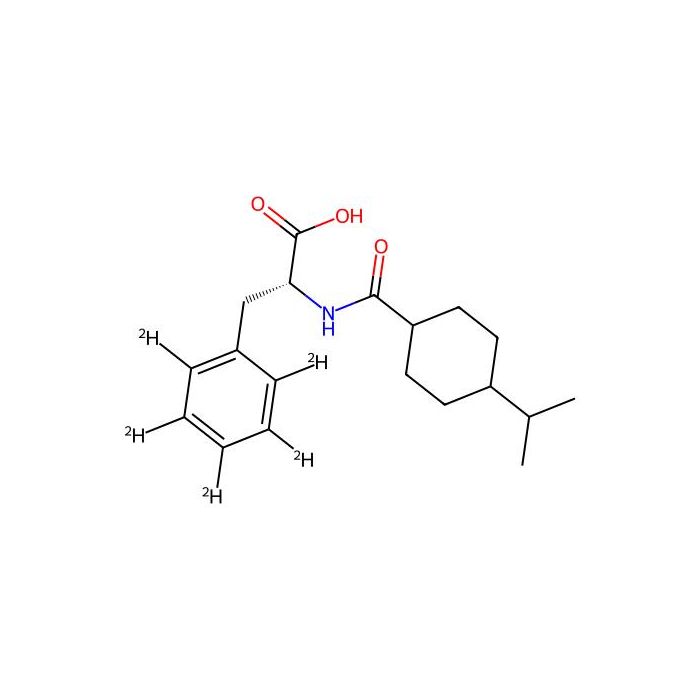
Nateglinide-d 5 is a deuterium labeled Nateglinide. Nateglinide, a D-phenylalanine derivative, is an orally active and short-acting insulinotropic agent and a DPP IV inhibitor. Nateglinide inhibits ATP-sensitive K+ channels in pancreatic β-cells. Nateglinide is used for the treatment of type 2 (non-insulin-dependent) diabetes mellitus.
Form:Solid
Especificações
Especificações e pureza
≥98%
Mecanismos bioquímicos e fisiológicos
Nateglinide-d 5 is a deuterium labeled Nateglinide. Nateglinide, a D-phenylalanine derivative, is an orally active and short-acting insulinotropic agent and a DPP IV inhibitor. Nateglinide inhibits ATP-sensitive K+ channels in pancreatic β-cells. Nateglin
Condições de armazenamento de armazenamento
Store at -20°C
Enviado em
Ice chest + Ice pads
Este produto requer transporte de cadeia fria. Serviços terrestres e outros serviços econômicos não estão disponíveis.
Determine the necessary mass, volume, or concentration for preparing a solution.
Dilution Calculator
Determine the dilution needed to prepare a stock solution.
Reconstitution Calculator
Revisões
Avaliações dos Clientes
Application Protocols
Tested applications, recommended dilutions, and detailed protocols are not provided for this item.
Item-specific protocols: Not specified for this item; refer to CoA/Spec Sheet and your laboratory’s validated methods.
General note: For LC–MS quantitation workflows, follow your internal SOPs for stable-isotope internal standards (calibration curve preparation, QC levels, extraction steps, and instrument parameters).
Biological Roles
This section provides general, literature-based context for the unlabeled parent molecule; it does not imply any medical or clinical use of this product.
Parent nateglinide (literature overview):
A D‑phenylalanine–derived small molecule of the meglitinide class that acts as a ligand for pancreatic β‑cell ATP‑sensitive K+ (KATP) channels via the sulfonylurea receptor complex, modulating cellular excitability in biochemical studies.
Exhibits amphiprotic behavior (acidic carboxyl and neutral amide), with affinity influenced by hydrophobic and hydrogen-bonding interactions in protein binding pockets.
Role of deuteration (analytical/biochemical):
Isotopic labeling with deuterium provides a mass tag for selective detection and quantification in complex biological matrices without materially changing binding or partitioning properties relative to the unlabeled analyte.
Facilitates ADME investigations in in vitro systems (e.g., microsomal stability, plasma protein binding) by allowing simultaneous monitoring of labeled and unlabeled species.
All uses of Nateglinide-d5 from Aladdin Scientific are strictly for research and laboratory purposes only.
Buffer Applications
Nateglinide-d5 is a hydrophobic, deuterium-labeled small molecule standard and is not used to prepare laboratory buffer systems. If dissolution into aqueous buffers is required for assays, adjust pH or include a miscible organic cosolvent (e.g., acetonitrile) as appropriate. Refer to Solvent Selection for practical guidance.
Green Alternatives
For analytical use, solvent choice dominates the environmental footprint. Consider greener mobile phases and sample-prep solvents without compromising data quality.
Comparison of common solvents (general guidance):
Acetonitrile vs. Ethanol/Water:
ACN offers superior volatility and chromatographic performance in reversed-phase LC–MS but carries higher toxicity and sourcing concerns.
Ethanol/water systems are greener; may require temperature control or gradient adjustments to match resolution.
DMSO vs. Ethanol:
DMSO ensures high solubility for stock solutions but is high-boiling; small volumes are typically acceptable.
Ethanol is preferable where solubility allows and when LC method tolerates it.
Buffers/additives:
Favor volatile ammonium salts (formate/acetate) over non-volatile buffers to reduce waste and instrument fouling.
Trade-offs:
Switching from ACN to greener solvents may impact retention and peak shape; re-optimize gradients and temperature.
Ensure the internal standard remains coeluting or closely tracking the analyte to preserve quantitation accuracy.
Note: The deuterated standard itself has no practical “green alternative”; environmental improvements come from solvent and workflow optimization (miniaturization, automation, reduced injection volumes).
Pharmaceutical Uses
No therapeutic or clinical applications are claimed for this product. For research and development settings, deuterated standards are commonly used as:
Reference standards in analytical method development and validation (e.g., compendial or in‑house assays) for the parent drug substance.
Process and formulation studies: spike-and-recover experiments to evaluate extraction efficiency, stability-indicating methods, and leachables/compatibility screening.
Impurity profiling and metabolite identification workflows, where coelution behavior of the isotopologue aids assignment.
Item-specific pharmacopeial status or certification: Not specified for this item; refer to CoA/Spec Sheet.
Physical Properties
Item-specific specifications are not provided; consult the CoA/SDS for authoritative data.
Appearance (item-specific): Not specified for this item; refer to CoA/Spec Sheet.
Melting point (item-specific): Not specified for this item; refer to CoA/Spec Sheet.
Boiling point (item-specific): Not applicable/rarely reported for solids of this class; Not specified for this item; refer to CoA/Spec Sheet.
Density (item-specific): Not specified for this item; refer to CoA/Spec Sheet.
Solubility (general guidance for nateglinide analogs; literature/experience):
Readily soluble in DMSO and DMF; soluble to moderately soluble in methanol and acetonitrile; low aqueous solubility at neutral pH, increased upon salt formation or basic adjustment.
Parent nateglinide is amphiprotic (carboxylic acid and amide); reported values vary across sources; verify with primary literature before method development.
Spectral behavior (general):
LC–MS: d5 label provides a +5 Da mass shift versus unlabeled nateglinide, aiding SIL quantitation and matrix-effect correction.
Note: Deuteration subtly shifts vibrational and NMR characteristics (e.g., suppressed 1H signals at labeled positions; distinct 2H NMR). These are general/literature observations, not item-specific specs.
Quality and Grades
Grade/Purity (item-specific): Not specified for this item; refer to CoA/Spec Sheet.
Considerations specific to deuterated reference standards:
Isotopic enrichment (%D): For quantitative LC–MS, high deuterium incorporation at the declared five positions is critical to minimize interference from unlabeled isotopologues. Confirm %D and isotopic distribution on the CoA.
Chemical purity vs. isotopic purity: Both impact performance. Chemical impurities may coelute or form adducts; isotopic back-exchange is generally negligible for non-exchangeable C–D sites but verify labeling positions.
Residual solvents / water content: Can affect exact concentration upon reconstitution and ESI response; check CoA for Karl Fischer or loss-on-drying where applicable.
Counterion/salt form: Free acid vs. salt (e.g., sodium) influences solubility and mass. Verify the exact form stated on the CoA to ensure correct molar calculations.
Stability testing: Look for LC–MS purity over time and stress conditions; deuterated analogs should mirror the unlabeled analyte’s chromatographic behavior.
Documentation:
Certificate of Analysis (CoA) typically includes batch-specific identity confirmation (HRMS, 1H/13C NMR, sometimes 2H NMR), isotopic enrichment, purity by HPLC/UPLC, and water/solvent content if applicable.
Reaction and Applications
Primary use is as a stable-isotope internal standard and tracer rather than as a synthetic precursor.
Analytical applications (principal):
Stable Isotope Dilution (SID) LC–MS/MS: Add Nateglinide-d5 as an internal standard to correct for matrix effects, extraction efficiency, and ionization variability when quantifying unlabeled nateglinide in research matrices.
ADME and metabolic stability assessments in in vitro systems (e.g., microsomes, hepatocytes), leveraging the +5 Da mass shift for unambiguous peak assignment without altering chromatographic behavior.
Synthetic/chemical applications (secondary):
Benchmark for assessing kinetic isotope effects (KIEs) at labeled positions if they are in mechanistically relevant C–H/C–D bonds (general/literature concept; verify labeling map before use).
Practical tips:
Prepare concentrated stocks in dry DMSO or ACN; verify concentration gravimetrically or by qNMR against a suitable reference if high-accuracy quantitation is required.
Monitor for coeluting isobaric interferences; optimize MRM/PRM transitions to exploit the +5 Da shift and characteristic fragment ions.
Avoid exchange-promoting conditions if any labels are at potentially exchangeable positions (rare for well-designed d5 standards; confirm on CoA).
Reaction Conditions
No item-specific reaction conditions are defined, as the material is intended as an analytical internal standard. General guidance for laboratory use:
Stock preparation (general): Dissolve in anhydrous DMSO or acetonitrile to prepare concentrated stocks (e.g., 0.5–10 mg/mL), then dilute into the working matrix. Verify solubility visually and by test injection.
LC–MS conditions (general, literature practice for similar analytes):
Column: C18 reversed-phase.
Mobile phases: Water with 0.1% formic or acetic acid (A) and acetonitrile or methanol with the same modifier (B).
Detection: ESI positive and/or negative depending on ionization of the carboxylate; optimize MRM transitions for +5 Da relative to analyte.
Stability (general): Store aliquots at low temperature; minimize repeated freeze–thaw. Assess bench-top and autosampler stability within your method validation.
These are general literature/practice notes, not item-specific specifications. Optimize empirically for your instruments and matrices.
Safety and Handling
Safety information specific to this item is not provided; default to good laboratory practice and consult the product SDS prior to use.
GHS classification (item-specific): Not specified for this item; refer to SDS.
Signal word / H-statements / pictograms (item-specific): Not specified for this item; refer to SDS.
General laboratory guidance (for small organic acids/amides; not a substitute for SDS):
PPE: lab coat, safety glasses, and appropriate chemically resistant gloves (e.g., nitrile). Avoid inhalation of dust and contact with skin/eyes.
Handling: Work in a fume hood. Use antistatic precautions when weighing fine powders. Avoid generating aerosols.
Incompatibilities: Strong oxidizers; strong bases/acids may cause degradation or salt formation—assess stability before prolonged exposure.
First aid (overview):
Inhalation: Move to fresh air; seek medical attention if symptoms persist.
Skin/eyes: Rinse with water for at least 15 minutes; remove contaminated clothing; seek medical advice if irritation persists.
Ingestion: Rinse mouth; do not induce vomiting; get medical attention.
Spills and disposal: Collect solids by gentle sweeping; absorb solutions with inert material; dispose of waste according to institutional and local regulations.
Always defer to the SDS for authoritative hazard classification and emergency measures.
Solvent Selection
Nateglinide-d5 behaves similarly to the parent nateglinide in polarity and solubility; choose solvents accordingly for analytical or preparative work.
Polarity/miscibility (general for class):
Good solubility in DMSO and DMF; moderate in acetonitrile and methanol/ethanol; limited in water at neutral pH. Aqueous solubility improves upon forming basic solutions (e.g., with 0.1–1% ammonia) or salts.
LC–MS sample prep:
Stock in DMSO or acetonitrile, followed by dilution into water/organic mobile phase (e.g., ACN/H2O with 0.1% FA or ammonium buffer) to minimize precipitation and ion suppression.
NMR:
For structural confirmation (general): DMSO‑d6 or CD3OD are typical; note that deuteration reduces 1H signals at labeled positions and may necessitate 2H NMR if labeling verification is required.
Comparison (general guidance):
DMSO: maximal solubility and stability; higher viscosity, potential ESI suppression at high %.
Acetonitrile: LC–MS friendly, low viscosity; slightly lower solubility than DMSO for some analytes.
Methanol/Ethanol: greener profile; may require mild base for complete dissolution of carboxylic acids.
Confirm solvent compatibility with your chromatographic and detection methods; small test injections are recommended.
Storage and Reconstitution
Storage conditions (item-specific): Store at −20°C.
Shipping (item-specific): Shipped in an ice chest with ice pads.
Additional item-specific details (appearance, stabilizers, reconstitution solvent, concentration): Not specified for this item; refer to CoA/Spec Sheet.
General good practice (not item-specific specifications):
Protect from moisture and prolonged light exposure; keep container tightly closed.
Allow container to equilibrate to room temperature before opening to minimize condensation.
If frequent access is expected, prepare single-use aliquots to avoid repeated freeze–thaw cycles.
Research Use Note: For research use only.
Structure and Identity
Nateglinide-d5 is a stable-isotope–labeled analog of the small-molecule nateglinide, incorporating five deuterium atoms for use as a quantitative internal standard and tracer in analytical workflows.
Item-specific identifiers (Product Data):
SKU: N648375
CAS: 1227666-13-8
CID (PubChem): 45040004
InChIKey: 255806 (as provided)
SMILES: Not specified for this item; refer to CoA/Spec Sheet.
Molecular Formula: Not specified for this item; refer to CoA/Spec Sheet.
Molecular Weight: Not specified for this item; refer to CoA/Spec Sheet.
Structural features (general/literature description of parent nateglinide):
A substituted amino acid (D-phenylalanine derivative) bearing a carboxylic acid and an amide linkage to a hydrophobic moiety; includes an aromatic phenyl ring and aliphatic substituents.
The d5 isotopologue replaces five protium atoms (1H) with deuterium (2H) at defined positions (labeling pattern varies by supplier; consult CoA for exact loci).
2D structure in words (general for class):
One aromatic ring attached to an α-amino acid backbone (–CH(NH–)–CO2H), with the amino nitrogen acylated by a bulky aliphatic group; the d5 label resides on non-exchangeable C–D positions to ensure MS stability.
Synthetic Utility
Although primarily an analytical standard, Nateglinide-d5 can have niche value in mechanistic organic chemistry.
Functional groups (general, parent structure): Carboxylic acid, amide, aromatic ring, and aliphatic substituents provide typical reactivity handles (salt formation, esterification, amidation of derivatives, and electrophile/aromatic substitutions on suitably activated rings in analog synthesis of the unlabeled compound).
Isotopic labeling advantages:
Kinetic Isotope Effect (KIE) probes when C–D bonds coincide with mechanistically relevant C–H positions in transformations of nateglinide analogs.
Mass balance tracking: facilitates reaction monitoring by LC–MS, distinguishing product/intermediate pools via +5 Da shift.
Retrosynthetic considerations (general): The amide link and amino-acid motif suggest convergent assembly from a protected amino acid and an activated acid derivative; deuterium incorporation is typically introduced via labeled building blocks or hydrogen–deuterium exchange at non-exchangeable positions during precursor synthesis (pattern vendor-specific; consult labeling map).
For routine synthesis, however, the deuterated standard is not a cost-effective starting material; use it sparingly for hypothesis-driven experiments.
Target Specificity
No target, epitope, or biological binding specificity is provided for this product. It is a small-molecule deuterated standard, not an antibody or targeted biologic.
Item-specific data: Not specified for this item; refer to CoA/Spec Sheet.
Perguntas frequentes
What is the purity of this product?
This product is supplied at ≥98% purity (chemical assay). Lot-specific values are stated on the Certificate of Analysis.
How should this product be stored?
Store at ?20 °C. Freezer storage is required to maintain the specified shelf life.
How is this product shipped?
This product ships in an insulated container with ice pads. Unpack on arrival and transfer it to the storage condition stated above.
What are the CAS number, molecular formula and molecular weight?
The CAS Number is 1227666-13-8, the molecular formula is C19H22D5NO3, and the molecular weight is 322.45 g/mol. InChIKey OELFLUMRDSZNSF-DKFMXDSJSA-N.
What documentation is provided?
Available product documentation, including Certificates of Analysis (COA), Safety Data Sheets (SDS), and specification sheets, is shown in the product document area. Document availability and access follow the current site policy.
Usamos cookies para garantir o funcionamento adequado do site e, quando permitido, para melhorar a sua experiência. Você pode gerenciar suas preferências a qualquer momento nas Configurações. Saiba mais em nossa Política de Cookies.
Deseja que lhe enviemos uma mensagem quando tivermos descontos disponíveis?
Lembrar-me mais tarde
Obrigado! Por favor, verifique a sua caixa de entrada de e-mail para confirmar.
Products are supplied to verified businesses, institutions, and qualified professionals for research and development use only. Not for use in humans, animals, diagnosis, or therapy.