≥98% para fluxos de trabalho cromatográficos e analíticos sensíveis que exigem interferência mínima da linha de base.
🌡
Armazenamento e envio
Store at 2-8°C,Desiccated Envio Wet ice. Consulte o COA específico do lote para obter as especificações exatas.
📋
Documentos de qualidade
SDS, COA, ficha técnica e folha de especificações disponíveis para download. COA específico do lote acessível por meio de pesquisa por número de lote.
📚
Comprovação documental
Citado em 0 publicações revisadas por pares nas áreas de cromatografia, síntese orgânica e reações de acoplamento cruzado.
Visão geral
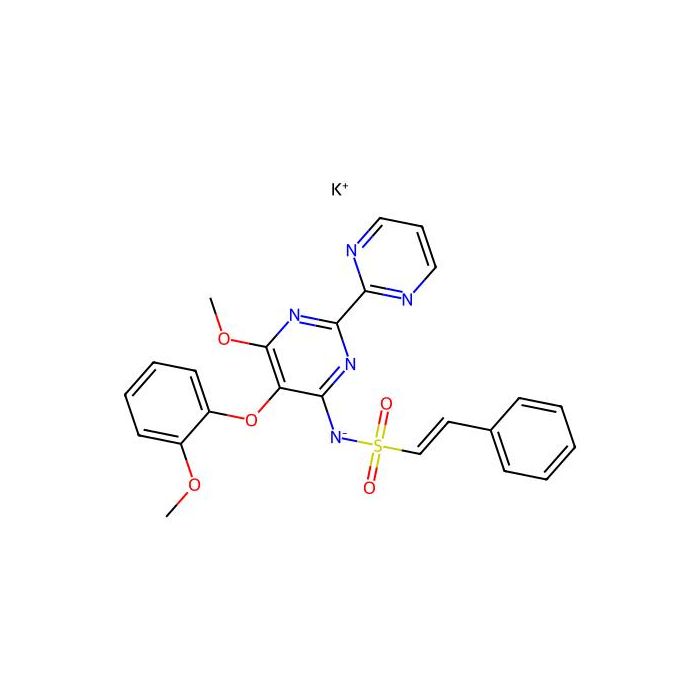
Nebentan potassium (YM598) is a potent, selective and orally active non-peptide endothelin ET A receptor antagonist through the modification of Bosentan . Nebentan potassium inhibits [ 125 I] endothelin-1 binding to cloned human endothelin ETA and ETB receptor, with K i of 0.697 nM and 569 nM, respectively YM598 can ameliorate the progression of cor pulmonale and myocardial infarction in vivo .
In Vitro
Nebentan potassium inhibits the specific binding of [ 125 I] endothelin-1 to endothelin ET A and ET B receptors in a concentration dependent manner, K i values are 0.697 nM and 1.53 nM for human and rat endothelin ETA receptors, respectively. In contrast, YM598 exhibits low affinities for human and rat endothelin ET B receptors, with K i values of 569 nM and 155 nM,respectively. In measurement of intracellular Ca 2+ concentration, Nebentan potassium concentration-dependently inhibits the increase in [Ca 2+ ]i induced by 10 nM endothelin-1 in both CHO cells and A10 cells, the IC 50 values are 26.2 nM for CHO cells and 26.7 nM for A10 cells, respectively. MCE has not independently confirmed the accuracy of these methods. They are for reference only.
In Vivo
Nebentan potassium (oral administration; 0.1-1 mg/kg; 4 weeks) significantly inhibits the progression of pulmonary hypertension and the development of right ventricular hypertrophy. Nebentan potassium (oral administration; 1 mg/kg; 30 weeks) significantly ameliorates the poor survival rate of CHF rats, it markedly reduces the hypertrophy of both ventricles as well as pulmonary congestion. MCE has not independently confirmed the accuracy of these methods. They are for reference only.
Nebentan potassium (YM598) is a potent, selective and orally active non-peptide endothelin ET A receptor antagonist through the modification of Bosentan ( HY-A0013 ). Nebentan potassium inhibits [ 125 I] endothelin-1 binding to cloned human endothelin ETA
Condições de armazenamento de armazenamento
Store at 2-8°C,Desiccated
Enviado em
Wet ice
Este produto requer transporte de cadeia fria. Serviços terrestres e outros serviços econômicos não estão disponíveis.
This compound belongs to the class of organic compounds known as bipyrimidines and oligopyrimidines. These are organic compounds containing two or more pyrimidine rings directly linked to each other. Pyrimidine is a 6-membered ring consisting of four carbon atoms and two nitrogen centers at the 1- and 3- ring positions.
External Descriptors
Not available
1. Djoumbou Feunang Y, Eisner R, Knox C, Chepelev L, Hastings J, Owen G, Fahy E, Steinbeck C, Subramanian S, Bolton E, Greiner R, and Wishart DS. ClassyFire: Automated Chemical Classification With A Comprehensive, Computable Taxonomy. Journal of Cheminformatics, 2016, 8:61.
Determine the necessary mass, volume, or concentration for preparing a solution.
Dilution Calculator
Determine the dilution needed to prepare a stock solution.
Reconstitution Calculator
Revisões
Avaliações dos Clientes
Application Protocols
No vendor-tested application protocols are provided for this specific item. The following outlines general practices for handling small molecules in discovery settings:
Stock preparation: Prepare concentrated stocks (e.g., 10–50 mM) in DMSO or water after a brief solubility test. Filter through 0.2 µm PTFE/RC filters if particulates remain.
Plate formatting: Dispense into 96/384-well plates under low-humidity conditions; seal with solvent-resistant films. Store plates at 2–8 °C or −20 °C per stability observations, minimizing freeze–thaw cycles.
Dilution: For biochemical assays, target ≤1–2% DMSO in final wells. Mix thoroughly to avoid precipitation. Confirm concentration by UV (if chromophore present) or qNMR for critical studies.
Stability checks: Run time-course LC-MS to assess stability over assay duration (e.g., 0–24 h) in the chosen buffer and temperature.
Documentation: Record batch number, salt form, solvent, and pH of working solutions.
Note: These are general recommendations only. Optimize conditions based on your assay and any structure-specific data you obtain. This product is for research use only.
Biological Roles
No biological function, pathway role, or target engagement is specified for this item in the product data. Accordingly, no biological claims can be made here.
General considerations when evaluating small molecules of unknown/unspecified target:
Determine ionization state and salt form before potency measurements; convert to free base/acid if necessary for consistent dosing on a molar basis.
Establish stability in relevant media (buffer, serum, microsomes) and monitor for hydrolysis/oxidation if functional groups suggest liability (structure not provided; perform empirical testing).
Perform orthogonal assays to verify on-target effects vs off-target or assay interference (e.g., redox cycling, fluorescence quenching). Utilize counterscreens and control compounds.
Assess basic ADME properties in exploratory studies only if needed for research (solubility, permeability, chemical stability), documenting the exact salt form tested.
Note: This product is designated for research use only. It is not intended for diagnostic, therapeutic, or clinical use.
Buffer Applications
This product is not presented as a buffering agent, and no acid/base parameters are provided.
Buffer role: Not typically applicable. No pKa values, buffering ranges, or recipes are specified for this item; refer to CoA/Spec Sheet if later provided.
Practical note (general):
If the compound must be formulated in buffer for assays, select a buffer system compatible with your readout (e.g., PBS, HEPES, or Tris) and ensure the compound is soluble at the working concentration. Prepare concentrated stocks in DMSO or water, then dilute into buffer with gentle mixing to avoid precipitation.
Verify pH after addition of the compound, as salt forms can slightly shift pH depending on their conjugate acid/base chemistry.
Green Alternatives
This catalog entry is a discrete small molecule, not a process solvent or bulk reagent; therefore, “green alternatives” mainly concern solvent and process choices during its handling and any auxiliary transformations.
Guidance for greener handling (general):
Prefer water and ethanol where chemically compatible; avoid chlorinated solvents unless necessary for analytical requirements.
For stock solutions, DMSO is common but consider glycerol/water cosolvents for biocompatible assays if solubility permits.
Minimize volumes in screening cascades by using microplate formats and acoustic dispensing to reduce waste.
Use room temperature operations where feasible; cold-chain is maintained only for stability per vendor guidance (2–8 °C, desiccated).
Illustrative comparison (general considerations, not item-specific):
DMSO vs 2-pyrrolidone: DMSO is broadly compatible but has higher environmental persistence; 2-pyrrolidone/NMP alternatives may aid solubility but come with worker exposure concerns. Evaluate assay compatibility and SDS data.
ACN vs MeOH for LC: ACN offers lower backpressure but higher environmental burden; MeOH is more benign but may change selectivity. Choose based on method performance and safety.
Waste reduction:
Consolidate analytical runs, use shorter columns and UHPLC where available, and adopt inline dilution to reduce solvent consumption.
Pharmaceutical Uses
No pharmacopeial status or excipient/application role is specified for this item. It is supplied strictly for research use.
Reference or analytical standard in pharmaceutical R&D method development, pending independent verification of identity and purity for the received batch.
Internal discovery screening as part of a small-molecule library under suitable lab controls.
Important limitations:
Do not use in humans or for clinical diagnosis or therapy.
No claims are made regarding GMP status, compendial compliance (USP/EP/JP), residual solvent limits, or elemental impurity controls for clinical manufacturing—such attributes are Not specified for this item; refer to CoA/Spec Sheet if available.
Documentation:
Maintain batch records, CoA, and any in-house qualification data (HPLC purity, water content, qNMR) to support traceability in research pipelines.
Physical Properties
Item-specific physicochemical constants were not provided in the product data. Do not treat the following as specifications; consult the CoA/Spec Sheet for definitive values.
Molecular weight (calculated): Not specified for this item; refer to CoA/Spec Sheet.
Molecular formula: Not specified for this item; refer to CoA/Spec Sheet.
Appearance: Not specified for this item; refer to CoA/Spec Sheet.
Melting point: Not specified for this item; refer to CoA/Spec Sheet.
Boiling point: Not applicable/reported for salts; many organic potassium salts decompose before boiling (general literature).
Density: Not specified for this item; refer to CoA/Spec Sheet.
Solubility: Not specified for this item; refer to CoA/Spec Sheet. General note: potassium salts of organic acids are often water-soluble and frequently dissolve in polar protic/aprotic solvents (e.g., H2O, MeOH, DMSO), but actual solubility for this item must be determined empirically.
LogP/logD: Not specified for this item; refer to CoA/Spec Sheet.
pKa (conjugate acid/base): Not specified for this item; refer to CoA/Spec Sheet.
Hygroscopicity: Not specified for this item; refer to CoA/Spec Sheet. Handle desiccated as directed in Storage.
Practical guidance (general):
Begin with a small-scale solubility screen (water, PBS, MeOH, EtOH, acetonitrile, DMSO) at room temperature and at 37 °C. Filter particulates prior to analytical work.
If LC analysis is required, evaluate both acidic and basic mobile phases to assess ion-pairing and retention behavior.
Quality and Grades
Grade/Purity information was not provided for this catalog entry; therefore, no item-specific grade claims can be made here.
Grade/Purity: Not specified for this item; refer to CoA/Spec Sheet.
Stabilizers/Inhibitors: Not specified for this item; refer to CoA/Spec Sheet.
General guidance on grading for small-molecule research reagents:
Research grade typically indicates suitability for chemical/biological research with standard analytical acceptance (e.g., NMR, HPLC/LC-MS). If HPLC-grade or bioactive screening grade is relevant, check the CoA for assay purity, residual solvent levels, and inorganic counterion content.
For screening libraries, vendors often control identity (HRMS), purity (HPLC area %), and salt form/water content. Verify these on the batch CoA, including any residual inorganic salts and moisture content that can affect weighed potency for bioassays.
If UV-critical applications (e.g., HPLC reference standard) are intended, obtain a batch with low UV-absorbing impurities; confirm by diode-array or PDA purity profile.
Trace metal content, water content (KF), and residual solvent limits: Not specified for this item; refer to CoA/Spec Sheet.
Best practices:
Record exact salt form and hydration state to ensure accurate molarity calculations.
If necessary, perform additional qualification (KF, qNMR) to align with your laboratory’s internal specifications.
Reaction and Applications
Manufacturer application notes were not provided for this item. Given its listing in a small-molecule/compound library, Nebentan potassium is typically suited for discovery workflows rather than as a general-purpose reagent.
Common research applications (general guidance):
Chemical biology screening: Preparation of DMSO stocks for biochemical or cell-based assays; track exact salt form for potency calculations.
Analytical reference: Use as a reference standard for LC/LC-MS method development and retention time assignment, provided identity and purity are verified.
Counterion studies: Where relevant, conversion between salt forms (e.g., K+ to Na+, H+, or organic amines) to probe physicochemical or biological effects.
Practical tips:
Weigh quickly in a dry environment to minimize moisture uptake (product is stored desiccated).
For aliquoting, pre-dry vials, purge with inert gas if oxidation/hydrolysis sensitivity is suspected (unknown here), and store chilled (2–8 °C) to match product guidance.
For NMR characterization, begin with D2O or DMSO-d6 depending on solubility. If spectra show broadening from ion pairing, add a drop of D2O to DMSO-d6 or a small amount of salt (e.g., KCl) to stabilize chemical shifts (general technique).
Note: No specific biochemical target or pathway is claimed for this item in the product data. All uses are for research only.
Reaction Conditions
No reaction conditions are specified for this product. If Nebentan potassium is used as a substrate or is converted to another salt/neutral form, consider the following general conditions for handling organic potassium salts:
Salt metathesis: Dissolve/suspend in water or polar alcohols; add stoichiometric acid (e.g., HCl, citric acid) to generate the free acid, extract into an organic phase (EtOAc, MTBE). Maintain temperature at 0–25 °C; monitor pH.
Ion exchange: Pass an aqueous solution through a protonated cation/anion exchange resin (as applicable) and elute; follow with solvent removal under reduced pressure at ≤40 °C to limit thermal degradation.
Coupling (if carboxylate): After acidification to free acid, standard coupling reagents (EDC/HOBt, HATU, T3P) in DMF/DCM/MeCN at 0–25 °C are typical (general literature). Verify that residual inorganic salts are minimized to avoid reagent quenching.
Drying: After aqueous workups, dry organic extracts over suitable drying agents (Na2SO4/MgSO4), filter, and evaporate gently.
Analytical controls:
Use LC-MS to monitor mass balance and detect formation of different salt forms or hydrates.
Record pH and ionic strength for reproducibility when performing salt exchanges.
Note: The above are general practices; they are not item-specific specifications.
Safety and Handling
Hazard data for this specific item were not supplied. Always consult the SDS for authoritative information.
From product data:
Storage: Store at 2–8 °C, desiccated.
Shipping: Wet ice.
GHS classification, pictograms, signal word, and H-statements: Not specified for this item; refer to SDS.
General laboratory precautions for small organic salts:
PPE: lab coat, safety glasses, and appropriate chemical-resistant gloves (e.g., nitrile). Avoid inhalation of dust and contact with skin/eyes.
Handling: Work in a fume hood to minimize dust exposure. Cap immediately after use. Allow cold shipments to equilibrate in a desiccator before opening to avoid moisture condensation.
Incompatibilities: Strong oxidizers and strong acids/bases may be incompatible depending on the anion/functional groups (unknown here). Segregate until SDS confirms specifics.
Spill/Exposure: For solids, gently sweep up with minimal dust generation; dispose per institutional guidelines. Eye/skin contact—rinse with water for at least 15 minutes; seek medical attention as per SDS.
Thermal decomposition: Organic potassium salts may char or decompose to release irritant fumes upon heating (general observation). Avoid unnecessary thermal stress.
Waste and environmental considerations:
Collect aqueous/organic solutions and contaminated materials as chemical waste. Avoid drain disposal unless permitted by local regulations and after review of SDS.
Solvent Selection
Item-specific solubility data are not provided; select solvents empirically. The following is general guidance for handling organic potassium salts used in discovery research.
Initial screen: Test water, phosphate-buffered saline (PBS), methanol, ethanol, acetonitrile, and DMSO at room temperature. Warm to 37 °C if needed and sonicate briefly to aid dissolution.
pH assistance: If the compound is a potassium salt of a carboxylic acid or phenol, it may be more soluble in water at neutral–basic pH. If the free acid form is preferred (e.g., for RP-HPLC), acidify a test aliquot and extract to an organic solvent; confirm no degradation.
Mixed cosolvents: For bioassays, a DMSO stock (e.g., 10–50 mM) diluted into aqueous buffer (≤1–2% DMSO final) is common practice when water solubility is limited.
Moisture sensitivity: Because storage is desiccated, limit atmospheric exposure during weighing to prevent water uptake that can skew concentrations.
Comparison considerations (general):
Water vs DMSO: Water is preferred for biocompatibility; DMSO enhances solubility for hydrophobic scaffolds but can affect assay readouts.
MeOH/EtOH: Useful for spectroscopy and preparative work; verify assay tolerance.
ACN: Favored for LC compatibility; less effective for strongly ionic species without modifiers.
Documentation:
Record the final solvent system and pH for reproducibility. Filter 0.2 µm prior to chromatography or bioassays to remove undissolved particulates.
Storage and Reconstitution
From product data (item-specific):
Storage conditions: Store at 2–8 °C, desiccated.
Shipping condition: Wet ice.
Additional guidance (general best practice for small organic salts):
Keep container tightly closed in a desiccator or with a fresh desiccant pouch. Allow to reach room temperature in a dry environment before opening to prevent moisture condensation.
If long-term storage beyond routine timelines is required, consider subdividing into single-use aliquots to avoid repeated moisture exposure.
Protect from prolonged light if chromophores are suspected (structure not provided); use amber vials as a precaution.
Reconstitution (when ready to use):
Solvent choice is assay-dependent. Begin with water or DMSO based on a small-scale solubility screen. If necessary, adjust pH or use mixed solvents (e.g., DMSO:water) to achieve target concentration.
Prepare accurate concentrations by weighing using an analytical balance and accounting for the exact salt form and hydration state (consult CoA for MW). If MW is not available, determine by HRMS or obtain from the supplier before preparing molar solutions.
Filter solutions (0.2 µm) for analytical work; for bioassays, sterile-filter if required by protocol.
Stability after reconstitution:
Not specified for this item; refer to CoA/Spec Sheet. As a general rule, prepare fresh solutions as needed and store working stocks chilled (2–8 °C) or frozen (−20 °C) based on stability assessments, avoiding multiple freeze–thaw cycles.
Research use only.
Structure and Identity
Nebentan potassium is listed as a small-molecule library compound. Item-specific structural identifiers are largely not provided in the product data; therefore, definitive structural assertions are not made here.
CAS: 342005-82-7 (as provided)
PubChem CID: 12093171 (as provided)
InChIKey: 403957 (as provided; note: this format is atypical for a full InChIKey; consult CoA/SDS or vendor record for confirmation)
Molecular formula: Not specified for this item; refer to CoA/Spec Sheet.
Molecular weight: Not specified for this item; refer to CoA/Spec Sheet.
SMILES: Not specified for this item; refer to CoA/Spec Sheet.
Synonyms: Not specified for this item; refer to CoA/Spec Sheet.
Structural features (general guidance):
The name suggests a potassium salt of an organic anion ("…potassium"), but the exact functional groups and scaffold are not provided. No stereochemical information is available.
Without a provided structure, 2D features (ring systems, heteroatoms, ionization state) cannot be detailed.
Recommendations for identity confirmation (general laboratory practice):
Acquire and retain the batch CoA for structural identifiers and salt stoichiometry.
Verify by independent methods where appropriate: HRMS (m/z consistent with potassium salt or free acid/base form), 1H/13C NMR (solvent selection based on solubility screening), and elemental analysis/ion chromatography for K+ content.
If needed, convert to the neutral/free-acid form to simplify NMR and LC-MS interpretation; document any counterion changes.
Synthetic Utility
Without a disclosed structure, only general comments on the potential utility of potassium salts in synthesis can be provided.
General synthetic considerations:
Counterion exchange: Potassium salts can be converted to the corresponding free acid or to alternative counterions (Na+, Li+, NR4+) via ion-exchange resins or acid/base workups, enabling optimization of solubility and crystallization behavior.
Purification handle: The ionic nature may aid separation from neutral impurities via aqueous workups, trituration with polar/nonpolar solvents, or SCX/SAX cartridges depending on charge state.
Derivatization: If Nebentan potassium is a carboxylate/phenolate salt, in situ acidification can liberate the nucleophilic free species for coupling (e.g., amide formation after activation with carbodiimides or acid chlorides). This is hypothetical pending structure confirmation—validate experimentally.
Solid-state manipulation: Salt formation can influence polymorphism and stability. If preparing alternative salt forms, characterize by XRPD/DSC/TGA.
Caveat:
Do not assume reactivity or compatibility without structure-specific data. Perform small-scale trials and analytical verification after any transformation or salt metathesis.
Target Specificity
Target specificity is not provided for this item and cannot be inferred from the available data.
Molecular target, pathway, or receptor: Not specified for this item; refer to CoA/Spec Sheet or primary literature if available.
Assay validation data (IC50, KD, selectivity panels): Not provided.
Guidance (general):
If employing this compound in target-based assays, establish a suitability dossier including analytical identity/purity, stability in assay buffer, and orthogonal confirmation of activity. Include negative/positive controls and evaluate potential assay interference (fluorescence quenchers, redox activity, aggregation).
Report exact salt form, concentration determination method, and solvent composition to ensure reproducibility across labs.
Perguntas frequentes
What is the purity of this product?
This product is supplied at ≥98% purity (chemical assay). Lot-specific values are stated on the Certificate of Analysis.
How should this product be stored?
Store at 2–8 °C, desiccated. Keep the container tightly closed with desiccant — the material is moisture-sensitive.
How is this product shipped?
This product ships chilled on wet ice. Unpack on arrival and transfer it to the storage condition stated above.
What are the CAS number, molecular formula and molecular weight?
The CAS Number is 342005-82-7, the molecular formula is C24H20KN5O5S, and the molecular weight is 529.61 g/mol. InChIKey WOPWEXSDEXIRNG-ZUQRMPMESA-N.
What documentation is provided?
Available product documentation, including Certificates of Analysis (COA), Safety Data Sheets (SDS), and specification sheets, is shown in the product document area. Document availability and access follow the current site policy.
Usamos cookies para garantir o funcionamento adequado do site e, quando permitido, para melhorar a sua experiência. Você pode gerenciar suas preferências a qualquer momento nas Configurações. Saiba mais em nossa Política de Cookies.
Deseja que lhe enviemos uma mensagem quando tivermos descontos disponíveis?
Lembrar-me mais tarde
Obrigado! Por favor, verifique a sua caixa de entrada de e-mail para confirmar.
Products are supplied to verified businesses, institutions, and qualified professionals for research and development use only. Not for use in humans, animals, diagnosis, or therapy.