
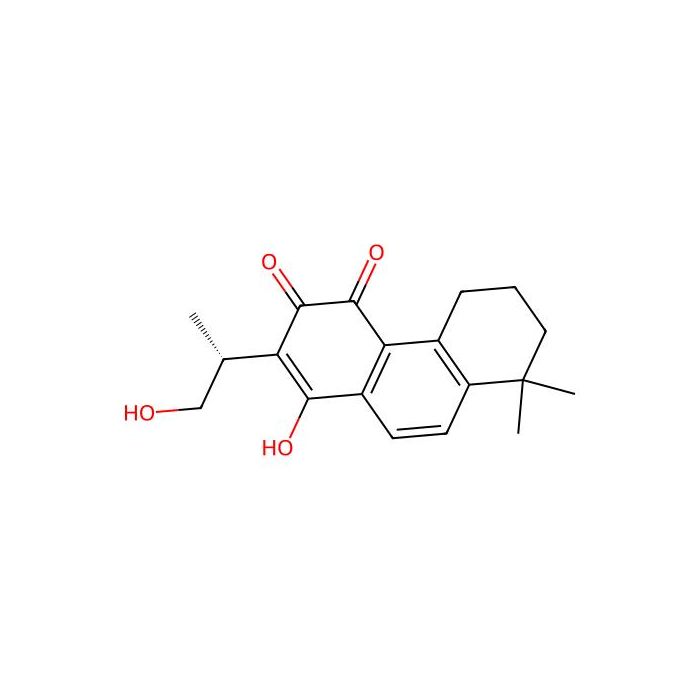
Determine the necessary mass, volume, or concentration for preparing a solution.
| Activity Type | Relation | Activity value | Units | Action Type | Journal | PubMed Id | doi | Assay Aladdin ID |
|---|
Neocryptotanshinone, a fatty diterpenoids from Salvia Miltiorrhiza , inhibits lipopolysaccharide-induced inflammation by suppression of NF-κB and iNOS signaling pathways
In Vitro
Neocryptotanshinone exhibits anti-inflammatory effect by suppression of NF-κB and iNOS signaling pathways. Neocryptotanshinone (10 μM and 20 μM, 24 h) inhibits LPS-induced iNOS protein expression in RAW264.7 cells. Neocryptotanshinone (20 μM, 24 h) shows no obvious cytotoxic effect towards murine RAW264.7 macrophages. MCE has not independently confirmed the accuracy of these methods. They are for reference only. Cell Viability AssayCell Line: RAW264.7 cells Concentration: 5, 10 and 20 μM Incubation Time: 24 hours Result: Inhibited LPS-induced cell viability in a dose-dependent manner. Western Blot AnalysisCell Line: RAW264.7 cells Concentration: 20 μM Incubation Time: 24 hours Result: Inhibited LPS-induced activation of NF-κB pathway and down-regulated LPS-induced expression of p-NF-κB p65, p-IκBα and p-IKKβ.
In Vivo
Neocryptotanshinone causes reversals of decreased pain thresholds induced by MSU treatment after 30, 60, and 120 min S. miltiorrhiza Bunge extract treatment (contains single active components). MCE has not independently confirmed the accuracy of these methods. They are for reference only. Animal Model: MSU-induced pain model in male ICR mice (weighing 20-25 g)Dosage: 10, 25, 50 or 100 mg/kg Administration: Oral gavage; for 30, 60, 120 min Result: Inhibited inflammatory symptoms and nociceptive behaviors in a dose-dependent manner.
Form:Solid
IC50& Target:iNOS
Taxonomy Tree
| Kingdom | Organic compounds |
|---|---|
| Superclass | Lipids and lipid-like molecules |
| Classe | Prenol lipids |
| Subclass | Diterpenoids |
| Intermediate Tree Nodes | Not available |
| Direct Parent | Tanshinones, isotanshinones, and derivatives |
| Alternative Parents | Phenanthrols Hydrophenanthrenes Naphthoquinones Naphthols and derivatives Tetralins Quinones Aryl ketones Vinylogous acids Enols Primary alcohols Organic oxides Hydrocarbon derivatives |
| Molecular Framework | Aromatic homopolycyclic compounds |
| Substituents | Tanshinone skeleton - Phenanthrol - Hydrophenanthrene - Phenanthrene - Naphthoquinone - 1-naphthol - Naphthalene - Tetralin - Aryl ketone - Quinone - Benzenoid - Vinylogous acid - Ketone - Cyclic ketone - Enol - Hydrocarbon derivative - Organic oxide - Alcohol - Organic oxygen compound - Carbonyl group - Organooxygen compound - Primary alcohol - Aromatic homopolycyclic compound |
| Descrição | This compound belongs to the class of organic compounds known as tanshinones, isotanshinones, and derivatives. These are a group of abietane-type norditerpenoid quinones. |
| External Descriptors | Not available |
| Activity Type | Relation | Activity value | Units | Action Type | Journal | PubMed Id | doi | Assay Aladdin ID |
|---|
| Activity Type | Relation | Activity value | Units | Action Type | Journal | PubMed Id | doi | Assay Aladdin ID |
|---|
| Activity Type | Relation | Activity value | Units | Action Type | Journal | PubMed Id | doi | Assay Aladdin ID |
|---|
| Activity Type | Relation | Activity value | Units | Action Type | Journal | PubMed Id | doi | Assay Aladdin ID |
|---|
| Activity Type | Relation | Activity value | Units | Action Type | Journal | PubMed Id | doi | Assay Aladdin ID |
|---|
| Activity Type | Relation | Activity value | Units | Action Type | Journal | PubMed Id | doi | Assay Aladdin ID |
|---|
| Activity Type | Relation | Activity value | Units | Action Type | Journal | PubMed Id | doi | Assay Aladdin ID |
|---|
| Activity Type | Relation | Activity value | Units | Action Type | Journal | PubMed Id | doi | Assay Aladdin ID |
|---|
| Activity Type | Relation | Activity value | Units | Action Type | Journal | PubMed Id | doi | Assay Aladdin ID |
|---|
| Activity Type | Relation | Activity value | Units | Action Type | Journal | PubMed Id | doi | Assay Aladdin ID |
|---|
| Activity Type | Relation | Activity value | Units | Action Type | Journal | PubMed Id | doi | Assay Aladdin ID |
|---|
| Activity Type | Relation | Activity value | Units | Action Type | Journal | PubMed Id | doi | Assay Aladdin ID |
|---|
| Activity Type | Relation | Activity value | Units | Action Type | Journal | PubMed Id | doi | Assay Aladdin ID |
|---|
| Activity Type | Relation | Activity value | Units | Action Type | Journal | PubMed Id | doi | Assay Aladdin ID |
|---|
| Activity Type | Relation | Activity value | Units | Action Type | Journal | PubMed Id | doi | Assay Aladdin ID |
|---|
| Activity Type | Relation | Activity value | Units | Action Type | Journal | PubMed Id | doi | Assay Aladdin ID |
|---|
| Activity Type | Relation | Activity value | Units | Action Type | Journal | PubMed Id | doi | Assay Aladdin ID |
|---|
| Activity Type | Relation | Activity value | Units | Action Type | Journal | PubMed Id | doi | Assay Aladdin ID |
|---|
| Activity Type | Relation | Activity value | Units | Action Type | Journal | PubMed Id | doi | Assay Aladdin ID |
|---|
| Activity Type | Relation | Activity value | Units | Action Type | Journal | PubMed Id | doi | Assay Aladdin ID |
|---|
| Activity Type | Relation | Activity value | Units | Action Type | Journal | PubMed Id | doi | Assay Aladdin ID |
|---|
| Activity Type | Relation | Activity value | Units | Action Type | Journal | PubMed Id | doi | Assay Aladdin ID |
|---|
| Activity Type | Relation | Activity value | Units | Action Type | Journal | PubMed Id | doi | Assay Aladdin ID |
|---|
| Activity Type | Relation | Activity value | Units | Action Type | Journal | PubMed Id | doi | Assay Aladdin ID |
|---|
| Activity Type | Relation | Activity value | Units | Action Type | Journal | PubMed Id | doi | Assay Aladdin ID |
|---|
| Activity Type | Relation | Activity value | Units | Action Type | Journal | PubMed Id | doi | Assay Aladdin ID |
|---|
| Activity Type | Relation | Activity value | Units | Action Type | Journal | PubMed Id | doi | Assay Aladdin ID |
|---|
| Activity Type | Relation | Activity value | Units | Action Type | Journal | PubMed Id | doi | Assay Aladdin ID |
|---|
| Activity Type | Relation | Activity value | Units | Action Type | Journal | PubMed Id | doi | Assay Aladdin ID |
|---|
| Activity Type | Relation | Activity value | Units | Action Type | Journal | PubMed Id | doi | Assay Aladdin ID |
|---|
| Activity Type | Relation | Activity value | Units | Action Type | Journal | PubMed Id | doi | Assay Aladdin ID |
|---|
| Activity Type | Relation | Activity value | Units | Action Type | Journal | PubMed Id | doi | Assay Aladdin ID |
|---|
| Activity Type | Relation | Activity value | Units | Action Type | Journal | PubMed Id | doi | Assay Aladdin ID |
|---|
| Activity Type | Relation | Activity value | Units | Action Type | Journal | PubMed Id | doi | Assay Aladdin ID |
|---|
| Activity Type | Relation | Activity value | Units | Action Type | Journal | PubMed Id | doi | Assay Aladdin ID |
|---|
| Activity Type | Relation | Activity value | Units | Action Type | Journal | PubMed Id | doi | Assay Aladdin ID |
|---|
| Activity Type | Relation | Activity value | Units | Action Type | Journal | PubMed Id | doi | Assay Aladdin ID |
|---|
| Activity Type | Relation | Activity value | Units | Action Type | Journal | PubMed Id | doi | Assay Aladdin ID |
|---|
| Activity Type | Relation | Activity value | Units | Action Type | Journal | PubMed Id | doi | Assay Aladdin ID |
|---|
| Activity Type | Relation | Activity value | Units | Action Type | Journal | PubMed Id | doi | Assay Aladdin ID |
|---|
| Activity Type | Relation | Activity value | Units | Action Type | Journal | PubMed Id | doi | Assay Aladdin ID |
|---|
| Activity Type | Relation | Activity value | Units | Action Type | Journal | PubMed Id | doi | Assay Aladdin ID |
|---|
| Activity Type | Relation | Activity value | Units | Action Type | Journal | PubMed Id | doi | Assay Aladdin ID |
|---|
| Activity Type | Relation | Activity value | Units | Action Type | Journal | PubMed Id | doi | Assay Aladdin ID |
|---|
| Activity Type | Relation | Activity value | Units | Action Type | Journal | PubMed Id | doi | Assay Aladdin ID |
|---|
| Activity Type | Relation | Activity value | Units | Action Type | Journal | PubMed Id | doi | Assay Aladdin ID |
|---|
| Activity Type | Relation | Activity value | Units | Action Type | Journal | PubMed Id | doi | Assay Aladdin ID |
|---|
| Activity Type | Relation | Activity value | Units | Action Type | Journal | PubMed Id | doi | Assay Aladdin ID |
|---|
| Activity Type | Relation | Activity value | Units | Action Type | Journal | PubMed Id | doi | Assay Aladdin ID |
|---|
| Activity Type | Relation | Activity value | Units | Action Type | Journal | PubMed Id | doi | Assay Aladdin ID |
|---|
| Activity Type | Relation | Activity value | Units | Action Type | Journal | PubMed Id | doi | Assay Aladdin ID |
|---|
| Solubilidade | DMSO : 100 mg/mL (318.09 mM; Need ultrasonic) |
|---|---|
| Peso molecular | 314.4 |
| XLogP3 | 3.000 |
| Hydrogen Bond Donor Count | 2 |
| Hydrogen Bond Acceptor Count | 4 |
| Rotatable Bond Count | 2 |
| Exact Mass | 314.152 Da |
| Monoisotopic Mass | 314.152 Da |
| Topological Polar Surface Area | 74.600 Ų |
| Heavy Atom Count | 23 |
| Formal Charge | 0 |
| Complexity | 560.000 |
| Isotope Atom Count | 0 |
| Defined Atom Stereocenter Count | 1 |
| Undefined Atom Stereocenter Count | 0 |
| Defined Bond Stereocenter Count | 0 |
| Undefined Bond Stereocenter Count | 0 |
| The total count of all stereochemical bonds | 0 |
| Covalently-Bonded Unit Count | 1 |
No tested applications or protocols are specified for this item. The following general guidance applies to handling hydrophobic small molecules in research workflows:
For any application-specific parameters (e.g., concentrations, incubation times), validate empirically. Item-specific, validated protocols are not provided; refer to internal SOPs or peer-reviewed literature.
Neocryptotanshinone is a natural-product diterpenoid quinone associated with Salvia (Danshen) species. While no biological data are provided for this catalog item, the following context summarizes literature/general knowledge for related tanshinones:
No claims are made regarding pharmacology, efficacy, or clinical utility. Any use should be confined to research/lab investigations with appropriate controls and solvent management.
This small-molecule, hydrophobic quinone is not a buffering agent and is not typically used to formulate aqueous buffer systems. For aqueous work, neocryptotanshinone is generally introduced via organic cosolvents (e.g., DMSO) into pre-existing buffers, with attention to final cosolvent percentage to prevent precipitation.
Practical notes (general):
No buffer composition, pKa, or buffering range is specified for this item.
Because neocryptotanshinone is typically handled in organic solvents, greener solvent selection can reduce environmental impact without compromising performance. Choices should be validated experimentally for this substrate.
Comparison of common options (general guidance):
DMSO vs DMF:
Ethyl acetate vs dichloromethane (DCM):
2-MeTHF/CPME vs THF:
Alcohols (EtOH, i-PrOH) vs MeOH:
Trade-offs:
No pharmacopeial grade or excipient role is specified for this item; it is provided strictly for research use only.
General formulation context for hydrophobic quinones in R&D (non-clinical, literature):
No claims are made regarding therapeutic use, dosage, or clinical development. For any regulated application, source material with appropriate GMP documentation; this catalog item does not specify such compliance.
Item-specific physicochemical specifications have not been provided for this SKU. Where useful, general literature descriptors for tanshinone-type abietane quinones are noted for orientation only.
Item-specific data:
Literature/general properties for related tanshinones (for guidance only; not item specifications):
If precise values (mp, UV cutoffs, residual solvents, metal content, water/peroxide levels) are required for QC or method development, please request the CoA/Specification Sheet for this lot.
Guidance on interpreting grade (general):
What to expect for this item:
Recommendations:
Without item-specific application notes, the following summarizes typical uses of abietane-type quinonoid diterpenes like neocryptotanshinone in research and synthesis (literature/general):
Practical tips:
The following are general, literature-based conditions pertinent to quinone-type substrates like neocryptotanshinone; they are not specifications for this item and should be optimized experimentally.
Reduction to hydroquinone:
Michael additions (thiols/amines):
Diels–Alder cycloadditions:
Electrophilic aromatic substitution:
General tips:
Safety information specific to this item has not been provided. Handle as a research chemical with standard laboratory precautions and consult the SDS for authoritative guidance.
Item-specific storage/shipping:
General safety considerations for quinonoid diterpenes (literature/general):
First-aid overview (general):
GHS classification, pictograms, signal word, and H-statements: Not specified for this item; refer to the SDS.
Neocryptotanshinone is a hydrophobic, quinonoid abietane diterpene. While item-specific solubility data are not provided, literature behavior of related tanshinones informs solvent choice.
Quick comparison (general):
Always confirm solvent choice empirically for your lot; item-specific solubility is Not specified for this item; refer to CoA/Spec Sheet.
Storage conditions (item-specific):
General reconstitution guidance (for research use):
Stability notes:
Any item-specific stability limits (e.g., shelf life, solution stability, water/peroxide/metal limits) are Not specified for this item; refer to CoA/Spec Sheet.
Research Use Note: For research use only.
Neocryptotanshinone is an abietane-type diterpenoid quinone isolated from Salvia (Danshen) species. It belongs to the tanshinone family of fused polycyclic ortho/para-quinones.
Structural features (general/literature description):
Note: Exact atom connectivity (SMILES/InChI) and stereochemical assignments for this specific catalog item are not specified; consult the CoA/SDS for definitive identifiers.
Neocryptotanshinone, as a fused-ring quinone, offers several handles for derivatization and study in synthetic and mechanistic chemistry (literature/general):
These transformations make neocryptotanshinone a useful platform for semisynthetic derivatization of the tanshinone scaffold, exploration of redox-dependent reactivity, and synthesis of analogs for materials or chemical biology studies.
This product is a small-molecule natural product; no biological target, antigen, epitope, clone, or isotype information applies. Target specificity data are not provided for this item. For chemical biology studies, any target interactions must be established experimentally for each assay system.