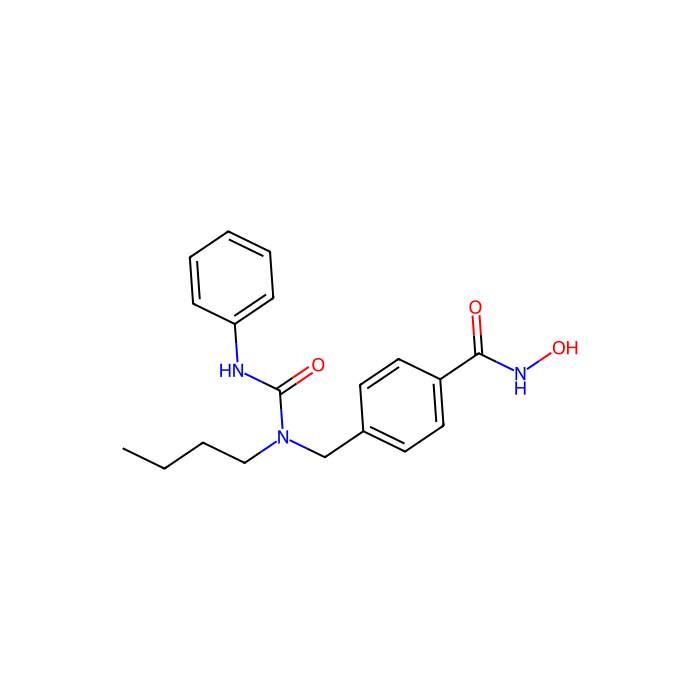
Nexturastat A - Moligand™, ≥98% , Inhibitor of histone deacetylase 1;Inhibitor of histone deacetylase 6, CAS No.1403783-31-2, Inhibitor of histone deacetylase 1;Inhibitor of histone deacetylase 6

CAS: 1403783-31-2 Cat. No.: N349054 Fórmula: C19H23N3O3 Peso molecular: 341.4 Número CE: 859-175-4
Disponível para encomenda
GRADE & PURITY Moligand™ ? Moligand™ — Aladdin's line of ligands and bioactive small molecules. Use for receptor, pathway, and binding studies needing defined small-molecule tools. ≥98%
Synonyms
MFCD28099804 | AKOS026750221 | Nexturastat A | Benzamide, 4-[[butyl[(phenylamino)carbonyl]amino]methyl]-N-hydroxy- | 4-((1-butyl-3-phenylureido)methyl)-N-hydroxybenzamide | N4R | SCHEMBL15289693 | BDBM50398716 | FT-0700450 | s7473 | J-690165 | NCGC0016192
Storage
Store at -20°C
Shipped In
Ice chest + Ice pads
★
Size
Alemanha (EU)
USA*
Price
Qty
1mg
N349054-1mg
—
3 Em stock

8,59€

12,93€
Gravar 4,34 € (33.56%)
5mg
N349054-5mg
—
3 Em stock

18,14€

27,68€
Gravar 9,55 € (34.48%)
25mg
N349054-25mg
—
2 Em stock

65,86€

98,84€
Gravar 32,97 € (33.36%)
100mg
N349054-100mg
—
2 Em stock

209,04€

314,03€
Gravar 105,00 € (33.43%)
Enter a quantity for the sizes you want to add.
🧪
Why this grade

Moligand™, ≥98% Moligand™ for sensitive chromatographic and analytical workflows requiring minimal baseline interference.

🌡

Storage & shipping

Store at -20°C Ships Ice chest + Ice pads Check lot-specific COA for exact specifications.

📋

Quality documents

SDS, COA, datasheet, and spec sheet available for download. Lot-specific COA accessible via lot number lookup.

📚

Literature proof

Cited in 0 peer-reviewed publications across chromatography, organic synthesis, and cross-coupling reactions.

Visão geral

Product Describtion:
Nexturastat A is a highly potent and selective inhibitor of histone deacetylase 6 (HDAC6) with IC50 value of 5 nM.

Product Application:

In B16 murine melanoma cells, Nexturastat A dose-dependently elevated acetyl α-tubulin levels without increasing histone H3 acetylation. Moreover, Nexturastat A potently inhibited the growth of B16 melanoma cells, with the GI50 value of 14.3 μM.

Specifications

Sinónimos
MFCD28099804 | AKOS026750221 | Nexturastat A | Benzamide, 4-[[butyl[(phenylamino)carbonyl]amino]methyl]-N-hydroxy- | 4-((1-butyl-3-phenylureido)methyl)-N-hydroxybenzamide | N4R | SCHEMBL15289693 | BDBM50398716 | FT-0700450 | s7473 | J-690165 | NCGC0016192
Especificações e pureza
Moligand™, ≥98%
Condições de armazenamento de armazenamento
Store at -20°C
Enviado em
Ice chest + Ice pads
Este produto requer transporte de cadeia fria. Serviços terrestres e outros serviços econômicos não estão disponíveis.
Grau
Moligand™
Tipo de ação
INHIBITOR
Mecanismo de ação
Inhibitor of histone deacetylase 1;Inhibitor of histone deacetylase 6
Pureza
≥98%
Nomes e identificadores
Pubchem Sid
Pubchem Sid Url
https://pubchem.ncbi.nlm.nih.gov/substance/504772119
Sorrisos canónicos
CCCCN(CC1=CC=C(C=C1)C(=O)NO)C(=O)NC2=CC=CC=C2
IUPAC Name
4-[[butyl(phenylcarbamoyl)amino]methyl]-N-hydroxybenzamide
InChIKey
JZWXMCPARMXZQV-UHFFFAOYSA-N
INCHI
1S/C19H23N3O3/c1-2-3-13-22(19(24)20-17-7-5-4-6-8-17)14-15-9-11-16(12-10-15)18(23)21-25/h4-12,25H,2-3,13-14H2,1H3,(H,20,24)(H,21,23)
SMILES isoméricas
CCCCN(CC1=CC=C(C=C1)C(=O)NO)C(=O)NC2=CC=CC=C2
Peso molecular
341.4
Reaxy-Rn
23135477
Reaxys-RN_link_address
https://www.reaxys.com/reaxys/secured/hopinto.do?context=S&query=IDE.XRN=23135477&ln=

Documentation

📋 Safety Data Sheet (SDS)

Comprehensive hazard, handling, storage, and regulatory compliance document.

Download SDS →

✅ Certificate of Analysis (COA)

Lot-specific quality data. Enter your lot number to retrieve the exact COA.

Look up COA →

📊 Datasheet

Quick-reference summary of product specifications and applications.

View datasheet →

🔬 Specification Sheet

Full quality attributes and acceptance criteria for this grade.

View spec sheet →

Advanced Data

Taxonomic Classification

Taxonomy Tree

KingdomOrganic compounds
SuperclassBenzenoids
ClasseBenzene and substituted derivatives
SubclassN-phenylureas
Intermediate Tree Nodes Not available
Direct ParentN-phenylureas
Alternative Parents Benzoic acids and derivatives  Benzoyl derivatives  Ureas  Hydroxamic acids  Organonitrogen compounds  Organic oxides  Hydrocarbon derivatives  Carbonyl compounds  
Molecular FrameworkAromatic homomonocyclic compounds
Substituents N-phenylurea - Benzoic acid or derivatives - Benzoyl - Urea - Hydroxamic acid - Carboxylic acid derivative - Organic nitrogen compound - Organic oxygen compound - Organic oxide - Hydrocarbon derivative - Organooxygen compound - Organonitrogen compound - Carbonyl group - Aromatic homomonocyclic compound
DescriçãoThis compound belongs to the class of organic compounds known as n-phenylureas. These are compounds containing a N-phenylurea moiety, which is structurally characterized by a phenyl group linked to one nitrogen atom of a urea group.
External Descriptors Not available
Estrutura 3D
Modelo de Estrutura Química Interativa


Alvos associados (humanos)
HDAC6 Tclin Histone deacetylase 6 (15 Activities)
Activity TypeActivity Value -log(M)Mechanism of ActionActivity ReferencePublications (PubMed IDs)
HDAC1 Tclin Histone deacetylase 1 (7 Activities)
Activity TypeActivity Value -log(M)Mechanism of ActionActivity ReferencePublications (PubMed IDs)
HDAC2 Tclin Histone deacetylase 2 (1 Activities)
Activity TypeActivity Value -log(M)Mechanism of ActionActivity ReferencePublications (PubMed IDs)
HDAC10 Tclin Histone deacetylase 10 (2 Activities)
Activity TypeActivity Value -log(M)Mechanism of ActionActivity ReferencePublications (PubMed IDs)
HDAC8 Tclin Histone deacetylase 8 (4 Activities)
Activity TypeActivity Value -log(M)Mechanism of ActionActivity ReferencePublications (PubMed IDs)
HDAC8 Tclin Histone deacetylase 8 (4516 Activities)
Activity TypeRelationActivity valueUnitsAction TypeJournalPubMed IddoiAssay Aladdin ID
HDAC10 Tclin Histone deacetylase 10 (801 Activities)
Activity TypeRelationActivity valueUnitsAction TypeJournalPubMed IddoiAssay Aladdin ID
HDAC2 Tclin Histone deacetylase 2 (3971 Activities)
Activity TypeRelationActivity valueUnitsAction TypeJournalPubMed IddoiAssay Aladdin ID
HDAC3 Tclin Histone deacetylase 3 (3654 Activities)
Activity TypeRelationActivity valueUnitsAction TypeJournalPubMed IddoiAssay Aladdin ID
HDAC4 Tclin Histone deacetylase 4 (2328 Activities)
Activity TypeRelationActivity valueUnitsAction TypeJournalPubMed IddoiAssay Aladdin ID
HDAC9 Tclin Histone deacetylase 9 (708 Activities)
Activity TypeRelationActivity valueUnitsAction TypeJournalPubMed IddoiAssay Aladdin ID
HDAC11 Tclin Histone deacetylase 11 (967 Activities)
Activity TypeRelationActivity valueUnitsAction TypeJournalPubMed IddoiAssay Aladdin ID
HDAC7 Tclin Histone deacetylase 7 (1047 Activities)
Activity TypeRelationActivity valueUnitsAction TypeJournalPubMed IddoiAssay Aladdin ID
5637 (630 Activities)
Activity TypeRelationActivity valueUnitsAction TypeJournalPubMed IddoiAssay Aladdin ID
MCF7 (126967 Activities)
Activity TypeRelationActivity valueUnitsAction TypeJournalPubMed IddoiAssay Aladdin ID
PC-3 (62116 Activities)
Activity TypeRelationActivity valueUnitsAction TypeJournalPubMed IddoiAssay Aladdin ID
T-24 (2342 Activities)
Activity TypeRelationActivity valueUnitsAction TypeJournalPubMed IddoiAssay Aladdin ID
HepG2 (196354 Activities)
Activity TypeRelationActivity valueUnitsAction TypeJournalPubMed IddoiAssay Aladdin ID
MV4-11 (7307 Activities)
Activity TypeRelationActivity valueUnitsAction TypeJournalPubMed IddoiAssay Aladdin ID
697 (196 Activities)
Activity TypeRelationActivity valueUnitsAction TypeJournalPubMed IddoiAssay Aladdin ID
HDAC6 Tclin Cereblon/Histone deacetylase 6 (114 Activities)
Activity TypeRelationActivity valueUnitsAction TypeJournalPubMed IddoiAssay Aladdin ID
MM1.S (1111 Activities)
Activity TypeRelationActivity valueUnitsAction TypeJournalPubMed IddoiAssay Aladdin ID
Alvos associados (não humanos)
Hdac1 Histone deacetylase 1 (93 Activities)
Activity TypeRelationActivity valueUnitsAction TypeJournalPubMed IddoiAssay Aladdin ID
Hdac5 Histone deacetylase 5 (5 Activities)
Activity TypeRelationActivity valueUnitsAction TypeJournalPubMed IddoiAssay Aladdin ID
Hdac6 Histone deacetylase 6 (222 Activities)
Activity TypeRelationActivity valueUnitsAction TypeJournalPubMed IddoiAssay Aladdin ID
HD1 Histone deacetylase (38 Activities)
Activity TypeRelationActivity valueUnitsAction TypeJournalPubMed IddoiAssay Aladdin ID
B16 (5829 Activities)
Activity TypeRelationActivity valueUnitsAction TypeJournalPubMed IddoiAssay Aladdin ID
rep Replicase polyprotein 1ab (378 Activities)
Activity TypeRelationActivity valueUnitsAction TypeJournalPubMed IddoiAssay Aladdin ID
Mecanismos de ação
Certificados(CoA,COO,BSE/TSE e Mapa de Análise)
C of A & Other Certificates(BSE/TSE, COO):
Analytical Chart:

Find and download the COA for your product by matching the lot number on the packaging.

5 results found

Lot NumberCertificate TypeDataItem
H2213259Certificate of AnalysisMay 13, 2025 N349054
H2213258Certificate of AnalysisMay 13, 2025 N349054
H2213255Certificate of AnalysisMay 13, 2025 N349054
H2213254Certificate of AnalysisMay 13, 2025 N349054
C2508166Certificate of AnalysisJun 14, 2022 N349054
Propriedades químicas e físicas
Solubilidadeinsoluble in H2O; ≥16.3 mg/mL in DMSO; ≥9.3 mg/mL in EtOH
Peso molecular341.400 g/mol
XLogP32.600
Hydrogen Bond Donor Count3
Hydrogen Bond Acceptor Count3
Rotatable Bond Count7
Exact Mass341.174 Da
Monoisotopic Mass341.174 Da
Topological Polar Surface Area81.700 Ų
Heavy Atom Count25
Formal Charge0
Complexity416.000
Isotope Atom Count0
Defined Atom Stereocenter Count0
Undefined Atom Stereocenter Count0
Defined Bond Stereocenter Count0
Undefined Bond Stereocenter Count0
The total count of all stereochemical bonds0
Covalently-Bonded Unit Count1
Calculadoras de soluções
Revisões

Avaliações dos Clientes

Application Protocols

Only information from product data may be listed here.

  • Tested applications, recommended dilutions, and positive controls: Not specified for this item.

Guidance

  • Please refer to the product’s CoA/Specification Sheet and your laboratory’s validated protocols. Literature methods for HDAC activity assays and tubulin acetylation readouts can serve as starting points, but they are not part of the item’s validated specifications.
Biological Roles

Contextual, literature-based description (no medical or clinical claims)

  • Molecular pharmacology

    • Nexturastat A is reported in the literature as a selective inhibitor of histone deacetylase 6 (HDAC6), a cytosolic deacetylase that targets non-histone proteins including α-tubulin, cortactin, and HSP90. The scaffold typically employs a hydroxamate zinc-binding group to chelate the catalytic Zn2+ within the HDAC active site.
  • Cellular pathways impacted (literature/general)

    • Microtubule dynamics: Inhibition of HDAC6 increases acetylated α-tubulin, influencing intracellular transport and cell morphology.
    • Protein quality control: HDAC6 participates in aggresome formation and autophagic clearance; chemical inhibition is used to probe these pathways.
    • Chaperone function: Modulates HSP90 acetylation status, impacting chaperone–client interactions.
  • Research utility

    • Serves as a chemical biology tool to dissect isoform-selective HDAC6 functions compared to nuclear HDACs (e.g., HDAC1/2/3). Selectivity profiles should be verified under laboratory-specific conditions.

Notes

  • Specific target-binding constants, cellular EC50/IC50 values, and selectivity ratios are method-dependent and should be taken from primary literature or determined de novo in your assay system. These are not item specifications.
Buffer Applications

This compound is not a buffering agent. However, appropriate buffer systems are essential for its use in biochemical assays.

General assay buffer considerations (literature/guidance; not item specifications)

  • HDAC activity assays commonly utilize near-neutral buffers (e.g., 25–50 mM HEPES or Tris, pH 7.4–8.0) with 100–150 mM NaCl, 0.01–0.05% Tween-20 to reduce nonspecific binding, and 1 mM TCEP or DTT if reductive stability of the enzyme requires it.
  • Maintain a constant final DMSO percentage (typically ≤0.1–1%) across all wells/tubes.
  • Include BSA (0.1–0.5 mg/mL) if adsorption to plasticware is observed.

Cell-based work (general)

  • Prepare DMSO stocks and dilute into serum-containing media; keep final DMSO low (≤0.1–0.2%) to minimize solvent effects.

Item-specific buffer recipes and compatibilities: Not specified for this item; refer to CoA/Spec Sheet and primary assay protocol references.

Green Alternatives

Not typically applicable. This product is a bioactive small-molecule probe rather than a solvent or bulk reagent where greener process alternatives are normally evaluated.

Pragmatic guidance (general)

  • Minimize DMSO volume and waste by preparing higher-concentration stocks and aliquoting to reduce disposal.
  • Where feasible, implement microscale assays and high-throughput formats to lower solvent consumption.
  • Follow institutional waste-segregation protocols for halogenated vs non-halogenated organics and aqueous/biological waste.

For greener choices in synthetic workflows or extractions, consult solvent replacement guides (e.g., preferring water, ethanol, 2-MeTHF, or CPME depending on application). These considerations are peripheral to this compound’s primary use as a screening probe.

Pharmaceutical Uses

No therapeutic or clinical use is claimed or supported for this catalog item. For research use only.

Relevant non-clinical, laboratory-oriented contexts (general)

  • Reference standard: Can serve as an internal control or benchmark inhibitor in discovery screening and mechanistic studies of HDAC6.
  • Formulation studies (in vitro only): Solubility and stability screening in assorted excipients/solvents to support analytical method development or delivery system research.
  • Analytical development: Use as a positive control in LC/UV or LC–MS method qualification when monitoring HDAC6 inhibitor panels (ensure appropriate response factors are established).

Pharmacopeial status, impurity thresholds, and clinical-quality specifications: Not specified for this item; refer to CoA/Spec Sheet. This product is not manufactured under GMP and is not intended for human or veterinary administration.

Physical Properties

Item-specific specs

  • Appearance: Not specified for this item; refer to CoA/Spec Sheet.
  • Molecular Weight (exact): Not specified for this item; refer to CoA/Spec Sheet.
  • Molecular Formula: Not specified for this item; refer to CoA/Spec Sheet.

Literature/general expectations for small-molecule HDAC inhibitors of this class (guidance; not product specifications)

  • Physical state: Typically isolated as an off-white to light-colored crystalline solid or amorphous solid (literature/generic).
  • Solubility profile: Readily soluble in polar aprotic solvents such as DMSO and DMF; limited aqueous solubility unless co-solvent or surfactant is used (literature/generic).
  • Aqueous handling: Stock solutions are commonly prepared at 10–50 mM in anhydrous DMSO and diluted into assay buffer with ≤0.1–1% final DMSO to maintain solubility (literature/generic).
  • Partitioning: Hydroxamate-bearing inhibitors often display moderate lipophilicity balanced by H-bond donors/acceptors; logP/logD is highly scaffold-dependent (literature/generic).
  • pKa: Hydroxamic acids exhibit characteristic acidity (pKa often in the ~8–9 range for the hydroxamate N–OH; varies with substitution). These are general values from literature and not item specifications.
  • Melting point, boiling point, refractive index, density, UV cutoff: Not specified for this item; refer to CoA/Spec Sheet.

Practical notes (general)

  • For spectroscopic quantitation, determine the compound’s extinction coefficient empirically in the chosen solvent system.
  • Filter or centrifuge diluted working solutions if any visible particulates form upon aqueous dilution (common with hydrophobic inhibitors).
Quality and Grades
  • Grade/Purity designation: Moligand™ (Product Data)

    • Moligand™ denotes inclusion in a small-molecule/compound library suitable for biochemical and cellular screening applications.
    • Typical expectations for library-grade reference compounds include verified identity (e.g., by NMR/HRMS/LC-MS) and assay-compatible purity; however, exact analytical methods and purity thresholds can vary by item and lot.
  • Item-specific quality metrics

    • Purity, residual solvents, water content, metal content, and UV profile: Not specified for this item; refer to CoA/Spec Sheet for lot-resolved data and analytical methods.
    • Stabilizers/inhibitors: Not specified for this item; refer to CoA/Spec Sheet.
  • Implications for use

    • Moligand™ compounds are intended for hit validation, target engagement studies, and assay development where consistent quality and identity are critical.
    • For quantitative biology (e.g., accurate IC50/Ki determination), verify purity by an orthogonal method and record the exact solvent system to reduce variability.
  • Documentation

    • Request the current Certificate of Analysis (CoA) and Specification Sheet for this SKU (N349054) to obtain lot-specific purity, analytical traces, and recommended handling particulars.
  • Compliance note

    • This product is supplied strictly for research use only and not for diagnostic or therapeutic applications.
Reaction and Applications

This product is not typically used as a synthetic reagent or solvent. Instead, it is employed as a research probe in biochemical and cellular studies.

Applicable research uses (literature/general)

  • Target engagement: Widely referenced as a selective HDAC-class probe in enzymology and chemical biology to explore deacetylase function, especially cytosolic HDAC6 (literature).
  • Phenotypic assays: Used to monitor tubulin acetylation and aggresome/autophagy pathways downstream of HDAC6 modulation (literature).
  • Assay development: Serves as a positive control or reference modulator in fluorescence- or luminescence-based HDAC activity assays.

Practical considerations (general)

  • Prepare concentrated DMSO stocks and minimize freeze–thaw cycles.
  • Include solvent-matched vehicle controls.
  • Confirm selectivity and potency under your assay conditions; parameters can shift with enzyme source, substrate, and buffer composition.

If you require a reagent for chemical synthesis or a reaction medium, consider relevant sections for solvents or building blocks; this item is best leveraged in the Biological Roles and Application-focused contexts.

Reaction Conditions

Not typically applicable as a reagent in chemical synthesis. However, for its primary use as a biochemical tool, the following general, literature-informed conditions are common for HDAC enzyme or cell-based assays (not product specifications):

  • Enzymatic assays

    • Buffer: 25–50 mM HEPES or Tris, pH 7.4–8.0; 100–150 mM NaCl; optional 0.01–0.05% Tween-20.
    • Temperature: 25–37°C depending on enzyme source and substrate turnover rates.
    • Solvent: DMSO stocks diluted to ≤0.1–1% final concentration.
    • Incubation: 15–60 min for end-point assays; longer for kinetic reads as needed.
  • Cell-based studies

    • Dosing: Prepare serial dilutions in medium; maintain constant DMSO (often ≤0.1–0.2%).
    • Exposure: 2–24 h typical for acetylated tubulin readouts; verify time courses empirically.
  • Expected outcomes (general)

    • Increased α-tubulin acetylation upon HDAC6 inhibition can be detected by Western blot or IF using acetyl-α-tubulin antibodies (verify with positive/negative controls).

For precise reaction/assay conditions, consult primary literature and optimize for your specific enzyme source, cell line, and detection modality.

Safety and Handling

Safety summary for research use only; always consult the SDS for authoritative guidance.

  • GHS classification, signal word, and hazard statements: Not specified for this item; refer to SDS.
  • Likely hazards (general for small organic inhibitors)
    • May cause skin/eye irritation and respiratory irritation if dust or aerosols are generated.
    • Avoid ingestion, inhalation, and prolonged or repeated contact.
  • Recommended PPE and engineering controls
    • Wear lab coat, safety glasses, and appropriate chemical-resistant gloves.
    • Handle powders/solid aliquoting in a fume hood or ventilated enclosure to minimize dust exposure.
  • Storage and stability (item-specific + general)
    • Store at −20°C (Product Data). Keep container tightly closed and protected from light and moisture.
    • Shipments are supplied cold (ice chest + ice pads) to maintain material integrity.
  • Incompatibilities (general)
    • Avoid strong oxidizing agents and strong acids/bases that may degrade hydroxamate or amide linkages.
    • Protect from prolonged exposure to heat and humidity.
  • First-aid overview (general)
    • Skin/eye contact: Rinse with copious water for at least 15 minutes; remove contaminated clothing.
    • Inhalation: Move to fresh air; seek medical attention if symptoms persist.
    • Ingestion: Rinse mouth; seek medical attention.

Note: This compound is for research use only and not for human or veterinary use. Defer to the product SDS for all hazard classification and emergency procedures.

Solvent Selection

Selection guidance for preparing stocks and working solutions of a hydrophobic small-molecule inhibitor (general/literature-informed; not item specifications):

  • Primary solvent for stocks

    • DMSO (anhydrous) is the standard choice due to high solubility and biological compatibility at low final percentages (≤0.1–1% v/v in assays).
    • DMF can be used for intermediate stocks; however, DMSO is generally preferred for bioassays.
  • Aqueous dilution strategy

    • Prepare concentrated DMSO stock (e.g., 10–50 mM) and dilute into assay buffer with vigorous mixing to avoid local supersaturation.
    • Maintain constant final DMSO across control and treated wells/tubes to avoid solvent artifacts.
  • Co-solvent and surfactant aids (if needed)

    • Small fractions of ethanol or PEG-400 and nonionic surfactants (e.g., 0.01–0.05% Tween-20) can help maintain solubility in certain biochemical or cell-based assays (evaluate compatibility).
  • Buffer compatibility (general)

    • Common HDAC assay buffers are near-neutral pH (e.g., Tris/HEPES ~pH 7.4–8). Avoid strong acids/bases that may hydrolyze hydroxamates.
  • Quick comparison (general)

    • DMSO: highest solvating power; best for screening stocks.
    • Ethanol: miscible with water; lower solvating power; limit final % to minimize cytotoxicity.
    • Aqueous only: often insufficient due to hydrophobicity; may cause precipitation on dilution.

Note: Determine precise solubility and stability empirically for your system and consult the CoA for any item-specific solvent notes.

Storage and Reconstitution
  • Item-specific storage and shipping

    • Storage Conditions: Store at −20°C (Product Data).
    • Shipped In: Ice chest + Ice pads (Product Data).
  • Reconstitution (general best practices; not item specifications)

    • Solvent: Prepare concentrated stock solutions in anhydrous DMSO (e.g., 10–50 mM). The exact solubility for this item is not specified; determine empirically.
    • Aliquoting: Divide stocks into single-use aliquots to avoid repeated freeze–thaw cycles.
    • Handling: Allow frozen aliquots to equilibrate to room temperature before opening to minimize moisture condensation.
    • Dilution: Add DMSO stock to buffer or culture medium with vigorous mixing to avoid precipitation; maintain uniform final DMSO across controls and treatments.
  • Stability notes

    • Protect from light and moisture. Keep tightly sealed under inert atmosphere if long-term storage is anticipated (general recommendation for moisture-sensitive hydroxamates).
    • Product-specific shelf life and stability data: Not specified for this item; refer to CoA/Spec Sheet.

For research use only. Always consult the SDS and CoA for authoritative handling and stability information.

Structure and Identity

Brief overview: Nexturastat A is a small-molecule research compound included in Aladdin’s Moligand screening library category and is widely referenced in the literature as a selective histone deacetylase (HDAC) probe.

  • Item-specific identifiers (Product Data)

    • SKU: N349054
    • Product Name: Nexturastat A
    • CAS: 1403783-31-2
    • PubChem CID: 71462653
    • InChIKey: 174575 (as provided)
    • SMILES: Not specified for this item; refer to CoA/Spec Sheet.
    • Molecular Formula: Not specified for this item; refer to CoA/Spec Sheet.
    • Molecular Weight: Not specified for this item; refer to CoA/Spec Sheet.
  • Structural features (literature/general description)

    • Reported in the literature as an HDAC6-selective inhibitor built on the canonical “cap–linker–zinc-binding group” pharmacophore common to hydroxamate-class HDAC ligands.
    • Typical features described include: an aromatic “cap” region, a heteroatom-containing linker, and a terminal hydroxamic acid that chelates the catalytic Zn2+ in HDAC active sites (literature).
  • 2D structure description (literature/general)

    • Planar/aromatic cap ring system connected through a short amide/alkyl/heteroatom linker to a hydroxamic acid terminus; the hydroxamate O,O-chelating group is oriented to engage Zn2+ within the enzyme pocket. Stereochemistry is generally not central to the reported scaffold (literature).

Note: For definitive structure representation (SMILES/InChI) and exact composition for this specific lot, consult the item’s CoA/Specification Sheet.

Synthetic Utility

This product is supplied as a finished small-molecule probe and is not typically used as a building block in multistep synthesis in routine practice.

General chemical features (literature/generic)

  • Functional groups commonly present in HDAC6 inhibitors of this class include a hydroxamic acid (metal-chelating), amide/urea or ether linkers, and aromatic cap motifs. Hydroxamates can be sensitive to strong acidic or basic hydrolysis and to certain coupling or oxidation conditions.
  • Protection/deprotection: Hydroxamic acids are less commonly used as synthetic handles; if derivatization is required, convert to suitable protected intermediates or prepare analogs upstream.

If your goal is to synthesize analogs or SAR series, consider acquiring starting materials and reagents specific to your designed scaffold; this particular SKU is better deployed as a biological tool compound rather than a synthetic intermediate.

Target Specificity

Only information from product data may be listed here.

  • Target/antigen, epitope, species reactivity, clone/isotype: Not specified for this item in the Product Data.

Note: Although Nexturastat A is widely discussed in the literature as an HDAC6-selective inhibitor, no target specificity data are provided within this catalog entry. Users should consult primary literature or generate in-house profiling data for their application.

Shall we send you a message when we have discounts available?

Remind me later

Thank you! Please check your email inbox to confirm.

Oops! Notifications are disabled.