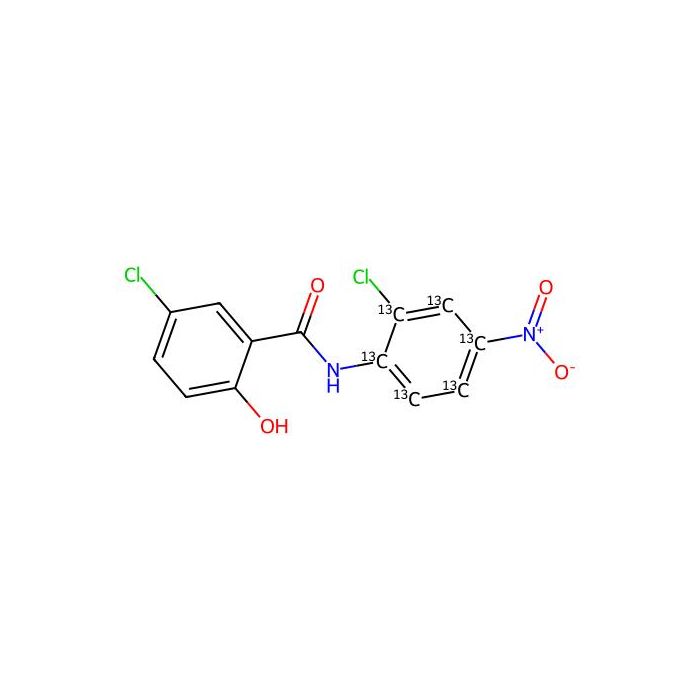
Niclosamide- 13 C 6 is the 13 C 6 labeled Niclosamide. Niclosamide (BAY2353) is an orally bioavailable chlorinated salicylanilide, with anthelmintic and potential antineoplastic activity. Niclosamide (BAY2353) inhibits STAT3 with IC50 of 0.25 μM in HeLa cells and inhibits DNA replication in a cell-free assay.
In Vitro
Stable heavy isotopes of hydrogen, carbon, and other elements have been incorporated into drug molecules, largely as tracers for quantitation during the drug development process. Deuteration has gained attention because of its potential to affect the pharmacokinetic and metabolic profiles of drugs. MCE has not independently confirmed the accuracy of these methods. They are for reference only.
Form:Solid
Especificações
Especificações e pureza
≥99%
Mecanismos bioquímicos e fisiológicos
Niclosamide- 13 C 6 is the 13 C 6 labeled Niclosamide. Niclosamide (BAY2353)xa0is an orally bioavailable chlorinated salicylanilide, with anthelmintic and potential antineoplastic activity. Niclosamide (BAY2353) inhibits STAT3 with IC50 of 0.25 μM in HeLa
Condições de armazenamento de armazenamento
Store at -20°C
Enviado em
Ice chest + Ice pads
Este produto requer transporte de cadeia fria. Serviços terrestres e outros serviços econômicos não estão disponíveis.
Tipo de ação
INHIBITOR
Pureza
≥99%
Nomes e identificadores
Peso molecular
333.08
Dados avançados
Certificados(CoA,COO,BSE/TSE e Mapa de Análise)
C of A & Other Certificates(BSE/TSE, COO):
Analytical Chart:
Calculadoras de soluções
Molarity Calculator
Determine the necessary mass, volume, or concentration for preparing a solution.
Dilution Calculator
Determine the dilution needed to prepare a stock solution.
Reconstitution Calculator
Revisões
Avaliações dos Clientes
Application Protocols
No vendor-tested bioassay protocols or dilutions are specified for this item.
General LC–MS/MS internal standard workflow (informational):
Stock preparation: Dissolve at 1–10 mM in anhydrous DMSO. Store aliquots at −20 °C.
Spiking: Add a fixed volume of Niclosamide-13C6 to each calibrator, QC, and unknown sample prior to extraction (typical final 1–50 ng/mL, adjust to method sensitivity).
Extraction: Protein precipitation with ACN or MeOH (3–5× volume), or SPE using reversed-phase cartridges; ensure consistent recovery across matrices.
Chromatography: Reversed-phase C18; mobile phase water/ACN with 0.1% formic acid or ammonium formate (2–10 mM). Gradient to 70–90% ACN over 5–10 min.
MS detection: Negative or positive ESI depending on method; monitor MRM for analyte vs +6 Da internal standard. Optimize cone/fragmentor settings for maximum response.
These steps are offered as general guidance only; verify and validate under your laboratory’s conditions.
Biological Roles
Contextual information for the unlabeled parent (niclosamide), provided for research planning; not a claim about this product’s use in humans or animals.
Mechanistic themes (literature):
Acts as a mitochondrial uncoupler and modulator of cellular bioenergetics in various model systems.
Interacts with multiple cellular pathways (e.g., Wnt/β-catenin, NF-κB) in biochemical studies; effects are context-dependent.
Displays membrane-associated and protonophoric behavior attributed to the phenolic/amide framework.
Relevance of 13C6 label (research utility):
Enables accurate mass-balance studies of niclosamide in cells, tissues, or environmental samples via isotope-dilution LC–MS.
Supports metabolic profiling: detection of phase II conjugates (e.g., glucuronides/sulfates) while preserving a clear internal-standard signal shifted by +6 Da.
Stability/biotransformation notes (general):
Phenolic conjugation (UGT/SULT pathways) is typically observed in biological matrices; the amide is relatively stable under physiological conditions (literature).
This section is informational for biochemical research design only. No medical or clinical claims are made.
Buffer Applications
Not typically applicable. Niclosamide-13C6 is a hydrophobic analytical standard rather than a buffering agent.
Practical lab note:
When preparing solutions for bioassays or LC–MS, dissolve first in DMSO or DMF and then dilute into the desired buffer (e.g., PBS, ammonium formate/acetate with 0.1% formic acid) keeping final organic ≤1% to prevent precipitation and maintain chromatographic compatibility.
Green Alternatives
This product is an isotopically labeled analytical standard; the key green-chemistry lever is solvent selection and sample preparation rather than substitution of the analyte.
Greener solvent considerations (general):
Prefer acetonitrile or methanol (widely managed, recyclable in LC labs) over chlorinated solvents.
For dissolution, DMSO is often necessary; minimize its use by preparing concentrated stocks and diluting into ACN/H2O or MeOH/H2O.
Consider ethanol/water extraction for simple matrices when sensitivity allows, though solubility of niclosamide may be limiting.
Small comparison (general):
DMSO: highest solvency; high boiling point complicates waste reduction.
MeOH/ACN: lower toxicity profiles (relative to DMF/DMF alternatives), facile recovery via distillation in centralized systems.
Process improvements:
Miniaturize extraction (µSPE/µQuEChERS) to reduce solvent volumes.
Use on-line SPE with aqueous-compatible loading to cut organic solvent usage.
Implement closed-loop solvent recycling for LC–MS mobile phases.
Note: There is no “green substitute” for the labeled analyte itself; environmental footprint is best addressed via prudent solvent and consumables management.
Pharmaceutical Uses
No therapeutic claims are made. This product is for research use only.
Formulation and analytical roles (general):
Isotopically labeled internal standard for QC/analytical method validation of niclosamide drug substance or drug product by LC–MS/MS.
Supports process development studies: recovery through extraction steps, stability-indicating methods, and leachable/extractable interference assessment by co-elution tracking.
Niclosamide (unlabeled) is described in pharmacopeial monographs in some jurisdictions; isotope-labeled analogs are typically referenced in analytical method appendices where isotope-dilution is employed. Consult method-specific guidance.
Practical notes:
Match matrix and sample prep between calibration standards and test articles; spike Niclosamide-13C6 prior to extraction for the most robust quantitation.
Document isotopic enrichment and purity on analytical certificates for regulatory submissions.
Physical Properties
Item-specific specifications (this lot):
Appearance: Not specified for this item; refer to CoA/Spec Sheet.
Grade/Purity: Not specified for this item; refer to CoA/Spec Sheet.
Literature/parent-compound properties (niclosamide; for context only — not item specs):
Molecular formula (unlabeled niclosamide): C13H8Cl2N2O4 (literature)
Solubility: sparingly soluble in water; soluble in DMSO, DMF, and moderately in ethanol/methanol (literature)
logP (octanol/water): ~4.2 (literature)
pKa (phenolic OH): ~6.5–7.5; amide is non-basic (literature)
UV-Vis: strong absorption in near-UV due to nitro-phenyl and amide conjugation (literature)
Isotopic-label considerations (general):
The 13C6 isotopologue preserves melting behavior and partitioning within experimental error; exact monoisotopic mass increases by +6.000 u relative to the 12C parent.
Practical notes for use (general):
Prepare concentrated stocks (e.g., 1–10 mM) in anhydrous DMSO or DMF to aid handling of sparingly soluble solids.
Filter stock solutions (0.2 µm PTFE) for LC–MS applications to remove particulates.
Always rely on the product’s CoA/Spec Sheet for item-specific numerical specifications.
Quality and Grades
Item-specific quality declarations:
Grade/Purity: Not specified for this item; refer to CoA/Spec Sheet.
How to interpret typical grades for isotope-labeled reference materials (general guidance):
Reference/Analytical grade: Emphasizes isotopic enrichment (e.g., 13C %), chemical purity (area % by HPLC/UPLC), and residual solvent limits. Low levels of unlabeled analyte and positional isomer impurities are critical for quantitative LC–MS.
Isotopic enrichment: Reported as atom % 13C and distribution of isotopologues (M+6, M+5, etc.). High enrichment (>98 atom % for the labeled positions) minimizes isotopic interference in isotope-dilution assays.
Identity confirmation: Typically supported by HRMS (exact mass shift), 1H/13C NMR (isotopic pattern), and chromatographic purity.
What to look for on the CoA (specific to this type of item):
Chemical purity (HPLC/UPLC area %), isotopic enrichment profile, water content (Karl Fischer), residual solvents, and counter-ion/trace inorganics if relevant.
Stability data for frozen storage and after reconstitution (DMSO, MeOH).
Stabilizers:
None are specified for this item. If a stabilizer is present, it will appear on the CoA/Spec Sheet and may affect UV/LC detection backgrounds.
Reaction and Applications
Primary application focus for Niclosamide-13C6 is as an isotopically labeled internal standard rather than as a synthetic reagent.
Analytical applications (general):
Isotope-dilution LC–MS/MS quantitation of niclosamide in complex matrices (biological samples, environmental, formulation). The +6 Da mass shift enables clean MRM transitions that track extraction and ionization variability.
Method development: assessment of matrix effects, recovery, and process efficiency by spiking known amounts of Niclosamide-13C6 prior to extraction.
Chemical reactivity context (parent compound):
Functional groups include phenolic OH (acidic, can form salts/esters), aryl amide (stable, hydrolysis-resistant under mild conditions), nitro- and chloro-arenes (electron-withdrawing).
Derivatization is uncommon for routine analytics but possible: phenolic O-acylation/silylation to improve volatility for GC; however, LC–MS is preferred due to polarity and thermal lability (literature/general).
Practical tips:
Protect from strong base during long incubations to avoid amide or phenolic transformations that could decouple the internal standard from the analyte’s behavior.
Match the chemical form (free base vs salt) between analyte and internal standard where possible to minimize retention time shifts.
Reaction Conditions
As an analytical internal standard, Niclosamide-13C6 is not typically subjected to preparative reactions. The following guidance addresses handling in solution and optional derivatization for specific analytical platforms.
General solution handling:
Solvents: DMSO, DMF for stock solutions; MeOH or ACN for working dilutions compatible with LC–MS (literature/general).
Temperatures: Room temperature dissolution; gentle warming (≤40 °C) and sonication can assist solubilization.
Light/moisture: Protect from prolonged light exposure; store aliquoted under inert headspace if long-term solution storage is required.
Optional derivatization (if GC analysis is mandatory; literature):
Phenolic silylation (e.g., BSTFA + 1% TMCS) at 60–70 °C for 15–30 min to improve volatility; verify that derivatization is mirrored for unlabeled analyte to maintain co-elution and ion ratios.
MRM transitions using the +6 Da precursor typically show similar collision-induced fragmentation patterns; collision energies and declustering potentials can be transferred from the unlabeled method with minor optimization.
Note: These are general literature-guided conditions for analytical workflows, not item-specific specifications.
Safety and Handling
Authoritative safety classification for this item is not specified here; consult the SDS for Niclosamide-13C6.
GHS/CLP (item-specific):
Signal Word: Not specified for this item; refer to SDS.
Hazard Statements, Pictograms, Classification: Not specified for this item; refer to SDS.
General hazards based on niclosamide chemistry (informational only):
Aromatic nitro and chlorinated salicylanilide structures may present hazards such as eye/skin irritation and aquatic toxicity (literature/general). Avoid inhalation of dust.
Combustible dust can form if finely divided; handle powders gently in a fume hood.
Recommended PPE and engineering controls (good laboratory practice):
Wear lab coat, nitrile gloves, and splash-resistant safety glasses.
Handle solids and solution prep in a certified chemical fume hood.
Use anti-static precautions when weighing fine powders.
Storage and incompatibilities:
Storage (item-specific): Store at −20 °C.
Keep container tightly closed, protected from light and moisture. Warm to room temperature in a desiccator before opening to minimize condensation.
Avoid strong oxidizers and strong bases that can promote hydrolysis of aryl amides (general).
First aid (overview; defer to SDS):
Skin/eye contact: Rinse with water for several minutes; remove contaminated clothing.
Inhalation: Move to fresh air; seek medical attention if symptoms occur.
Ingestion: Rinse mouth; seek medical advice. Provide SDS to responders.
Solvent Selection
For a hydrophobic, weakly acidic salicylanilide like Niclosamide-13C6, solvent choice primarily supports analytical preparation and assay compatibility.
Preferred solvents (general):
DMSO or DMF: excellent solvents for initial stock solutions (high solvency for aryl amides); miscible with water and organic mobile phases.
Methanol or acetonitrile: suitable for LC–MS working solutions; may require sonication to dissolve from solid.
Avoid pure aqueous media due to very low aqueous solubility of the parent compound.
Prepare a concentrated DMSO stock (e.g., 1–10 mM), then dilute at least 100× into aqueous-organic mixtures (e.g., 50:50 ACN:H2O + 0.1% FA) to keep final DMSO ≤1% for LC–MS or biochemical assays.
Warm (≤40 °C) and sonicate to assist dissolution; avoid prolonged heating.
Comparison (general):
DMSO vs MeOH: DMSO provides highest solubility; MeOH/ACN give cleaner LC–MS baselines and faster evaporation. A common strategy is dissolution in DMSO followed by dilution into ACN/H2O for injection.
Storage and Reconstitution
Storage conditions (item-specific): Store at −20 °C.
Shipping (item-specific): Shipped in an ice chest with ice pads to maintain cold chain.
Long-term handling (general best practice for small-molecule standards):
Keep tightly capped in a desiccated environment; allow the vial to reach room temperature before opening to prevent condensation.
Prepare single-use aliquots of concentrated stock solutions (e.g., 1–10 mM in anhydrous DMSO or DMF) and store at −20 °C or below. Minimize freeze–thaw cycles.
For working solutions, dilute into MeOH, ACN, or aqueous-organic mobile phases immediately before use. Store short-term (hours to a few days) at 2–8 °C, protected from light.
Inspect solutions for precipitation or discoloration before use; discard if degradation is suspected.
Reconstitution (if supplied as solid):
Open vial in a dry environment; weigh quickly.
Add calculated volume of solvent to reach target concentration; mix by gentle vortex and brief sonication if needed.
Always refer to the product’s CoA/Spec Sheet for any item-specific guidance on solvent choices, concentration limits, and stability.
Structure and Identity
Isotopically labeled salicylanilide featuring six 13C atoms for mass spectrometry workflows; same connectivity as niclosamide.
Item-specific identifiers:
CAS: 1325808-64-7 (product-specific)
SKU: N647673
InChIKey: Not specified for this item; refer to CoA/Spec Sheet.
SMILES: Not specified for this item; refer to CoA/Spec Sheet.
Molecular Formula: Not specified for this item; refer to CoA/Spec Sheet.
Molecular Weight: Not specified for this item; refer to CoA/Spec Sheet.
Structural features (literature, niclosamide parent):
Core scaffold: salicylanilide (benzamide linking two substituted phenyl rings)
Functional groups: phenolic OH (ortho to amide), amide (–NH–C(=O)–), para-nitro (–NO2), two aryl chlorides (one on each ring)
Ring systems: two para- and ortho-substituted benzene rings connected via anilide linkage
“13C6” indicates six carbons are 13C-enriched; connectivity and functional groups are identical to unlabeled niclosamide.
The 13C substitution yields predictable mass shifts (+6.000 u relative to the 12C parent) useful for isotope-dilution quantitation.
2D description in words (general):
An amide carbonyl links a 2-hydroxy-5-chlorobenzoyl ring to an aniline ring bearing ortho-chloro and para-nitro substituents; phenolic OH is ortho to the carbonyl.
Synthetic Utility
While primarily an analytical standard, understanding the parent compound’s reactivity informs stability and derivatization strategies.
Functional group behavior (general, niclosamide parent):
Phenolic OH: weak acid; can be protected (e.g., silyl/benzyl ethers) or derivatized (acylation, carbamate formation) if needed for specific analytical methods (e.g., GC amenable derivatives).
Amide: robust under neutral conditions; hydrolyzes only under strong acid/base or prolonged heating.
Nitro- and chloro-arenes: strongly deactivating; generally inert to electrophilic substitution but can participate in nucleophilic aromatic substitution (SNAr) under forcing conditions.
Utility of the 13C6 label:
Tracer for mass balance in synthetic campaigns involving niclosamide (e.g., salt formation, polymorph screening) without altering chemical behavior.
Internal reference to monitor side reactions (O- vs N-acylation, unintended hydrolysis) by LC–MS through distinct MRM channels.
Takeaway:
For most labs, the greatest "synthetic" value is as a rigorously behaved internal standard mirroring the analyte throughout sample workup and analysis.
Target Specificity
Not applicable. Niclosamide-13C6 is a small-molecule analytical standard and does not possess antigen/epitope-based specificity typical of biological affinity reagents.
Perguntas frequentes
What documentation is provided?
Available product documentation, including Certificates of Analysis (COA), Safety Data Sheets (SDS), and specification sheets, is shown in the product document area. Document availability and access follow the current site policy.
What is the purity of this product?
This product is supplied at ≥99% purity (chemical assay). Lot-specific values are stated on the Certificate of Analysis.
How should this product be stored?
Store at ?20 °C. Freezer storage is required to maintain the specified shelf life.
How is this product shipped?
This product ships in an insulated container with ice pads. Unpack on arrival and transfer it to the storage condition stated above.
What are the CAS number, molecular formula and molecular weight?
The CAS Number is 1325808-64-7, the molecular formula is C7[13C]6H8Cl2N2O4, and the molecular weight is 333.08 g/mol.
Usamos cookies para garantir o funcionamento adequado do site e, quando permitido, para melhorar a sua experiência. Você pode gerenciar suas preferências a qualquer momento nas Configurações. Saiba mais em nossa Política de Cookies.
Deseja que lhe enviemos uma mensagem quando tivermos descontos disponíveis?
Lembrar-me mais tarde
Obrigado! Por favor, verifique a sua caixa de entrada de e-mail para confirmar.
Products are supplied to verified businesses, institutions, and qualified professionals for research and development use only. Not for use in humans, animals, diagnosis, or therapy.