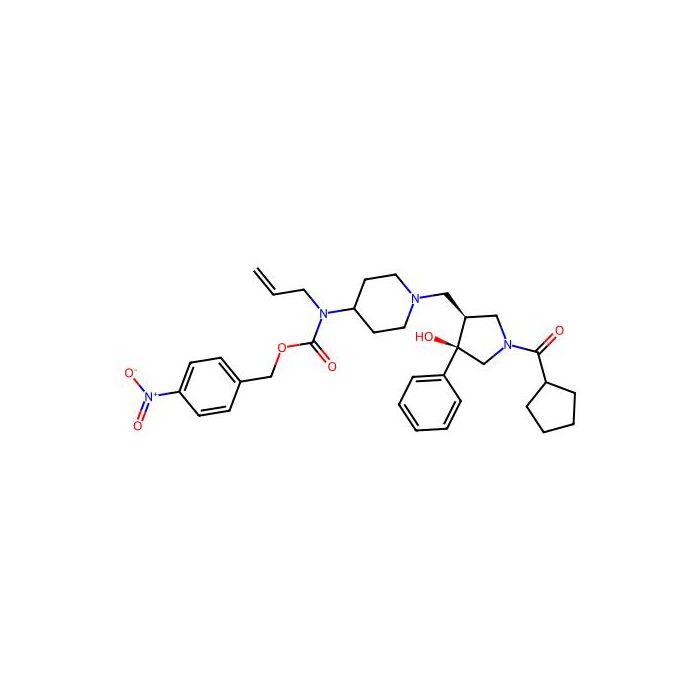
This compound belongs to the class of organic compounds known as phenylpyrrolidines. These are polycyclic aromatic compounds containing a benzene ring linked to a pyrrolidine ring through a CC or CN bond. Pyrrolidine is a five-membered saturated aliphatic heterocycle with one nitrogen atom and four carbon atoms.
External Descriptors
Not available
1. Djoumbou Feunang Y, Eisner R, Knox C, Chepelev L, Hastings J, Owen G, Fahy E, Steinbeck C, Subramanian S, Bolton E, Greiner R, and Wishart DS. ClassyFire: Automated Chemical Classification With A Comprehensive, Computable Taxonomy. Journal of Cheminformatics, 2016, 8:61.
DMSO : 95 mg/mL (160.82 mM; Need ultrasonic) H2O : <0.1 mg/mL (ultrasonic;warming;heat to 60°C) (insoluble)
Peso molecular
590.700 g/mol
XLogP3
4.400
Hydrogen Bond Donor Count
1
Hydrogen Bond Acceptor Count
7
Rotatable Bond Count
10
Exact Mass
590.31 Da
Monoisotopic Mass
590.31 Da
Topological Polar Surface Area
119.000 Ų
Heavy Atom Count
43
Formal Charge
0
Complexity
961.000
Isotope Atom Count
0
Defined Atom Stereocenter Count
2
Undefined Atom Stereocenter Count
0
Defined Bond Stereocenter Count
0
Undefined Bond Stereocenter Count
0
The total count of all stereochemical bonds
0
Covalently-Bonded Unit Count
1
Calculadoras de soluções
Molarity Calculator
Determine the necessary mass, volume, or concentration for preparing a solution.
Dilution Calculator
Determine the dilution needed to prepare a stock solution.
Reconstitution Calculator
Revisões
Avaliações dos Clientes
Application Protocols
No tested application protocols (e.g., specific assay formats, concentrations, or instrument settings) are provided for this item.
Recommended dilutions, positive controls, or experimental conditions: Not specified for this item; refer to CoA/Spec Sheet and primary literature.
General non-binding guidance
Prepare validated stock solutions (e.g., in DMSO) and perform concentration–response studies spanning at least 3–4 logs.
Include vehicle-only controls and, where relevant, orthogonal assay formats to confirm activity and mitigate false positives.
Please consult peer-reviewed literature associated with CAS 934740-33-7 and your internal SOPs to develop and validate application-specific protocols.
Biological Roles
Item-specific biological target and mechanism are not provided in this listing.
Target specificity: Not specified for this item; consult primary literature via CAS 934740-33-7 and PubChem CID 16663418 for curated annotations.
Research context (general): Small-molecule library compounds are commonly used to modulate proteins such as GPCRs, ion channels, transporters, or enzymes, enabling interrogation of signaling pathways, receptor pharmacology, and phenotypic outcomes in cells or biochemical systems.
Practical considerations for biological studies (general)
Establish compound activity with an orthogonal assay pair (e.g., binding and functional readouts) to minimize assay-artifact risk.
Verify time-dependence and reversibility of effects; confirm concentration–response relationships (full curves over ≥10 concentrations).
Control for DMSO or other vehicle effects; maintain constant solvent content across all wells or samples.
Assess basic ADME-relevant attributes experimentally as needed for your system: stability in buffer and microsomes, permeability (e.g., PAMPA/MDCK), and nonspecific binding to plastic or serum proteins.
Data integrity
Include internal calibrants and reference standards where available to benchmark activity and confirm compound identity during longitudinal studies.
All biological uses are for research purposes only; no clinical or diagnostic use is intended or implied.
Buffer Applications
Nifeviroc is not a buffering agent. However, preparation of assay-ready solutions often involves dilution of an organic stock into aqueous buffers.
General buffer practices for small-molecule assays
Vehicle: Prepare concentrated DMSO stocks (e.g., 10–50 mM) after confirming solubility, then dilute into the assay buffer (e.g., PBS, HEPES, HBSS, or assay-specific media) while maintaining a constant final DMSO fraction (typical 0.1–0.5% v/v; verify tolerance).
Order of addition: Add compound stock last to a pre-warmed, vigorously mixed buffer or cell medium to minimize local supersaturation and precipitation.
Surfactants: Low levels of non-ionic surfactants (e.g., 0.01–0.05% Tween-20 or Pluronic F-68) can mitigate aggregation or adsorption; confirm that surfactant does not interfere with the readout.
Protein carriers: For highly hydrophobic compounds, 0.1–0.5% BSA can improve apparent solubility and reduce plastic adsorption; verify impact on binding/assay kinetics.
pH control: Use a buffer system aligned with your biological assay (e.g., HEPES 20–25 mM for near-neutral pH stability). Avoid drastic pH shifts when introducing DMSO stocks.
Quality control
Visual inspection and nephelometry/DLS can detect precipitation or aggregation.
Prepare fresh working solutions daily unless stability data support longer use.
Item-specific buffer recipes or stability windows are not provided for this product; consult your internal method development data.
Green Alternatives
As a discrete bioactive compound, Nifeviroc has no direct “green alternative.” Sustainability opportunities relate to the workflow (solvents, scale, and waste) used for handling and analysis.
Greener handling suggestions (general)
Prefer aqueous buffers with minimal DMSO (e.g., ≤0.1–0.5% v/v) where assay performance allows.
Choose lower-toxicity, more sustainable organic solvents for sample prep when feasible (e.g., ethanol or isopropanol instead of chlorinated solvents). Confirm analyte solubility and stability first.
Miniaturize assays (96/384/1536-well) to reduce compound and solvent consumption.
Consolidate analytical runs and use shorter UHPLC methods to reduce solvent waste.
Illustrative comparison (workflow-focused)
DMSO vs DMF/NMP for stock solutions: DMSO is generally preferred from both EHS and assay-compatibility perspectives; DMF/NMP should be reserved for difficult solubilization cases and used at the smallest practical volumes.
ACN vs MeOH in LC: MeOH is typically less hazardous and has a lower carbon footprint per liter, but ACN can deliver sharper peaks. Select based on method performance and waste profile.
Waste management
Segregate halogenated from non-halogenated waste streams to facilitate appropriate disposal.
Use high-recovery vials and minimal dead volumes to reduce solvent-intensive rinsing.
All changes should be validated to ensure no compromise to data quality or compound integrity.
Pharmaceutical Uses
No pharmacopeial monograph or excipient role is specified for this item. This product is supplied strictly for research use only.
Relevant non-clinical, pre-formulation, and analytical contexts (general)
Reference standard: Can be used as a research standard for LC/UPLC method development, system suitability, and retention-time/ion-ratio confirmation, provided identity and purity are verified against the CoA and in-house criteria.
Impurity/degradation studies: Useful for stress-testing analytical methods (acid/base, oxidative, thermal, photolytic) to map degradation pathways and develop stability-indicating assays; ensure safe handling and proper waste disposal.
Solubility/permeability screens: May support discovery-stage assessments (shake-flask solubility, kinetic solubility, PAMPA/MDCK) to understand assay feasibility.
Solid-form work: If sufficient quantity is available, polymorph and salt-screening experiments can be conducted to evaluate physical stability for in vitro research materials.
Regulatory note
This compound is not intended for human or veterinary use, drug substance/intermediate manufacturing, or clinical diagnostic applications.
Documentation
No item-specific pharmaceutical specifications are provided; consult the CoA/SDS and applicable internal SOPs before use as a reference or system suitability material.
Physical Properties
Item-specific physicochemical properties are not provided in this listing.
Appearance: Not specified for this item; refer to CoA/Spec Sheet.
Melting point (MP): Not specified for this item; refer to CoA/Spec Sheet.
Boiling point (BP): Not specified for this item; refer to CoA/Spec Sheet.
Density: Not specified for this item; refer to CoA/Spec Sheet.
Solubility: Not specified for this item; refer to CoA/Spec Sheet.
LogP, pKa, refractive index: Not specified for this item; refer to CoA/Spec Sheet.
General laboratory guidance (literature/practice)
Many bioactive small molecules are prepared as concentrated DMSO stocks (e.g., 10–50 mM) and diluted into aqueous assay buffers; actual solubility must be verified experimentally for Nifeviroc.
If solid at room temperature (common for library compounds), determine solubility by tiered solvent screening: DMSO, DMF, ethanol, acetonitrile, followed by buffered aqueous mixtures with co-solvent (≤1–2% v/v DMSO typically favored for biological assays).
Hygroscopicity and light sensitivity: Storage requirements below indicate protection from light and desiccation; handle quickly in low humidity to minimize moisture uptake and potential degradation.
Analytical characterization (general)
Establish an HPLC or UPLC purity method with diode-array and MS detection to assess purity, degradants, and solubility behavior.
For quantitative solution work, determine extinction coefficients (if UV-active) in relevant solvents by Beer–Lambert validation.
Quality and Grades
Grade/Purity: Not specified for this item; refer to CoA/Spec Sheet.
How to interpret quality for a screening-compound listing (general guidance)
Library/screening quality: Vendors commonly provide high chemical purity (e.g., ≥95% by HPLC) for small-molecule bioactives; however, acceptance criteria, chromatographic methods, and detection wavelengths vary. Rely on the specific CoA for this lot.
Identity confirmation: CoA typically includes LC–MS and/or HRMS; NMR spectra may be provided or available on request. Establish in-house reference data if you will use the compound for quantitative bioassays or as a system suitability standard.
Stabilizers/additives: Not specified for this item; if present, they will be listed on the CoA/SDS and may influence UV background, MS ionization, or assay readouts.
Impurity considerations: Trace residual solvents, inorganic salts, or closely related synthetic impurities can affect sensitive assays. Review the CoA impurity profile and, if necessary, perform a brief pre-use purification (e.g., prep-HPLC) to meet internal specifications.
Batch-to-batch comparability: For long-term projects, procure contiguous lots or reserve material from a single lot. Confirm assay performance equivalence upon lot change with a small bridging study.
Documentation supplied
CoA and SDS: The authoritative sources for purity, identity, and safety data. Contact Aladdin Scientific support with the SKU (N651083) for documentation requests.
Reaction and Applications
This product is offered as a bioactive/screening small molecule rather than a general-purpose synthetic reagent.
Synthetic reaction use: Not typically used as a stoichiometric reagent, catalyst, or solvent. No item-specific reaction roles are provided.
Research applications (general, non-clinical): Suitable for target-based or phenotypic screening, SAR benchmarking, QC system suitability testing, and as a spiking standard for analytical method development.
Mechanistic studies: Can serve as a tool compound candidate in receptor/ligand binding, signal modulation, or pathway interrogation, subject to verification of the specific biological target from primary literature linked to the provided CAS/CID.
Good laboratory practices
Verify identity and purity by LC–MS/NMR before use in quantitative assays.
Perform solubility checks and establish maximum tolerated co-solvent concentrations for the biological system of interest.
Include vehicle controls and, when available, orthogonal positive/negative controls to deconvolute off-target or assay-interference effects.
If you intend to incorporate Nifeviroc into a chemical reaction (e.g., derivatization for probe synthesis), validate compatibility and stability under the proposed conditions, as library compounds may contain functional groups sensitive to strong acids/bases, oxidants, or high temperatures.
Reaction Conditions
Not applicable. This product is supplied as a discrete bioactive/screening compound rather than a reagent or catalyst, and no item-specific reaction conditions are provided.
If researchers plan to derivatize or conjugate Nifeviroc for probe development (general guidance):
Begin with micro-scale trials (≤1–5 mg) to assess stability to proposed conditions (acid/base, oxidants/reductants, heat).
Use anhydrous, oxygen-free conditions if literature suggests sensitivity; employ inert atmosphere and low light consistent with the storage guidance.
Monitor by LC–MS for selectivity and degradation, and confirm identity by NMR/HRMS of isolated products.
For routine laboratory use in screening and assays, focus on solution preparation and stability rather than chemical reaction conditions.
Safety and Handling
Hazard classification for this specific item is not provided in the listing.
GHS classification, pictograms, signal word, H-statements: Not specified for this item; refer to COA/SDS.
Research use note: For research use only.
General laboratory precautions (defer to SDS for authoritative guidance)
PPE: Use safety glasses, lab coat, and appropriate chemically resistant gloves. Work in a fume hood to avoid inhalation of dusts/aerosols or solvent vapors during solution preparation.
Light and moisture sensitivity: The product is to be protected from light and stored desiccated; minimize exposure during handling, weigh rapidly, and cap promptly.
Incompatibilities: Avoid strong oxidizers and strong acids/bases unless a controlled reaction or stability study is intended. Keep away from ignition sources when using flammable solvents (e.g., DMSO, DMF, MeCN, EtOH mixtures).
First aid (overview; consult SDS): In case of skin/eye contact, rinse with water for at least 15 minutes and remove contaminated clothing. If inhaled, move to fresh air. If ingested, rinse mouth and seek medical attention.
Spill/accidental release: Avoid dust formation. Adsorb solutions with inert material (e.g., vermiculite) and dispose of in accordance with institutional and local regulations.
Waste: Collect solutions/solids as hazardous organic waste in properly labeled containers.
Always consult the product-specific SDS prior to first use for complete hazard and response information.
Solvent Selection
Item-specific solubility data are not provided. The following best practices apply to many hydrophobic/neutral small-molecule library compounds.
Primary stock preparation
DMSO is typically the first-choice solvent for concentrated stocks (e.g., 10–50 mM), owing to broad solvency and compatibility with many biological assays at ≤0.1–1.0% v/v final DMSO.
Alternatives for challenging solubility: DMF or NMP for initial dissolution, followed by dilution into DMSO to create a handling-friendly stock. Validate assay tolerance to these solvents.
Aqueous assay dilution
Pre-warm buffers (e.g., PBS, HBSS, assay-specific buffers) to room temperature and add compound stocks slowly with mixing to minimize precipitation.
Keep final co-solvent low and constant across controls and test wells (common ranges 0.1–0.5% v/v DMSO).
Miscibility and polarity considerations (general)
DMSO: Highly polar, HBD/HBA, miscible with water and most organics; often ideal for library compound stocks.
Ethanol/MeOH: Useful for UV or MS workflows; biological tolerance varies by system.
Acetonitrile: Volatile and MS-friendly; poor water tolerance for some hydrophobes when diluted rapidly—mix gradually.
Small comparison (guidance)
DMSO vs EtOH: DMSO provides superior solvency for many drug-like solids and less volatility; ethanol offers faster drying in analytical prep but may limit achievable stock concentration.
Always confirm Nifeviroc’s actual solubility and stability in chosen solvents empirically before committing to assays.
Storage and Reconstitution
Item-specific storage requirements are provided and should be strictly followed to maintain integrity.
Storage conditions (as provided)
Protect from light.
Store at −20°C.
Keep desiccated.
Shipped in an ice chest with ice pads.
Practical guidance
Upon receipt: Allow the sealed container to equilibrate to room temperature before opening to avoid moisture condensation. Open quickly in a low-humidity environment.
Aliquoting: If solid, aliquot promptly to minimize repeated freeze–thaw and moisture exposure. If a DMSO stock is prepared, distribute into single-use aliquots (e.g., amber vials or 96-well plates) and store at −20°C, protected from light.
Freeze–thaw: Minimize cycles. Thaw on ice or at room temperature, mix gently, and promptly return unused material to storage. Avoid repeated warming of the bulk container.
Reconstitution: Solvent choice is assay-dependent; DMSO is commonly used for initial dissolution. Filter through a 0.22 µm PTFE or PVDF filter if particulate is observed and if compatible with your study.
Stability: No item-specific stability data are provided; prepare fresh working solutions as needed unless you have established stability under your conditions.
Documentation
Retain CoA/SDS with the lot number for traceability. For any long-term studies, record storage history and solution preparation details to support data integrity.
Structure and Identity
Nifeviroc is offered as a research-use small molecule from our screening/compound library catalog.
SKU: N651083
Product name: Nifeviroc
CAS: 934740-33-7
PubChem CID: 16663418 (literature identifier)
InChIKey: Not specified for this item; refer to CoA/Spec Sheet.
SMILES: Not specified for this item; refer to CoA/Spec Sheet.
Molecular formula: Not specified for this item; refer to CoA/Spec Sheet.
Molecular weight: Not specified for this item; refer to CoA/Spec Sheet.
Structural notes
Item-specific structural features (ring systems, functional groups, stereochemistry): Not specified for this item; refer to CoA/Spec Sheet and primary literature linked to the provided CAS/CID.
2D description (general): As a library-grade, receptor-ligand-type small molecule, Nifeviroc is typically a discrete organic scaffold suitable for medicinal chemistry and biochemical assay work. For exact atom connectivity and functional group analysis, consult the SDS/Spec Sheet or authoritative databases using the provided CAS and CID.
Identity confirmation recommendations (general)
Cross-check CAS and CID across multiple databases (e.g., PubChem, vendor CoA) before quantitative work.
Verify peak identity by orthogonal methods (e.g., LC–MS retention time vs. reference, HRMS m/z, and 1H/13C NMR) when establishing in-house reference standards.
Synthetic Utility
Nifeviroc is provided as a finished small-molecule research compound and is not typically employed as a building block or reagent in routine synthetic chemistry.
Functional-group reactivity: Not specified for this item; refer to CoA/Spec Sheet and literature if derivatization is planned.
Probe or analog generation (general): If structural information from literature is leveraged, researchers may consider limited derivatization to create labeled probes or close analogs for SAR; such efforts require confirmation of functional group compatibility and stability under planned reaction conditions.
Purification guidance (general): For any derivatization attempts, reversed-phase prep-HPLC is commonly effective for drug-like scaffolds; normal-phase silica may be viable depending on polarity and stability.
Because item-specific structural details and reactivity are not provided in this listing, any synthetic use should be preceded by a thorough literature review (using CAS 934740-33-7 and CID 16663418) and small-scale feasibility studies.
Target Specificity
Item-specific target information is not provided in this listing.
Target/class: Not specified for this item; refer to primary literature and curated databases using CAS 934740-33-7 and PubChem CID 16663418.
Species reactivity, selectivity profile, Ki/IC50 values, and off-target panels: Not specified for this item; refer to CoA/Spec Sheet and peer-reviewed sources.
Recommendation
When using Nifeviroc as a tool compound, confirm target engagement with at least two orthogonal assays and include appropriate positive/negative controls to validate specificity in your biological system.
Perguntas frequentes
What is the purity of this product?
This product is supplied at ≥98% purity (chemical assay). Lot-specific values are stated on the Certificate of Analysis.
How should this product be stored?
Store at ?20 °C, protected from light, desiccated. Keep the container tightly closed with desiccant — the material is moisture-sensitive.
How is this product shipped?
This product ships in an insulated container with ice pads. Unpack on arrival and transfer it to the storage condition stated above.
What are the CAS number, molecular formula and molecular weight?
The CAS Number is 934740-33-7, the molecular formula is C33H42N4O6, and the molecular weight is 590.71 g/mol. InChIKey JNSKQYZFEVKYDB-UVMMSNCQSA-N.
What documentation is provided?
Available product documentation, including Certificates of Analysis (COA), Safety Data Sheets (SDS), and specification sheets, is shown in the product document area. Document availability and access follow the current site policy.
Usamos cookies para garantir o funcionamento adequado do site e, quando permitido, para melhorar a sua experiência. Você pode gerenciar suas preferências a qualquer momento nas Configurações. Saiba mais em nossa Política de Cookies.
Deseja que lhe enviemos uma mensagem quando tivermos descontos disponíveis?
Lembrar-me mais tarde
Obrigado! Por favor, verifique a sua caixa de entrada de e-mail para confirmar.
Products are supplied to verified businesses, institutions, and qualified professionals for research and development use only. Not for use in humans, animals, diagnosis, or therapy.