Determine the necessary mass, volume, or concentration for preparing a solution.
Dilution Calculator
Determine the dilution needed to prepare a stock solution.
Reconstitution Calculator
Revisões
Avaliações dos Clientes
Application Protocols
No tested biological assay applications are provided for this SKU. Protocol-style guidance specific to WB, IHC, IF, or FC is not applicable to an inorganic oxyhydroxide material.
For materials processing or catalysis, please refer to the Reaction Conditions and Synthetic Utility sections for general, literature-based procedural guidance and then adapt to your specific system.
Biological Roles
Item-specific biological data: Not specified for this item; refer to CoA/Spec Sheet.
General information (literature):
Essentiality: Niobium has no established biological role in humans or common model organisms. It is typically encountered as insoluble oxides/hydroxides with very low bioavailability.
Interaction with biomolecules: Hydrated niobium oxides can adsorb phosphate and carboxylate-containing ligands via surface –OH groups; this underpins their use in adsorption studies and water treatment research.
Biocompatibility context: Certain niobium-containing oxides and alloys are investigated for corrosion resistance and surface stability; however, such notes are materials-science observations and not medical claims.
Enzymatic pathways: None known; niobium is not a cofactor in characterized metalloenzymes.
All uses of this product are intended for research and laboratory applications only. Do not use in diagnostic, therapeutic, or clinical settings.
Buffer Applications
This product is an inorganic solid and not a buffering agent. Conventional biological or analytical buffer systems (e.g., phosphate, HEPES, Tris) do not apply here.
Practical note:
If dispersing the material in aqueous media, the pH of the suspension will influence surface charge and stability. Choose a buffer that does not strongly complex niobium (avoid fluoride). Acetate, nitrate, or sulfate media are commonly used in materials studies, but optimization is application-specific.
Green Alternatives
Context: Niobium oxyhydroxide is an inorganic solid, so “green alternatives” pertain to synthesis routes, processing media, and functional substitutes rather than solvent replacement.
Greener considerations (literature):
Aqueous processing: Favor water-based precipitation/peptization over organic solvent routes. Control pH to minimize waste neutralization.
Benign oxidants: For forming peroxoniobium species, use H2O2 in water rather than organic peracids.
Lower-temperature treatments: Employ hydrothermal aging or microwave-assisted methods to achieve desired surface properties at reduced calcination temperatures, saving energy.
Substitute catalysts: Where acidity alone is required, compare with solid acids such as sulfated zirconia, niobium-doped silicas, or heteropolyacid-supported materials to balance activity vs. sustainability, availability, and recovery.
Thermal stability: sulfated zirconia may lose sulfate at high T; NbOx dehydroxylates to Nb2O5.
Niobium oxyhydroxide vs. liquid mineral acids
Heterogeneous processing reduces corrosivity and simplifies separation; minimizes aqueous salt waste from neutralization.
Trade-offs:
Niobium supply chain is geographically concentrated; consider recycling and catalyst regeneration to reduce critical material intensity.
Higher-temperature calcination steps may offset some benefits; optimize thermal profiles for minimal energy use.
Pharmaceutical Uses
Item-specific pharmacopeial status or excipient role: Not specified for this item; refer to CoA/Spec Sheet.
Context (general, non-clinical):
Niobium oxyhydroxide is not a standard pharmaceutical excipient. Its relevance in pharma settings is typically indirect—e.g., as a heterogeneous catalyst/support in fine-chemical steps during research-scale process development.
For any process development involving this material, ensure extractables/leachables, residual metals, and particulate control are evaluated per internal QA protocols. No medical or clinical applications are implied or supported for this SKU.
Regulatory note:
If materials derived from niobium oxyhydroxide are used upstream in API research, downstream purification and impurity clearance strategies must be validated; consult applicable pharmacopeial and ICH guidance.
Physical Properties
Item-specific specifications (this product):
Appearance: Not specified for this item; refer to CoA/Spec Sheet.
Molecular weight: Not specified for this item; refer to CoA/Spec Sheet.
Other specifications (density, particle size, surface area, water content): Not specified for this item; refer to CoA/Spec Sheet.
General/literature characteristics for niobium oxyhydroxides:
Physical state: White to off-white amorphous solid or gel; may be obtained as hydrated powder after drying.
Thermal behavior: Dehydrates and condenses upon heating to form Nb2O5; progressive phase evolution to crystalline Nb2O5 commonly occurs above ~300–600 °C (literature; onset depends on preparation and hydration level). No defined boiling point (inorganic solid).
Solubility: Insoluble in common organic solvents; generally insoluble in neutral water but can form hydrated dispersions/colloids depending on pH and ionic strength. Dissolves or peptizes to varying extents in strongly acidic fluoride-containing media (e.g., HF) via complex formation; can partially dissolve/transform under strongly basic conditions to niobates (literature).
Surface chemistry: Brønsted and Lewis acidic surface sites are typical; surface hydroxyl density depends on hydration and calcination history (literature).
Particle attributes: Often high surface area in the as-precipitated state; agglomeration is common and may be reduced by peptization or sonication (literature).
Note: For any quantitative values (surface area, loss on drying, phase purity), consult the specific CoA for this SKU.
Quality and Grades
Grade/Purity for this specific SKU: Not specified for this item; refer to CoA/Spec Sheet.
Interpretation and context (general guidance):
Inorganic oxide/hydroxide materials are often characterized by phase composition (XRD), surface area (BET), particle size/morphology (SEM/TEM), loss on ignition (LOI), and elemental impurities (ICP-OES/ICP-MS). When purity/grade is stated (e.g., 99%, 4N metals basis), it typically refers to total metallic impurities excluding loss on drying.
For catalysis and materials applications, additional descriptors may be provided: acidity (NH3-TPD), basicity (CO2-TPD), hydroxyl density (IR), and residual anions (Cl−, NO3−, SO4 2−) from synthesis. If such attributes are critical, request the current CoA and specification sheet for SKU N193049.
Stabilizers/additives: None specified for this item. If a hydration level or peptizing ion is important for your workflow, verify with the CoA.
Batch-to-batch considerations: Oxyhydroxide materials are sensitive to drying and calcination history; minor differences in processing can alter surface area, acidity, and reactivity. We recommend documenting pretreatment protocols (temperature, ramp, dwell, atmosphere) for reproducibility.
Compliance notes:
UV cutoffs, HPLC absorbance, or organic trace specifications are generally not applicable to inorganic hydroxide/oxide powders unless explicitly provided.
Reaction and Applications
Use cases (literature and common practice for niobium oxyhydroxide materials):
Oxide precursor: Dehydroxylation/calcination yields Nb2O5 with tunable phase and surface area. The resulting oxide serves in catalysis (acidic/Redox), optics, and as a precursor to lithium/sodium niobates for electroceramics and energy storage.
Solid acid catalysis: Hydrated niobium oxides/oxyhydroxides exhibit strong Brønsted acidity; used in esterifications, etherifications, dehydration of alcohols, and biomass upgrading. Surface –OH groups and Lewis-acidic Nb sites jointly contribute to activity.
Support/scaffold: As a high-surface niobium phase for dispersing metals (e.g., Pt/NbOx, Pd/NbOx) to tune metal–support interactions in hydrogenation or electrocatalysis.
Ion exchange/adsorption: Surface –OH and acid sites allow uptake of oxyanions (e.g., phosphate, arsenate) from water; performance depends on pH and pretreatment.
Precursor chemistry: Conversion to peroxoniobium species with H2O2 affords soluble yellow peroxo complexes useful in thin film deposition baths or analytical chemistry.
Practical tips:
Pretreatment matters: Gentle drying (80–120 °C) preserves hydroxyl density; higher calcination reduces surface area but increases structural robustness.
Avoid chloride contamination if catalytic selectivity is sensitive; wash precipitates thoroughly when preparing in-house.
When forming peroxo species, control temperature (<25–30 °C) and pH to maintain complex stability (literature).
Note: No item-specific application testing is provided for this SKU; the above are general literature-guided uses for niobium oxyhydroxide materials.
Reaction Conditions
Guidance below is based on literature/general practice; adjust to your substrate and scale. No item-specific validated conditions are provided for this SKU.
Solvent: Neat or solvent-assisted (e.g., toluene, xylene, or alcohol as both reagent and solvent).
Temperature: 60–140 °C commonly reported; higher temperatures increase rate but may promote side reactions.
Catalyst loading: 1–20 wt% relative to substrate (heterogeneous); optimize by turnover frequency and separation ease.
Water management: Remove water azeotropically or via sweep gas to drive equilibrium.
Dehydration of polyols/biomass-derived oxygenates:
Solvent: Water or high-boiling polar organics (e.g., EG, glycerol) depending on target.
Temperature: 120–220 °C (batch/flow); monitor for coke formation.
Formation of peroxoniobium complexes:
Medium: Aqueous H2O2 (e.g., 15–30 wt%) at 0–25 °C.
Note: Control pH (mildly acidic) and avoid chloride contamination to stabilize yellow peroxo solutions.
Calcination to Nb2O5:
Atmosphere: Air or O2.
Profile: Ramp 1–5 °C/min to 300–600 °C; dwell 2–6 h depending on targeted phase/surface area. Higher T yields more crystalline, lower-area oxides.
Solid-state to niobates:
Mix with alkali carbonate/hydroxide; heat 700–1000 °C as required by phase diagram.
Always evaluate with small-scale trials; characterize spent solids (XRD, BET, IR) to correlate structure with performance.
Safety and Handling
GHS classification for this item: Not specified; refer to the product SDS for authoritative hazard, precautionary, and classification information.
General laboratory safety guidance (literature/standard practice for metal oxyhydroxide powders):
Likely hazards: Nuisance dust; mechanical irritation to eyes, skin, and respiratory tract. Avoid inhalation of fine particulates and prolonged contact with skin or eyes.
Personal protective equipment (PPE): Safety glasses or goggles, lab coat, and appropriate chemical-resistant gloves. Use a dust mask/respirator if airborne dust may be generated (follow institutional PPE assessments and SDS guidance).
Engineering controls: Handle powders in a fume hood or glovebox to minimize dust. Employ local exhaust/HEPA capture when transferring or milling powders.
Incompatibilities/Reactive conditions: Strong acids and bases can transform the material (dissolution to complexes or niobates). Fluoride-containing acids (e.g., HF) can solubilize niobium via hexafluoroniobate species—handle only with specialized training. Avoid contact with strong reducing agents at elevated temperature. Avoid moisture if a defined hydration state is required for your process.
Thermal treatment: Gradual heating recommended to avoid rapid dehydroxylation and dusting; sintering can occur at elevated temperatures.
First aid (overview): If inhaled—move to fresh air; if on skin—wash with soap and water; if in eyes—rinse cautiously with water for several minutes; if ingested—rinse mouth and seek medical advice. Always consult the SDS.
Solvent Selection
This product is a solid inorganic oxyhydroxide, not a solvent. Solvent selection is therefore relevant only for dispersion, processing, or reaction media.
General guidance (literature):
Aqueous media: Dispersions can be prepared in water; stability depends on pH, ionic strength, and surface charge. Slightly acidic peptization (e.g., with HNO3) is a known approach to deagglomerate hydrous niobium oxides.
Alcohols/polyols: Limited dispersibility; can serve as media for solvothermal modification or ligand exchange on the surface.
Nonpolar solvents: Generally unsuitable unless surface-modified (e.g., with carboxylates/phosphonates) to render particles organophilic.
Strong acids/bases: Use intentionally for dissolution/phase transformation—e.g., HF or fluoride-containing acids to form fluoro-complexes; concentrated alkali to generate niobates. Handle with appropriate safety controls.
Comparison notes:
For colloidally stable dispersions, aqueous acidic systems (nitrate- or chloride-free if needed) often outperform neutral water in preventing flocculation.
If the application is sol–gel or film deposition, alcohol–water mixtures or chelating additives (e.g., citrates) can help control aggregation and drying behavior.
Always align solvent/media choice with the downstream process (calcination to Nb2O5, ion exchange, or surface functionalization). Verify compatibility with your analytical methods and substrates.
Storage and Reconstitution
Storage conditions (item-specific): Room temperature (per Product Data). Store tightly closed in a clean, dry environment. Protect from cross-contamination and excessive humidity to maintain a consistent hydration state.
Shipping: Normal (per Product Data).
Reconstitution/Preparation notes (general):
Drying state: Hydration can influence performance. If a defined state is needed, standardize a pretreatment (e.g., dry at 110 °C under air or vacuum for a set time) and record conditions.
Dispersions: To prepare aqueous dispersions, add powder slowly to the medium under stirring; sonication can reduce agglomeration. Adjust pH to promote peptization if desired (avoid fluoride). Filter through appropriate pore size if large agglomerates are problematic.
Calcination: If Nb2O5 is required, employ a controlled ramp and dwell as noted under Reaction Conditions.
Stability:
In sealed containers at ambient conditions, solids are generally stable. Avoid prolonged exposure to acids/bases unless intentional, as this will alter composition.
Any additional, item-specific instructions (e.g., moisture limits, particle size, phase purity) are Not specified for this item; refer to CoA/Spec Sheet.
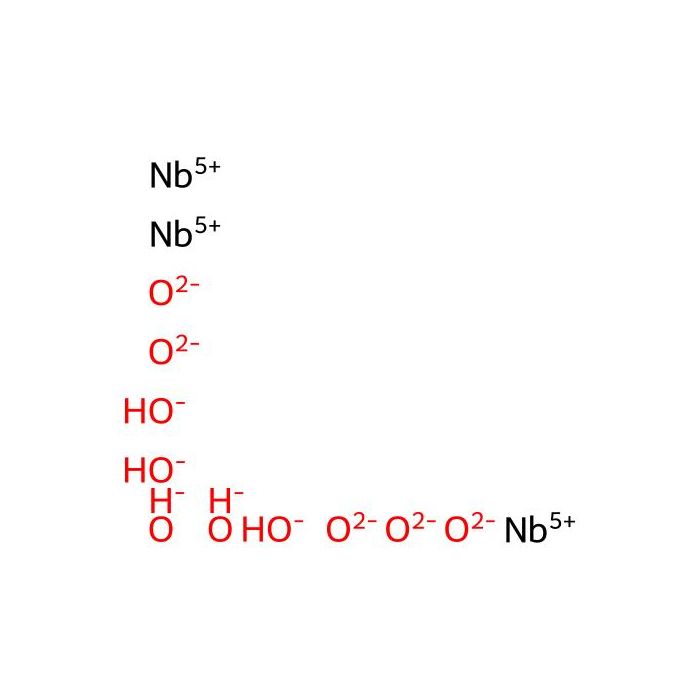
Structure and Identity
Product name: Niobium hydroxide oxide (often described in the literature as a niobium oxyhydroxide phase)
CAS: 37349-30-7
InChIKey: Not specified for this item; refer to CoA/Spec Sheet.
SMILES: Not specified for this item; refer to CoA/Spec Sheet.
Molecular formula: Not specified for this item; refer to CoA/Spec Sheet.
Molecular weight: Not specified for this item; refer to CoA/Spec Sheet.
General structural description (literature):
Niobium “hydroxide oxide” commonly denotes a polymeric oxyhydroxide of niobium in a high oxidation state (typically Nb(V)). The solid is frequently amorphous or poorly crystalline and can be considered as hydrated niobium pentoxide domains.
Local coordination is usually distorted octahedral NbO6, with a network of μ-oxo (Nb–O–Nb) and μ-hydroxo (Nb–OH–Nb) bridges; terminal –OH groups may be present on particle surfaces.
Extended structure forms gels or fine powders composed of aggregated nanodomains; long-range order depends on preparation (e.g., precipitation, hydrothermal aging, peptization).
It is best viewed as an inorganic polymer/oxide-hydroxide framework rather than a discrete molecular species; therefore, line notations (SMILES) and single-molecule identifiers are generally not applicable.
Stereochemistry/functional groups (literature):
Functional motifs: oxo (Nb=O or Nb–O–Nb), hydroxo (Nb–OH), and aquo ligation in wet states.
Typical oxidation state: Nb(V).
Synthetic Utility
General reactivity landscape (literature):
Acidic surface catalysis: Promotes esterification (carboxylic acid + alcohol), etherification (including isobutene hydration/oligomerization analogues), and dehydration of polyols/monosaccharides. Water tolerance of niobium oxyhydroxide is advantageous versus many solid acids.
Redox-support effects: NbOx-modified supports can alter the electronic properties of dispersed transition metals, tuning hydrogenation/dehydrogenation selectivity (e.g., SMSI-like behavior).
Precursor transformations: Thermal treatment affords Nb2O5, a gateway to perovskite and layered niobates (e.g., via solid-state with alkali carbonates/hydroxides). Soft chemistry routes yield peroxoniobium species for sol–gel films and coatings.
Surface functionalization: –OH-terminated surfaces allow grafting of organophosphonic acids, carboxylates, silanes, or catechols to create organophilic particles or tailored acid–base properties.
Retrosynthetic/value considerations:
Serves as a bench-stable, non-volatile, and relatively safe niobium(V) source compared with NbCl5 or alkoxides; preferred when chloride-free or low-volatility precursors are desired.
Facilitates heterogeneous catalysis and separations without introducing mobile counterions, simplifying workup and enabling catalyst recycling.
Note: Specific activity/selectivity depends on hydration level, residual anions, and calcination history; document pretreatment for reproducibility.
Target Specificity
Not applicable. This product is an inorganic material, not a biological affinity reagent or antibody. No antigen/epitope/clone/isotype information is associated with SKU N193049.
Usamos cookies para garantir o funcionamento adequado do site e, quando permitido, para melhorar a sua experiência. Você pode gerenciar suas preferências a qualquer momento nas Configurações. Saiba mais em nossa Política de Cookies.
Deseja que lhe enviemos uma mensagem quando tivermos descontos disponíveis?
Lembrar-me mais tarde
Obrigado! Por favor, verifique a sua caixa de entrada de e-mail para confirmar.
Products are supplied to verified businesses, institutions, and qualified professionals for research and development use only. Not for use in humans, animals, diagnosis, or therapy.

 D2324047