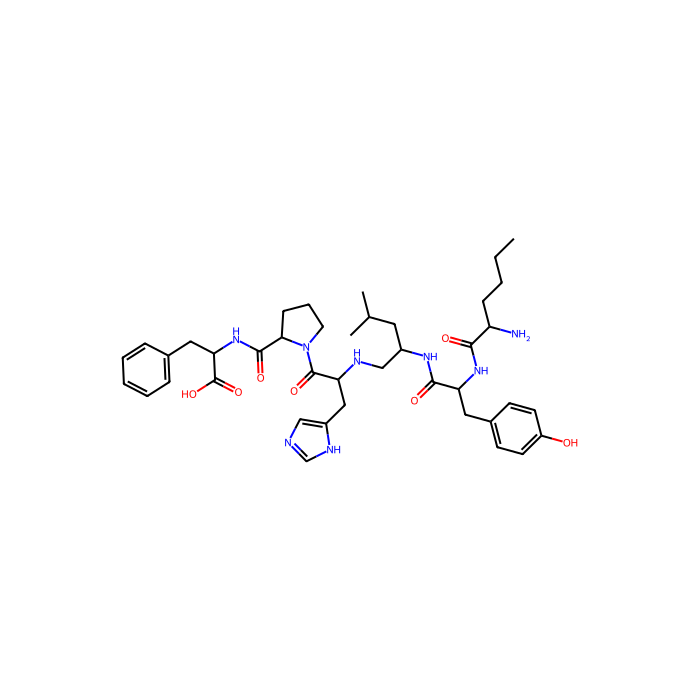
Norleual, CAS No.334994-34-2

CAS: 334994-34-2 Cat. No.: N288500 Fórmula: C41H58N8O7 Peso molecular: 774.95 PubChem CID: 91691127
Disponível para encomenda
GRAU & PUREZA ≥97%
★
Tamanho
Alemanha (EU)
USA*
Preço
Qtd
1mg
N288500-1mg
—
4 Em stock
367,83€
2mg
N288500-2mg
—
2 Em stock
546,59€
5mg
N288500-5mg
—
1 Em stock
1093,26€
Enter a quantity for the sizes you want to add.

Visão geral

Norleual, an angiotensin (Ang) IV analog, is a hepatocyte growth factor (HGF)/c-Met inhibitor with an IC50 of 3 pM. Norleual is an AT4 receptor antagonist and exhibits potent antiangiogenic activities.

Especificações

Product Name
Norleual, CAS No.334994-34-2
Especificações e pureza
≥97%
Mecanismos bioquímicos e fisiológicos
Angiotensin IV analog. Highly potent HGF/c-MET inhibitor (IC50= 3 pM). Inhibits HGF-induced MDCK cell proliferation and invasionin vitro. Also AT4receptor antagonist; disrupts LTP stabilization. Antiangiogenic.
Sequência
XYLHPF(Modifications: X = Nle, Leu-3-His-4 peptide bond replaced with CH2NH)
Tipo de ação
ANTAGONIST
CAS
334994-34-2
Tipo de molécula
Small molecule
Armazenamento e envio
Condições de armazenamento de armazenamento
Store at -20°C
Enviado em
Ice chest + Ice pads

Dados avançados

Estrutura 3D
Modelo de Estrutura Química Interativa


Certificados(CoA,COO,BSE/TSE e Mapa de Análise)
C of A & Other Certificates(BSE/TSE, COO):
Analytical Chart:

Find and download the COA for your product by matching the lot number on the packaging.

6 results found

Lot NumberCertificate TypeDataItem
F2305802F2305802Certificate of AnalysisMar 13, 2026 N288500
F2305803F2305803Certificate of AnalysisMar 13, 2026 N288500
F2305804F2305804Certificate of AnalysisMar 13, 2026 N288500
F2305805F2305805Certificate of AnalysisMar 13, 2026 N288500
F2305806F2305806Certificate of AnalysisMar 13, 2026 N288500
F2305807F2305807Certificate of AnalysisMar 13, 2026 N288500
Calculadoras de soluções
Revisões

Avaliações dos Clientes

Application Protocols

No tested applications, recommended dilutions, or validated protocols are provided in the Product Data for this item.

General guidance for peptide use (literature-based; not item-specific):

  • Stock preparation: Dissolve to a convenient concentration (e.g., 1–50 mM) in water or DMSO depending on solubility; filter-sterilize if needed (0.22 μm).
  • Aliquoting: Dispense single-use aliquots to avoid repeated freeze–thaw cycles.
  • Assay introduction: For DMSO stocks, limit final DMSO to ≤0.5–1% v/v in biochemical assays unless otherwise validated.
  • Controls: Include solvent-only and unrelated peptide controls to assess nonspecific effects.

Please consult peer-reviewed sources for protocols specific to “Norleual” matching the exact sequence and analytical confirmation of your lot. This product is for research use only.

Biological Roles

Item-specific biological roles are not provided in the Product Data. The following context is general and literature-based for small peptides.

  • Peptides as probes: Short peptides can mimic substrate recognition motifs or binding epitopes, enabling interrogation of enzyme specificity and protein–protein interactions in vitro.
  • Norleucine substitution (literature context): Incorporation of norleucine (Nle) in peptides is a common strategy to enhance hydrophobicity and oxidative stability (as a methionine surrogate), potentially influencing binding and proteolysis rates.
  • Aldehyde-terminated peptides (literature context): Peptide aldehydes are studied as reversible covalent probes for certain proteases; they can form hemiacetal/hemiaminal adducts with catalytic residues. This is a general biochemical concept and not a claim for the specific item.
  • Pathways: Peptides used as research tools do not necessarily map to endogenous metabolic pathways unless they mimic native sequences; applicability depends on the exact sequence and modifications.

Important

  • No target, pathway, or activity information is specified for this SKU. For experiment design, consult peer-reviewed publications that explicitly reference the exact Norleual sequence and analytical characterization matching your lot.
Buffer Applications

This product is a peptide research reagent and is not itself a buffering agent. Therefore, conventional buffer system formulation (e.g., phosphate, Tris, HEPES) is not directly applicable.

Practical notes (general):

  • Dissolution buffers: Use low-ionic-strength phosphate, HEPES, or acetate buffers to dissolve and handle peptide solutions; adjust pH mildly to aid solubility.
  • Assay compatibility: Select buffers free of nucleophiles or reactive carbonyl scavengers if studying aldehyde-containing peptides (literature context). Avoid high primary-amine content when reversible imine formation would confound results.

For actual buffer recipes and pH ranges, refer to standard buffer preparation guides. No item-specific buffer formulation is provided in the Product Data.

Green Alternatives

Peptide handling is already largely compatible with greener practices due to frequent use of aqueous media. The suggestions below are general, literature-based, not item specifications.

  • Prefer aqueous systems: Where solubility permits, conduct dilutions and assays in water or buffered saline instead of organic-rich media.
  • Right-size stocks: Prepare small, high-concentration stocks (e.g., in water or DMSO) to minimize solvent volume and waste; aliquot to avoid repeat freeze–thaw.
  • Volatile co-solvents: If an organic co-solvent is required, prefer acetonitrile or ethanol over higher-toxicity options; keep final assay concentrations low.
  • Avoid chlorinated solvents: Rarely needed for peptides; avoid unless absolutely necessary for a specific analytical method.
  • Solid-phase minimization: When reconstituting lyophilized materials, dissolve directly in the final buffer system to reduce transfers and rinses.

Illustrative comparison (general):

  • Water/buffer: minimal EHS concerns; may require pH tuning for solubility.
  • Ethanol: renewable, low-toxicity; limited solvency for highly hydrophobic sequences.
  • Acetonitrile: LC–MS friendly, volatile; handle with ventilation.
  • DMSO: effective solvency, but persistent; use sparingly and capture for waste segregation.

Check institutional green-chemistry guidelines for peptide workflows and choose the least hazardous solvent that achieves reliable performance.

Pharmaceutical Uses

No pharmaceutical or clinical use is claimed or supported for this product. It is supplied strictly for research use only.

General formulation context for peptides (literature-based; not item-specific):

  • Excipient compatibility: For preclinical assay materials, peptides are often formulated in aqueous saline or buffered solutions with optional stabilizers (e.g., carrier proteins at low percentages) to minimize adsorption.
  • Device/material interactions: Peptides can adsorb to plastics and glass; low-bind tubes and controlled ionic strength can reduce losses at low concentrations.
  • Sterility considerations: When sterility is required for cell-free or cell-based assays, filter through 0.22 μm membranes after dissolution in sterile media compatible with the peptide.

No pharmacopeial status, dosage form, or excipient system is specified in the Product Data for SKU N288500.

Physical Properties

Key physical data for this specific item are not provided in the Product Data. The following notes distinguish item-specific facts from general literature expectations for peptide materials.

Item-specific (from Product Data):

  • Appearance: Not specified for this item; refer to CoA/Spec Sheet.
  • Molecular weight: Not specified for this item; refer to CoA/Spec Sheet.

General properties for peptide/peptidomimetic materials (literature guidance; not item specifications):

  • State/form: Often supplied as a solid (powder or lyophilized cake) for peptides; hygroscopicity can vary with sequence and counterions.
  • Solubility: Many small peptides dissolve in water, aqueous buffers, and/or DMSO; hydrophobic sequences may require co-solvents (e.g., acetonitrile, ethanol) or mild pH adjustment. Start with small test volumes.
  • pH effects: Ionizable side chains govern solubility; dissolution can be improved by adjusting pH to transiently ionize termini (e.g., 0.1% acetic acid for cationic peptides or dilute ammonium bicarbonate for anionic peptides).
  • Stability: Peptide aldehydes (if present, literature context) can be sensitive to oxidation and hydration; low temperature and inert atmosphere improve stability.
  • Partitioning: Peptides generally have low logP unless heavily hydrophobic or protected; sequence dependent (no single value applies).

If precise values (mp, bp, density, logP, pKa, refractive index, water content) are required for your workflow, please consult the CoA/Spec Sheet and SDS for this SKU.

Quality and Grades

Understanding quality context for this peptide product.

Item-specific quality details:

  • Grade/Purity: Not specified for this item; refer to CoA/Spec Sheet.
  • Appearance: Not specified for this item; refer to CoA/Spec Sheet.

General considerations for peptide materials (literature/industry norms):

  • Typical reporting: Peptide products are commonly characterized by purity (HPLC area %), mass confirmation (ESI/HRMS), and counterion content (e.g., TFA, acetate). When present, residual solvents, water content (Karl Fischer), and peptide content may be reported.
  • Grades:
    • Crude: Minimal purification; suitable for screening where sequence length/complexity allows.
    • Desalted / >70–90% purity: Routine biochemical assays, binding screens.
    • >95–98% (analytical): Demanding biochemical/biophysical studies.
  • Stabilizers: Peptide aldehydes (literature context) may be stabilized via dry storage under inert gas or formulated as bisulfite adducts; verify on the CoA if applicable. No stabilizer is specified for this item in the Product Data.

Recommendations:

  • Request and review the CoA/Spec Sheet for exact purity, analytical traces (HPLC/LC–MS), and counterion identity for SKU N288500 before critical experiments.
Reaction and Applications

Applications focus on peptide research; item-specific application claims are not provided in the Product Data. The following are general, literature-based considerations for peptide materials such as Norleual.

  • Biochemical assays: Short peptides are widely used as tool compounds for probing enzyme recognition, binding, and structure–activity relationships (SAR) in vitro. If an aldehyde terminus is present (literature context), reversible covalent interactions with catalytic nucleophiles (e.g., cysteine/serine) can be studied.
  • Analytical characterization: Suitable for HPLC/UPLC retention profiling, LC–MS/MS fragmentation studies (sequence confirmation), and CD/FTIR for secondary-structure assessment in solution.
  • Assay development: Can serve as a positive/negative control or competitor in binding and kinetic experiments when aligned with published protocols for the same sequence.
  • Surface presentation: Conjugation to carriers (e.g., BSA) or surfaces (e.g., SPR/biolayer interferometry) through N-terminus, C-terminus, or side chains allows affinity measurements.
  • Derivatization (general): Peptide termini can be modified with fluorophores, biotin, or isotopic labels for detection and quantification.

Notes

  • No manufacturer-supplied application list is provided for SKU N288500. Users should consult the primary literature for “Norleual” to select appropriate assay formats and concentrations.
  • All uses are for research only; no diagnostic or therapeutic applications are supported.
Reaction Conditions

No reaction condition data are specified for this catalog item. For researchers intending to derivatize or conjugate peptide materials, the following general, literature-based conditions may be relevant (not item-specific):

  • Dissolution: 1–10 mg/mL in water, buffer, or DMSO depending on solubility; gentle warming and brief sonication can assist dissolution.
  • pH windows:
    • Amide coupling (NHS ester to amines): pH 7.5–8.5 in phosphate/borate buffers; minutes to hours at rt.
    • Schiff base formation (with aldehydes): pH 5.5–7.5; stabilize via NaBH3CN or similar for reductive amination (observe safety protocols).
    • Maleimide–thiol conjugation: pH 6.5–7.5; rapid at rt.
  • Temperatures: Typically ambient; keep low temperatures for labile functionalities (e.g., aldehydes) and store intermediates cold.
  • Atmosphere: For oxidation-sensitive motifs, exclude air and moisture; use inert gas and dry solvents.

These conditions are general references for peptide manipulation. Confirm applicability to your specific lot by consulting the CoA and performing small-scale trials.

Safety and Handling

Safety guidance for laboratory use of peptide materials.

Item-specific hazard data (from Product Data):

  • GHS classification / pictograms / signal word / H-statements: Not specified for this item; refer to SDS.

General laboratory safety (applicable to peptides and peptide aldehydes; literature guidance):

  • PPE: Wear lab coat, safety glasses, and appropriate gloves (e.g., nitrile). Avoid inhalation of powders and contact with skin/eyes.
  • Handling: Work in a clean, dry area. For powders, minimize dust generation; consider weighing in a ventilated enclosure. If the material contains an aldehyde group (literature context), avoid prolonged exposure to moisture and oxidants.
  • First aid (overview):
    • Skin/eye contact: Rinse with water for ≥15 min; remove contaminated clothing. Seek medical attention if irritation persists.
    • Inhalation: Move to fresh air; seek medical help if symptoms occur.
    • Ingestion: Rinse mouth; do not induce vomiting; obtain medical assistance.
  • Incompatibilities (general): Strong oxidizers; for aldehydic peptides, avoid amine-rich reagents that can form imines and strong bases/acids that may cause hydrolysis.
  • Environmental: Prevent release to drains; collect spills with inert absorbent.

Always consult the product’s SDS for authoritative hazard classification, exposure controls, and disposal guidance. This product is supplied for research use only.

Solvent Selection

Guidance for dissolving and handling peptide materials like Norleual (general, literature-based; not item specifications).

  • Primary choices:
    • Water / aqueous buffers: First-line for polar/charged peptides. Use low-ionic-strength buffers initially; adjust pH to promote ionization if needed.
    • DMSO: Broadly effective co-solvent; prepare a concentrated stock (e.g., 10–50 mM) and dilute into assay buffers with vigorous mixing to prevent precipitation.
    • Acetonitrile (MeCN) with water (0–50%) or ethanol: Aids dissolution of hydrophobic sequences; compatible with many bioassays at low final percentages.
  • pH strategy: Slight acidification (e.g., 0.1% acetic or formic acid) can help dissolve basic/cationic peptides; mild basic buffers (e.g., ammonium bicarbonate, pH 8–8.5) may help acidic/anionic peptides. Avoid extremes that risk hydrolysis.
  • Order of addition: Add solvent to the solid incrementally while gently vortexing/sonicating. For DMSO stocks, back-dilute slowly into buffer.
  • Filtration: 0.22 μm filtration can clarify solutions for cell-free assays; verify compatibility for any cell-based work.

Comparison (general):

  • Water/buffer: biocompatible, but sequence-dependent solubility.
  • DMSO: excellent solvency, but limit final concentration to avoid assay interference.
  • MeCN/water: useful for hydrophobic materials, volatile and LC–MS friendly.

Note: Exact solvent compatibility for this item is not specified; verify empirically and consult the CoA.

Storage and Reconstitution

Practical guidance for maintaining integrity and preparing solutions.

Item-specific storage/shipping (from Product Data):

  • Storage condition: Store at -20°C.
  • Shipped in: Ice chest + ice pads.

General best practices for peptide materials (literature-based; not item-specific):

  • Long-term storage: Keep desiccated, protected from light, and under inert gas if possible. For aldehyde-containing peptides (literature context), minimize exposure to moisture and oxygen.
  • Aliquots: Upon first opening, split into single-use aliquots to avoid repeated freeze–thaw cycles.
  • Reconstitution:
    • Start with high-purity water or buffer at neutral pH; if insoluble, incrementally add DMSO or a small amount of acidified water (0.1% acetic acid) or mild base as appropriate.
    • Gently vortex and, if needed, sonicate briefly. Avoid foaming.
    • Filter (0.22 μm) for sterile applications.
  • Working solutions: Store at 2–8°C for short periods (hours to a day). For longer periods, freeze at -20°C or below. Avoid multiple freeze–thaw cycles.
  • Stability checks: Verify integrity by HPLC/LC–MS after storage, especially before critical assays.

For precise stability, solubility limits, and reconstitution solvents specific to this SKU, consult the CoA/Spec Sheet.

Structure and Identity

Concise identity overview for this peptide-based research reagent.

  • Product name: Norleual (SKU: N288500)
  • CAS: 334994-34-2
  • PubChem CID: 91691127
  • InChIKey (as provided): 204864
  • SMILES: Not specified for this item; refer to CoA/Spec Sheet.
  • Molecular formula: Not specified for this item; refer to CoA/Spec Sheet.
  • Molecular weight: Not specified for this item; refer to CoA/Spec Sheet.

Structural features (general, literature context):

  • The name “Norleual” is commonly used in the literature to denote a short peptide incorporating a norleucine (Nle) residue and an aldehyde terminus; such peptides are often explored as protease-targeting probes. This description is provided as general literature context and is not a specification of the supplied item.
  • As a peptide-like research material, the 2D structure is typically composed of a linear chain of amino-acid-derived units with amide bonds; side chains may include a straight-chain hydrophobic group (from norleucine) and potentially an aldehyde functional group at a terminus (literature, general).

Notes

  • Exact stereochemistry, sequence, protecting groups (if any), and terminal functionalities for this catalog item are not specified in the provided Product Data. Please consult the item’s CoA/Spec Sheet for definitive structural information.
Synthetic Utility

As supplied, Norleual is intended as a biochemical research reagent rather than a synthetic reagent. Nevertheless, general features of small peptides provide some utility in chemical biology (literature-based; not item-specific):

  • Functional handles: N-terminus, C-terminus, and selected side chains offer points for conjugation (e.g., NHS ester coupling, click chemistry after azide/alkyne installation) enabling probe or affinity tag attachment.
  • Aldehyde chemistry (literature context): If an aldehyde terminus is present, transient Schiff base formation and subsequent reductive amination permit immobilization or label installation; reversible covalent interactions can be harnessed in screening.
  • Protecting-group strategies: Standard peptide chemistry allows orthogonal protection/deprotection for site-selective modifications; however, details for this item are not specified.
  • Retrosynthetic role: Peptide fragments can serve as SAR modules in modular synthesis of peptidomimetics by substituting residues with noncanonical analogs (e.g., norleucine for methionine).

Because the exact sequence and termini for this SKU are not provided, users should verify compatibility of any planned derivatization or coupling with the item’s CoA/Spec Sheet before proceeding.

Target Specificity

No target, epitope, or specificity information is provided in the Product Data for SKU N288500.

  • Antigen/Target: Not specified for this item; refer to CoA/Spec Sheet.
  • Species reactivity / clone / isotype: Not applicable; this product is not an antibody.

Researchers interested in target engagement should consult the primary literature that explicitly characterizes the exact Norleual sequence and its binding/biochemical profile, ensuring alignment with the analytical identity of this item.

Perguntas frequentes

What is the purity of this product?
This product is supplied at ≥97% purity (chemical assay). Lot-specific values are stated on the Certificate of Analysis.
How should this product be stored?
Store at ?20 °C. Freezer storage is required to maintain the specified shelf life.
How is this product shipped?
This product ships in an insulated container with ice pads. Unpack on arrival and transfer it to the storage condition stated above.
What are the CAS number, molecular formula and molecular weight?
The CAS Number is 334994-34-2. InChIKey LOHDEFSMLITXTG-RZAPKHMUSA-N.
What documentation is provided?
Available product documentation, including Certificates of Analysis (COA), Safety Data Sheets (SDS), and specification sheets, is shown in the product document area. Document availability and access follow the current site policy.

Deseja que lhe enviemos uma mensagem quando tivermos descontos disponíveis?

Lembrar-me mais tarde

Obrigado! Por favor, verifique a sua caixa de entrada de e-mail para confirmar.

Ops! As notificações estão desativadas.