for sensitive chromatographic and analytical workflows requiring minimal baseline interference.
🌡
Storage & shipping
Store at -20°C Ships Ice chest + Ice pads Check lot-specific COA for exact specifications.
📋
Quality documents
SDS, COA, datasheet, and spec sheet available for download. Lot-specific COA accessible via lot number lookup.
📚
Literature proof
Cited in 0 peer-reviewed publications across chromatography, organic synthesis, and cross-coupling reactions.
Visão geral
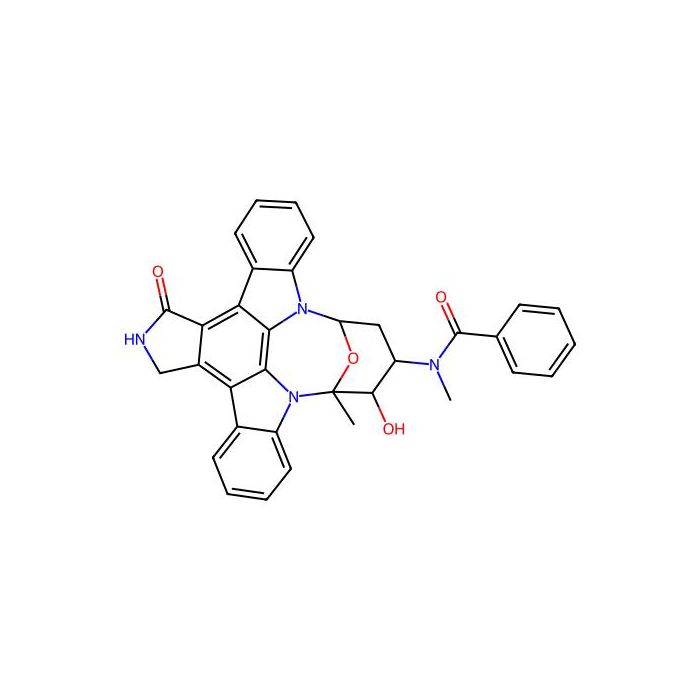
O-Desmethyl Midostaurin (CGP62221; O-Desmethyl PKC412) is the active metabolite of Midostaurin via cytochrome P450 liver enzyme metabolism. O-Desmethyl Midostaurin can be used as an indicator for Midostaurin metabolism in vivo Midostaurin is a multi-targeted protein kinase inhibitor with IC 50 ranging from 22-500 nM.
Form:Solid
IC50& Target:IC50: active metabolite of Midostaurin
O-Desmethyl Midostaurin (CGP62221; O-Desmethyl PKC412) is the active metabolite of Midostaurin ( HY-10230 ) via cytochrome P450 liver enzyme metabolism. O-Desmethyl Midostaurin can be used as an indicator for Midostaurin metabolism in vivo. Midostaur
Condições de armazenamento de armazenamento
Store at -20°C
Enviado em
Ice chest + Ice pads
Este produto requer transporte de cadeia fria. Serviços terrestres e outros serviços econômicos não estão disponíveis.
This compound belongs to the class of organic compounds known as indolocarbazoles. These are polycyclic aromatic compounds containing an indole fused to a carbazole.
External Descriptors
Not available
1. Djoumbou Feunang Y, Eisner R, Knox C, Chepelev L, Hastings J, Owen G, Fahy E, Steinbeck C, Subramanian S, Bolton E, Greiner R, and Wishart DS. ClassyFire: Automated Chemical Classification With A Comprehensive, Computable Taxonomy. Journal of Cheminformatics, 2016, 8:61.
Determine the necessary mass, volume, or concentration for preparing a solution.
Dilution Calculator
Determine the dilution needed to prepare a stock solution.
Reconstitution Calculator
Revisões
Avaliações dos Clientes
Application Protocols
Item-specific, tested application protocols are not provided for this listing.
General protocols (research use):
Preparation of DMSO stock:
Warm compound vial to room temperature while sealed. Add DMSO to achieve 10–50 mM. Vortex and, if needed, sonicate briefly. Filter through 0.22 µm PTFE for analytical work.
Enzymatic kinase assay setup (generic):
Prepare serial dilutions in assay buffer keeping final DMSO constant (e.g., 0.5%). Include vehicle control. Pre-incubate compound with enzyme (5–10 min) before initiating with ATP/substrate. Read by fluorescence or luminescence per kit instructions.
Thermal shift (DSF):
Mix protein (1–5 µM) with dye and compound at 1–50× molar excess; ramp 25→95°C at 1°C/min; analyze ΔTm vs vehicle.
LC–MS reference standard use:
Prepare calibration standards spanning expected concentration range; use stable-isotope internal standard if available. Store working solutions at −20°C, protected from light; avoid >3 freeze–thaw cycles.
Always validate conditions for your specific target/protein and instrumentation. This compound is for research use only.
Biological Roles
Item-specific biological targets are not specified for this listing.
General context (research only; no clinical claims):
Chemical biology class: Midostaurin and its O‑desmethyl analogs are widely studied as ATP-competitive ligands for protein kinases. The O‑desmethyl conversion introduces a phenolic hydrogen-bond donor, altering water-network interactions in the adenine pocket and sometimes modulating selectivity and residence time.
Metabolism relevance: O‑Desmethyl species commonly arise from hepatic O‑dealkylation (e.g., CYP-mediated). Studying this metabolite aids in understanding biotransformation routes, exposure–response relationships, and off-target liabilities in chemical biology.
Assay utility: Utilized in thermal shift assays (DSF), isothermal titration calorimetry (ITC), surface plasmon resonance (SPR), and kinase activity assays to map binding energetics and allosteric effects.
ADME characteristics (typical for this scaffold family): high plasma protein binding and low aqueous solubility; O‑desmethylation often modestly increases polarity and can impact permeability and efflux. Exact values are study- and system-dependent.
Caveats:
Binding profiles are kinase- and assay-dependent; consult primary literature for quantitative Ki/Kd/IC50 values under matched conditions.
Ensure that compound identity and purity are verified before drawing biological conclusions; minor impurities may significantly affect cell-based readouts for potent ligands.
Buffer Applications
This product is a hydrophobic small-molecule ligand rather than a classical buffering reagent.
Not typically used to establish buffer pH or ionic strength. No buffer capacity data apply.
Practical relevance to buffers (for assays):
Vehicle effects: Maintain constant DMSO percentage across all wells/tubes to avoid assay drift; typical final DMSO is ≤0.1–1% v/v depending on target tolerance.
Precipitation management: Include 0.01–0.05% nonionic surfactant (e.g., Tween 80) or 0.1% BSA in assay buffers to mitigate nonspecific adsorption and precipitation of lipophilic ligands.
Order of addition: Add DMSO stock to buffer under vigorous mixing; avoid adding aqueous buffer directly into concentrated DMSO stock to prevent localized precipitation.
pH considerations: Phenolic moieties can be ionizable at high pH; maintain physiological pH (7.0–7.4) unless studying pH-dependent effects. Avoid strong base which may cause degradation.
For buffer recipes and pH ranges, use standard systems (HEPES, PBS, Tris) as dictated by the biological assay; this compound does not serve as a buffering agent.
Green Alternatives
Although this product is a solid active small molecule rather than a solvent or bulk reagent, greener choices affect its handling and analytics.
Stock solution solvents:
Conventional: DMSO, DMF, NMP.
Greener alternatives (where compatible): Cyrene (dihydrolevoglucosenone), propylene carbonate, or bio-based PEG-400 blends for formulation/extraction steps. Validate solubility and assay compatibility before adoption.
Workup and chromatography:
Replace dichloromethane with greener ethers/esters (e.g., CPME, EtOAc) when purifying derivatives.
Use ethanol or isopropanol in place of methanol when feasible for recrystallization or precipitation steps.
Comparison highlights (general):
DMSO vs Cyrene: DMSO offers unmatched solvency and assay precedent; Cyrene is bio-based and less problematic for EHS but can be more viscous and UV-active—assess impact on analytics.
DMF/NMP vs propylene carbonate: PC is safer and greener but may not dissolve highly lipophilic scaffolds as efficiently.
Operational tips:
Minimize solvent volumes by preparing higher-concentration stocks and using microdosing to achieve target assay concentrations.
Implement closed-vial dilutions and low-dead-volume tips to reduce waste.
Consider supercritical CO2 or greener normal-phase conditions if preparative purification of analogs is required.
Note: Always confirm compound stability and assay performance when substituting greener solvents.
Pharmaceutical Uses
No pharmacopeial or excipient status is provided for this item; it is sold strictly for research use only.
General formulation/CMC considerations for midostaurin-class research compounds (non-clinical, lab scale):
Solubilization strategies: DMSO or ethanol/PEG-400 co-solvent systems, Captisol (sulfobutylether-β-cyclodextrin), or lipid-based vehicles may be explored for non-clinical studies. Validate compatibility with the intended model before use.
Stability concerns: Protect from light and heat; avoid strong acids/bases. Phenolic functionality can undergo oxidation—include antioxidants only if validated not to interfere with assays.
Reference standards: O‑desmethyl analogs may be used as analytical standards in method development for metabolism studies (e.g., LC–MS/MS in vitro systems). Ensure traceability to a characterized lot/CoA.
Solid-state: If polymorphism is relevant to your work (e.g., dissolution studies), assess by PXRD/DSC. Not specified for this item.
Important restrictions:
Do not formulate for human or veterinary administration. No clinical claims are made or implied.
For any GLP or regulatory-facing work, obtain lot-specific CoA and, if required, additional characterization (water content, residual solvents, impurities) from your QA processes.
Physical Properties
Item-specific (from Product Data):
Molecular weight: Not specified for this item; refer to CoA/Spec Sheet.
Molecular formula: Not specified for this item; refer to CoA/Spec Sheet.
Appearance: Not specified for this item; refer to CoA/Spec Sheet.
Storage: Store at −20°C (per Product Data). Shipped in ice chest with ice pads.
Literature/general expectations for midostaurin O-desmethyl analogs (not item specifications):
Physical state: typically a pale solid or foam; strongly lipophilic with very low aqueous solubility.
Solubility profile: good solubility in DMSO and DMF; moderate in MeOH/EtOH/acetone; poor in water and aliphatic hydrocarbons.
pKa/logP: midostaurin-class scaffolds are neutral to weakly basic with high logP; O‑desmethyl increases H‑bonding and may modestly lower logP relative to parent.
UV/Vis: extended aromaticity gives strong UV absorption in 200–320 nm range; exact λmax depends on substitution and solvent.
Melting point, density, refractive index, and vapor pressure: Not specified for this item; consult CoA/literature if needed for method development.
Practical notes:
Prepare concentrated DMSO stock (e.g., 10–50 mM) for assay use; dilute into assay buffer with vigorous mixing to prevent precipitation.
Filter (0.22 µm PTFE) solutions in organic solvents to remove particulates before analytical use.
If hygroscopicity is suspected, equilibrate closed container to room temperature before opening to minimize condensation.
Quality and Grades
Item-specific (from Product Data):
Grade/Purity: Not specified for this item; refer to CoA/Spec Sheet.
Guidance on interpreting quality information for research-use small molecules (general):
Typical research grades include “≥95% (HPLC)” or higher for screening sets. Purity specifications, assay methods (HPLC/UPLC with UV or MS), and water/volatile content (KF, TGA) should be consulted on the CoA.
Identity confirmation is commonly via 1H NMR and LC–MS; some vendors also provide 13C NMR and HRMS. For kinase ligands, chiral/stereochemical integrity (if applicable) and polymorph may influence bioassay results.
Stabilizers/additives: Not typically added for this class; if present, they must be disclosed. Absence of stabilizers is preferable for biological assays to avoid interference.
UV cutoff and residual solvent limits are relevant if using for analytics; if these matter, request chromatograms and residual solvent data.
Best practices:
Verify purity by orthogonal methods (e.g., HPLC-UV and LC–MS). For sensitive assays, consider drying under high vacuum to remove trace solvents prior to weighing.
Record batch-specific CoA identifiers in ELNs to ensure traceability across studies.
Note: In the absence of an explicit catalog grade on this listing, treat as research-use material and rely on batch CoA for exact specifications.
Reaction and Applications
Item-specific manufacturer applications: Not provided for this item.
Research-use applications (general for O-desmethyl midostaurin):
Reference standard/control: Commonly employed as a metabolite/analog reference in kinase biochemistry, target engagement assays, and LC–MS bioanalytical method development. Use DMSO stocks and verify concentration by UV or quantitative NMR.
SAR and profiling: Suitable for broad kinase panel screening to probe how O‑desmethylation (phenolic OH vs methoxy) affects binding thermodynamics, solvation, and selectivity.
Physicochemical studies: Compares permeability, solubility, and microsomal stability vs parent midostaurin; useful in metabolite-ID and PK modeling workflows.
Synthetic/derivatization uses (general):
Phenolic handle: The phenolic OH enables selective O‑acylation, O‑alkylation, or carbonate/carbamate formation to access prodrugs or probe analogs. Protecting-group strategies (e.g., TBDMS, benzyl) are straightforward.
Conjugation chemistry: The phenol can be linked to reporter tags (biotin, fluorophores) via carbonate/carbamate linkers for chemoproteomics pull-downs or imaging probe development (research use only).
Practical tips:
For bioassays, pre-screen solubility in assay buffer at intended concentrations; include a vehicle control for DMSO content.
For analytical methods, use stable-isotope internal standards when quantitating in complex matrices; monitor potential in-source fragmentation of phenolic derivatives.
Maintain cold, light-protected conditions during sample prep to minimize degradation.
Reaction Conditions
Item-specific reaction condition data are not provided for this listing. Below are general literature-style guidelines for common transformations on phenolic, polyaromatic kinase-ligand scaffolds (not item specifications):
O‑Alkylation (Williamson-type):
Base: K2CO3 or Cs2CO3 (1.2–2.0 equiv)
Electrophile: benzyl or alkyl halide/mesylate (1.2–1.5 equiv)
Solvent: DMF or acetone; 20–50°C; 2–16 h.
O‑Acylation/Carbonate formation:
Reagent: acyl chloride or chloroformate (1.1–1.5 equiv)
Base: pyridine/DMAP or Et3N; solvent: DCM or THF; 0–25°C; 0.5–4 h.
Carbamate formation:
CDI activation then amine addition; or triphosgene/Boc2O strategies under mild base; 0–25°C.
Protection of phenol:
TBDMS-Cl, imidazole, DMF, rt–40°C; or benzylation as above; deprotection by TBAF or hydrogenolysis respectively.
Analytical/assay prep:
DMSO stock 10–50 mM; dilute into buffer to ≤1% DMSO final with vigorous mixing.
Notes:
Due to the complex core, avoid strong nucleophiles/bases that could engage unintended positions. Monitor reactions by LC–MS and 1H NMR for selectivity.
Expected yields are substrate-dependent; late-stage functionalizations on complex scaffolds often deliver modest yields (30–70%) and benefit from microwave or microflow optimization where compatible.
Light and oxygen sensitivity should be assessed; use amber glassware and inert atmosphere when scaling sensitive steps.
Safety and Handling
Item-specific hazard data (from Product Data):
GHS classification: Not specified for this item; refer to SDS.
Signal word / H-statements / pictograms: Not specified for this item; refer to SDS.
General laboratory safety guidance for lipophilic, heteroaromatic small molecules (not item-specific):
PPE: lab coat, safety glasses, and appropriate chemically resistant gloves (nitrile recommended). Handle powders and DMSO concentrates in a fume hood to avoid inhalation and solvent carry-through.
Avoid: inhalation of dust/aerosols, skin contact, and ingestion. Wash thoroughly after handling.
Incompatibilities: strong oxidizers, strong acids/bases that may cause decomposition; avoid prolonged exposure to light/air at elevated temperature.
First aid overview: If inhaled—move to fresh air; seek medical attention if symptoms occur. Skin/eye contact—rinse with water for at least 15 minutes; remove contaminated clothing; seek medical advice. If swallowed—rinse mouth; do not induce vomiting; get medical attention.
Spill response: Avoid dusting; gently cover and collect with inert absorbent; dispose according to institutional and local regulations.
Waste: Treat as organic hazardous waste. DMSO solutions of bioactive organics should be collected separately when required by local policy.
Special risks: No specific peroxide or explosive hazard is expected for this scaffold; however, finely divided solids can become airborne—minimize dust.
Always consult the product SDS for authoritative hazard classifications and response procedures.
Solvent Selection
Solubility and solvent choice strongly influence assay performance for lipophilic kinase-ligand scaffolds.
Item-specific: No quantitative solubility data provided for this item; consult CoA.
General/literature-based guidance for O-desmethyl midostaurin–type molecules:
Primary stock solvent: DMSO (anhydrous) is preferred for preparing concentrated stocks (e.g., 10–50 mM). DMF is an alternative when DMSO is incompatible with the assay.
Co-solvent systems: For working solutions in aqueous buffers, keep final DMSO ≤0.1–1% v/v when possible; employ co-solvents (0.5–2% PEG-400, 0.01–0.05% nonionic surfactant such as Tween 80 or Pluronic F-68) if precipitation occurs.
Other organics: MeOH, EtOH, acetonitrile, and acetone generally dissolve this class; propylene glycol and NMP can be used for higher loadings in formulation development.
Polarity/miscibility (qualitative): strong π–π chromophore with limited HBA/HBD balance; expect poor water miscibility and strong affinity for polar aprotic solvents.
Practical tips:
Warm and vortex DMSO stocks (≤40°C) to aid dissolution; avoid prolonged heating or light exposure.
Pre-wet pipette tips with solvent to minimize adsorption losses at low microgram scales.
For LC–MS analytics, acetonitrile/water with 0.1% formic acid typically provides sharp peaks; monitor for secondary retention from strong hydrophobic interactions.
Comparison (qualitative):
DMSO: highest solvency, assay-compatible at low %.
DMF/NMP: similar solvency; higher toxicity—use sparingly.
MeOH/ACN: good for analytics; may have lower maximum solubility than DMSO.
Storage and Reconstitution
Item-specific (from Product Data):
Storage: Store at −20°C.
Shipping: Ice chest with ice pads.
Appearance: Not specified for this item; refer to CoA/Spec Sheet.
Reconstitution and handling (general guidance for lipophilic small molecules; not item specifications):
Upon receipt: Allow the sealed container to equilibrate to room temperature before opening to avoid moisture condensation. If supplied under inert atmosphere, maintain protection until first use.
Reconstitution:
Prepare concentrated stocks in anhydrous DMSO (e.g., 10–50 mM). Vortex and, if necessary, sonicate briefly to fully dissolve. Record exact concentration.
For aqueous working solutions, add DMSO stock to buffer under vigorous mixing; keep final DMSO constant across samples.
Aliquoting:
Divide DMSO stock into single-use aliquots (amber vials or low-bind tubes) and store at −20°C to minimize freeze–thaw. Avoid frost-free freezers that cycle above 0°C.
Stability considerations:
Protect from light and air where feasible. Avoid prolonged exposure to >25–30°C. If discoloration or precipitation occurs, prepare a fresh solution and verify by LC–MS/HPLC.
Freeze–thaw:
Limit to ≤3 cycles. Thaw at ambient temperature, mix gently, and promptly return unused aliquots to −20°C.
Always consult the batch-specific CoA/SDS for definitive storage and handling instructions.
Structure and Identity
Brief description: O-Desmethyl Midostaurin is the O-demethylated metabolite/analog of the multi-kinase inhibitor midostaurin (a staurosporine-inspired indolocarbazole/benzoylurea-type scaffold). It typically features a polycyclic heteroaromatic core with multiple heteroatoms and at least one phenolic OH (from O‑demethylation).
Item-specific (from Product Data):
Product name: O-Desmethyl Midostaurin
CAS: 740816-86-8
InChIKey: 289600 (note: truncated/atypical format in listing)
SKU: O646451
Category: Small molecules and compound libraries (研究用)
Not specified for this item; refer to CoA/Spec Sheet:
Molecular formula; Molecular weight; SMILES; full InChI/InChIKey
Literature/structure notes (for orientation; not item specifications):
Structural class: midostaurin analog with one methoxy → hydroxy conversion (O-desmethyl). Expect a rigid, polycyclic heteroaromatic system bearing amide/urea-like linkages and aryl substituents.
Functional groups (typical): phenolic OH, multiple aromatic rings, tertiary/secondary amines or urea/amide motifs, ether(s) (fewer than midostaurin), possible tertiary alcohol.
2D description (conceptual): a fused indole/indolocarbazole-like core connected through a linker to a substituted benzoyl/aryl moiety; O‑demethylation yields a phenolic position capable of H‑bond donation.
Notes: Exact atom connectivity, stereochemistry, and tautomeric/ionization states should be confirmed from a primary structure reference or the product CoA prior to quantitative work or registration.
Synthetic Utility
From a synthetic chemistry perspective, O-Desmethyl Midostaurin provides a phenolic handle on a densely functionalized, polycyclic kinase-ligand scaffold.
Key functional elements (general for this scaffold class):
Phenolic OH created by O‑demethylation enables selective O‑acylation, O‑alkylation (Williamson conditions), carbonate/carbamate formation, and Mitsunobu-type inversions when tethering to nucleophiles.
Multiple aromatic rings permit late-stage cross-coupling on halo-derivatives (if present in a given analog); direct C–H functionalization methods may also be applicable under mild conditions.
Potential amide/urea motifs allow for chemoselective derivatization (e.g., CDI or carbonyldiimidazole activation for linker attachment) when tolerated by the scaffold.
Applications:
Probe synthesis: Install linkers/spacers through the phenol to generate affinity probes (biotin, azide/alkyne handles for click chemistry) for target engagement studies.
Prodrug exploration: Mask the phenol with biodegradable carbonates to tune solubility and permeability in preclinical models (research only).
Photoprobes: Phenol can be elaborated to diazirine- or benzophenone-containing carbamates for photo-crosslinking experiments.
Practical considerations:
Maintain mild conditions to preserve the polycyclic core; avoid strong acids/bases and high temperatures that could induce rearrangement or decomposition.
Use non-nucleophilic bases (DIPEA, Cs2CO3) and polar aprotic solvents (DMF, DMSO, acetone) for O‑alkylations; monitor by LC–MS due to strong UV absorption.
Purification may require gradient RP-HPLC given lipophilicity and close-running impurities.
Target Specificity
Item-specific data: Not specified for this item; refer to CoA/technical notes. No antibody/biologic attributes apply.
General research context:
O‑Desmethyl midostaurin analogs are studied as ATP-competitive ligands across diverse kinases. However, quantitative target specificity (Kd/Ki/IC50 panels, off-target profiles, residence times) is assay- and laboratory-dependent and is not provided here.
Recommendations:
If target specificity is critical to your study, perform in-house profiling or consult peer-reviewed kinase panel data for O‑desmethyl analogs under conditions matching your assays (ATP concentration, co-factors, temperature, time-dependent inhibition, etc.).
Consider orthogonal confirmation of target engagement (e.g., CETSA/thermal shift, NanoBRET, SPR) to corroborate enzymatic inhibition readouts.
Usamos cookies para garantir o funcionamento adequado do site e, quando permitido, para melhorar a sua experiência. Você pode gerenciar suas preferências a qualquer momento nas Configurações. Saiba mais em nossa Política de Cookies.
Deseja que lhe enviemos uma mensagem quando tivermos descontos disponíveis?
Lembrar-me mais tarde
Obrigado! Por favor, verifique a sua caixa de entrada de e-mail para confirmar.
Products are supplied to verified businesses, institutions, and qualified professionals for research and development use only. Not for use in humans, animals, diagnosis, or therapy.